

What if unresponsive automatic wipers point to a setting or sensor contact issue, not a failed sensor? If you’re wondering how to test a rain sensor after replacement, begin with a cautious check while the vehicle is parked. After windshield work, it’s reasonable to check whether the sensor responds to moisture on the glass, especially if the wipers aren’t behaving as expected.
This checklist walks you through a repeatable test without driving in the rain or pouring water over the windshield. You’ll confirm the wiper setting, inspect the glass around the sensor, and apply a light mist while the vehicle remains stationary. Follow your owner’s manual if it gives different instructions or advises against a water test.
A basic test can show whether the wipers respond under the conditions you create. It can’t confirm that the sensor is properly seated or that any required electronic procedure has been completed. Use the steps below to narrow down whether the issue may involve settings, sensor-to-glass contact, or vehicle electronics, and to identify when professional follow-up makes sense.
Key Takeaways
- Check your owner’s manual for the correct automatic-wiper setting and any vehicle-specific instructions before testing.
- Learn how to test a rain sensor after replacement with the vehicle parked and a light mist over the sensor area.
- Keep the glass in front of the sensor clear, and note whether the wipers respond consistently.
- A failed test alone doesn’t prove the sensor or replacement is faulty. Settings, sensor contact, or vehicle electronics may be involved.
- Record what you observe so you can describe the concern clearly during professional follow-up.
What a Rain Sensor Should Do After Windshield Replacement
The practical goal is to see whether automatic wipers respond to moisture while the vehicle is safely parked. A rain sensor detects water in a specific area of the windshield and sends information to the vehicle’s wiper-control electronics. When the control is set to the correct automatic mode, those electronics can activate or adjust the wipers. The response depends on the vehicle’s design and settings, so there is no single reaction time or wiping pattern that applies to every car.
A parked check is a useful first observation after glass work. It shows whether the system responds under the conditions you create, but it doesn’t establish that every sensor component or electronic function is operating correctly. A basic functional check shows whether the wipers respond; a full diagnostic identifies why they do or don’t. Treat the test as an observation, not a complete assessment.
How the windshield-mounted rain sensor works
Look for the sensor area on the inside of the windshield, commonly behind or near the rear-view mirror. Its position and appearance vary by vehicle, and a cover may hide the module. The sensor monitors its designated sensing area, not the entire windshield. Moisture elsewhere on the glass may not prompt a response if the sensor area stays dry.
In many optical systems, the sensor evaluates changes in light as moisture affects the glass. Its readings pass to the vehicle’s wiper-control electronics, which determine whether and how to operate the wipers. The general principle and automotive applications are outlined in Rain Sensor Technology. Use your owner’s manual to identify the AUTO setting and learn how any sensitivity control affects operation.
What can change when a windshield is replaced
The sensor needs to sit against the replacement windshield as the vehicle design intends. Optical coupling is the connection that lets the sensor read through the glass. Depending on the system, an interface material may help create that connection. If the sensor isn’t seated correctly or the interface is disturbed, its readings may be affected. Don’t remove the sensor cover or try to reposition the module yourself. Its mounting and handling can be vehicle-specific.
Replacement glass also means the sensor is reading through a different windshield surface. The correct fit and optical path matter, but the requirements depend on the vehicle and sensor design. Some vehicles may require a reset, initialization, or calibration after replacement; others may follow a different procedure. Don’t assume every vehicle needs the same step, or that a rain sensor follows the same procedure as an ADAS camera. Use the owner’s manual or vehicle-specific service information for applicable instructions.
These distinctions help frame how to test a rain sensor after replacement: look for a response without treating one result as a final diagnosis. If the wipers behave unexpectedly, note the selected mode, sensitivity setting, and test conditions. Those details make follow-up more focused.
Before Testing: Check the Wiper Setting and Sensor Area
Before testing, rule out setup issues. Park on level ground in a safe place, keep the vehicle stationary, and consult the owner’s manual for the correct wiper control and ignition or accessory mode. Some vehicles require the ignition to be on for automatic wipers to operate. Confirm how your vehicle activates the system before applying water.
Use the manual’s instructions for your make, model, and year. Controls that look similar can operate differently, and a sensitivity adjustment may change how readily the system responds. This check concerns the rain sensor and wiper controls. It is separate from camera-based ADAS recalibration, which applies to specific driver-assistance systems and follows vehicle-dependent procedures. A wiper test does not verify camera calibration.
Confirm the vehicle is in automatic-wiper mode
Look for an AUTO label, a rain-sensor symbol, or another control described in your manual. Some vehicles use a marked intermittent setting for sensor-controlled wiping, while others have a dedicated automatic mode. Don’t assume the first intermittent position activates the rain sensor. If there’s a sensitivity dial or adjustment on the stalk, note its position and follow the manual’s guidance before changing it.
- Identify the automatic-wiper control in the owner’s manual.
- Check whether the system needs the ignition or accessory mode on.
- Set sensitivity as directed, if your vehicle has an adjustment.
- Keep the vehicle parked and stationary throughout the check.
Check the sensor area without disturbing it
From inside the vehicle, look at the windshield around the sensor, commonly near the rear-view mirror. Check for an obvious covering, debris, or moisture that could obstruct its sensing field. Avoid touching the sensor. Don’t pry off its cover, mirror assembly, or trim, and don’t handle wiring or electrical connectors. If the module appears loose or displaced, stop and record what you see instead of trying to reseat it.
Visible fit and cleanliness are useful observations after windshield work, but they don’t confirm the sensor’s optical connection or electronic operation. Note any dashboard message, unusual wiper behavior, and the control setting you selected. These details help focus follow-up without assuming the sensor is faulty.
For broader context, learn about windshield replacement safety and technology alongside your vehicle’s specific instructions. If a concern remains after replacement, Pinnacle Auto Glass provides windshield replacement services and windshield repair for personal and commercial vehicles.
How to Test a Rain Sensor After Replacement, Step by Step
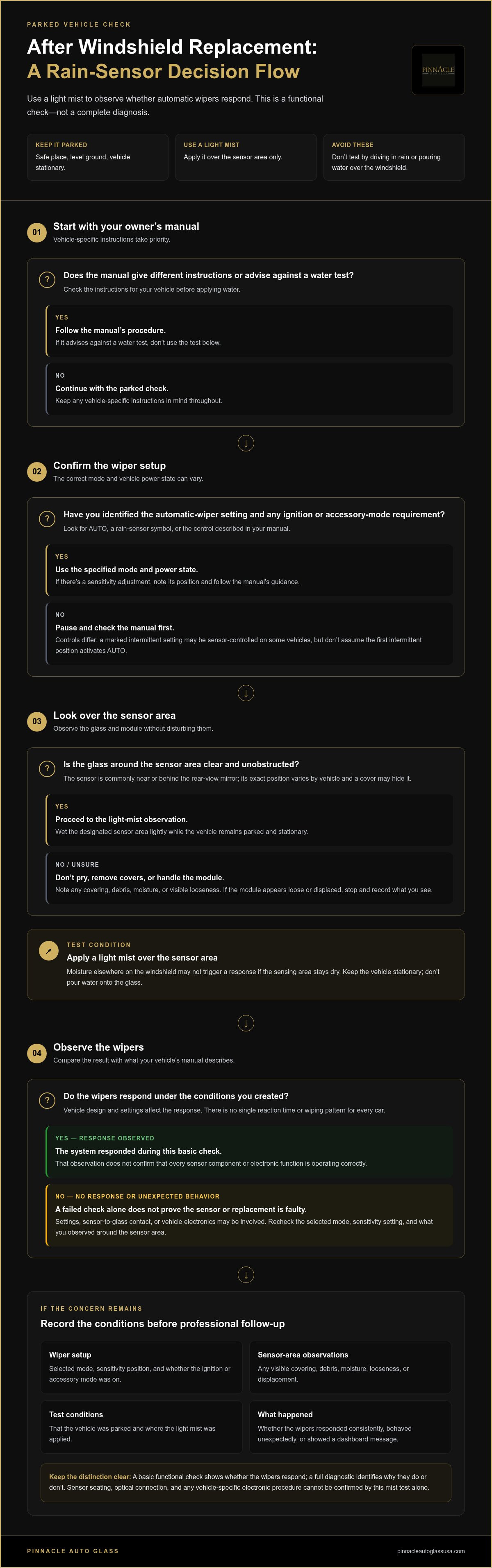
Use this as a controlled observation, not a definitive diagnosis. It can show whether the automatic wipers respond under the conditions you create, but it can’t confirm sensor fit, wiring, or whether a vehicle-specific service procedure is complete. Follow your owner’s manual first. If it advises against a water test or gives a different procedure, use its instructions instead.
Park safely, select the vehicle’s automatic-wiper mode, follow its operating instructions, then apply a light mist of clean water to the windshield’s sensor area and observe the wipers.
Run a controlled test while parked
- Choose a safe location. Park on level ground away from traffic, keep the vehicle stationary, and secure it as directed by the owner’s manual. Don’t test while driving or with anyone standing near the wiper blades.
- Set the wiper control. Select AUTO or the manufacturer-designated rain-sensing setting. If the manual specifies an ignition or accessory mode, follow that instruction. Keep your hands clear of the blades and their path, since the wipers may activate without warning.
- Apply a light mist. From a safe position, mist clean water onto the outside of the windshield over the sensor’s sensing area. Use a spray bottle or another gentle method. Don’t pour water over the glass, use a pressure washer, or spray into gaps around the sensor housing.
- Watch the response. Note whether the wipers activate or adjust their operation. The exact response can vary by vehicle and sensitivity setting, so don’t rely on a universal time limit or expect every system to behave identically. Stop if the manual says to stop or if anything seems unsafe.
Record what the wipers do
Make the result useful. Note whether the wipers responded, stayed inactive, or behaved inconsistently. Record the selected mode, sensitivity setting if present, and any dashboard warning. Also note visible conditions around the sensor, such as moisture or an obstruction. These observations describe what happened without claiming to identify the cause.
If the owner’s manual permits another attempt, repeat the check while changing only one condition at a time, such as the sensitivity setting. This makes it easier to tell whether the response changes with the control setting. Don’t keep repeating the test if the wipers behave erratically, the sensor looks displaced, or the vehicle displays a warning. Avoid touching or moving the sensor.
A single unsuccessful attempt doesn’t prove the replacement glass or sensor is faulty. The selected mode, vehicle instructions, sensor contact, or an electronic issue may affect the result. Keep your notes for follow-up if the concern continues after replacement. Pinnacle Auto Glass provides windshield replacement services and windshield repair for personal and commercial vehicles.
If the Rain Sensor Fails the Test: What to Check Next
An unsuccessful check can be frustrating, especially after windshield replacement. But one test doesn’t prove the glass or sensor is faulty. The result is an observation, not a diagnosis. First review the selected wiper mode and the vehicle’s instructions. If those were correct, record what happened and don’t take the sensor apart or try to reposition it.
Use the comparisons below to choose a safe next step. Each observation can point to a category worth investigating, but it can’t establish the cause on its own.
Observation: The wipers stayed inactive, and AUTO mode may not have been selected.
Possible category: Control setting or vehicle-specific operating instructions.
Safe next step: Check the owner’s manual, select the specified automatic mode, and repeat the parked test only if the manual allows it.
Observation: The sensor looks loose, shifted, or visibly out of place.
Possible category: Sensor seating or its connection to the windshield.
Safe next step: Don’t adjust or remove it. Note what you see and arrange a professional inspection.
Observation: The correct setting was selected, but the wipers didn’t respond, responded inconsistently, or a warning appeared.
Possible category: Sensor operation, wiring, or a vehicle-specific reset or service procedure.
Safe next step: Stop if the manual advises service or the wipers act unpredictably. Record the result and seek professional follow-up.
Separate a settings issue from a possible installation concern
If AUTO mode wasn’t selected, follow your vehicle’s instructions and repeat the parked check before drawing conclusions. If the setting was correct but there was no response, document that result without assigning blame. A visible shift or looseness is a reason to stop and request an inspection, not to press the sensor back into place. Don’t handle connectors or wiring.
A rain sensor and a camera-based ADAS feature are distinct systems. Their procedures aren’t interchangeable, and a rain-sensor check doesn’t confirm camera calibration. ADAS recalibration is a separate, vehicle-dependent process that may be relevant after windshield replacement. For camera-system questions, consult vehicle-specific service information or an ADAS calibration reference guide.
Know when to stop testing and seek professional help
Stop testing if a dashboard warning appears, the wipers behave unpredictably, the sensor looks displaced, or the owner’s manual directs you to seek service. Don’t keep spraying water or make repeated adjustments in an attempt to force a response. Share clear observations instead. Include the vehicle’s make, model, and year, the windshield replacement date, the mode and sensitivity setting used, any warning message, and what the wipers did.
These details help focus follow-up on the post-replacement glass concern without assuming a specific fault. Pinnacle Auto Glass provides professional windshield replacement and repair for personal and commercial vehicles. Learn about Pinnacle Auto Glass windshield service.
Getting Professional Follow-Up After Windshield Replacement
If the wipers still don’t respond as expected, bring clear observations to the next conversation about the windshield work. A brief account of the test helps distinguish what you saw from what still needs assessment. It also prevents a single parked check from being treated as a diagnosis. The goal is to explain the concern accurately, not to diagnose the sensor yourself.
What details to share about the test
Gather the vehicle and replacement details first. Include the year, make, and model, plus the windshield replacement date if you have it. Then describe exactly what happened during the check. For example, note whether you selected AUTO, whether you adjusted sensitivity, and whether the wipers stayed inactive, started, or behaved inconsistently after the light mist.
- Share any dashboard warning or message, using its exact wording if possible.
- Say whether the concern began immediately after the windshield replacement or appeared later.
- Describe visible observations near the sensor, such as an apparent shift or obstruction, without touching or removing anything.
- Note whether the owner’s manual gave specific instructions or cautioned against testing.
These details give a glass professional useful context about the post-replacement concern. They don’t establish that the sensor, glass, wiring, or vehicle electronics are at fault. When discussing how to test a rain sensor after replacement, keep the result factual: “AUTO selected, light mist applied, no wiper response” is more useful than a guess about the cause.
How windshield and ADAS follow-up fit together
Rain-sensing wipers and camera-based driver-assistance systems perform different functions. A rain sensor signals automatic wiper operation; an ADAS camera supports specific driver-assistance features. A rain-sensor test doesn’t verify camera operation, and it doesn’t confirm whether camera recalibration is needed. Vehicle-specific service information determines whether a system requires a reset, initialization, or calibration after windshield replacement.
Pinnacle Auto Glass provides windshield replacement and repair, as well as ADAS recalibration. These services relate to windshield work, but camera recalibration is a distinct, vehicle-dependent process. Don’t assume it follows the same steps as a rain-sensor check. Keep any camera warning or driver-assistance concern separate when describing what you’ve noticed.
For focused follow-up, have your vehicle details, replacement date, and test notes ready. Pinnacle Auto Glass supports glass needs for personal and commercial vehicles through windshield replacement and repair, with ADAS recalibration for applicable systems. Review the company’s windshield services to understand the glass services relevant to your concern.
Take the Next Step With Confidence
A rain-sensor check is most useful when it helps you decide what to do next, not when it pushes you to guess at a repair. If the concern continues, keep your notes with the vehicle’s service history. That can make future glass or system discussions more focused and help distinguish a wiper concern from a separate driver-assistance issue. Use vehicle-specific service information for any required procedure rather than attempting an adjustment based on a general guide.
Understanding how to test a rain sensor after replacement gives you a safe starting point, but persistent concerns deserve appropriate follow-up. Pinnacle Auto Glass provides windshield replacement and repair for personal and commercial vehicles, along with ADAS recalibration for applicable systems. These services address distinct vehicle needs, and any procedure depends on the vehicle. Explore Pinnacle Auto Glass windshield services to take the next step for your glass needs.
Frequently Asked Questions
Can I test a rain sensor with a garden hose?
Use a hose only if your vehicle’s instructions permit it and you can apply water gently while the vehicle is parked. A light mist is easier to control than a hose and avoids soaking the windshield or sensor area. Never use a pressure washer or direct a forceful stream at the sensor housing. Keep clear of the wiper blades, which may start unexpectedly.
Does every rain sensor need calibration after windshield replacement?
No. The required procedure varies by vehicle and sensor system. Some vehicles may call for a reset, initialization, or other service step, while others may not require the same procedure. Use the owner’s manual or vehicle-specific service information rather than assuming calibration is always needed. Rain-sensor procedures are also distinct from camera-based ADAS recalibration, which applies to applicable driver-assistance systems.
Why are my automatic wipers still not working after I select AUTO?
AUTO may not be the correct setting for your vehicle, or the system may require a specific ignition mode or sensitivity adjustment. The sensor area could also be obstructed, or the vehicle may need a procedure described in its service information. Check the manual and any dashboard messages. If the controls are set correctly and the issue continues, record what you observe and arrange professional follow-up.
Can a replacement windshield affect how a rain sensor works?
Yes. The sensor reads conditions through a designated area of glass, so its seating and optical connection to the replacement windshield can matter. If the sensor is visibly shifted or loose after glass work, don’t try to reseat it yourself. Note the change and have the concern assessed. A windshield replacement doesn’t, by itself, establish that the sensor is damaged or that a particular procedure is required.
Should I drive in the rain to see whether the sensor works?
No. Don’t create a driving test to troubleshoot automatic wipers. Rainfall varies, and a moving test can distract you from driving safely. If you encounter rain during ordinary driving and the automatic mode doesn’t respond as expected, use the wiper control manually as needed to maintain visibility. Make a note of the conditions and have the system concern assessed before relying on automatic operation.
What does it mean if the rain sensor works only sometimes?
Intermittent operation doesn’t identify a single cause. The selected sensitivity, moisture in the sensor’s field, or a vehicle-specific system issue may affect what you observe. Note whether the response changes with the control setting, weather, or location of moisture on the glass. If the behavior persists or includes unexpected wiping, avoid further experiments and share those details during professional follow-up.
Is a rain sensor the same as a windshield camera?
No. A rain sensor detects moisture for automatic wiper operation, while a windshield camera supports specific driver-assistance functions. Both may be mounted near the rear-view mirror, but they perform different jobs and may have different service requirements. A basic wiper response check doesn’t verify a camera’s function or calibration. Follow vehicle-specific service information for camera-related warnings or ADAS concerns after windshield replacement.


