

A cracked windshield can lead to a ticket if it blocks your view, and some states also restrict damage based on its size or location. The laws on driving with a damaged windshield vary by state. In California, Vehicle Code Section 26710 prohibits driving when windshield damage obstructs the driver’s view of the road. A vehicle may also fail inspection because of windshield damage, depending on state requirements.
It’s understandable to wonder whether a chip or crack is serious enough to affect your ability to drive. This article explains when windshield damage can lead to a ticket, how state rules and inspections address visibility and damage location, and why windshield condition matters to ADAS cameras and sensors. You’ll also learn how repair or replacement fits into the decision, so you can assess the damage and decide what to do next.
Key Takeaways
- Rules vary by state: damage location and visibility can matter as much as the size of a chip or crack.
- A windshield that obstructs your view may lead to a ticket, while some violations can be corrected by repairing the damage.
- California law specifically addresses windshield damage that blocks the driver’s view of the road.
- Damage near an ADAS camera may affect driver-assistance systems and can require windshield replacement and recalibration.
- Inspection standards differ by state, so understand how your local requirements treat cracks, chips, and windshield condition.
State laws on obstructed views and windshield damage
The laws on driving with a damaged windshield vary by state and depend on where the damage is. A crack that leaves your view clear in one state may still affect inspection or enforcement in another.
Obstructed View and Windshield Damage Rules
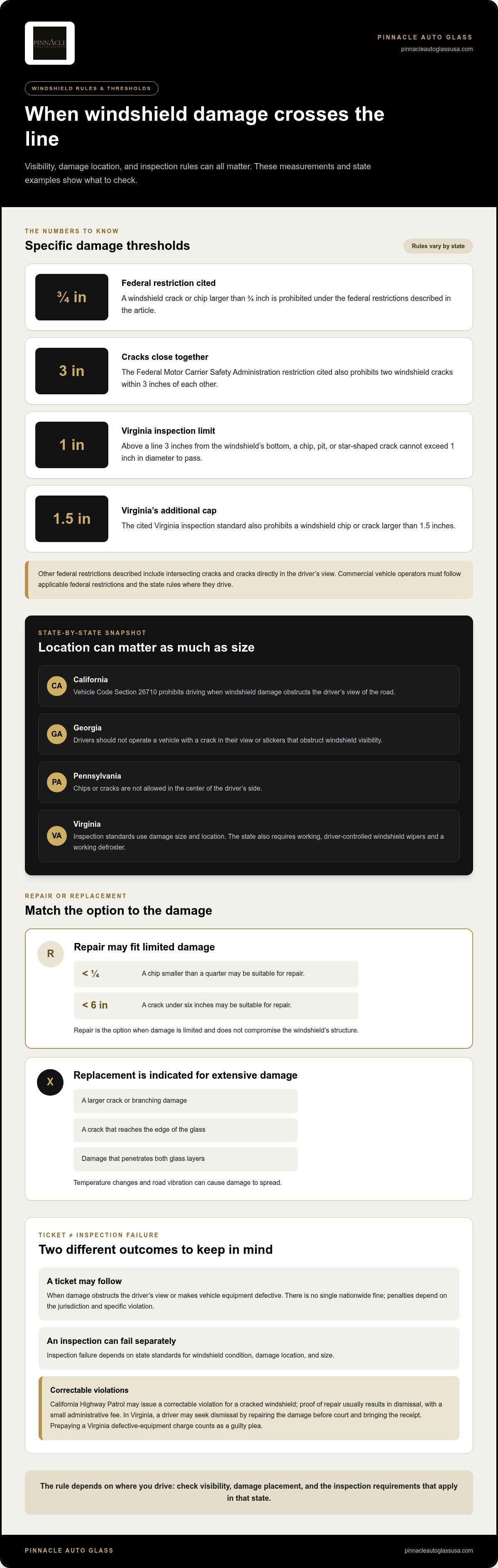
Obstructed-view rules focus on whether windshield damage blocks the driver’s view of the road. In Georgia, drivers should not operate a vehicle with a crack in their view or stickers that obstruct windshield visibility. Pennsylvania does not allow chips or cracks in the center of the driver’s side. These examples show why a defect’s location can matter as much as its size.
Federal regulations prohibit driving with a windshield crack or chip larger than 3/4 inch, with intersecting cracks, or with cracks directly in the driver’s view. According to the Federal Motor Carrier Safety Administration, two windshield cracks within three inches of each other are also prohibited. These restrictions give drivers specific damage conditions to consider alongside state rules.
Windshield Inspection Standards
Inspection standards assess whether windshield damage meets the requirements for a vehicle to pass inspection. Virginia uses the location and size of damage as criteria. A chip, pit, or star-shaped crack above a line three inches from the windshield’s bottom cannot exceed one inch in diameter to pass. Virginia’s cited inspection standard also prohibits a windshield chip or crack larger than 1.5 inches.
Virginia’s standard appears in 19 VAC 30-70-210, page 210-2, paragraphs 7 and 8. The state also requires working, driver-controlled windshield wipers and a working defroster. These requirements make windshield condition relevant beyond cracks alone. A damaged windshield can also weaken vehicle structure and affect airbag deployment, so inspection concerns connect directly to safety.
Differences in State Windshield Laws
State laws vary in how they address visibility, damage size, and inspection results. Georgia addresses cracks in the driver’s view and windshield obstructions; Pennsylvania specifies the center of the driver’s side. Virginia uses specific inspection measurements. Some states restrict damage by size or placement even when it does not obstruct visibility, so do not assume one state’s standard applies everywhere.
Commercial vehicle operators must follow applicable federal restrictions and the state rules where they drive. Motorcycle requirements depend on state rules for that vehicle type; the windshield standards described here do not establish one nationwide motorcycle threshold. Windshield crack laws apply in the state where the vehicle is being driven. Before crossing state lines, consider whether a crack could violate the next state’s visibility or inspection rules.
Can you get a ticket for a cracked windshield?
Yes. A cracked windshield can lead to a ticket if it violates state visibility or equipment rules. Inspection failure is a separate issue and depends on the state’s inspection standards.
When Damage Can Lead to a Ticket
A windshield ticket may follow when damage obstructs the driver’s view or makes the vehicle’s equipment defective. In Virginia, Code § 46.2-1003 makes using defective or unsafe equipment on a highway unlawful. A defective-equipment charge is a traffic infraction. California Highway Patrol officers can issue a correctable violation for an ignored cracked windshield.
There is no single nationwide fine for a windshield ticket. The penalty depends on the jurisdiction and the specific violation. In Virginia, prepaying a defective-equipment charge counts as a guilty plea, so understand the charge before choosing that option.
Wipers, mirrors, and inspections may be subject to requirements separate from windshield-crack rules. Virginia requires driver-controlled windshield wipers in good working condition and a working defroster. State inspections may also assess windshield condition, while mirror requirements depend on the applicable vehicle-equipment rules.
Fix-It Tickets and Penalties
A fix-it ticket gives a driver a chance to correct a cited vehicle problem. California Highway Patrol may issue a correctable violation for a cracked windshield. Proof of repair usually results in dismissal, with a small administrative fee. Ignoring the violation could lead to higher fines and a record entry.
In Virginia, a driver charged over a cracked windshield may seek dismissal by repairing the damage before court and bringing the receipt. This differs from prepaying, which counts as a guilty plea. Keep repair documentation and follow the instructions attached to the citation.
Address a chip or crack promptly for safety and to reduce the chance of further damage. Temperature changes and road vibration can cause damage to spread. A chip smaller than a quarter or a crack under six inches may be suitable for repair. Larger cracks, branching damage, cracks that reach the edge, or damage through both glass layers call for replacement.
Choose repair when the damage is limited and doesn’t compromise the windshield’s structure. Choose replacement when the crack is extensive, reaches the glass edge, or penetrates both layers. Prompt windshield repair can address eligible chips and short cracks before they spread; replacement is the relevant option for more extensive damage.
Repair documentation can matter after a citation: a driver may be able to avoid fines by providing proof that the windshield was repaired or replaced afterward. Attend to windshield cracks promptly to help pass vehicle inspection, avoid a ticket, and stay safe. Virginia Code § 46.2-1003 applies to defective or unsafe devices or equipment mentioned in § 46.2-1002, so the scope of the equipment rule matters when assessing a charge.
In Georgia, a starburst or spider-web crack larger than 3 inches square or in diameter anywhere on the windshield is described as prohibited. Leaving a windshield violation uncorrected could result in higher fines and the violation remaining on the driver's record, making prompt repair and proof of correction important.
California windshield visibility law
California’s rule focuses on whether windshield damage obstructs the driver’s view of the road. A crack outside the driver’s sightline raises a different visibility question from damage directly across the forward view.
California Vehicle Code Section 26710 prohibits driving a vehicle when windshield damage obstructs the driver’s view of the road, according to the California Legislature. The rule makes visibility the central issue. For example, a star-shaped crack in the driver’s direct view can interfere with seeing traffic, signs, or hazards. The statute does not make every crack automatically unlawful; the key condition is obstruction of the road view.
When assessing a cracked windshield, consider where the damage is and what it obscures from the driver’s seat. A small chip near the edge may leave the forward view clear, while a branching crack across the driver’s sightline can obscure other vehicles or road markings. Reflections can also make damage more distracting at certain angles. These examples help explain the visibility concern, but they do not replace the statutory test.
Repair can address eligible chips and short cracks before they spread. Temperature changes, road vibration, and a slammed door can widen existing damage, and a small chip can become a full-length crack within days. A crack that branches in several directions, reaches the glass edge, or penetrates both layers calls for replacement. The damage’s size, location, and depth help determine which option fits.
Insurance is separate from California’s visibility rule. Comprehensive coverage may cover windshield damage caused by road debris, storms, or other incidents beyond the driver’s control. Coverage depends on the policy and cause of damage, so review your terms before arranging repairs. A claim does not change the visibility requirement: you still need a clear view of the road.
Before driving, sit in your normal position and look toward the road. Note whether a crack or chip blocks your forward view. If damage lies across that view, do not treat it as merely cosmetic. Arrange repairs as soon as possible, especially if the crack is growing or branching. California drivers should also remember that visibility is not the only concern: severe windshield damage can weaken vehicle structure and affect airbag deployment.
Damage affecting ADAS cameras and sensors
Windshield damage can affect Advanced Driver Assistance Systems (ADAS) if it interferes with a camera’s view. A windshield replacement on an ADAS-equipped vehicle may require professional recalibration for the system to function properly.
Many vehicles have an ADAS camera behind the windshield, often near the rearview mirror. The camera reads visual information through the glass. A crack, chip, or distortion in its viewing area can interfere with what the camera detects. For example, damage across the camera’s line of sight may affect how clearly it reads lane markings or identifies vehicles ahead.
The damage’s location can matter more than its length. A small chip near a camera may be more relevant to ADAS function than a longer crack outside its view. You can check whether damage is close to a visible camera housing, but appearance alone cannot show whether the camera’s view or calibration has changed.
Windshield replacement may require professional recalibration if the damage affects an ADAS camera or sensor. Recalibration aligns the system with the vehicle’s camera position and windshield so its readings match the road view. Replacing the glass without recalibration can leave the camera inaccurately aimed. For vehicles with ADAS, we recalibrate the system after a windshield replacement to ensure all safety features function properly.
ADAS features vary by vehicle. Depending on the system, a camera may support functions such as lane-related alerts or forward collision warnings. If a warning appears after windshield damage or replacement, do not assume the feature is working normally. Follow the vehicle’s instructions and arrange professional assessment and recalibration where required.
ADAS impairment and illegality are separate questions. A camera issue alone does not establish that driving is illegal under every state law. A windshield that also obstructs the driver’s view can raise a separate visibility concern. After an accident, inspect the visible glass damage and check for ADAS warning indicators before relying on driver-assistance features.
When arranging replacement, tell your auto-glass service that the vehicle has a camera or sensor mounted at the windshield. The vehicle’s make and model, camera location, and damage position help determine the work needed. After installation and recalibration, check the dashboard for system warnings and consult the owner’s manual for vehicle-specific status indicators. Do not treat a clear-looking windshield as proof that a camera is correctly aligned.
Windshield damage that can fail a vehicle inspection
A vehicle can fail inspection because of windshield damage, but the outcome depends on state requirements. Inspectors may consider where a crack sits, whether it obstructs the driver’s view, and whether separate cracks move against one another. Virginia illustrates how inspection standards can assess both visibility and windshield condition.
In Virginia, cracks that move in relation to one another can weaken the windshield structure and cause an inspection failure. The movement matters because the glass must remain stable as part of the vehicle. Several shifting cracks present a different inspection concern from an isolated chip. Damage can also make the glass more vulnerable to road debris, pressure changes, or extreme temperatures.
Virginia’s inspection standard is set out in 19 VAC 30-70-210, page 210-2, paragraphs 7 and 8. The cited standard prohibits a windshield chip or crack larger than 1.5 inches. It also gives a specific placement test: a chip, pit, or star-shaped crack above a line three inches from the windshield’s bottom cannot exceed one inch in diameter to pass. These criteria show why both location and size can matter.
Inspection outcomes can depend on more than a measurement. A crack may branch in several directions, reach the glass edge, or compromise the glass layers. Damage that penetrates both layers compromises structural integrity and requires full replacement. Larger cracks, especially near an edge, can also undermine the glass-to-frame bond. An inspector may consider the damage pattern and condition, not just one visible spot.
Inspection rules differ across the United States. A windshield defect that triggers a failure in one state may be treated differently elsewhere, because each state sets its own requirements. The available market research reports that one in 10 cars fail to meet Virginia state inspection standards. That figure covers all inspection standards, not windshield defects alone, so it should not be read as a windshield-failure rate.
Before an inspection, note whether damage blocks the driver’s view, spreads toward an edge, or branches across the glass. Check for movement between cracks and consider whether the windshield remains structurally sound. If larger cracks or layered damage are present, arrange windshield replacement before the inspection. For limited damage, windshield repair may address the defect while preserving the existing glass.
Severity matters because extensive windshield cracking is not merely a visibility concern. A severely cracked windshield is more vulnerable to failure under impact, pressure changes, or extreme temperatures, increasing risk to vehicle occupants. This vulnerability makes the glass condition important even when the immediate question is whether the vehicle will pass inspection. Do not treat severe cracking as cosmetic or assume it will remain stable as conditions change. Promptly addressing the damage can help you avoid relying on glass that is more vulnerable to failure. The risks include impact as well as pressure and temperature changes, so attend to the windshield’s condition before those stresses occur.
Pinnacle Auto Glass: Windshield Replacement
Pinnacle Auto Glass provides windshield repair and replacement for damage that needs attention. A chip or short crack may be suitable for repair; larger or more extensive damage may call for replacement. For vehicles with ADAS, we recalibrate the system after a windshield replacement to ensure all safety features function properly.
Pinnacle Auto Glass serves fleet operators, commercial trucks, and RVs with glass services. The right service depends on the damage, vehicle, and whether a windshield camera or sensor is affected. Professional glass service is a practical next step when you have a visibility, safety, or inspection concern.
Contact Pinnacle Auto Glass to arrange windshield repair, replacement, or ADAS recalibration.
Make Your Next Step Count
Understanding the laws on driving with a damaged windshield helps you make an informed decision. Next, consider the condition of your glass and vehicle: does the damage need repair or replacement, and does a windshield-mounted camera make recalibration necessary? Addressing those needs gives you a clear plan instead of letting uncertainty delay a decision.
Pinnacle Auto Glass offers Windshield Repair and Windshield Replacement, along with ADAS Recalibration when needed after windshield work. Share what you’ve noticed about the damage and your vehicle’s equipment to identify the service that fits. You can contact Pinnacle Auto Glass to discuss your windshield needs and determine a practical next step.
Choose a next step that supports visibility and your vehicle’s condition. A focused assessment can help you move forward with confidence.
Frequently Asked Questions
How do states define windshield damage that obstructs the driver's view?
States generally consider windshield damage obstructive when it interferes with the driver’s view of the road. The practical question is whether the defect blocks a needed sightline from the normal driving position. A mark that seems minor from outside may look different from the driver’s seat, especially if it overlaps traffic signals, lane markings, or approaching vehicles. Rules may also address damage location separately from direct obstruction.
What are the legal limits for cracks, chips, and damage in the driver's line of sight?
There isn’t one size limit that applies across every state. Federal regulations prohibit driving with a crack or chip larger than 3/4 inch, intersecting cracks, or cracks directly in the driver’s view. The Federal Motor Carrier Safety Administration also identifies two cracks within three inches of each other as prohibited. State rules can add separate size or placement restrictions, so don’t treat one measurement as a universal safe threshold.
How can I check my state's specific windshield damage laws?
Use your state’s official vehicle code and inspection guidance rather than relying on a general national summary. Search for windshield, obstructed view, defective equipment, and inspection standards. Read the rules for driving separately from inspection criteria: one may govern road use, while another determines whether the vehicle passes inspection. If your trip crosses state lines, review the rules for every state where you’ll drive.


