
Could a small crack pass while a larger one fails? The answer to “will a cracked windshield pass state inspection” depends on the rules where your vehicle will be inspected and how the damage affects visibility. State requirements vary, so a quick glance at the crack alone may not tell you whether the vehicle will pass.
Before inspection, find the current official standard for your state and compare it with the damage on your windshield. This guide explains what criteria to look for, how to document the damage, and when windshield repair or replacement may be a practical next step. It also explains why damage in the driver’s line of sight can matter, even when a crack seems small.
Pinnacle Auto Glass provides windshield repair and replacement, including mobile service at your home, office, or another convenient location. For vehicles with ADAS, recalibration follows windshield replacement. Use the steps below to prepare with a clearer understanding of both the inspection rules and your glass-service options.
Key Takeaways
- There isn’t one inspection rule for every state. Find the current official requirements where your vehicle will be inspected.
- To assess whether a cracked windshield will pass state inspection, note the damage’s location and its effect on your view, then compare those details with your state’s criteria.
- Record where the crack is and how it affects visibility. Use those observations to assess the windshield against official guidance.
- Check the applicable state requirements before relying on forum posts or advice written for another state.
- Windshield repair or replacement addresses damaged glass, but the inspector determines whether the vehicle meets state criteria. Pinnacle Auto Glass provides a warranty on both the glass and installation, with service-related issues repaired at no additional cost.
Will a Cracked Windshield Pass State Inspection? Start With Your State's Rules
There is no single pass-or-fail rule for cracked windshields that applies across every state. The answer to “will a cracked windshield pass state inspection” depends on the current requirements where the vehicle will be inspected. A crack may affect visibility or raise a concern about the glass, but that alone doesn’t establish whether it violates a particular inspection rule.
A state vehicle inspection standard is the official set of requirements an inspector uses to assess whether a vehicle meets that state’s inspection rules. For windshield damage, look for official guidance on glass condition, visibility, and any stated damage criteria. Don’t assume a particular crack size or location automatically means a failure unless the applicable standard says so.
Keep safety concerns separate from inspection criteria. A crack can interfere with a driver’s view, so it deserves attention. General information about windshield safety standards can explain the glass’s role and construction, but it doesn’t replace your state’s inspection requirements.
Why a cracked windshield does not have one nationwide answer
Inspection programs are established and administered under state-specific rules. Requirements and procedures differ, and some states may not use the same inspection process. A rule or example for one state can’t determine the result in another. Find the current official inspection guidance for the state where the inspection will take place, then use it to understand what the inspector is expected to assess.
What the Missouri example can, and cannot, tell drivers elsewhere
A state-focused ranking guide may discuss damage zones and inspection criteria specific to that state. Those details can help local drivers understand what to look for, but any claimed thresholds should be checked against current official guidance before being relied on. One state’s criteria do not establish whether a vehicle will pass elsewhere. Treat examples as specific to the rules they describe, not as nationwide standards.
Use the official source to answer three practical questions: Does the standard address windshield cracks or chips? Does it explain how damage location or visibility is assessed? Does it give a specific limit or inspection outcome? If the guidance doesn’t clearly answer a question, don’t fill the gap with a forum post or a rule quoted for another state. Compare the stated criteria with your windshield’s condition, then decide whether glass service is a practical next step.
What Inspectors May Consider When a Windshield Is Cracked
Inspectors may assess whether windshield damage affects visibility or meets the condition requirements in their state’s inspection program. These are related questions, but they aren’t interchangeable. A crack can raise a safety concern without automatically failing inspection, while a state’s written standard may set specific criteria the inspector must apply.
A visible crack’s inspection significance depends on the applicable state criteria. Don’t treat a crack’s length, shape, or location as a nationwide pass-or-fail test. Note those details, then compare them with the official rules that apply where the vehicle will be inspected.
How damage location and visibility can matter
Start by noting where the damage sits from the driver’s perspective. A crack in the area you look through while driving may raise a visibility concern, particularly if it crosses your forward view or draws your attention. Damage outside that area may present a different practical concern. Neither location guarantees a pass or failure. Check how your state’s inspection wording addresses visibility and windshield condition.
Assess the glass from the normal seated driving position. Note whether the damage overlaps your forward view, appears as a chip or branching mark, or is difficult to see from inside the vehicle. These observations help you describe the condition accurately, but they don’t replace an inspector’s evaluation or determine the legal result.
Why crack size and type are not universal pass-or-fail tests
People may describe damage as a crack, chip, or star break. These terms help explain what the glass looks like, but they aren’t automatically legal categories with the same meaning in every state. Similarly, a measurement or damage limit mentioned in one state’s guide shouldn’t be assumed to apply elsewhere. Confirm each specific criterion in current official guidance.
Look for the exact language used by the inspection authority. Does it refer to the driver’s viewing area, impaired visibility, damaged glass, or a stated measurement? Keep that wording in context. If the official source sets a specific criterion, apply it as written rather than relying on a rule remembered from another state or an online discussion.
For a useful comparison, record the damage’s location, its appearance, and whether it interferes with your view. Then match each observation to the state’s official criteria. This turns “will a cracked windshield pass state inspection” into a more specific question: does this damage meet the standard that applies to this vehicle’s inspection?
If the damage may affect your clear view, professional glass service is a practical step while you review the applicable criteria. Pinnacle Auto Glass provides windshield repair and replacement to address damaged glass. The inspection outcome depends on the state’s rules and the inspector’s assessment.
Cracked Windshield Inspection: Compare the Damage With Official Criteria
Use a simple comparison to separate what you observe from what your state requires. The table below is a worksheet, not a pass-or-fail test. Leave the state-criterion column blank until you find current official inspection guidance. Don’t fill it with a rule from another state or an unverified online example.
| Damage location | Visibility impact | Official state criterion | Source checked |
|---|---|---|---|
| In or near the driver’s normal viewing area | Describe whether the damage crosses or distracts from the forward view | Copy the applicable wording from official state guidance | Record agency, page or document title, and date checked |
| Outside the driver’s normal viewing area | Note whether it’s visible from the driver’s seat or affects the view | Copy any applicable rule; don’t assume this location is exempt | Record agency, page or document title, and date checked |
| Chip, crack, or branching mark | Describe its appearance and whether it interferes with a clear view | Check whether the state standard addresses this type of damage | Record agency, page or document title, and date checked |
Record the details that help you assess your windshield
Before looking up the rule, make a clear record of the damage. Note its position in relation to your normal viewing area, whether it looks like a crack, chip, or star-shaped break, and whether you’ve noticed it changing. If practical, take clear photos from outside and from the driver’s seat. Photos can document the condition, but they can’t determine the inspection result.
Match your observations to the rule that applies
Find current windshield or glass guidance from the official vehicle inspection agency for the state where the inspection will take place. Read the full relevant passage, not just a short excerpt, and match its wording to your notes. If it refers to visibility, for example, compare that criterion with what you can see from the driver’s position. Don’t transfer a measurement or damage-zone example from one state to another unless your state’s official guidance establishes the same rule.
If the official wording is unclear, don’t turn uncertainty into a promised pass or failure. Record what you found and use the inspection authority’s published guidance to understand its criteria.
Keep the inspection decision separate from the glass-service decision. State rules determine whether the vehicle meets inspection criteria; a glass professional assesses whether repair or replacement is appropriate for the damage. Glass service addresses the windshield, but it doesn’t determine the inspection result. If the damage affects your view, arranging repair or replacement is a practical next step while you clarify the applicable standard.
Preparing for State Inspection With a Cracked Windshield
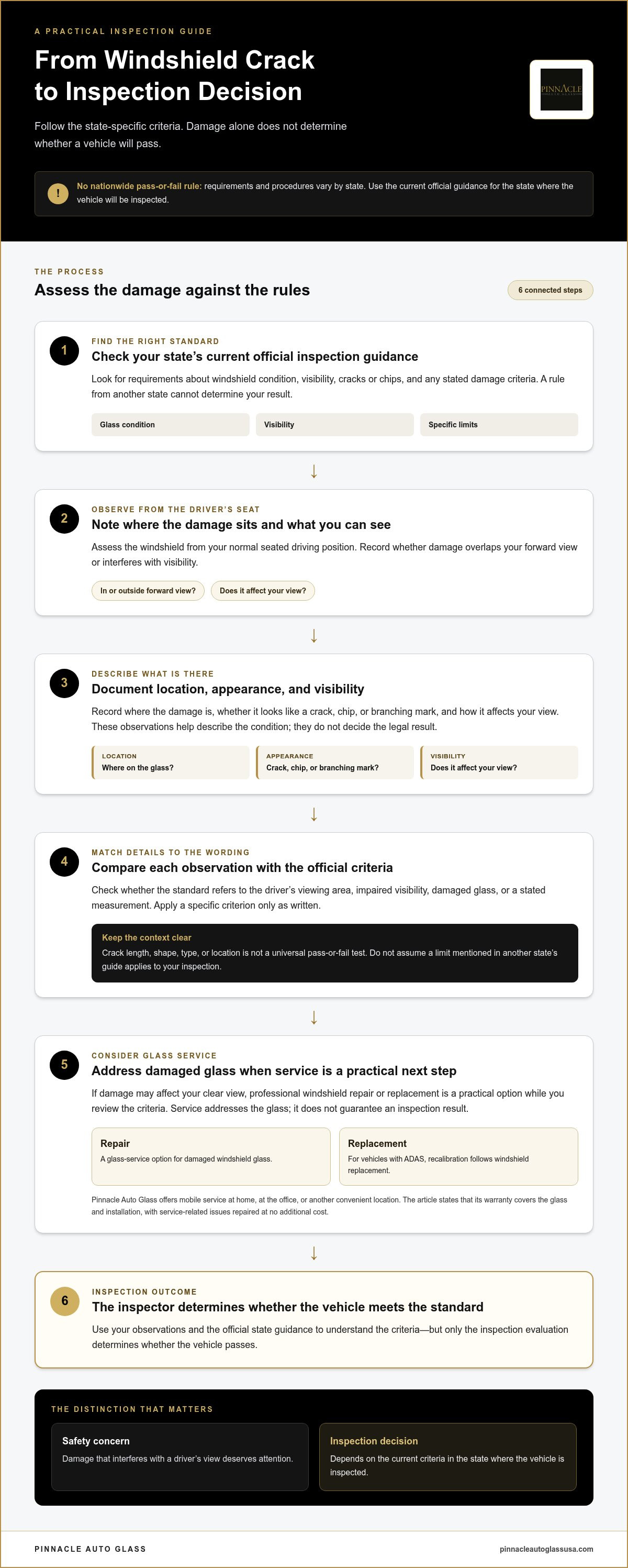
A clear preparation process helps you avoid relying on assumptions. Check the rule for the state and inspection type that apply, record what you see, then decide whether glass service is a practical next step. Forum posts and articles about another state can offer context, but they can’t establish your inspection result.
Find current inspection guidance before your appointment
Look for windshield, glazing, or visibility criteria on the official state vehicle inspection agency’s website. Confirm that the guidance applies to your vehicle and inspection type, and check its publication or update date before relying on a quoted threshold. If the agency publishes separate inspection materials, use the one that covers your vehicle rather than assuming a general safety page describes the inspection standard.
- Identify the state. Confirm where the vehicle will be inspected. The applicable requirements come from that state’s inspection program, not an online example from somewhere else.
- Find the official guidance. Search the state inspection agency’s website for terms such as “windshield,” “glazing,” and “visibility.” Read the full passage and note the agency, document or page title, and update date. Don’t rely on a forum post or an article about another state as the final word.
- Document the damage. Record its location relative to your normal viewing area, describe whether it looks like a crack, chip, or branching break, and note any changes you’ve observed. Clear photos can help you keep a record, but they don’t decide whether the vehicle passes.
- Arrange appropriate glass service if needed. Compare your observations with the official wording. If the damage affects your view or concerns you, professional repair or replacement can address the glass. That work is separate from the inspector’s pass-or-fail decision.
Decide whether professional glass service is the practical next step
Pinnacle Auto Glass provides windshield repair and replacement, with mobile service at your home, office, or another convenient location. The team handles paperwork and works directly with most insurance providers for windshield services. The appropriate glass solution depends on the damage, while the state’s inspection criteria determine the inspection outcome.
For more background as you prepare, look for Professional Windshield Repair: A Comprehensive 2026 Guide to Safety and Savings and Why Hiring a Certified Auto Glass Technician is Critical for Vehicle Safety. These guides can help you understand repair considerations and technician qualifications. Use them alongside current official state guidance, not in place of it.
Once you’ve reviewed your state’s criteria, arrange windshield repair or replacement if addressing the damage is your next step.
How Pinnacle Auto Glass Helps With a Cracked Windshield
Repair or replacement can be a practical response when windshield damage needs attention, especially if it affects your view or concerns you before an inspection. The right service depends on the damage and the vehicle. The inspector applies the relevant state criteria, so keep that decision separate from your choice to address damaged glass.
When windshield repair or replacement may be appropriate
Pinnacle Auto Glass provides windshield repair and windshield replacement. Some types of damage may be suitable for repair, while other conditions may call for replacement. The vehicle and the glass damage both matter. For more context on replacement, see Professional Windshield Replacement: The Complete Safety and Technology Guide. Whatever service is appropriate, compare your windshield with current official inspection guidance rather than assuming the work determines the result.
Windshield repairs usually take around 30 minutes, while full replacements typically take 60-90 minutes, depending on your vehicle. Pinnacle provides mobile auto-glass service at your home, office, or another convenient location, and handles paperwork with insurance providers. We provide a warranty on both the glass and our installation. Any service-related issues will be repaired at no additional cost.
What to expect after replacement on an ADAS-equipped vehicle
For vehicles with ADAS, we recalibrate the system after a windshield replacement to ensure all safety features function properly. Recalibration is part of the replacement process for ADAS-equipped vehicles. Don’t treat the vehicle as ready to drive before required recalibration is completed.
Wait at least 24 hours before washing your car to allow the adhesive to fully set. After that, you can wash it normally.
If you’re considering service because of damage or an upcoming inspection, keep the next steps clear: use your state’s official criteria to understand inspection requirements, then address the glass based on its condition. Glass service addresses the windshield, while the inspection process determines whether the vehicle passes.
Ready to address a cracked windshield? Arrange windshield repair or replacement with Pinnacle Auto Glass, then prepare for inspection using the applicable official rules.
Take the Next Step With Confidence
Uncertainty about “will a cracked windshield pass state inspection” doesn’t have to leave you stuck. Use your state’s official criteria to answer the inspection question, then make a separate decision about whether the damage needs professional attention. Keeping those decisions distinct helps you act on what you can verify without assuming that repair or replacement guarantees a particular inspection result.
If your windshield needs service, Pinnacle Auto Glass can help with repair or replacement. Mobile service brings auto-glass work to your home, office, or another convenient location. We provide a warranty on both the glass and our installation. Any service-related issues will be repaired at no additional cost. For vehicles with ADAS, we recalibrate the system after a windshield replacement to ensure all safety features function properly.
Choose a clear next step: review the official inspection guidance, note any questions about the damage, and arrange the glass service that fits your situation. Schedule windshield repair or replacement with Pinnacle Auto Glass.
Frequently Asked Questions
Can a cracked windshield pass state inspection if the crack is outside the driver's view?
It may, but location alone doesn’t guarantee a pass. Whether a cracked windshield will pass state inspection depends on the rules for that state and how the damage is assessed. Note whether the crack is outside the driver’s usual viewing area and whether it still interferes with visibility. Compare those details with the current official criteria before deciding how to proceed.
Do all states require a vehicle inspection for a cracked windshield?
No single nationwide inspection requirement applies to every driver. States set their own inspection programs, and the type of inspection required can depend on where the vehicle is registered or used. Check your state’s official motor vehicle or inspection agency information to see whether an inspection applies to your situation and whether windshield condition is included. Don’t assume a rule from another state applies to your vehicle.
Can a repaired windshield pass a state inspection?
Yes, a repaired windshield may pass if its condition meets the applicable state criteria, but the repair itself doesn’t guarantee approval. The inspector assesses the windshield as presented, using the rules for that inspection. A repair may address a chip, but its location or remaining effect on visibility could still matter under the applicable criteria. Review the official standard after service and follow the inspection agency’s process.
Will a small chip fail a state vehicle inspection?
Not necessarily. “Small” isn’t a universal inspection category, and size alone may not settle the outcome. A chip near the driver’s viewing area could be treated differently from one elsewhere, depending on state wording. Look for criteria that address glass damage, visibility, or damage location. If the rule specifies a measurement, use the official text and make sure it applies to your vehicle and inspection type.
Should I repair a cracked windshield before my inspection?
Consider arranging service before inspection if the damage affects your view, is changing, or raises a concern under the official state criteria. First identify what the inspection rule says, then compare it with your windshield’s condition. A glass professional can assess whether repair or replacement is appropriate. Addressing the damage may be a sensible step, but it doesn’t guarantee that the vehicle will pass inspection.
Can an inspector fail a vehicle because a windshield crack is spreading?
An inspector may fail a vehicle if the damage violates the applicable inspection standard, but a spreading crack isn’t automatically a failure under one nationwide rule. If you’ve noticed the crack extending, document the change and check whether your state’s criteria address visibility or windshield condition. A growing crack can become more concerning, so review your options before inspection day.
Does windshield replacement affect ADAS after a failed inspection?
It can. On a vehicle equipped with Advanced Driver Assistance Systems (ADAS), windshield replacement may affect systems that rely on sensors or cameras mounted near the glass. For vehicles with ADAS, we recalibrate the system after a windshield replacement to ensure all safety features function properly. This is separate from the inspection decision: recalibration addresses the vehicle’s safety systems, while the inspector applies the relevant state criteria to determine the inspection result.


