
A windshield crack isn’t automatically a violation, but its location could make the difference. DOT regulations for commercial truck windshields consider more than whether the glass is damaged. The affected area, the driver’s view, and the applicable inspection criteria all matter.
It can be difficult to tell whether a crack, chip, tint, decal, or mounted device could affect compliance. Federal windshield requirements and commercial vehicle inspection criteria are related, but they serve different purposes. Knowing which rule applies helps drivers and fleet managers respond based on the issue rather than guess.
This 2026 guide explains the federal baseline under 49 CFR § 393.60, how windshield damage and visibility are evaluated, and what to know about tint, obstructions, and mounted devices. It also covers when to arrange commercial glass repair or replacement. For vehicles with ADAS, we recalibrate the system after a windshield replacement to ensure all safety features function properly.
Key Takeaways
- DOT regulations for commercial truck windshields and periodic inspection criteria serve different purposes. Identify which one applies before deciding what to do about damage.
- A crack or chip can’t be assessed by size alone. Its location, effect on visibility, and the applicable standard matter.
- Record the vehicle, damage location, visibility concerns, and any repair or inspection actions to support fleet maintenance tracking.
- Arrange a professional glass evaluation when damage may affect visibility or windshield condition. Repair or replacement addresses the glass, but does not determine an inspection result.
- Pinnacle Auto Glass provides mobile glass service for fleets and commercial trucks. For vehicles with ADAS, recalibration follows windshield replacement.
DOT Windshield Regulations for Commercial Trucks: Which Rules Apply?
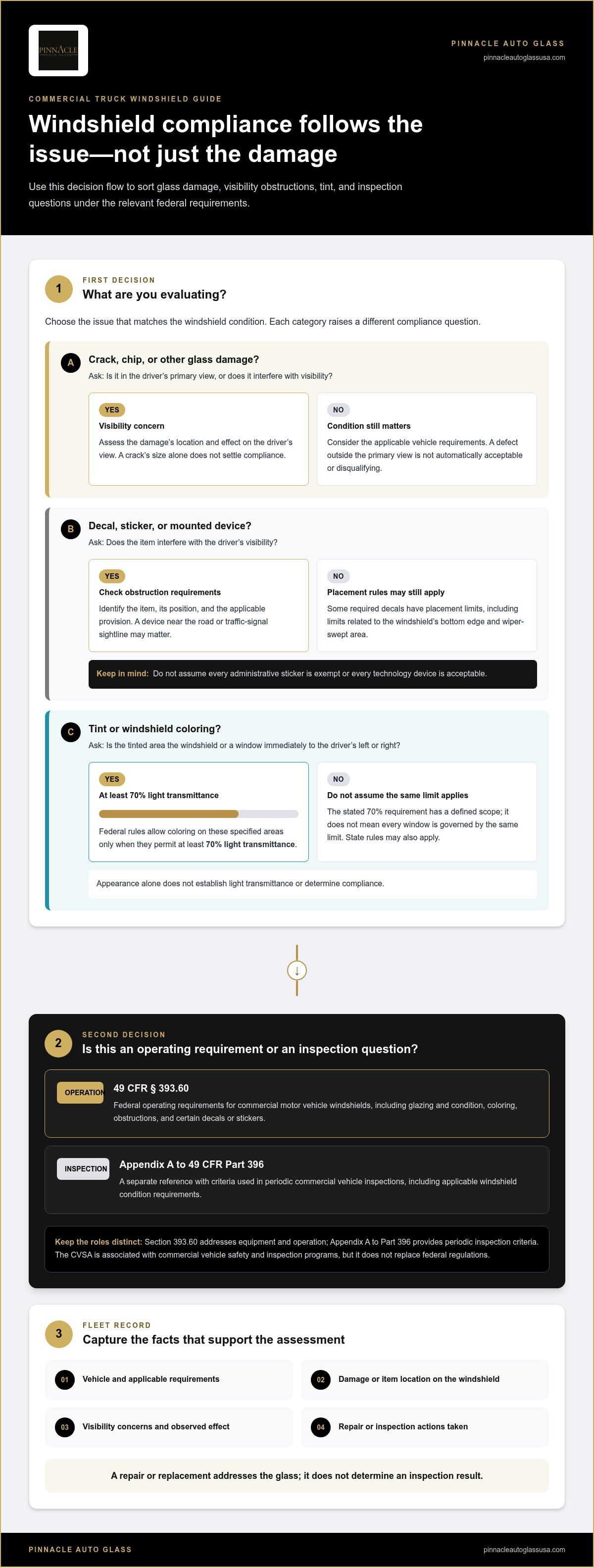
Commercial truck windshield compliance involves meeting applicable equipment requirements and keeping the vehicle in condition to pass required inspections. These are related but separate questions. One set of rules applies to vehicle equipment during operation, while another provides criteria for periodic inspections. The distinction matters when a fleet is deciding how to respond to a crack, a windshield-mounted device, or a visibility concern.
Citation-ready summary: 49 CFR § 393.60 sets federal operating requirements for commercial motor vehicle windshields, while Appendix A to 49 CFR Part 396 provides criteria used in periodic commercial vehicle inspections.
What does 49 CFR 393.60 cover?
Section 393.60 addresses windshield glazing and condition, as well as coloring, obstructions, and certain decals or stickers. In practical terms, it helps establish the glass and windshield setup a covered vehicle must have while operating. Its provisions are relevant to damage in the driver’s view, tinted areas, and items attached to the glass.
Read the section as an equipment and operating standard, not as a complete prediction of an inspection result. The vehicle’s type and configuration matter, and the location and effect of damage can change the compliance question. Don’t assume a small defect is automatically acceptable or automatically disqualifying based on size alone.
How do federal inspection standards fit in?
Appendix A to Part 396 is a separate reference for periodic inspections. It helps inspectors assess whether a commercial motor vehicle meets inspection criteria, including applicable windshield condition requirements. That role differs from § 393.60, which addresses requirements for vehicle equipment and operation. The Commercial Vehicle Safety Alliance (CVSA) is also associated with commercial vehicle safety and inspection programs, but it does not replace federal regulations.
For fleets, identify both the rule and the context before deciding what a defect means. A maintenance review, a roadside inspection, and a periodic inspection may involve different processes. Record observed damage and actions taken, and use current regulatory text when assessing a specific vehicle.
- Vehicle type: Confirm which federal requirements apply to the truck and its use.
- Damage location: Note where the crack, chip, or other defect sits on the windshield.
- Visibility: Consider whether the condition interferes with the driver’s view.
- Rule context: Separate ongoing equipment requirements from periodic inspection criteria.
These distinctions explain why a description such as “small crack” may not settle the issue. A defect outside the driver’s primary view may raise a different concern from one that obstructs visibility. An attached device or decal should also be assessed under the provisions that apply to that item. For a broader maintenance approach that connects glass decisions with fleet planning, see the commercial and fleet glass management guide.
What Federal Windshield Rules Say About Condition and Visibility
Federal windshield requirements address more than cracks. They also consider whether the driver can see clearly, whether the glass meets applicable condition standards, how windshield coloring affects light transmission, and whether decals or devices interfere with the required view. Assess each issue on its own facts.
Citation-ready definition: Under 49 CFR § 393.60, a windshield obstruction is an item or condition that interferes with the driver’s visibility in a way the applicable rule restricts.
A crack is a condition of the glass; a device or decal raises an obstruction question. A windshield could involve both, but the relevant standards and details may differ. Consider DOT regulations for commercial truck windshields by category rather than applying a single pass-or-fail rule to every mark or item.
How do visibility and windshield obstructions affect compliance?
The driver’s view is central. A mounted device near the sightline to the road or traffic signals may matter even when the glass itself is intact. Federal rules address the placement of certain devices and restrict items that interfere with visibility. Required decals may be permitted only within specified placement limits, including limits related to the windshield’s bottom edge and wiper-swept area.
Don’t assume every sticker is exempt because it serves an administrative purpose, or that every mounted device is acceptable because it supports vehicle technology. Identify the item, its location, and the applicable provision. Fleet records can note what is attached to the glass and whether it affects the driver’s view.
What should fleets know about tint and windshield coloring?
Federal rules allow coloring or tinting on the windshield and the windows immediately to the driver’s left and right only when those areas permit at least 70% light transmittance. This requirement has a defined scope. It does not mean every window is governed by the same limit. State rules may also apply, particularly for vehicles operating within one state.
A tint’s appearance alone doesn’t establish its light transmittance or determine whether it complies. Consider the glass location, measured light transmission, vehicle operation, and any applicable state requirement. Don’t assume tint passes or fails based only on how dark it looks.
For a practical review, separate the issues before deciding on action:
- Visibility: Does damage, tint, or an attached item affect the driver’s view?
- Glass condition: Is the glass damaged or discolored in a way addressed by the applicable standard?
- Coloring: Does the tint meet the federal light-transmission requirement for the specific glass area?
- Attachments: Is a decal or device placed in accordance with the rule that applies to it?
If damage needs professional attention, commercial truck windshield repair and replacement can address the glass condition. Keep visibility and attachment questions distinct, and assess each against the current federal text and relevant state rules.
Will a Truck Windshield Crack Pass a DOT Inspection?
Sometimes, but a crack or chip can’t be judged by size alone. Its position, type, effect on the driver’s view, and the applicable federal inspection criteria all matter. There isn’t one universal crack-size cutoff that decides every commercial truck windshield inspection.
Under 49 CFR § 393.60, the critical viewing area is measured upward from the top of the steering wheel, excluding a 2-inch border at the top and a 1-inch border along each side of the windshield. The regulation describes specific allowances for certain damage in this area. Appendix A to Part 396 provides separate periodic inspection criteria, so don’t treat one simplified measurement as a guaranteed pass or fail.
How do damage location and type change the assessment?
A chip, an isolated crack, intersecting cracks, and other glass defects are not interchangeable. A small chip may be repairable, but repairability alone doesn’t establish inspection compliance. Damage near the driver’s viewing area can raise a different concern from damage elsewhere, especially if it disrupts visibility. The table summarizes the federal references and a practical next step.
| Damage type | Location | Relevant rule | Action |
|---|---|---|---|
| Single crack | Critical viewing area | 49 CFR § 393.60 allows a single crack that does not intersect another crack; no maximum length is specified. Verify current text. | Document its location and check visibility and inspection criteria. |
| Chip or star break | Critical viewing area | A damaged area may be allowed if it fits within a 3/4-inch disc and is at least 3 inches from another similar damaged area. Verify current text and applicability. | Record the damage size and spacing, then arrange an evaluation. |
| Intersecting cracks | Critical viewing area | The single-crack allowance does not describe intersecting cracks. Apply the governing condition and inspection standards. | Have the damage assessed promptly, particularly if it affects the driver’s view. |
| Other damage or discoloration | Any location, with added visibility concern in the viewing area | Assess under 49 CFR § 393.60 and the applicable Part 396 inspection criteria. | Document the condition and its effect on visibility. |
Are commonly quoted limits universal?
No. The 3/4-inch damaged-area and 3-inch spacing figures are tied to the damage allowance described in 49 CFR § 393.60. They are not blanket approval for every crack, location, vehicle, or inspection. The single-crack provision also doesn’t mean any crack will pass regardless of visibility or other conditions.
Use the figures as part of a rule-specific assessment, not as a shortcut. A roadside review and a periodic inspection may involve different criteria. If damage is spreading, intersects other cracks, or obstructs the driver’s view, arrange a professional glass evaluation. Pinnacle Auto Glass provides windshield repair and replacement for commercial trucks and fleets. Glass service addresses the windshield, but does not determine a DOT inspection result.
What Should Drivers and Fleet Managers Do About Windshield Damage?
A consistent response helps a fleet assess damage, protect visibility, and keep clear maintenance records. Don’t wait for an inspection appointment to make a plan. DOT regulations for commercial truck windshields depend on factors such as damage location and applicable criteria. Document what you see, review the relevant requirements, and arrange a professional evaluation when needed.
Use this sequence whenever a driver reports a chip, crack, or other windshield concern:
- Document the damage. Take clear photographs from outside and inside the cab. Record the vehicle, date, damage location, and whether the defect appears to have changed.
- Assess visibility. From the driver’s position, note whether the damage interferes with the view of the road, traffic signals, or surrounding vehicles. Treat this as an observation, not a final compliance decision.
- Review the applicable rule. Consider the vehicle’s use and the difference between operating requirements and inspection criteria. Record the regulation or inspection reference used for the assessment.
- Arrange professional evaluation. If damage affects visibility, is spreading, or raises a compliance concern, schedule glass service to assess whether repair or replacement is appropriate.
What information should a driver or fleet record?
Make the report useful to the next person handling the vehicle. Photograph the damage in context and close up, then describe its position from the driver’s perspective, such as “lower passenger side” or “near the driver’s line of sight.” Include when it first appeared, whether it has changed, and any observed effect on visibility.
Keep the report, photographs, repair or replacement paperwork, and inspection records with the vehicle’s maintenance history. Consistent records help fleet managers follow up, identify unresolved issues, and understand what action was taken. If a driver notices new damage after an earlier report, add a dated update rather than replacing the original notes.
When should a fleet arrange professional glass service?
Arrange an evaluation promptly if damage obstructs the driver’s view, appears to be growing, or raises a question about windshield condition under the applicable rules. A professional can assess whether windshield repair or replacement is appropriate. Neither service determines a DOT inspection outcome.
Pinnacle Auto Glass provides windshield repair and replacement for commercial trucks and fleets, with mobile service at a home, office, or another convenient location. For vehicles with ADAS, we recalibrate the system after a windshield replacement to ensure all safety features function properly. For added context on safe replacement and vehicle technology, see this professional windshield replacement safety guide.
Have damage that needs professional attention? Arrange commercial glass service.
Commercial Truck Windshield Repair, Replacement, and ADAS Next Steps
Professional glass service gives fleet managers a practical next step when a windshield is damaged. A technician assesses the glass and determines whether repair or replacement is appropriate. That work addresses the windshield condition, but it does not determine whether a truck will pass a DOT inspection. Inspection outcomes depend on applicable requirements and the vehicle’s condition.
Pinnacle Auto Glass serves fleets, commercial trucks, and RVs with mobile auto-glass service at a customer’s home, office, or another convenient location. We bring expert auto glass repair and replacement to your doorstep, fully equipped to get the job done. You don’t need to be present as long as we can access your car, though having someone available to answer questions can be helpful.
What happens during commercial truck glass service?
Service starts with an assessment of the damaged windshield. The appropriate work may be a repair or a full replacement, depending on the glass condition and vehicle. Windshield repairs usually take around 30 minutes, while full replacements typically take 60-90 minutes, depending on your vehicle.
Mobile service brings repair or replacement to a convenient location, helping operators coordinate work around vehicle access and fleet operations. Keep the service record with the vehicle’s maintenance documents, including whether the glass was repaired or replaced. The record supports follow-through, but does not substitute for an inspection or determine its result.
Wait at least 24 hours before washing your car to allow the adhesive to fully set. After that, you can wash it normally.
We provide a warranty on both the glass and our installation. Any service-related issues will be repaired at no additional cost. We accept cash, credit/debit cards, and most insurance.
Why does ADAS recalibration matter after windshield replacement?
Some advanced driver assistance systems use a camera mounted at or near the windshield. Removing and replacing the glass can affect the camera’s position, so recalibration is required after windshield replacement on vehicles equipped with ADAS. We handle ADAS sensor recalibration when required.
We offer a detailed 5-point sensor check that evaluates the alignment and function of all critical sensors in your vehicle’s ADAS system. This check supports attention to system function after glass service; it is not a DOT inspection or a guarantee of inspection approval.
For fleet planning, treat glass work and system follow-through as connected steps: assess the damage, complete the needed repair or replacement, and address ADAS recalibration when the vehicle is equipped with those features. The ADAS calibration reference guide explains how recalibration relates to auto glass service.
Arrange commercial glass service with Pinnacle Auto Glass when a truck needs windshield repair or replacement.
Make Windshield Readiness Part of Fleet Planning
Build windshield checks into routine fleet oversight rather than treating each defect as an isolated surprise. A clear process for reporting damage, tracking follow-up, and arranging glass service helps teams respond consistently as vehicles move between drivers and routes. Focus on each truck’s condition and applicable requirements, not on a one-size-fits-all assumption about what will pass.
Understanding DOT regulations for commercial truck windshields gives fleet managers a stronger basis for deciding when to seek a professional assessment. Pinnacle Auto Glass provides glass services for fleets, commercial trucks, and RVs, with mobile service at a home, office, or another convenient location. For vehicles with ADAS, recalibration follows windshield replacement to support proper system function.
Put a practical next step in place for a vehicle with damaged glass. Arrange commercial truck glass service with Pinnacle Auto Glass.
Frequently Asked Questions
Do DOT windshield regulations apply to every commercial truck?
No. Federal commercial motor vehicle requirements depend on whether the vehicle falls within the applicable regulatory definitions and operating scope. A truck used in interstate commerce may be subject to federal requirements, while other vehicles may be governed by different state or local rules. Don’t assume a vehicle’s commercial use alone settles the question. Identify its classification and operation, then review the rules that apply to that vehicle.
What happens if a truck fails an inspection because of windshield damage?
The outcome depends on the inspection finding and the severity of the condition. An inspector may cite a violation, and serious defects can lead to an out-of-service order. The driver or fleet manager should record the finding, arrange appropriate glass service, and retain repair documentation with the vehicle’s maintenance records. A repair can address the glass, but it doesn’t guarantee a particular inspection result or replace any required follow-up process.
Can a dash camera or other device be mounted on a commercial truck windshield?
Possibly, but the device’s placement must comply with applicable obstruction requirements and must not interfere with the driver’s view. Before mounting a camera, consider its position relative to the driver’s sightline, road view, and windshield wiper area. A location that works in one cab may block visibility in another. Review the current federal rule and any applicable state requirements before installing or relocating windshield-mounted equipment.
Are windshield tint requirements the same for every commercial vehicle?
No. Federal rules set a light-transmission requirement for coloring or tinting on the windshield and the windows immediately to the driver’s left and right. Other windows are not subject to that same federal provision. State requirements may add rules, especially for vehicles operating only within a state. Assess the window location and vehicle operation rather than assuming one tint standard applies uniformly across every vehicle and jurisdiction.
Does federal law set one maximum crack length for truck windshields?
No universal maximum crack length applies to every truck windshield. Under 49 CFR § 393.60, the rule describes an allowance for a single crack in the critical viewing area when it doesn’t intersect another crack, without specifying a maximum length for that crack. That detail alone doesn’t decide compliance. Location, visibility, damage type, and the applicable inspection criteria still matter, so a simple length measurement isn’t a complete assessment.
Do windshield decals or stickers affect commercial truck compliance?
They can, depending on the decal’s purpose and placement. Federal provisions address certain required decals and stickers, including where they may be placed in relation to the windshield’s lower edge and wiper-swept area. Don’t assume every sticker is permitted just because it is small or required by an organization. Record what is attached and where, then compare the placement with the current rule and any relevant state requirements.
Are DOT windshield rules different from state inspection requirements?
They can differ. Federal requirements provide a baseline for commercial motor vehicles within their scope, while states may apply additional or stricter rules, particularly to intrastate vehicles. Inspection procedures and requirements can therefore depend on where and how the truck operates. For a vehicle that crosses state lines or works within one state, identify its operating scope and review the relevant federal and state rules before making a compliance decision.


