
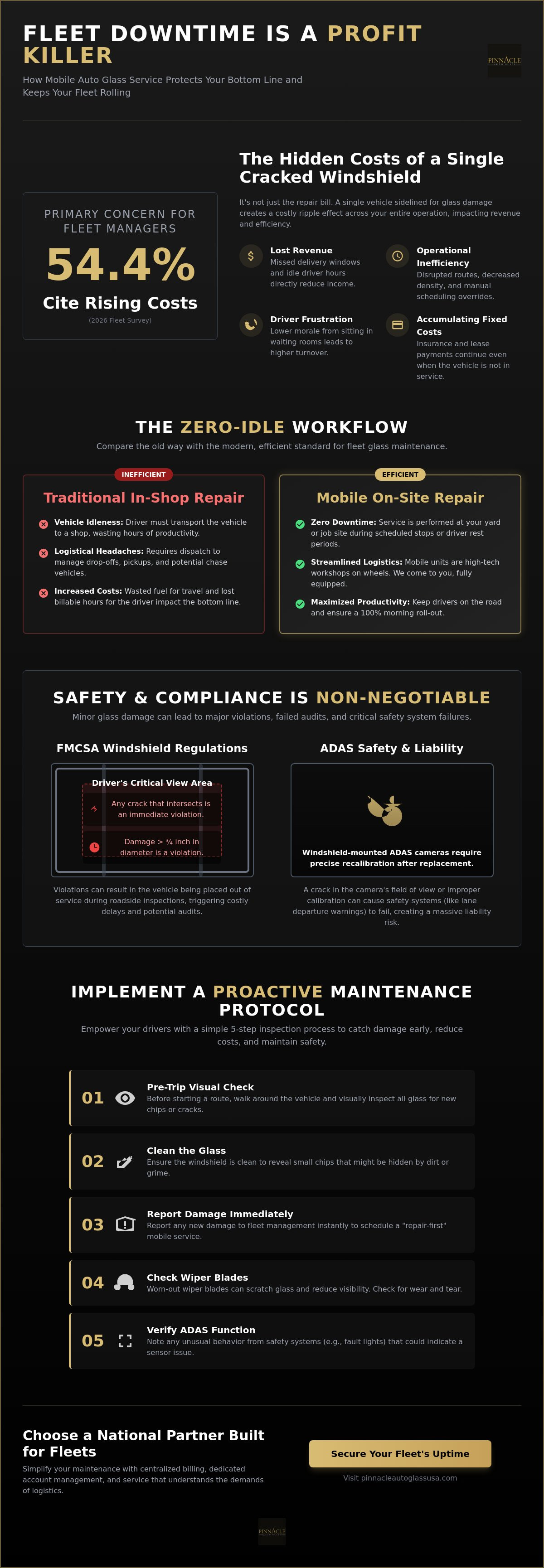
A 2026 survey found that 54.4% of fleet managers cite rising costs as their primary concern. One of the most persistent drains on your budget isn't just the repair bill itself. It's the lost revenue from idle vehicles. You shouldn't have to choose between safety and productivity. By reducing fleet downtime with mobile glass repair, you can keep your drivers on the road while maintaining the highest safety standards. Our mobile units bring expert care directly to your yard or job site. This turns a day-long logistics headache into a brief, manageable pause.
We understand that managing a modern fleet involves more than just fixing cracks. It's about navigating complex FMCSA regulations and ensuring that advanced safety sensors remain perfectly calibrated. This guide shows how mobile auto glass services eliminate operational delays and protect your bottom line through proactive maintenance. We'll preview how zero-disruption repair cycles and simplified reporting can transform your operations. You will also learn how to maintain ADAS safety compliance to mitigate liability risks in an increasingly automated industry.
Key Takeaways
- Identify the hidden operational costs of vehicle idleness and learn how to avoid FMCSA safety audits triggered by minor glass damage.
- Discover the "zero-idle" workflow for reducing fleet downtime with mobile glass repair, keeping your commercial trucks on the road without logistical delays.
- Understand why mobile ADAS recalibration is non-negotiable for 2026 fleet models to ensure safety systems like lane departure warnings remain compliant.
- Establish criteria for selecting a national glass partner that offers centralized billing and dedicated account management for large-scale fleets.
- Implement a 5-step driver inspection protocol and a "repair-first" philosophy to catch minor damage early and protect your maintenance budget.
Calculating the Operational Impact of Fleet Glass Damage
A 2026 survey found that 54.4% of fleet managers cite rising costs as their top concern. One of the most persistent drains on your budget isn't just the repair bill itself. It's the true cost of glass damage, which includes missed delivery windows, disrupted route density, and driver downtime. Reducing fleet downtime with mobile glass repair is a financial strategy, not just a maintenance choice. This is a mistake. When a truck is sidelined, your fixed costs like insurance and lease payments continue to accumulate without any offsetting income.
Ignoring a small chip often leads to a "ripple effect" across your entire logistics chain. If one vehicle is pulled from a route, other drivers must absorb the workload. This decreases route density and increases fuel consumption per stop. It also strains your scheduling software, forcing manual overrides that lead to further delays. Catching damage early prevents these logistical bottlenecks and keeps your delivery promises intact.
The Hidden Expenses of Traditional In-Shop Repair
Traditional shop visits require a driver to transport the vehicle, wait for the service, and return to the route. This wastes fuel and billable hours. If a driver spends several hours managing a glass repair at a facility, those are hours of lost productivity that you can't recover. It also impacts driver morale. Professional drivers prefer being on the road rather than sitting in a waiting room. To further improve the driver experience, you can explore Commercial Window Tinting to reduce glare and heat during shifts. Equipment downtime can lead to frustration and higher turnover rates in a competitive labor market. On-site service eliminates these soft costs by keeping the vehicle where it belongs.
Safety Compliance and Risk Management for Fleets
Safety isn't just about the driver's view. Modern windshields are integral to the vehicle's design. They provide significant structural integrity during a rollover. A compromised windshield is a major liability. It can also lead to expensive legal issues and safety audits. The FMCSA prohibits any windshield damage larger than 3/4 inch in diameter within the area swept by the wipers. Cracks that intersect are also immediate violations that can result in a vehicle being placed out of service during a roadside inspection.
Modern fleets also rely heavily on Advanced Driver-Assistance Systems (ADAS). These technologies use cameras mounted behind the glass to monitor the road. If a crack appears in the camera's field of vision, the system may malfunction. This creates a massive liability risk if an accident occurs. Consistent maintenance of your commercial truck glass ensures you pass annual inspections and stay compliant with ever-tightening federal safety standards.
Why Mobile Glass Repair is the Standard for Modern Logistics
Mobile glass repair has evolved into a critical logistical tool for the 2026 transportation industry. The process begins with a streamlined dispatch system that coordinates technician arrival with your fleet's existing downtime. Once on-site, technicians handle everything from minor chip repairs to complex commercial truck glass replacements. This workflow removes the logistical burden from your dispatchers. By reducing fleet downtime with mobile glass repair, you ensure that essential maintenance happens while vehicles are already stationary for loading or driver rest.
Modern mobile units are essentially high-tech workshops on wheels. They carry specialized lifting equipment for oversized heavy-duty windshields and industrial-grade adhesives that meet strict safety standards. This capability allows for the same level of precision found in a static facility but delivered directly to your yard or job site. The integrity of the vehicle is preserved through the use of precision setting tools that ensure a perfect seal every time, protecting the cab from leaks and wind noise.
On-Site Efficiency and Yard Management
Effective fleet management relies on maximizing "yard time." This is the period when vehicles are parked between shifts or during mandatory driver rest periods. Coordinating glass services during these windows aligns with federal best practices for fleet management by optimizing asset utilization and reducing empty miles. A single mobile technician can service multiple vehicles in one visit. This efficiency eliminates the need for "chase vehicles" or secondary drivers to shuttle trucks to a repair shop. You maintain a 100% morning roll-out because the work is completed before the first key turn of the day.
Maintaining Professional Standards in the Field
Professional field service requires more than just a basic toolkit. We utilize high-quality, fast-curing resins and OEM-equivalent glass to ensure every installation meets original structural specifications. Specialized weather-shielding techniques allow technicians to maintain a controlled environment even in outdoor settings. This ensures that the urethane bonds correctly regardless of the humidity or temperature. Mobile glass repair is a specialized logistical service designed to integrate seamlessly into complex supply chain operations rather than a simple mechanical fix. If you need to streamline your maintenance schedule and protect your equipment, partnering with a dedicated fleet glass services provider is the most efficient path forward. This proactive approach keeps your drivers focused on the road and your cargo moving on schedule.
Integrating ADAS Recalibration into Mobile Fleet Maintenance
By 2026, the complexity of commercial vehicle safety systems has reached a peak. Most new fleet models come standard with sophisticated camera and sensor arrays. These systems assist with lane keeping and emergency braking. Because these sensors are often mounted directly behind the windshield, a simple glass replacement is no longer a standalone task. For modern fleets, ADAS calibration auto glass services are essential to restore vehicle functionality. Reducing fleet downtime with mobile glass repair now requires a provider who can handle both the physical glass and the digital calibration in a single visit.
Recalibration generally falls into two categories: static and dynamic. Static calibration involves a fixed environment with specialized targets. Dynamic calibration requires the technician to drive the vehicle at specific speeds under certain road conditions. Many commercial trucks require a combination of both to ensure the forward collision warning and lane departure systems are accurate. If the camera is off by even a fraction of a degree, the safety system could fail to activate or trigger a "ghost" braking event. This is why professional recalibration is a non-negotiable step in the repair cycle.
The Role of Safety Systems in Fleet Liability
Ignoring recalibration creates a massive liability gap. If a fleet vehicle is involved in an accident, insurance adjusters and legal teams often examine the vehicle's maintenance logs. They look for proof that all safety systems were functional. ADAS data is increasingly used in accident reconstruction. If you skipped a calibration after a windshield swap, your organization could be held liable for system failure. To help navigate these complex liability issues and protect your business interests, firms like Matthew Fornaro, P.A. provide specialized legal counsel on business law and risk management. The cost of a professional recalibration is negligible compared to the potential legal and insurance fallout from an uncalibrated safety system. It's a critical investment in risk management.
Mobile Recalibration: Technology Meets Convenience
On-site recalibration requires specialized diagnostic tools and alignment targets. Our mobile units are equipped with the latest software to interface with various vehicle makes and models. Technicians must follow a strict protocol to ensure the sensors are aligned to the manufacturer's exact specifications. Once the process is finished, we provide a digital certificate of completion. This documentation is vital for your fleet maintenance records and helps prove compliance during safety audits. It ensures that reducing fleet downtime with mobile glass repair doesn't come at the expense of driver safety or regulatory standing. You get a fully functional vehicle back on the road without the need for a secondary trip to a dealership.
Selecting a National Partner for Fleet Glass Maintenance
Scaling a fleet operation requires more than just reactive fixes from local shops. You need a strategic partner that understands the specific demands of high-volume logistics. Reducing fleet downtime with mobile glass repair is only effective if your provider can deliver consistent quality across your entire service area. Evaluating an auto glass service provider involves looking beyond the price tag. You must prioritize reliability, technical range, and administrative efficiency. A partner capable of handling everything from standard delivery vans to complex semi truck windshield replacement ensures that your entire fleet remains operational under one maintenance umbrella.
Consistency is the hallmark of a professional partnership. When your vehicles are spread across different regions, you can't afford variations in service quality. A national provider ensures that the same safety standards and technical protocols are followed at every location. This uniformity simplifies your management tasks. It also gives you peace of mind that every vehicle in your fleet meets your organization's safety requirements, regardless of where the repair takes place.
Certification and Technical Expertise Standards
Technical skill is the foundation of vehicle safety. You should always demand that your provider employs technicians certified by the Auto Glass Safety Council (AGSC). Knowing that a certified auto glass technician is performing the work is vital for preserving vehicle warranties and ensuring structural integrity. Commercial and heavy-duty glass requires specialized handling that differs significantly from passenger vehicles. A qualified partner will have a documented history of working with large-scale fleets. They should offer both repair and replacement capabilities to provide the most cost-effective solution for every situation. This versatility prevents unnecessary replacements when a high-quality resin repair is sufficient.
Streamlined Logistics and Account Reporting
Managing a large fleet involves a significant amount of paperwork. A national partner simplifies this through centralized billing and electronic invoicing. This allows your accounting department to process payments for multiple locations through a single portal. You should look for features like fleet-wide maintenance tracking and customized scheduling portals for your dispatchers. These tools provide real-time visibility into which vehicles are serviced and when. Consistent pricing and service quality across your national footprint are essential for predictable budgeting. If you are ready to optimize your maintenance workflow and protect your bottom line, it's time to partner with a professional fleet glass services provider today. This transition moves your maintenance from a series of emergencies to a streamlined, predictable process.
Developing a Proactive Fleet Glass Maintenance Protocol
Transitioning from reactive repairs to a proactive strategy is the most effective way of reducing fleet downtime with mobile glass repair. A structured protocol ensures that minor issues are caught before they escalate into expensive replacements or safety violations. We recommend implementing a 5-step daily inspection for every driver to maintain equipment standards. This routine turns your team into the first line of defense against operational delays.
- Conduct a perimeter walk-around to check for fresh impact points.
- Inspect the primary wiper sweep area for small chips or pits.
- Verify the ADAS camera window is clear of debris or cracks.
- Check the windshield edges for stress fractures near the seal.
- Record all findings in the vehicle's digital log immediately.
This simple routine allows you to utilize a repair-first approach. Catching a chip early saves a significant portion of your maintenance budget and keeps the original factory seal intact. It also prevents the "temperature shock" effect. This occurs when a tiny chip turns into a full-width crack during overnight cold snaps or intense afternoon sun. By fixing these issues on-site during scheduled yard time, you avoid the need for emergency road calls that disrupt your delivery windows.
Driver Training and Early Detection
Training your team to distinguish between repairable damage and immediate replacement needs is vital. A chip smaller than a quarter can usually be filled on-site in under 30 minutes. If drivers ignore these spots, they risk a road call that takes the vehicle out of service for hours. Your protocol should include an emergency response plan that identifies exactly who to call when a crack occurs on the road. Drivers must also be trained to recognize ADAS warning lights on the dashboard. If a safety sensor detects an obstruction after an impact, the vehicle shouldn't be operated until a technician verifies the system. This proactive detection reduces liability and keeps your insurance premiums stable.
Implementing the Pinnacle Fleet Solution
Modern logistics require integrated solutions that fit into your digital workflow. You can easily incorporate Pinnacle Auto Glass into your existing maintenance software. This integration allows for automated scheduling and real-time repair tracking across your entire organization. For larger operations, we recommend scheduling periodic "fleet sweeps." During these sessions, our technicians visit your yard to inspect and repair all non-urgent glass issues across every parked vehicle at once. This maximizes efficiency and ensures that reducing fleet downtime with mobile glass repair becomes a standard part of your operational rhythm. Take the next step by contacting a fleet specialist to design a customized service plan today. Our goal is to keep your cargo moving and your drivers safe through expert, on-site care.
Optimizing Your Fleet Operations for 2026
Modern fleet management requires a shift from reactive fixes to strategic maintenance. You've seen how minor glass damage can spiral into FMCSA violations and revenue loss. By implementing proactive driver inspections and reducing fleet downtime with mobile glass repair, you keep your vehicles earning instead of idling. This approach ensures your safety systems remain compliant through precise ADAS recalibration while protecting your bottom line from the hidden costs of traditional shop visits. It's about turning a maintenance hurdle into a competitive advantage.
Success in a competitive logistics landscape depends on reliable partnerships. We provide the expertise needed to manage complex glass requirements across your entire operation. Our team offers specialized commercial glass technicians and mobile ADAS recalibration capabilities to handle any vehicle in your inventory. With a national service footprint, we're ready to support your growth and simplify your maintenance workflow. Streamline your fleet maintenance with Pinnacle Auto Glass fleet solutions today. Your fleet's efficiency is our priority, and we're ready to help you stay ahead of the curve.
Frequently Asked Questions
How quickly can a mobile glass technician respond to a fleet vehicle on-site?
Response times depend on current dispatch volume and technician location at the time of your request. Most mobile units aim to service fleet vehicles during their next scheduled yard time or within one business day. This ensures that maintenance happens during natural pauses in your logistics schedule. By coordinating repairs with your existing downtime, we eliminate the need to pull active vehicles from their assigned routes for simple glass fixes.
Can mobile glass repair units handle large commercial semi-truck windshields?
Yes, specialized mobile units are fully equipped to handle commercial truck glass, including oversized semi-truck windshields. Our technicians use heavy-duty setting tools and high-strength adhesives to ensure proper alignment and seal integrity on large cabs. This capability allows for comprehensive fleet maintenance without requiring your trucks to visit a physical shop. We bring the workshop to your yard, ensuring your heavy equipment stays on site and ready for the next shift.
Is ADAS recalibration included in mobile fleet windshield replacement services?
ADAS recalibration is a standard component of our mobile fleet windshield replacement services for vehicles with safety sensors. Our technicians perform both static and dynamic recalibrations on-site to ensure forward collision and lane departure systems are fully functional. This is a critical step in reducing fleet downtime with mobile glass repair while maintaining safety compliance. We provide a digital certificate of completion for your maintenance logs to prove every vehicle meets safety standards.
What is the maximum chip size that can be repaired on a fleet vehicle?
The FMCSA prohibits any windshield damage larger than 3/4 inch in diameter within the area swept by the wipers. Generally, chips smaller than a quarter can be repaired if they aren't in the driver's line of sight or near the glass edge. Catching these early prevents the need for a full replacement. This repair-first philosophy is a key strategy for reducing fleet downtime with mobile glass repair and saving maintenance costs.
Does mobile glass repair work in rain or extreme temperatures?
Mobile glass repair can be performed in various conditions using specialized weather-shielding and moisture-wicking techniques. Technicians use industrial-grade resins designed to bond effectively in high humidity or extreme temperatures. If the weather is too severe to guarantee a safe and permanent seal, we'll coordinate a reschedule for the next clear window. Our priority is always the safety and structural integrity of your vehicle, regardless of the service location.
How does centralized billing work for national fleet accounts?
Centralized billing consolidates all service invoices from multiple fleet locations into a single, organized account. Fleet managers receive comprehensive digital reports that simplify accounting and maintenance tracking across a national footprint. This system reduces administrative overhead for your dispatchers and ensures consistent pricing for every vehicle in your inventory. You get a clear view of your maintenance spend without the hassle of managing dozens of individual vendor relationships or separate paper invoices.
Will mobile windshield replacement affect my vehicle's manufacturer warranty?
Professional mobile windshield replacement doesn't void your vehicle's manufacturer warranty when performed to OEM standards. We use high-quality, OEM-equivalent glass and AGSC-certified technicians to ensure the structural integrity of your fleet vehicles remains intact. Following these industry-standard protocols protects your long-term asset value and ensures every repair meets the original factory specifications. You can maintain your fleet with confidence, knowing that your warranty and safety standards are fully preserved.
How long must a fleet vehicle remain stationary after a mobile glass replacement?
Most fleet vehicles must remain stationary for approximately 30 to 60 minutes after a windshield replacement. This "Safe Drive Away Time" allows the high-strength urethane adhesive to cure sufficiently to hold the glass in place during an impact or rollover. Technicians will provide a specific departure time based on the humidity and temperature at your site. Following this pause is essential for driver safety and the long-term durability of the glass seal.


