Is your windshield just a piece of glass, or is it the only thing keeping your safety sensors from failing in a crisis? Modern vehicles rely on the glass to support the roof during a rollover and to house the cameras that power your emergency braking. When you need a repair, hiring a certified auto glass technician is the only way to ensure these systems remain reliable. You might feel confused by the wide range of price points in the market. It's natural to worry that a lower quote could lead to leaks or safety failures, especially since AAA research shows ADAS-related repairs can add up to 37% to total collision costs.
This guide explains why professional certification is a non-negotiable requirement for modern car owners. You'll discover how experts maintain your vehicle's structural integrity and ensure your safety systems function perfectly. We'll cover the latest industry standards, the risks of poor workmanship, and how to verify a technician's credentials so you can ensure your car is safe for your family or employees.
Key Takeaways
- Modern windshields provide up to 60% of a vehicle's structural integrity during a rollover, making proper installation vital for occupant safety.
- A certified auto glass technician ensures that your ADAS cameras and sensors are correctly mounted and calibrated to maintain features like automatic braking.
- Learn how the latest ANSI/AGSC/AGRSS 005-2022 standards govern the materials and adhesive chemistry used during your replacement.
- Understand the real-world risks of poor workmanship, including failed airbag deployment and compromised adhesive bonds that lead to leaks.
- Discover the specific questions you should ask a service provider to verify their professional credentials before booking a replacement.
The Evolution of Automotive Glass and Modern Safety Systems
Automotive glass technology has moved far beyond simple weather protection. In the past, glass was a passive shield. Today, it is a sophisticated safety component integrated into the vehicle's structural and electronic systems. Treating a windshield as "just glass" is a dangerous mistake. Modern vehicles rely on the glass to maintain their shape during accidents and to provide a clear "eye" for safety computers. If the installation is flawed, the entire safety network of the car is compromised.
Windshields as Structural Components
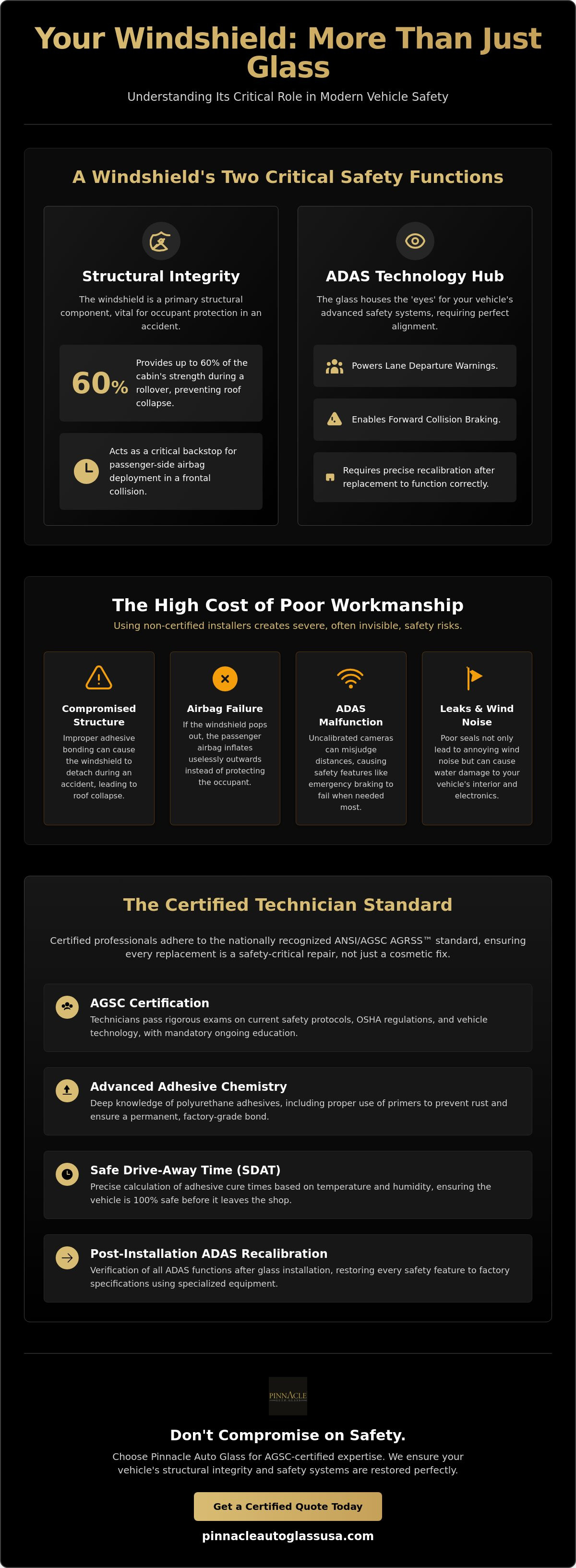
Your windshield is a primary structural element. During a rollover accident, the glass provides up to 60% of the cabin's structural integrity. It prevents the roof from collapsing and protects the occupants inside. Beyond roof support, the glass serves as the essential backstop for the passenger-side airbag. If the glass fails to stay in place during a collision, the airbag won't deploy toward the passenger. It will simply fire out through the empty frame, leaving the occupant unprotected.
This structural strength depends entirely on the bond between the glass and the vehicle frame. Experts use high-grade polyurethane adhesives to ensure the laminated safety glass meets Federal Motor Vehicle Safety Standards for retention. A professional windshield replacement is a complex mechanical repair. It requires specific cure times and precise application techniques that go far beyond a cosmetic fix.
The Integration of ADAS Technology
Advanced Driver Assistance Systems (ADAS) have fundamentally changed the role of the glass. Windshields now serve as the mounting point for forward-facing cameras and sensors. These systems power critical features like Lane Departure Warning and Forward Collision Braking. These cameras require absolute clarity and perfect alignment to function. A camera that's misaligned by even a fraction of a millimeter can miscalculate the distance to the car ahead by several feet. This can result in delayed braking or unexpected system failures.
A certified auto glass technician understands these technical requirements. They know that a replacement isn't finished until the ADAS features are recalibrated. Uncertified installers often skip this step because they lack the specialized equipment or training. This negligence leaves your safety sensors blind. When you work with a certified auto glass technician, you ensure that every safety feature is restored to factory specifications. This precision is vital for your safety on the road.
What Defines a Certified Auto Glass Technician in 2026?
A certified auto glass technician is a specialist who has demonstrated mastery through rigorous, standardized testing. In 2026, this designation means the individual has successfully passed the AGSC certification examination. This exam isn't a one-time hurdle. It requires professionals to prove their knowledge of current safety protocols, OSHA regulations, and advanced vehicle technologies. Ongoing education is mandatory. Technicians must stay current as vehicle manufacturers introduce new materials and sensor configurations every year.
True certification goes beyond basic mechanical skills. It requires a deep understanding of adhesive chemistry. Technicians must know how specific urethanes react to different weather conditions. They also calculate precise Safe Drive Away Times (SDAT). This calculation ensures the vehicle is safe to operate before the customer leaves the shop. Without this expertise, the glass might appear secure while failing to provide structural support during a collision. It's the difference between a cosmetic fix and a safety-critical repair.
Understanding AGSC and ANSI Standards
The Auto Glass Safety Council (AGSC) maintains the Automotive Glass Replacement Safety Standard (AGRSS). This is the only nationally recognized safety standard for the industry. Because it's developed under the American National Standards Institute (ANSI), it remains unbiased and focused solely on consumer protection. These standards dictate specific steps for every installation:
- Mandatory use of specific primers to prevent rust and ensure a permanent bond.
- Strict adherence to temperature and humidity requirements during the curing process.
- Detailed documentation of all materials used for safety traceability.
- Verification of ADAS functionality after the glass is set in the frame.
Master vs. General Technician Designations
The industry recognizes different tiers of expertise. A General Technician has passed the core competency tests. They understand the fundamentals of safe installation and current vehicle safety standards. However, a Master Technician represents a higher level of commitment. This designation requires at least nine years of experience in the field. Master Technicians are often the preferred choice for complex luxury vehicles or large commercial fleets. Their deep technical background allows them to handle intricate sensor arrays and specialized glass types that generalists might find challenging.
It's important to distinguish between "qualified" and "certified" professionals. A technician might be qualified by passing an exam, but a certified auto glass technician typically works for a company that undergoes independent, third-party audits. These audits verify that the shop actually follows the safety standards they claim to uphold. If you're looking for this level of verified safety, you should work with a provider that prioritizes these high industry standards. This ensures your vehicle remains a safe environment for your family or employees.
The Real-World Risks of Using Non-Certified Specialists
Choosing a low-cost, uncertified installer often leads to hidden costs that surface weeks or months later. While a water leak or annoying wind noise is frustrating, the invisible failures are far more dangerous. Non-certified workers frequently rush the process to save time. This haste compromises the chemical bond between the glass and the frame. Beyond safety, there is a significant financial liability. Insurance companies are increasingly strict about documentation. If a future claim involves a failed windshield that was installed by an uncertified shop, the insurer may deny coverage for the damage.
Compromised Structural Integrity
Improper removal of the old glass is a common error among untrained workers. If an installer scratches the metal frame, known as the pinchweld, and fails to apply specialized corrosion primers, "rust jacking" occurs. Over time, rust grows under the seal. This lifts the glass and creates gaps that compromise the vehicle's crumple zones. These zones are designed to absorb energy during a head-on collision. If the bond is weak, the vehicle cannot manage the impact forces as intended by the manufacturer. A certified auto glass technician follows strict protocols to prevent this corrosion. Safe Drive-Away Time (SDAT) is the specific duration required for the adhesive to cure enough to meet federal safety standards for windshield retention during an accident.
ADAS Misalignment and Sensor Failure
Modern safety systems demand extreme precision. A camera tilted by only one degree can result in a 50-foot tracking error on the road. This inaccuracy leads to "ghost braking," where the car slams on the brakes for non-existent obstacles. Many discount installers lack the expensive diagnostic tools required for ADAS calibration auto glass services. Even when you are opting for mobile glass repair, you must ensure the provider has a verified plan for recalibration. Without this step, your lane-keeping and emergency braking features may fail when you need them most.
Hiring a certified auto glass technician eliminates these variables. These professionals are trained to use the correct primers and urethane types for your specific vehicle model. This high level of expertise is why the requirement of AGSC membership includes mandatory certification for all technicians. It provides a layer of accountability that protects your vehicle and your family from avoidable mechanical failures.
How to Verify Professional Auto Glass Specialists Before Booking
Do not assume every shop with a sign is qualified. You must take an active role in verifying credentials. A certified auto glass technician should be able to provide their individual certification number and its expiration date upon request. This number proves they have passed the necessary safety exams. You should also confirm that the facility adheres to the ANSI/AGSC/AGRSS 005-2022 standard. This represents the most current industry benchmark for safety and quality as of June 2026. Following these standards is the only way to ensure your vehicle's structural integrity is maintained.
Ask about the specific materials they use. High-quality shops use premium polyurethane adhesives and can tell you exactly which brand they apply. They must also define the required cure time for that specific product. If a shop cannot provide a clear Safe Drive-Away Time, they are ignoring critical safety data. Finally, ensure your quote includes a comprehensive ADAS recalibration report. This document proves that your safety cameras were tested and aligned to factory specifications after the glass was set. Without this report, you have no proof that your safety sensors are actually working.
Key Questions to Ask Your Service Provider
Before you hand over your keys, ask these three direct questions to gauge the shop's competence:
- "Do you provide a written warranty on both parts and labor?" A reputable provider stands behind their work in writing.
- "Will you perform a static or dynamic recalibration after the install?" The answer depends on your vehicle's specific requirements, but the technician must know the correct procedure for your model.
- "Do your technicians participate in continuing education for new vehicle models?" Technical requirements change fast. Your installer must keep their skills current to handle the latest glass technologies.
Checking Insurance and Liability Credentials
Certification often dictates how insurance companies view a service provider. A shop employing a certified auto glass technician is much more likely to be an approved vendor for major insurance carriers. This simplifies the billing process and ensures the repair meets insurer standards. Beyond certification, verify that the company carries garage keepers and liability insurance. This protects you in the rare event of damage occurring while the vehicle is in their care. It also signals that the business is stable and professional.
Always demand a post-installation checklist for your records. This record should detail the technician’s name, the adhesive used, and the ADAS calibration results. If you want to ensure your vehicle meets these high safety standards, contact Pinnacle Auto Glass for a professional consultation. Getting the job done right the first time protects both your vehicle's value and your passengers' safety.
Choosing Pinnacle Auto Glass for Certified Expertise and Safety
Pinnacle Auto Glass simplifies the complexities of modern vehicle maintenance by prioritizing technical precision. Our team consists of highly trained auto glass specialists who treat every installation as a critical safety event. Every certified auto glass technician on our staff understands that a windshield is a structural component, not a simple accessory. We don't use generic or sub-standard materials. We utilize OEM-quality glass and industry-leading adhesives to ensure your vehicle returns to its factory-specified strength and clarity.
Efficiency shouldn't come at the expense of safety. We offer comprehensive mobile and in-shop services designed to minimize your downtime without skipping essential steps. Our workflow provides a seamless integration of windshield replacement and ADAS recalibration in a single appointment. This eliminated the need for secondary trips to a dealership. By handling the glass and the electronics simultaneously, we ensure your safety sensors are fully functional the moment you drive away. This integrated approach is why fleet managers and individual car owners trust our expertise.
Our Commitment to Rigorous Safety Standards
We believe that industry certification is the baseline, not the ceiling. Our internal training programs exceed basic requirements to keep our team at the forefront of automotive technology. We maintain a strict focus on precision to prevent long-term issues like rust, wind noise, or water leaks. Safety remains our primary metric for success. We enforce strict adherence to Safe Drive-Away Times for every adhesive we use. This protects every passenger by ensuring the bond is fully cured and capable of supporting the roof and airbags during an impact.
Nationwide Solutions for Personal and Fleet Vehicles
Our service model provides consistent quality standards across all service areas. Whether you manage a single family car or a massive logistics network, you receive the same level of professional attention. We offer specialized expertise for commercial truck glass and heavy-duty logistics fleets. These larger vehicles require specific technical knowledge and heavy-duty materials that general shops often can't provide. Our technicians are equipped to handle the unique challenges of fleet glass services with speed and accuracy.
Don't leave your vehicle's structural integrity to chance. Working with a certified auto glass technician is the only way to guarantee that your modern safety systems will perform when you need them most. Our team is ready to provide the reliable, high-quality results you expect. Contact Pinnacle Auto Glass today for a quote from a certified professional and ensure your vehicle is safe for the road ahead.
Secure Your Vehicle with Professional Glass Installation
Modern windshields are no longer passive components. They are active safety devices that support the vehicle frame and house critical sensor technology. Choosing a professional ensures your structural integrity remains intact and your ADAS features function exactly as the manufacturer intended. A certified auto glass technician possesses the specialized training to manage these high-stakes repairs without compromising occupant safety.
Pinnacle Auto Glass provides the technical expertise required for both personal vehicles and complex commercial operations. We are certified ADAS recalibration experts who utilize OEM-quality glass and high-grade adhesives to restore every car to factory standards. Our team offers professional fleet and commercial services to keep your business moving safely. Get a Quote from a Certified Specialist at Pinnacle Auto Glass today to secure your vehicle. Drive with confidence knowing your repair was completed by a professional who prioritizes quality and reliability. We are ready to assist you with all your auto glass needs.
Frequently Asked Questions
Is it illegal to have an uncertified technician replace my windshield?
It isn't illegal in most jurisdictions to hire an uncertified individual, but it's a significant risk to your vehicle's safety and your insurance coverage. Some states, like New York and Massachusetts, have recently introduced stricter regulations regarding ADAS notifications and safety standards. While you won't face criminal charges, using an uncertified shop can leave you liable for safety failures or lead to denied insurance claims if the installation doesn't meet federal standards.
How can I tell if an auto glass technician is actually certified?
You can verify a technician's status by asking for their official certification ID card or checking the Auto Glass Safety Council (AGSC) online database. A legitimate professional will have a unique certification number and an expiration date for their credentials. They should also be able to explain their adherence to the latest ANSI/AGSC/AGRSS 005-2022 standards. If a shop is hesitant to provide this information, it's a clear signal to look elsewhere.
Does auto insurance require me to use a certified glass shop?
Many insurance providers recommend or require shops that employ a certified auto glass technician to ensure the repair meets federal safety standards. While you usually have the right to choose your service provider, insurers often prefer "approved vendors" who provide documented proof of their work. Using an uncertified shop might complicate your reimbursement process, especially for complex tasks like ADAS recalibration that require specialized equipment and training.
What is the difference between a licensed technician and a certified one?
A license is a basic business requirement to operate, while certification is a mark of technical expertise and safety knowledge. Licensing doesn't guarantee that an installer knows how to handle adhesive chemistry or sensor alignment. Certification requires passing rigorous exams on structural physics and current safety protocols. It proves the technician has the skills to maintain your vehicle's integrity during a rollover or airbag deployment.
How long does it take for a certified technician to complete a replacement?
The installation process usually takes about an hour, but you must also account for the Safe Drive-Away Time (SDAT). This is the time required for the adhesive to cure enough to meet federal safety standards. A professional will calculate this time based on the specific urethane used and the current weather conditions. You should never drive the vehicle before the technician confirms the bond is strong enough to support the roof and airbags.
Can a certified technician perform mobile windshield repairs?
Certified professionals can perform many services via mobile units, provided the environment allows for a safe installation. A certified auto glass technician will evaluate the weather and site conditions to ensure the adhesive cures correctly. However, some advanced safety systems require a controlled shop environment for static recalibration. A reputable specialist will always tell you if your specific vehicle needs to be serviced in a shop for maximum safety.
Why do certified technicians insist on ADAS recalibration?
Recalibration is mandatory because the glass serves as the mounting platform for your car's safety "eyes." Even a tiny misalignment during a windshield replacement can cause features like emergency braking or lane-keep assist to fail. Certified technicians follow manufacturer mandates to ensure these sensors are perfectly aligned. They understand that skipping this step leaves the driver at risk of "ghost braking" or other dangerous system errors on the road.
Does certification cover both windshield repair and full replacement?
Yes, professional certification encompasses the standards for both minor repairs and full glass replacements. Technicians are trained to identify when a chip can be safely filled and when the damage is too extensive to maintain structural integrity. This training ensures that every job, no matter how small, meets the same rigorous quality standards. It gives you peace of mind that your repair won't compromise the glass's strength over time.


