An estimated 88% of vehicles that require ADAS recalibration after a repair never actually receive it. This startling 2026 market statistic means thousands of cars are currently operating with misaligned safety sensors. It's frustrating when a standard windshield replacement turns into a complex technical procedure. You're likely facing unexpected costs and confusing jargon while worrying if your emergency braking will function correctly in a crisis.
This guide clarifies the critical relationship between ADAS calibration auto glass and your personal safety. You'll understand why recalibration isn't just a digital update. It's a mandatory physical alignment of safety geometry that protects lives. This process is now a legal requirement in states like New York and Arizona to ensure every repair meets strict manufacturer standards. We've entered an era where your windshield is a sophisticated safety component, not just a piece of glass.
We'll provide a clear breakdown of the 2026 calibration standards and the specific steps needed to validate your vehicle's safety systems. You'll gain the confidence to handle insurance requirements and the peace of mind that comes from a professional, precise recalibration. We move quickly from identifying the need to providing a clear path forward for your vehicle's integrity.
Key Takeaways
- Understand the physical connection between your windshield and the advanced sensors that power your vehicle's safety features.
- Discover why even a one-degree shift in ADAS calibration auto glass results in significant "projection errors" that compromise emergency braking.
- Learn to distinguish between static recalibration performed in a controlled environment and dynamic recalibration conducted on the road.
- Prepare for your service with a checklist of essential requirements, including fuel levels, tire pressure, and cargo weight.
- Recognize the importance of using high-quality glass to maintain the transparency and accuracy of your vehicle's safety cameras.
What is ADAS Calibration in Auto Glass?
Modern vehicles are essentially high-performance computers on wheels. At the heart of this technology is a network of sensors, cameras, and radar units known as Advanced Driver-Assistance Systems (ADAS). These systems provide a safety net for drivers by monitoring the road and intervening when necessary. When we discuss ADAS calibration auto glass, we're referring to the precise alignment of these safety components after a windshield replacement or repair.
The physical connection is straightforward but critical. Most forward-facing cameras are mounted directly to a bracket on the interior of the windshield. These cameras are the primary input for systems like Lane Keep Assist and Forward Collision Warning. Because the camera looks through the glass, its alignment is entirely dependent on the position and quality of that glass. Even a microscopic shift in the camera's angle can lead to significant errors in how the vehicle interprets the road.
It's helpful to distinguish between two key terms used in the automotive glass industry:
- Calibration: The initial programming and alignment of safety systems performed by the manufacturer on the assembly line.
- Recalibration: The process of testing and resetting these systems after a repair or glass replacement to ensure they meet original factory specifications.
The Role of the Windshield in Modern Vehicle Safety
Think of your windshield as the "eye" for your car's computer. For these safety systems to function, the glass must offer perfect optical purity. Any distortion or ripple in the glass can confuse the camera, leading to delayed reactions or false alerts. Sensor performance relies heavily on glass clarity. This is why even a minor chip or crack in the camera's field of vision is a serious safety concern. It doesn't just weaken the glass; it blinds your safety systems. High-quality glass ensures the camera has a clear, unobstructed view of the road ahead.
Common ADAS Features Linked to Your Glass
Your vehicle's glass is the primary interface for several life-saving technologies. These features work in tandem to prevent accidents and protect passengers:
- Automatic Emergency Braking (AEB): This system relies on visual data to detect pedestrians or stopped vehicles. If the camera is misaligned, the car might not brake in time during an emergency.
- Lane Departure Warning: Cameras track painted road markings through the glass. If the camera can't "see" clearly, it can't warn you when you drift out of your lane.
- Adaptive Cruise Control: This feature creates a synergy between radar and windshield-mounted cameras to maintain safe following distances from other vehicles.
The Science of Misalignment: Why Every Millimeter Matters
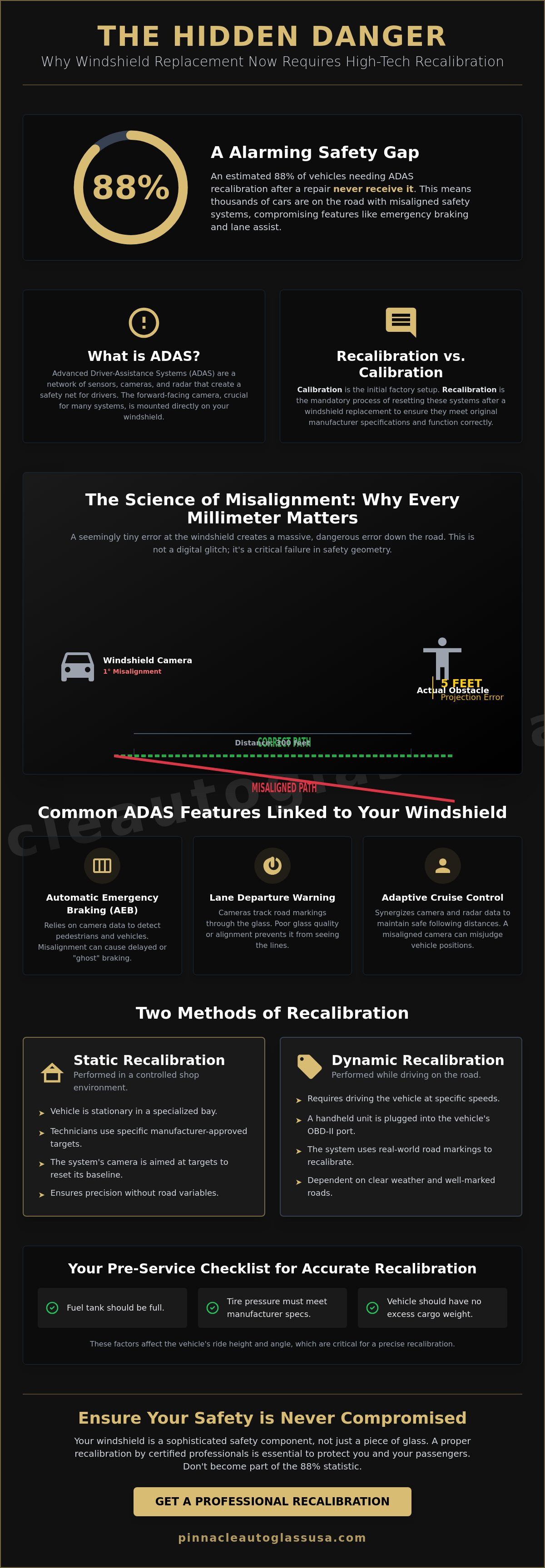
Precision is the foundation of vehicle safety. When a technician performs a windshield replacement, they are moving the mounting point for your car's most sensitive cameras. A 1-degree shift at the windshield bracket might seem insignificant. However, at highway speeds, that tiny angle projects a massive error. If your camera is off by just one degree, its "view" of the car ahead could be shifted by five feet at a distance of 300 feet. This mathematical reality leads to "ghost braking," where the car reacts to an imaginary obstacle, or a complete failure to detect a pedestrian in your path.
Physical mounting is a delicate process. New glass thickness and the specific composition of the laminate affect the camera's height and angle. Even using a different adhesive bead thickness can throw the system out of spec. Many owners believe their car will eventually "learn" or self-calibrate. This is a myth for most Level 2 autonomous vehicles. These systems require a static environment and specific targets to reset their baseline. Professional shops prioritize these measurements because they understand that safety isn't a suggestion. For expert guidance on your next repair, consider a team that specializes in ADAS recalibration.
The Geometry of Forward-Facing Cameras
The CMOS sensor inside your camera calculates distance by measuring the size of objects against fixed focal points. Windshield curvature plays a massive role here. If the new glass has even a slight variation in its curve, it changes how light refracts before reaching the sensor. Optical deviation refers to the bending of light as it passes through the windshield, which can delay AEB response times by several critical milliseconds. The NHTSA on Driver Assistance Technologies emphasizes that these systems are only effective when they operate within precise manufacturer tolerances.
Safety Consequences of Skipping Recalibration
Skipping this step creates a hidden danger. There is a high risk of the lane departure system recalibration failing during a highway drift, leaving you without a warning when you need it most. Many drivers assume that if no warning lights appear on the dashboard, the system is fine. This is a dangerous misconception. A system can be misaligned and still report as "active" because it doesn't know its perspective is skewed. This creates significant liability issues for drivers and fleet owners in the event of an accident.
Static vs. Dynamic Recalibration: Understanding the Methods
Every vehicle manufacturer specifies a precise method for resetting safety systems after a repair. There isn't a one-size-fits-all approach to ADAS calibration auto glass services. Technicians generally use two primary methods: static and dynamic. Static recalibration occurs in a specialized shop environment using physical targets. Dynamic recalibration involves a road test where the vehicle's computer "learns" by observing real-world surroundings. Choosing the correct method depends entirely on the make, model, and year of your vehicle.
Some high-end 2026 models require dual recalibration. This means the car must pass a static test in the service bay before undergoing a dynamic road test. Successful calibration requires a perfect "handshake" between the vehicle's electronic control unit (ECU) and the diagnostic tool. If the environment isn't perfect or the battery voltage fluctuates, the software will reject the calibration entirely. Technicians monitor live data streams during this process to ensure the vehicle's "brain" accepts the new parameters without error.
The Controlled Environment of Static Calibration
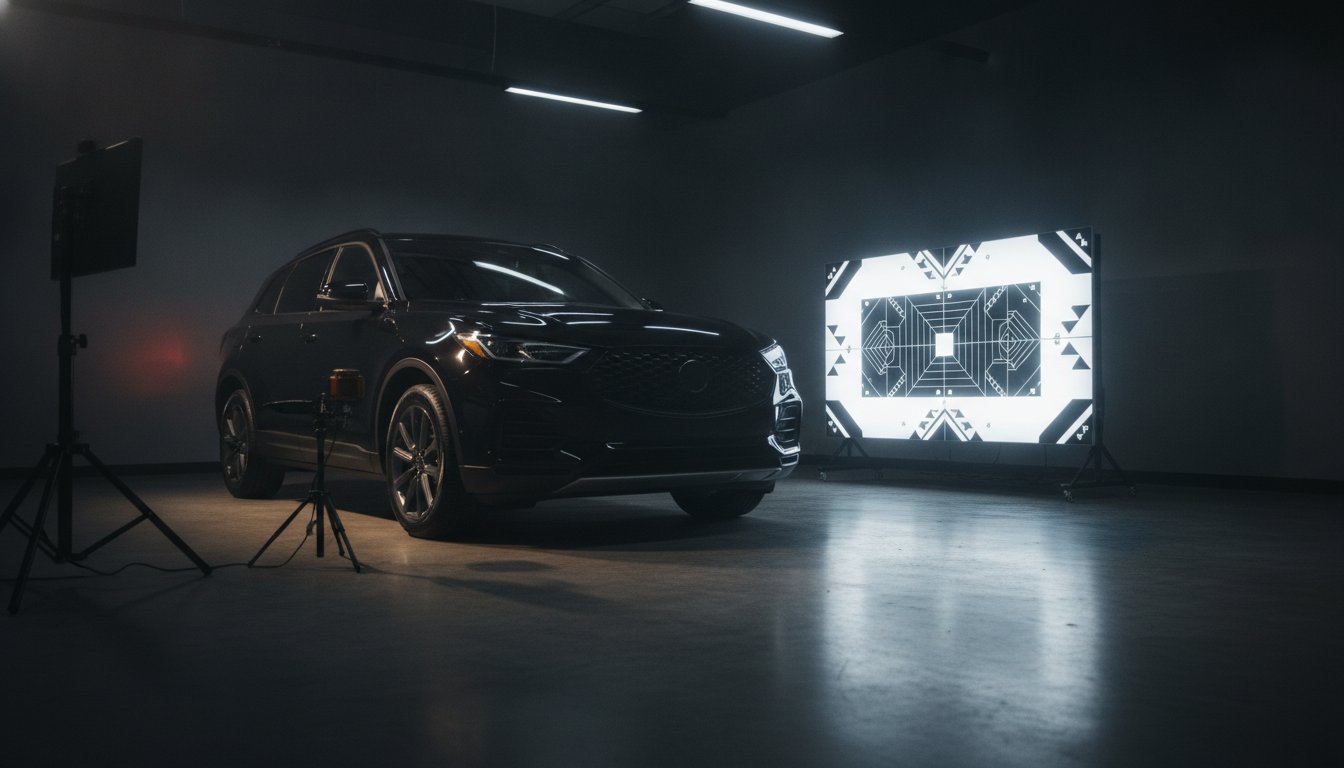
Static calibration is a highly technical process that demands a dedicated space. It requires a perfectly level floor to ensure the vehicle sits at the correct factory height. The shop must have specific, high-output lighting to prevent glare on the camera lens and a neutral background so the sensors don't get distracted by wall clutter. Technicians use laser-guided tools to place physical targets at exact distances from the bumper. This method is preferred for forward collision warning recalibration because it eliminates external road variables. Adhering to the Auto Glass Safety Council ADAS Calibration Checklist ensures every step follows these rigorous safety standards for 2026 vehicles.
The Real-World Testing of Dynamic Calibration
Dynamic calibration takes the technology out onto the pavement to test its performance in live traffic. The technician plugs a handheld diagnostic tool into the OBD-II port and drives the car at specific, sustained speeds. During this drive, the vehicle's computer identifies lane lines, road signs, and other cars to establish a new visual baseline. This process can be challenging because it relies on external factors. Heavy rain, snow, or faded road markings can prevent the system from completing the "learn" cycle. For most 2026 model vehicles, a typical dynamic test drive takes between 15 and 45 minutes depending on traffic density and road conditions.
The Vehicle Owner’s Guide to the Recalibration Process
Preparing your vehicle for an ADAS calibration auto glass service is a shared responsibility between the owner and the technician. To ensure the car sits at the correct factory height, you must arrive with a full fuel tank. Check your tire pressure to ensure it matches the manufacturer's specifications on the door jamb. You should also clear out the trunk to remove heavy items. These steps are vital because the software needs a perfectly balanced vehicle to establish an accurate baseline for its safety sensors.
A professional service always begins with a pre-diagnostic scan. This step identifies any pre-existing fault codes before the glass comes off. It protects you by documenting the state of your vehicle's electronics before the repair begins. The technician then performs the physical glass installation following safe windshield replacement standards. Once the new glass is cured and the calibration is finished, a final "Verification Scan" confirms the system is fully operational. You should receive a certificate of completion. This document is your proof that the vehicle is safe to return to the road.
If you need to restore your vehicle's safety features with expert precision, schedule your windshield replacement and recalibration with our team today.
Insurance and Coverage for ADAS Services
Most comprehensive insurance policies cover ADAS services as part of a glass claim. Because these systems are essential for the vehicle's safety functions, insurers generally recognize the charge as a necessity rather than an upgrade. You should ensure your provider sees the itemized recalibration on the initial estimate. Proper documentation is also helpful for future vehicle resale. A buyer in 2026 will want proof that the safety systems were maintained according to factory standards after any glass work.
What to Ask Your Auto Glass Specialist
You shouldn't hesitate to vet the shop handling your safety. Ask if their technicians are certified in ADAS procedures and what specific diagnostic tools they use. A reputable shop will always provide a post-calibration report for your records. It's also important to understand the total timeline for ADAS recalibration after windshield replacement. While a standard glass swap might take an hour, the calibration process adds significant time to the appointment. Planning for this extra time ensures the work isn't rushed and your safety isn't compromised.
Pinnacle Auto Glass: Professional Integrity in ADAS Safety
Pinnacle Auto Glass maintains a strict commitment to restoring every vehicle to its exact OEM safety specifications. We recognize that ADAS calibration auto glass is not an optional add-on. It's a critical safety requirement. Our process starts with high-quality glass selection. We use materials that offer maximum sensor transparency to ensure your cameras have an undistorted view of the environment. This attention to detail prevents the refractive errors that lead to system failures or false alarms. When you choose us, you're choosing a partner that values precision over shortcuts.
Our expertise extends to the most complex integrated systems on the market. We provide specialized solutions for adaptive cruise control recalibration and advanced pedestrian detection. Whether you drive a personal sedan or manage a nationwide logistics network, our team provides the same level of technical precision. We bridge the gap between simple glass replacement and total vehicle safety restoration. You don't have to choose between a fast repair and a safe one. We deliver both by following a methodical, manufacturer-approved workflow.
Expertise in Commercial and Fleet Glass
Commercial fleet safety relies on consistent recalibration across every vehicle in the lineup. A single misaligned camera in a heavy-duty truck creates a massive liability risk for the operator and the company. We specialize in Fleet Glass Services that prioritize safety compliance without causing unnecessary downtime. Our technicians understand that for a logistics operation, every hour a vehicle is off the road costs money. We streamline the recalibration process to ensure your commercial trucks are both safe and back in service quickly. Pinnacle acts as a dedicated partner for fleet managers who need reliable, documented safety results for insurance and compliance purposes.
The Pinnacle Promise of Safety
Our organization has invested heavily in the latest 2026 diagnostic and calibration technology. We don't rely on outdated software or generic targets. Our certified technicians undergo rigorous training to stay ahead of the rapid changes in vehicle tech. They understand the nuances of different makes and models, ensuring a perfect "handshake" between the car and the diagnostic tool every time. We provide a clear, solution-oriented approach that removes the confusion from technical repairs. Your safety is our primary metric for success. Ensure your safety with professional ADAS calibration from Pinnacle Auto Glass and drive with total confidence.
Prioritize Your Safety with Precision Calibration
Maintaining a modern vehicle requires more than just replacing broken components. It demands a precise technical alignment of the systems that protect you. You now understand how even a microscopic shift in your windshield camera causes significant errors in emergency braking and lane departure warnings. Whether your car needs a controlled shop environment or a dynamic road test, professional ADAS calibration auto glass services are mandatory for safety.
You don't have to handle these technical tasks on your own. Our team provides the specialized expertise required to restore your vehicle's safety features to factory standards. We offer nationwide service for personal and fleet vehicles, supported by certified ADAS technicians and comprehensive insurance claim assistance. We simplify the process so you can stay focused on the road ahead.
Schedule Your Professional ADAS Recalibration Today and drive with the peace of mind that your safety systems are ready for any emergency.
Frequently Asked Questions
Is ADAS recalibration really necessary after a simple windshield replacement?
Yes, recalibration is mandatory because the forward-facing camera is physically attached to the glass. Even a microscopic shift during installation changes the camera's angle of vision. This misalignment can lead to critical safety system failures, such as delayed emergency braking or incorrect lane departure warnings. Skipping this step leaves your vehicle's safety features unreliable and puts you at risk on the road. Proper alignment ensures your car reacts correctly to obstacles.
How long does the ADAS calibration process take on average?
The process typically takes between one and three hours to complete. A standard windshield replacement takes about an hour, but the ADAS calibration auto glass procedures require additional time for setup and testing. Static calibrations require precise target placement in a controlled environment, while dynamic calibrations involve a road test of 15 to 45 minutes. Total appointment time varies based on your vehicle's specific manufacturer requirements and system complexity.
Will my insurance cover the cost of ADAS recalibration?
Most insurance companies cover recalibration costs when they are part of a comprehensive glass claim. Since these systems are essential for the safe operation of the vehicle, insurers recognize them as a necessary part of the repair. We recommend verifying your specific coverage details with your provider before the service. Our team provides detailed documentation to help simplify the insurance claim process for both personal vehicle owners and commercial fleet operators.
Can I drive my car if the ADAS recalibration hasn't been completed yet?
You should not drive your vehicle if the recalibration is incomplete. Without proper alignment, your safety systems may provide false alerts or fail to intervene during a collision. In some cases, a misaligned camera can cause the vehicle to brake suddenly without cause, creating a hazard for you and other drivers. To ensure your safety, always wait until a certified technician confirms the system is fully operational and passes a final verification scan.
What is the difference between a static and a dynamic calibration?
Static calibration occurs inside a specialized service bay using physical targets and laser-guided alignment tools. It requires a level floor and specific lighting conditions to be successful. Dynamic calibration is performed while driving the vehicle on the road at sustained speeds. The car's computer uses this drive to "learn" the environment by tracking lane lines and traffic patterns. Some 2026 models require a dual process that includes both methods.
Do all cars have ADAS, or just newer luxury models?
ADAS is standard on most modern vehicles, not just luxury models. The NHTSA will require automatic emergency braking on all new light vehicles sold in the U.S. by 2028. Most cars manufactured after 2018 already include at least one sensor or camera mounted to the windshield. If your vehicle has lane-keep assist or collision warnings, it likely requires specialized ADAS calibration auto glass services after any glass repair or replacement.
What happens if my car fails the recalibration process?
If a vehicle fails recalibration, the technician must identify the underlying cause before the car is safe to drive. Common issues include poor glass quality, improper installation, or a damaged sensor. Environmental factors like bad weather or poor road markings can also cause a dynamic calibration to fail. The system must pass a final diagnostic scan to ensure all safety parameters meet the original manufacturer specifications before the vehicle is released.
Can any auto glass shop perform ADAS calibration, or do I need a specialist?
You must use a shop that possesses specialized diagnostic equipment and certified technicians. Standard glass shops may not have the significant investment required for OEM-compliant calibration tools and software. It is vital to choose a specialist who understands the nuances of modern vehicle electronics. Always ask for a post-calibration report to verify that your safety systems were reset according to the specific requirements of your vehicle's manufacturer.


