Industry studies in 2026 indicate that a staggering 88% of required ADAS recalibrations are being missed or skipped during vehicle repairs. This is a critical safety gap because your car's sensors depend on microscopic precision to keep you safe. When you undergo a windshield replacement, the cameras and radar units attached to the glass are often shifted. This shift makes professional adaptive cruise control recalibration a non-negotiable safety requirement to ensure your vehicle's "eyes" are pointing exactly where your wheels are heading.
It's natural to feel frustrated by additional service requirements when your car seems to be driving fine. You want to trust that your safety systems will perform perfectly during highway driving without worrying about technical failures. This guide explains why precision alignment is a physical necessity rather than a software patch. We'll cover how the professional recalibration process works, the impact of new regulations, and how these services maintain your vehicle's factory safety standards.
Key Takeaways
- Understand how your windshield functions as a lens for safety sensors and why any glass replacement requires a precision reset.
- Learn the operational differences between static and dynamic methods and why your vehicle manufacturer dictates the specific alignment path.
- Discover why the absence of dashboard warning lights does not guarantee safety and how professional adaptive cruise control recalibration prevents dangerous "ghost braking" errors.
- Prepare for your service by understanding the necessary vehicle conditions, such as specific fuel levels and tire pressure requirements, for a successful reset.
- Identify why OEM-level software and specialized technician training are essential for maintaining the integrity of your Advanced Driver Assistance Systems (ADAS).
The Physics of Precision: Why Adaptive Cruise Control Recalibration is Vital
Modern windshields are no longer just passive barriers against wind and debris. They serve as the primary mounting point and optical lens for your vehicle's Advanced Driver Assistance Systems (ADAS). When a technician performs a windshield replacement, they are essentially removing and reinstalling the "eyes" of your car. The Forward-Facing Camera (FFC) and radar sensors rely on a perfectly clear, unobstructed view through the glass to function. Because these sensors are physically attached to the interior surface, even a microscopic shift in the glass angle can cause significant system errors.
Adaptive cruise control is a primary beneficiary of this technology. It uses sensor data to calculate safe following distances and manage vehicle speed in real-time. If the sensor is misaligned by even a fraction of a millimeter, the computer receives incorrect data about the road ahead. This makes professional adaptive cruise control recalibration a manufacturer-mandated safety requirement rather than an optional service. It ensures the digital world of the car's computer matches the physical reality of the road. Over 90% of new vehicles sold in 2026 feature these systems, making precision alignment more important than ever before.
The 1-Degree Error Margin and Highway Safety
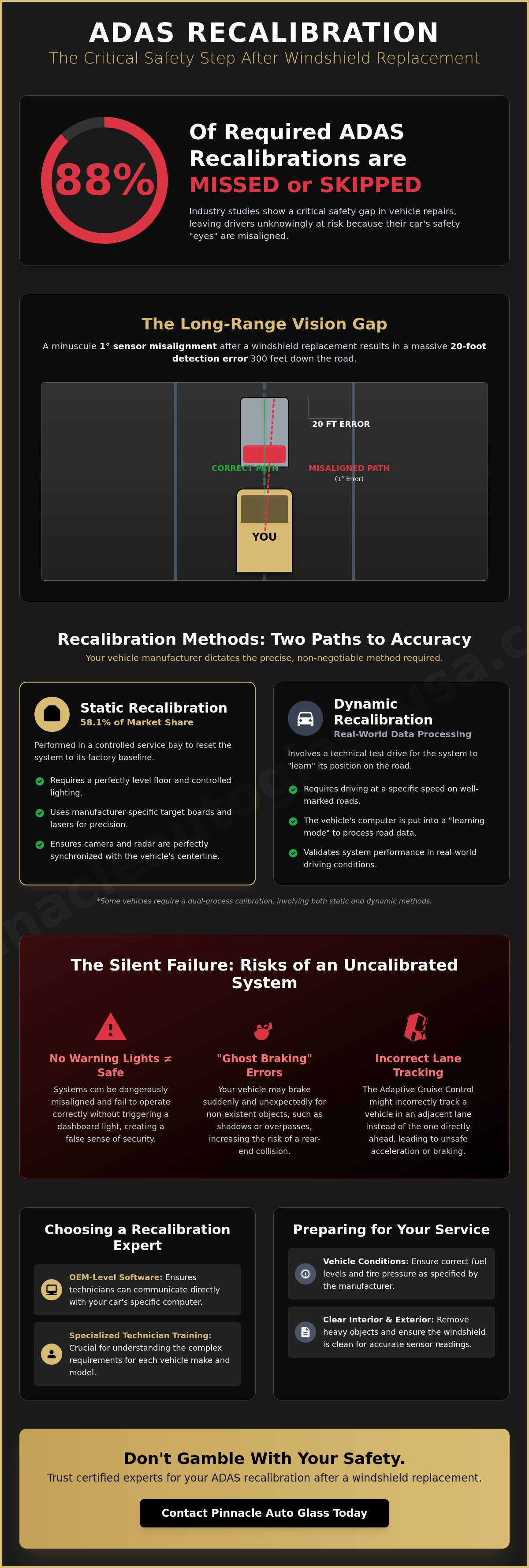
A mere 1-degree misalignment at the sensor bracket results in a massive detection error of approximately 20 feet when looking 300 feet down the road. This phenomenon, known as the "Long-Range Vision Gap," can lead to dangerous failures during highway driving. Your car's "cone of vision" must be perfectly centered to identify lane markings and other vehicles correctly. Without precise adaptive cruise control recalibration, the sensor might track a vehicle in the adjacent lane instead of the one directly ahead. This mathematical reality of sensor triangulation means that even a small installation variance can delay emergency braking or cause unexpected acceleration.
How Windshield Specs Affect Sensor Clarity
The optical clarity of your glass is just as important as its physical position. Manufacturer-specific glass is designed with precise thickness and curvature to manage light refraction. If the glass is too thick or has a slight wave, it can distort the camera's view, much like wearing someone else's prescription glasses. High-quality glass ensures the camera bracket sits at the exact angle required by the OEM. This relationship between the camera lens and the glass surface is critical for the system to distinguish between a shadow and a solid object on the highway.
Static vs. Dynamic Recalibration: Two Paths to System Accuracy
Restoring your vehicle's safety systems isn't a one-size-fits-all task. Original Equipment Manufacturers (OEMs) dictate the specific protocols for adaptive cruise control recalibration based on the vehicle's make, model, and sensor configuration. Technicians utilize OEM-level diagnostic software to communicate with the car's computer and identify the required procedure. This ensures that every adjustment meets factory safety standards. Skipping these specific steps can lead to system failure or inaccurate detection on the road.
The choice between static and dynamic methods depends entirely on the sensor hardware. Some vehicles require only one method, while others need a dual-process calibration to be fully certified. As of 2026, static calibration remains the dominant service type, accounting for 58.1% of the market. This popularity is due to the high level of accuracy achieved in a controlled setting. Professional shops must invest in specific infrastructure to perform these tasks correctly, as generic tools often fail to meet the tight tolerances required for modern ADAS.
Static Recalibration: Laboratory Conditions in the Shop
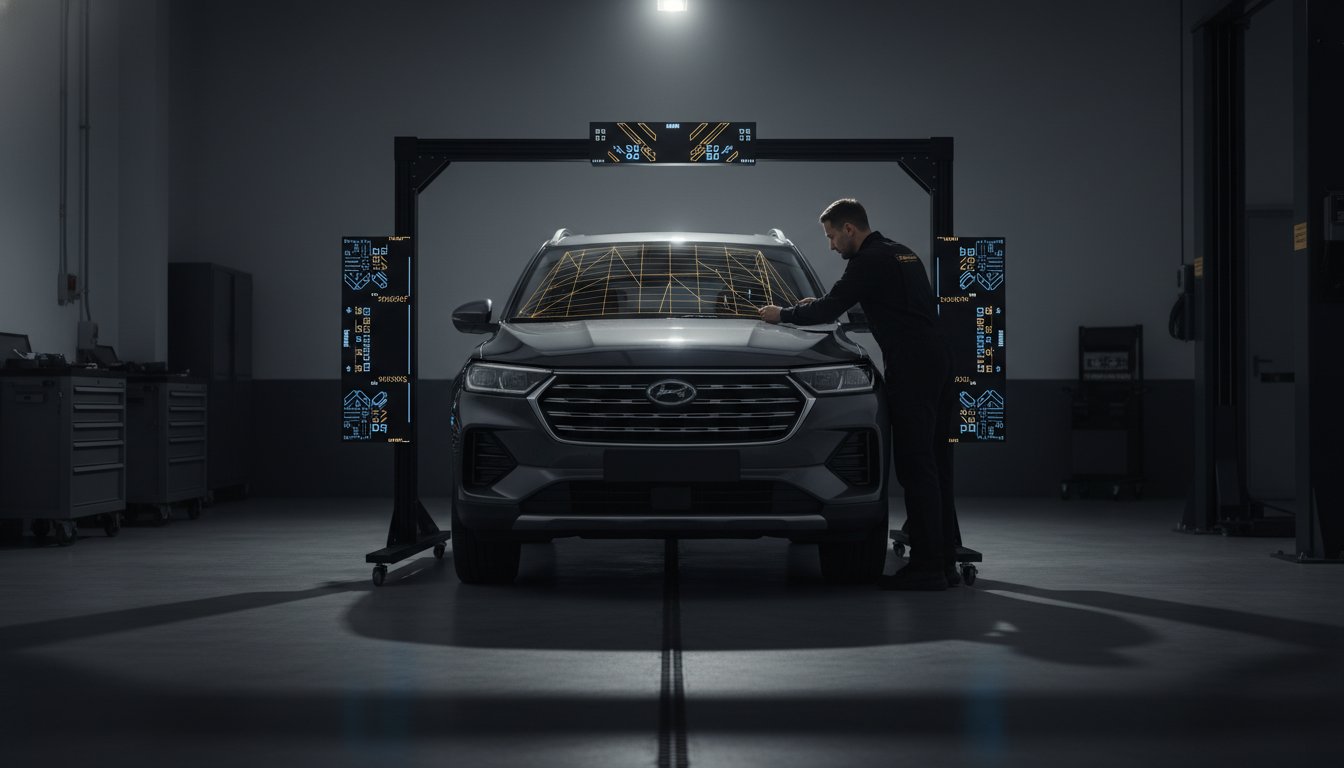
Static recalibration takes place in a specialized service bay. This environment must meet strict criteria, including a perfectly level floor and controlled lighting. Technicians set up precision target boards and use laser levels to pinpoint the sensor's focal point. Even a slight tilt in the floor can throw off the alignment. Brands like Honda and Toyota often require this method for their safety suites. It provides a stable baseline that ensures the camera and radar are perfectly synchronized with the vehicle's centerline.
Dynamic Recalibration: Real-World Data Processing
Dynamic recalibration involves a technical test drive on public roads. The vehicle's computer is placed into a "learning mode" while a technician drives at sustained speeds, typically between 40 and 60 mph. The system uses this time to identify lane markers, guardrails, and other vehicles to map its surroundings. Environmental conditions play a major role here. Heavy rain, direct sunlight, or poorly maintained road markings can prevent the system from completing the cycle. If you need to restore your vehicle's safety features, it is best to consult with an ADAS recalibration expert to determine which process your car requires.
The Hidden Risks of Skipping ACC Recalibration
A common misconception among drivers is that the absence of a dashboard warning light indicates a healthy safety system. This is often false. Modern sensors can "fail active," meaning they continue to operate while providing incorrect data to the vehicle's computer. Without professional adaptive cruise control recalibration, your car may make automated decisions based on a distorted view of the road. This creates a dangerous environment where the vehicle does not realize its own vision is compromised.
The most frequent result of this misalignment is "ghost braking." This occurs when the radar or camera incorrectly identifies a bridge, an overhead sign, or a vehicle in an adjacent lane as an immediate obstacle. Because of the "Long-Range Vision Gap," a tiny 1-degree error at the sensor mount translates to a 20-foot discrepancy on the road at a distance of 300 feet. At highway speeds, this error margin is the difference between a safe stop and a collision. Uncalibrated sensors often delay emergency braking responses because the computer cannot accurately triangulate the distance to the car ahead.
Safety suites also suffer from "hunting" behaviors. Lane departure systems may pull the steering wheel toward incorrect road markings or struggle to stay centered in a lane. This constant correction causes unnecessary wear on steering components and increases driver fatigue. Over time, these small errors degrade the reliability of the entire ADAS network, making the technology a liability rather than a helpful tool.
Liability and Insurance Implications
Skipping a required recalibration carries significant legal and financial risks. In 2025 and 2026, states like New York and Arizona passed legislation requiring repair facilities to inform consumers in writing about the necessity of ADAS services. If you ignore these requirements and a collision occurs, your insurance provider may deny coverage based on a failure to maintain safety standards. Obtaining a Certificate of Calibration after a windshield replacement protects your resale value and provides physical proof that the vehicle meets OEM specifications.
Commercial Fleet Safety and Compliance
For businesses managing fleet glass services or commercial truck glass, compliance is a matter of operational survival. DOT safety standards require all safety equipment to be fully functional. Integrating adaptive cruise control recalibration into your maintenance schedule prevents costly downtime and keeps insurance premiums stable. It ensures that delivery vans and heavy trucks remain safe for the public while protecting the company from the massive liability of a preventable ADAS failure.
What to Expect During a Professional Recalibration Service
Professional service begins with a diagnostic Pre-Scan. This initial report identifies any existing issues before the glass is touched and establishes a baseline for the vehicle's health. Once the technician completes the windshield replacement, the actual adaptive cruise control recalibration begins. This is a methodical, multi-step process that ensures the camera and radar units are communicating correctly with the car's central computer. It bridges the gap between physical installation and digital accuracy.
Technicians use specialized diagnostic tablets to interface with the vehicle's OBD-II port. They follow a precise sequence to reset the sensor's parameters and clear any internal errors triggered by the glass removal. A typical appointment for both glass replacement and recalibration takes between three and four hours. This timeframe allows the windshield adhesive to set properly while giving the technician enough time to perform the necessary digital alignment. You should plan to leave your vehicle for at least half a day to ensure all safety protocols are met.
Preparing Your Vehicle for Service
Accuracy depends on the vehicle's physical stance. You should arrive at the shop with a full tank of gas and an empty trunk. Excessive cargo weight or a low fuel level can tilt the car's frame by a fraction of a degree. This subtle shift is enough to throw off the sensor's long-range vision during the adaptive cruise control recalibration. Technicians will also verify that your tire pressure matches manufacturer specifications. These steps ensure the vehicle sits at the exact ride height intended for factory-standard safety performance. Finally, ensure your dashboard is clear of clutter that could obstruct the camera's optical field.
The Validation and Certification Phase
After the physical and digital adjustments are made, a Post-Scan is conducted. This final diagnostic check confirms that all fault codes are cleared and the system is fully operational. You will receive a Calibration Certificate upon completion. This document is essential for your maintenance records and insurance compliance. For a deeper look at the installation side of this process, see our Professional Windshield Replacement: The Complete Safety and Technology Guide. If you have recently replaced your glass, you must book a professional ADAS recalibration to restore your safety features immediately.
Choosing an Expert for Adaptive Cruise Control Recalibration
Selecting the right technician is the most important step in restoring your vehicle's safety features. ADAS technology evolves rapidly, requiring technicians to undergo continuous specialized training to stay current with 2026 manufacturer standards. Pinnacle Auto Glass bridges the gap between expert glass installation and technical precision. We use OEM-level software rather than generic diagnostic tools. Generic equipment often lacks the specific updates needed for the latest vehicle models, which can result in an incomplete or inaccurate adaptive cruise control recalibration.
Insurance and warranty protection are primary concerns for most vehicle owners. Most insurance companies cover the cost of recalibration when it is part of a necessary windshield replacement. We simplify this process by providing comprehensive documentation and "Pre-Scan" and "Post-Scan" reports directly to your insurance provider. This transparency ensures your claim is handled efficiently and your manufacturer warranty remains valid. Whether you drive a personal sedan or manage a commercial fleet, our goal is to return your vehicle to the road in a condition that meets or exceeds factory safety specifications.
Technology-First Glass Solutions
The quality of the glass is just as important as the software used to align the sensors. Pinnacle Auto Glass utilizes glass that meets strict optical standards to prevent light refraction issues that can confuse camera optics. Every installation we perform includes a comprehensive safety review. By acting as a single-source provider for both the hardware installation and the software alignment, we eliminate the risk of communication errors between different service providers. This integrated approach ensures that your adaptive cruise control recalibration is performed on a stable, high-quality foundation.
Nationwide Support for Commercial Fleets
For businesses, vehicle downtime represents a significant loss of revenue. Our fleet glass services and commercial truck glass solutions are designed to minimize this impact. We provide consistent safety compliance across multi-state operations, ensuring that every heavy-duty truck or delivery van in your fleet meets DOT safety standards. Maintaining these systems is a proactive way to manage insurance premiums and protect your drivers from preventable ADAS failures. Schedule your professional adaptive cruise control recalibration with Pinnacle Auto Glass to ensure your fleet remains safe and compliant.
Secure Your Vehicle's Future Safety
The safety of your vehicle depends on the perfect alignment of its sensors. Professional adaptive cruise control recalibration ensures that your car's technology interprets the road with factory-level precision. Skipping this essential step introduces unnecessary risks like delayed emergency braking and lane departure errors. By choosing a specialized provider, you maintain the integrity of your ADAS suite and ensure compliance with the latest state regulations.
Pinnacle Auto Glass provides the technical expertise needed for both personal vehicles and nationwide commercial fleet support. Our certified ADAS technicians use OEM-level software to perform precise resets after every windshield replacement. We prioritize your efficiency by including insurance claim assistance to simplify the service process. Our team is ready to deliver reliable results that keep your safety systems functional and your operations moving forward.
Get a Quote for Windshield Replacement and ADAS Recalibration
Take the next step toward a safer driving experience today.
Frequently Asked Questions
Do I really need recalibration if my adaptive cruise control seems to work fine?
Yes, you must perform the service even if the vehicle feels normal during your drive. Safety systems can "fail active," which means they continue to operate while providing incorrect data to the vehicle computer. A minor 1-degree misalignment at the sensor bracket leads to a 20-foot detection error on the road at highway distances. Only a professional reset ensures the digital system matches the physical reality of the road.
How long does the adaptive cruise control recalibration process take?
You should plan for a service window of three to four hours. This timeframe covers the physical windshield installation and the subsequent adaptive cruise control recalibration. The duration varies based on whether your specific vehicle requires a static shop setup, a dynamic test drive, or both. This allows enough time for the glass adhesive to set while the technician performs the methodical digital alignment.
Will my auto insurance cover the cost of ADAS and camera recalibration?
Most insurance providers cover the cost of ADAS and camera recalibration when it's part of a covered glass claim. We assist with this process by providing "Pre-Scan" and "Post-Scan" reports directly to your carrier. This documentation proves the service was a necessary safety requirement to restore the vehicle to factory standards. It also helps protect your coverage by showing that all manufacturer protocols were followed.
What happens if I choose to skip the recalibration after a windshield replacement?
Skipping the service creates significant safety and legal liabilities. You may experience dangerous "ghost braking" or a complete failure of the emergency braking system to engage when needed. Additionally, insurance companies in 2026 are increasingly denying collision claims if they find a required safety reset was omitted. You also risk voiding your manufacturer warranty by failing to follow mandated repair procedures.
Can a mobile glass service perform ACC recalibration on-site?
On-site service is only possible for vehicles that require dynamic recalibration. Static procedures require a controlled shop environment with a perfectly level floor and specific lighting to ensure sensor accuracy. Many professional services now utilize physical locations to meet these strict environmental standards. If your car requires a static setup, a mobile-only approach will not meet the necessary safety tolerances.
Why is recalibration more expensive for some vehicle models than others?
Costs vary based on the hardware complexity and the specific OEM requirements for each model. Some vehicles utilize a complex fusion of camera, radar, and LiDAR sensors that require individual target setups and longer labor times. The high cost of specialized software subscriptions and precision equipment also influences the price. Technicians must use model-specific tools to ensure the system meets factory safety specifications.
Is there a difference between camera recalibration and radar recalibration?
Yes, these services target different sensor types. Camera recalibration aligns the optical lens used for identifying lane markings and traffic signs, while radar recalibration adjusts the sensor that detects physical objects and calculates distance. Adaptive cruise control recalibration often involves both systems working in tandem to ensure accurate tracking. Each sensor has its own set of alignment protocols and precision targets.
Will I get a warning light if my camera is out of alignment?
A warning light is not guaranteed after a windshield replacement. While severe blockages or disconnected wires trigger a dashboard alert, a slight physical misalignment often goes undetected by the vehicle's internal diagnostics. The system may continue to operate with a "skewed" view of the road. Professional testing is the only way to confirm the sensors are pointing exactly where the wheels are heading.


