
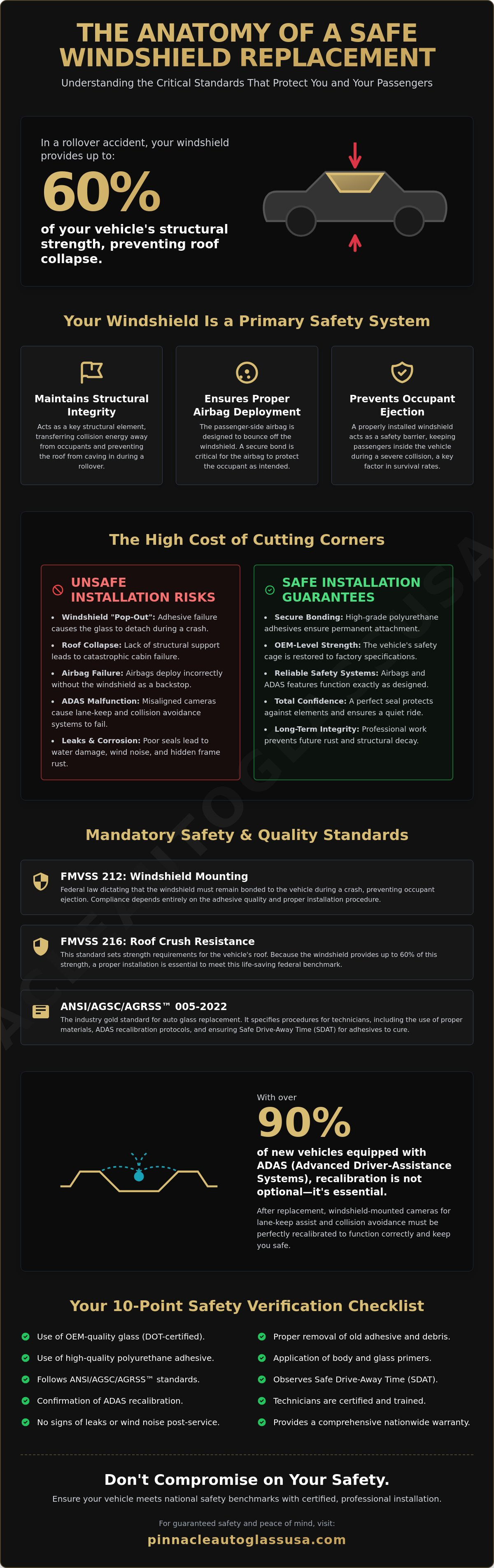
Did you know that your windshield provides up to 60% of your vehicle's structural strength during a rollover accident? It's not just a shield against the wind. It's a critical safety component that supports your roof and ensures your airbags deploy correctly. When you need a replacement, you must ensure the work meets the latest safe windshield replacement standards to protect your passengers. It's natural to feel anxious about whether the glass will stay in place or if your safety sensors will still function after the job is done.
We believe every driver deserves total confidence in their vehicle's safety. This guide explains the federal safety requirements and technical standards, including the ANSI/AGSC/AGRSS 005-2022 protocols updated for 2026 technology. You'll learn exactly how to verify a technician's work and confirm that your safety systems are ready for the road. We provide a clear checklist for your next service and explain why precise recalibration is essential for the 90% of new vehicles equipped with advanced driver assistance features.
Key Takeaways
- Understand how your windshield provides up to 60% of your vehicle's structural integrity and ensures proper airbag deployment.
- Learn to identify the federal safe windshield replacement standards that prevent glass from popping out during a crash.
- Discover why ADAS recalibration is a non-negotiable step for maintaining your vehicle's lane-keep and collision-avoidance systems.
- Access a 10-point checklist to verify that your technician uses the correct adhesives and follows industry-approved installation steps.
- Find out how to confirm the quality of your replacement glass and why a nationwide warranty is essential for long-term peace of mind.
Why Safe Windshield Replacement Standards Protect You
Your windshield is a sophisticated safety device, not just a clear piece of glass. It acts as a primary structural element of your vehicle's safety cage. Adhering to safe windshield replacement standards ensures that this component performs exactly as the manufacturer intended during an emergency. If these standards aren't met, the glass may fail to support the roof or stay attached to the frame, putting everyone inside at risk. We prioritize these protocols because a windshield is your first line of defense in a collision.
Safety standards are specifically designed to prevent "pop-outs." This dangerous event occurs when the adhesive fails during a collision, causing the windshield to detach entirely from the vehicle body. When the glass pops out, the passenger-side airbag loses its critical support. These airbags are engineered to bounce off the interior of the windshield before protecting the passenger. Without that solid backstop, the airbag cannot deploy correctly, leaving occupants vulnerable to severe injury. Proper installation follows rigorous Federal Motor Vehicle Safety Standards to keep the glass bonded to the frame even under extreme pressure.
The Structural Role of Automotive Glass
Modern vehicles rely on the windshield for a significant portion of their cabin strength. In the event of a rollover accident, the glass provides up to 60% of the structural integrity needed to prevent the roof from collapsing. It acts as a pillar that transfers energy away from the occupants. Beyond roof support, the glass maintains the airtight seal required for the cabin's structural cage. If the safe windshield replacement standards aren't strictly followed, the vehicle's safety cage is compromised. This structural support is vital for the timing and force of every safety system in your car.
Consequences of Substandard Installation
Choosing a provider that ignores industry standards leads to severe risks. Substandard work often results in roof collapse during accidents because the glass cannot bear the weight of the vehicle. You might also face failures in autonomous braking or lane-keep systems if the glass isn't aligned perfectly with the vehicle's cameras. On a daily basis, poor seals cause water leaks and distracting wind noise. These leaks eventually lead to hidden frame corrosion. Rust forms under the glass and prevents the adhesive from sticking, which makes the windshield useless during an impact. We focus on quality materials to prevent these long-term safety hazards.
Safe Drive Away Time (SDAT) is the critical window for adhesive curing that ensures the windshield remains securely bonded to the frame during a collision.
Federal and Industry Standards: FMVSS, ANSI, and DOT
Safety in the automotive industry relies on a strict legal framework. These regulations ensure that every component, from the engine to the glass, performs predictably during an emergency. Federal and industry regulations set the baseline for safe windshield replacement standards, moving beyond simple aesthetics to focus on life-saving performance. Understanding these codes helps you verify that your vehicle remains as safe as the day it left the factory.
The National Highway Traffic Safety Administration (NHTSA) enforces several Federal Motor Vehicle Safety Standards (FMVSS) that directly impact glass installation. FMVSS 212 is perhaps the most critical; it dictates windshield mounting and retention requirements. This standard ensures the glass stays in place during a collision to prevent occupants from being ejected. Additionally, FMVSS 216 establishes requirements for roof crush resistance. Because the windshield provides vital support to the roof pillars, a substandard installation can lead to a structural failure that these federal laws are designed to prevent. All glazing materials used in these installations must also comply with FMVSS 205, which governs the transparency and strength of automotive glass.
Understanding FMVSS Compliance
Compliance with FMVSS 212 depends entirely on the strength of the adhesive bond. Professional installers must use high-quality, automotive-grade polyurethane adhesives that meet or exceed original equipment manufacturer (OEM) specifications. Using "short-cut" materials or failing to follow proper priming steps compromises the bond. This can lead to a total failure of the retention system during an impact. We ensure every safe windshield replacement standards protocol is met by following OEM-equivalent procedures, which guarantee the glass and frame act as a single, solid unit. If you are unsure about the materials used in your vehicle, it is best to consult with experts in professional windshield replacement who prioritize these safety benchmarks.
DOT and ANSI Glass Certifications
Every piece of certified automotive glass features a permanent "bug" or stamp in the corner. This stamp includes a DOT code, which is a unique number assigned to the specific manufacturer by the Department of Transportation. This allows for total traceability in the supply chain. Alongside the DOT code, you will find references to ANSI Z26.1. This is the industry benchmark for glazing materials, testing for impact resistance, light transmission, and fragmentation patterns. "Bargain" glass often lacks these rigorous certifications. Low-quality glass may have optical distortions that interfere with your vision or cause safety sensors to malfunction. Choosing glass that meets ANSI standards ensures your view remains clear and your vehicle's safety systems function without error.
The 10-Point Safety Checklist for Windshield Installation
Professional glass installation involves more than just fitting a new pane into a frame. It requires a disciplined adherence to the Auto Glass Replacement Safety Standard (AGRSS). This 10-point checklist ensures your vehicle meets the highest safe windshield replacement standards for structural integrity and passenger protection. We follow these steps meticulously to restore your vehicle to its factory safety specifications.
- Pre-installation vehicle inspection: Technicians examine the frame for existing damage and scan for ADAS sensor errors before removal.
- Vehicle protection: We apply specialized covers to the interior upholstery and exterior paint to prevent damage from tools or adhesive.
- Full adhesive cut-out: We remove the old urethane down to the metal frame. This "full cut-out" method is the only way to ensure a fresh, reliable bond.
- Pinch weld cleaning and priming: Technicians clean the frame and apply primers to prevent rust and promote perfect chemical adhesion.
- Adhesive application: We use OEM-grade polyurethane adhesive applied at the correct temperature and humidity levels for a stable cure.
Installation and Bonding Requirements
Precision alignment is mandatory for a 100% airtight and watertight seal. Even a minor misalignment can lead to distracting wind noise or dangerous leaks. We also verify the Safe Drive Away Time (SDAT) for every job. This window is calculated based on the specific adhesive brand and the current weather conditions. You must never drive the vehicle before this time has passed. Additionally, we replace all single-use moldings and clips according to manufacturer guidelines. Reusing old hardware often leads to loose trim and compromised safety during a collision. These steps are fundamental to maintaining safe windshield replacement standards.
Post-Installation Testing
Once the glass is set, we test all integrated components. This includes checking rain sensors, lane-departure cameras, and heating elements. A final visual inspection identifies any "sucks" or gaps in the adhesive bead that could cause future failure. We also provide thorough documentation. We record the glass batch and adhesive lot numbers for warranty tracking and your permanent records. This transparency gives you confidence that every material used meets national safety benchmarks. Our methodical approach ensures that your vehicle's safety systems are fully restored and ready for the road.
ADAS Recalibration: The New Standard in Post-Installation Safety
Modern windshields are more than just structural barriers. They serve as the housing for your vehicle's "eyes." Advanced Driver Assistance Systems (ADAS) rely on cameras and sensors mounted directly behind the glass. Because these systems are integrated into the windshield, every replacement must include a verification process to maintain safe windshield replacement standards. As of 2026, over 90% of new vehicles feature at least one ADAS component. Treating calibration as an optional add-on is a dangerous mistake. It's a mandatory safety requirement for every modern vehicle.
Precision is the only acceptable metric here. A deviation of just one degree in the camera's mounting angle can result in a 60-foot error on the road ahead. This misalignment means your car might "see" a hazard in the wrong lane or fail to detect a pedestrian directly in your path. For a deeper look at specific systems, read our Lane Departure System Recalibration: The 2026 Vehicle Safety Guide. We prioritize these technical steps to ensure your safety tech works exactly as designed.
Static vs. Dynamic Recalibration
Vehicles require different methods to reset their sensors based on manufacturer specifications. Static calibration occurs in a controlled shop environment using specialized targets and laser levels. This process requires perfectly level floors and specific lighting to ensure accuracy. Dynamic calibration involves a specific driving protocol on clearly marked roads. The vehicle's computer "learns" its surroundings while in motion. Some complex vehicles require both methods to achieve maximum safety. We use manufacturer-specific equipment to guarantee these systems are reset to factory tolerances.
Ensuring Your Safety Systems Function Correctly
Failure to recalibrate introduces significant risks to your daily commute. You might experience "false positives" where the automatic emergency braking engages without cause. This can lead to unexpected stops and rear-end collisions. Proper ADAS recalibration after windshield replacement is also critical for adaptive cruise control recalibration. These systems must "see" the exact distance to the car in front of you to maintain a safe gap and adjust speed correctly.
We never return a vehicle until we verify system readiness. Our technicians perform a final scan to ensure no fault codes remain in the safety module. This verification is the final step in meeting safe windshield replacement standards and national safety benchmarks. If your vehicle features safety cameras, book professional ADAS recalibration services with our certified team to ensure your car protects you as intended.
Ensuring Your Vehicle Meets National Safety Benchmarks
Restoring your vehicle's safety requires more than just a quick fix. It demands a provider that strictly follows safe windshield replacement standards from start to finish. You need to verify that the shop uses certified technicians who understand the complex relationship between structural glass and modern safety tech. Professional shops are transparent about their materials and processes, ensuring you leave with a vehicle that is as safe as it was on the showroom floor. We believe that every driver should have access to clear documentation regarding their repair.
Always demand a nationwide warranty for your service. Whether you choose mobile or in-shop service, a warranty protects you against defects in materials or workmanship. It also signals that the business is stable and confident in its technical capabilities. Transparency in the recalibration process is another hallmark of a top-tier provider. You should receive a digital or physical report confirming that your ADAS sensors have been successfully reset and are communicating correctly with the vehicle's onboard computer. This report serves as your proof that the safety systems are active and accurate.
The final step of a professional install involves reviewing your safety certificate. This document should list the specific glass and adhesive batch numbers used for your vehicle. Your technician will also provide critical care instructions, such as keeping a window cracked to prevent pressure spikes or avoiding high-pressure car washes for the first 24 hours. Following these instructions is vital for the adhesive to reach its full structural strength. These small steps ensure the long-term reliability of the bond and the safety of your passengers.
Choosing a Qualified Auto Glass Specialist
Don't be afraid to ask direct questions before booking your appointment. Ask your technician about their specific certifications, such as those from the Auto Glass Safety Council. A reputable specialist will confirm they use OEM-quality glass and high-performance polyurethane that meets federal retention standards. It is also highly efficient to choose a provider that offers comprehensive glass and ADAS solutions in a single visit. This ensures that the same team handles the installation and the technical calibration, reducing the risk of communication errors between different service centers. One visit saves time and guarantees that all systems are synchronized perfectly.
The Pinnacle Standard of Excellence
Our team is committed to meeting or exceeding all FMVSS and ANSI requirements for every client. We understand that your family's safety depends on the integrity of our work. This is why Pinnacle Auto Glass prioritizes safety over speed for every vehicle we service. We take the necessary time to ensure the adhesive cures correctly and the sensors are aligned with absolute precision. We don't cut corners because we know that a properly installed windshield is a life-saving device. Schedule your professional inspection and replacement today to ensure your vehicle meets the highest safe windshield replacement standards available in 2026.
Drive with Confidence and Total Protection
Modern driving requires a high level of technical precision. Your windshield is no longer just a piece of glass. It is a structural pillar and a sensor hub. Following the 10-point checklist we discussed protects your vehicle's roof strength and ensures your airbags deploy as intended. Don't settle for installations that skip the calibration step or use low-grade adhesives. Choosing a provider that adheres to safe windshield replacement standards ensures your car remains a protective cage for you and your passengers. We are ready to help you maintain these benchmarks with expert care and industry-leading materials.
Our team provides professional fleet and commercial services nationwide with a focus on reliability. We are certified ADAS recalibration experts and maintain full compliance with all FMVSS safety standards. Get a Professional Safety-First Windshield Quote from Pinnacle Auto Glass. Your safety is our priority. We look forward to getting you back on the road safely and restoring your vehicle to its factory specifications.
Frequently Asked Questions
What are the Federal Motor Vehicle Safety Standards (FMVSS) for windshields?
The primary federal regulations are FMVSS 205, 212, and 216. FMVSS 205 sets the requirements for the transparency and strength of glazing materials. FMVSS 212 focuses on windshield retention, ensuring the glass stays bonded to the frame during a crash to prevent occupant ejection. Finally, FMVSS 216 establishes standards for roof crush resistance, where the windshield provides vital structural support during a rollover accident.
Can I drive my car immediately after a windshield replacement?
No, you must wait for the Safe Drive Away Time (SDAT) to expire before operating your vehicle. This window is the specific time required for the polyurethane adhesive to cure enough to meet safe windshield replacement standards. Driving too early can cause the glass to shift or fail to remain attached during a collision. Your technician will provide a specific wait time based on the adhesive type and current weather conditions.
How do I know if my new windshield is DOT approved?
You can verify approval by looking for the "bug" or permanent stamp in a lower corner of the glass. This stamp must include a DOT code, which is a unique identification number assigned to the manufacturer by the Department of Transportation. This code confirms the glass meets federal requirements for impact resistance and optical clarity. If the glass lacks this traceable code, it may not be compliant with national safety regulations.
Is it safe to get a mobile windshield replacement during bad weather?
Mobile replacement is only safe during rain or snow if the work is performed in a dry, sheltered area like a garage. Moisture and extreme humidity interfere with the chemical bonding of the adhesive. If a covered environment is not available, it is best to schedule an in-shop service. This ensures the installation occurs in a controlled environment, which is necessary for a permanent and watertight seal.
What happens if my ADAS camera is not recalibrated after a glass change?
Operating a vehicle without recalibrating the ADAS camera can lead to severe safety system failures. Your lane departure warnings and automatic emergency braking rely on a precise camera angle to detect road markings and obstacles. A misalignment of just one degree can cause the system to miss a hazard or trigger a "false positive" braking event. Recalibration ensures these sensors communicate accurately with your vehicle's computer after the glass is moved.
Does a cracked windshield affect the structural integrity of my car?
Yes, even a small crack compromises the structural integrity of your vehicle. The windshield provides up to 60% of the cabin strength during a rollover and supports the proper deployment of the passenger-side airbag. A crack weakens the glass's ability to resist pressure and weight. Replacing damaged glass is the only way to restore the safety cage to its original factory strength and protect occupants during an impact.
What is the difference between OEM and aftermarket glass safety standards?
Both OEM and aftermarket glass must meet the same federal safety requirements, but OEM glass is produced to the vehicle's exact original specifications. This ensures a perfect fit and matches the thickness and tint of the factory glass. While aftermarket glass is a safe and regulated alternative, OEM glass often provides superior optical clarity. This clarity is vital for the cameras and sensors used in modern driver assistance systems.
How can I verify that a technician is properly certified for safety standards?
You should ask the shop if their technicians are certified by the Auto Glass Safety Council (AGSC). A qualified specialist will be able to explain the safe windshield replacement standards they use for every installation. Reputable providers are transparent about their training and will provide documentation regarding the glass and adhesive lot numbers used for your repair. This level of accountability is a hallmark of a professional glass service.


