
What if the fastest way to review a fleet glass repair invoice isn’t to start with the amount due, but with the service record behind it? When vehicle details, work orders, approvals, and repair notes don’t line up, even a routine glass charge can stall in accounts payable. Managing fleet glass repair invoices starts with making those records consistent.
Every invoice should identify the vehicle, describe the work completed, and connect that work to an approval. This guide lays out a repeatable process for checking those details, matching charges to vehicle records, and resolving exceptions before they delay reconciliation. It also explains what to document when windshield replacement includes ADAS recalibration, so the repair and calibration records stay connected. Use the checklist to help your team review invoices consistently and plan around vehicle availability.
Key Takeaways
- Managing fleet glass repair invoices gets easier when each charge is linked to an authorized repair, the correct vehicle, and a clear service record.
- Use a consistent naming convention for invoices, work orders, and supporting documents so records are easier to match and retrieve.
- Compare vehicle and work-order identifiers against source records before reviewing invoice details, then route mismatches for resolution.
- Assign an owner to each handoff, from damage report and authorization through repair, invoice approval, and reconciliation.
- Clear repair descriptions, including ADAS recalibration when applicable, help operations and finance connect completed work to the right vehicle.
What managing fleet glass repair invoices should accomplish
Managing fleet glass repair invoices means linking every charge to an authorized repair, the correct vehicle, and a service record that shows what was completed. The goal isn’t to diagnose the glass issue from an invoice. It’s to confirm that the documented work matches the approved service and that finance has the information needed to review the charge.
Keep each service type clear. Glass repair, windshield replacement, and applicable ADAS recalibration are distinct parts of the service record. If replacement work includes recalibration, identify it in the supporting documentation. For background on the repair process and safety considerations, see this professional windshield replacement safety guide.
This record-based approach supports a consistent invoice processing workflow, from invoice receipt through review and payment. It also gives operations and accounts payable a shared reference for approvals, budgeting, and audit readiness.
Which fleet glass invoice details should be traceable?
Build each record around identifiers that let a reviewer move from the invoice to the vehicle and approved work without guesswork. Capture:
- Vehicle: unit number, VIN, year, make, model, and internal fleet location or assignment.
- Service event: service date, work-order or authorization reference, repair type, and completion status.
- Invoice: vendor identity, invoice identifier, and itemized work descriptions.
- Supporting records: references to the work order, approval, and service documentation.
Use the same identifiers across the invoice, work order, and related records. If the unit number is missing or inconsistent, pause the review and resolve the mismatch before routing the charge for approval.
Why do standardized records matter beyond payment?
Searchable, consistently named records help reviewers spot duplicate submissions and find unresolved exceptions. They also give fleet teams a usable service history. Over time, that history can support planning by showing which vehicles have had glass work, what type of service was completed, and whether follow-up documentation remains outstanding.
A fleet glass invoice should connect the vehicle, authorization, completed work, and charge in one traceable record. Keep the review focused on documentation rather than asking accounts payable to assess repair decisions. Match the completed service to its supporting record, then route unclear or incomplete items to the person responsible for resolving them.
How to standardize fleet glass repair invoice documentation
A consistent record structure turns managing fleet glass repair invoices into a repeatable process instead of a fresh investigation each time. Set the same required fields and handoffs for every vehicle and service event, whether the work is glass repair or replacement.
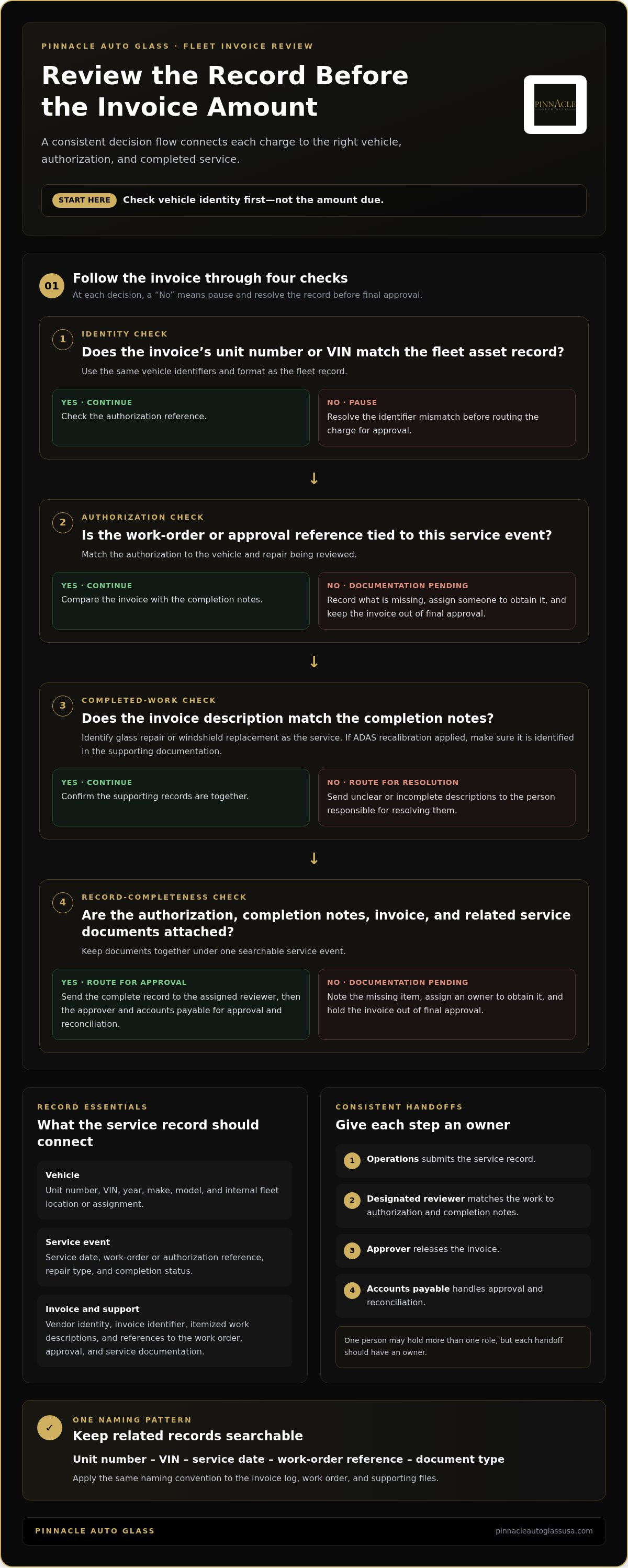
Use this sequence for each invoice:
- Identify the vehicle. Enter the fleet unit number and VIN using the same format found in the fleet record.
- Match the authorization. Attach the work-order or approval reference tied to the service event.
- Review the work. Compare the invoice description with completion notes. Identify whether the service was glass repair or replacement, and whether ADAS recalibration applied.
- Attach the records. Keep the authorization, completion notes, invoice, and related service documents together.
- Route for approval. Send the complete record to the assigned reviewer, then to accounts payable for approval and reconciliation.
Create a consistent invoice and work-order record
Adopt one naming convention across the fleet, such as unit number-VIN-service date-work-order reference-document type. Apply it to the invoice log, work order, and supporting files. Store each item under one searchable service event rather than in separate folders that require staff to reconstruct the repair history.
Make vehicle identifiers and repair type required internal fields before an invoice enters approval. If the service involved windshield replacement and ADAS recalibration, record recalibration as part of the service context where applicable. The ADAS calibration and auto glass reference guide explains how recalibration relates to auto glass work.
Set practical documentation and approval rules
Assign clear roles: operations submits the service record, a designated reviewer matches the work to authorization and completion notes, an approver releases the invoice, and accounts payable reconciles it. One person may hold more than one role, but each handoff should have an owner.
Use a consistent status such as Documentation pending for an invoice with a missing attachment, unclear description, or unmatched work order. This flags the record for follow-up without treating every omission as a billing error. Record what’s missing, assign the person responsible for obtaining it, and keep the invoice out of final approval until the record is complete.
Before glass service is arranged, share the vehicle identifiers and authorization reference with the repair partner. These details help connect the completed work to the correct vehicle. For fleet glass work, coordinate service with Pinnacle Auto Glass using the same identifiers your team uses in its records.
How to review fleet glass repair invoices and resolve discrepancies
A reliable review starts with identity, not line-item scrutiny. First, match the invoice’s unit number or VIN to the fleet asset record. Then confirm its work-order or authorization reference. If those identifiers don’t align, pause and resolve the mismatch before comparing service descriptions or charges. This order helps prevent an invoice from being attached to the wrong vehicle or repair event.
Once the vehicle and work order match, compare the billed service with the authorization and completion record. Check whether the documentation describes glass repair or replacement, and whether applicable ADAS recalibration is recorded as part of the service event. Reviewers are verifying that the invoice corresponds to documented work, not re-diagnosing the repair.
What should reviewers match before approval?
Use the same comparison points for each invoice. Record the source checked, the reviewer’s action, and what happens if information doesn’t match. That makes the decision clear to the next person in the approval chain.
| Invoice field | Expected source record | Reviewer action | Exception outcome |
|---|---|---|---|
| Unit number or VIN | Fleet asset record | Match at least one identifier; resolve conflicting details | Log as a vehicle identification mismatch |
| Work-order or authorization reference | Approved work order | Confirm the reference belongs to this vehicle and service event | Route for authorization lookup or correction |
| Repair type and description | Approved scope and completion record | Compare the billed glass work with the authorized and completed service | Flag unclear descriptions or scope differences |
| ADAS recalibration, if applicable | Service documentation | Check that related recalibration work is identified in the record | Request or locate supporting documentation |
| Invoice identifier | Invoice log and prior submissions | Search for an existing record with the same identifier | Mark a possible duplicate for review |
How should a team handle invoice exceptions?
Don’t treat every discrepancy as a billing error. A transposed unit number may be a clerical mismatch; an invoice describing work beyond the approved scope raises a different question. Missing completion notes are a documentation gap, while a repeated invoice identifier may indicate a duplicate submission. Classifying the issue helps direct it to the right owner.
Log each exception with the discrepancy type, responsible reviewer, missing information or question, and resolution status. Keep routine invoices moving when records match, and route flagged items for follow-up. Approve matched records and route exceptions through a documented review. This focused approach makes managing fleet glass repair invoices consistent without placing every submission on hold.
How to build a fleet glass invoice workflow that avoids bottlenecks
A clear workflow keeps service coordination and invoice review moving in parallel. Start when damage is reported: document the vehicle and work authorization, arrange the glass service around operational needs, record completion, and route the invoice for review. Close the process with approval and reconciliation. Pass the same vehicle and work-order references through each step, so finance doesn’t have to rebuild the service history after the repair.
Plan service timing with vehicle availability in mind, while keeping authorization and completion records tied to the event. Scheduling and return-to-service planning can overlap with reducing fleet downtime with mobile glass repair. The vehicle’s operating needs guide coordination, while the documentation follows the repair through invoice review.
Who handles each step in the invoice process?
Give every handoff an owner. Operations documents the damage, vehicle details, and work authorization. A service coordinator records repair completion, gathers related service documents, and routes them with the invoice. Accounts payable matches the invoice to those records, approves routine items under the fleet’s process, and tracks exceptions. Define who receives an item when the assigned owner is unavailable, so it doesn’t sit between departments.
Keep the workflow visible with a simple status at each stage, such as reported, authorized, scheduled, completed, under review, and reconciled. This lets operations see where a vehicle stands and finance see what remains before payment processing.
Which process measures reveal recurring problems?
Choose a routine review cadence that fits invoice volume and your internal payment cycle. At each review, check open records and recurring exception types. Track:
- Incomplete invoice records and missing completion documents.
- Unmatched work orders or vehicle identifiers.
- Duplicate invoice submissions.
- Unresolved exceptions, including their current owner and status.
Use consistent categories, then review patterns by vehicle, repair type, and service partner. For example, repeated missing completion notes may point to a handoff gap, while recurring identifier mismatches may indicate inconsistent data entry. Treat these as prompts to investigate, not proof of a cause. Avoid setting a universal resolution deadline or claiming savings without support from your fleet’s own records.
A practical workflow balances vehicle availability with traceable service records. Arrange fleet glass service with Pinnacle Auto Glass and carry your vehicle identifiers and authorization references through each service event. This gives operations and accounts payable a clear record to follow from damage report to reconciliation.
How to coordinate fleet glass invoices with a professional repair partner
Invoice coordination starts before service is arranged. Share the vehicle unit number, VIN, service date, and work-order or authorization reference with the repair partner. Use the same identifiers in your fleet records and internal invoice log. Consistency helps operations and finance connect the completed glass work to the right vehicle without relying on memory or guesswork.
What service details help connect repairs to invoices?
Make the service description specific enough to distinguish the work performed. Record whether the service involved glass repair, windshield replacement, or commercial truck glass. If ADAS recalibration applies, identify it in the service event and supporting records. Retain completion documentation with the invoice and authorization so reviewers can follow the event from approval through completed work.
Clear records support both sides of the handoff. Fleet staff can confirm the authorized service was completed, and accounts payable can match the invoice to the corresponding vehicle and work order. This is especially useful when similar repairs occur across multiple vehicles or when invoice review happens after a vehicle has returned to operations.
What are the next steps for a fleet team?
Put your internal process in place before the next service request. Choose a standard invoice checklist, name the people responsible for authorization, service documentation, review, and approval, and agree on how to flag incomplete or mismatched records. Apply the checklist to upcoming glass repairs. Use actual invoice exceptions to refine categories and clarify handoffs rather than adding checks that don’t address a recurring issue.
Pinnacle Auto Glass provides glass repair and replacement for fleets and commercial vehicles, including commercial truck glass and ADAS recalibration. Share your vehicle identifiers and authorization reference when arranging service, then retain the related completion documentation with the invoice. This gives your team a clear record for its approval and reconciliation process.
Once your checklist and approval roles are established, explore Pinnacle Auto Glass fleet services for your fleet’s glass service needs. A consistent process makes managing fleet glass repair invoices more straightforward by keeping service records connected to the work performed.
Put a Consistent Fleet Glass Process Into Practice
Managing fleet glass repair invoices works best when each charge connects to the right vehicle, authorization, completed service, and supporting records. Standardize the fields your team captures, match invoices against work orders and completion documentation, and route exceptions to a clear owner. This keeps routine reviews moving while surfacing gaps that need follow-up.
Apply the checklist to upcoming repairs, then use recurring exceptions to refine your handoffs. Clear service records also help operations and accounts payable identify glass repair, replacement, and applicable ADAS recalibration within the same service history.
Pinnacle Auto Glass provides professional glass repair and replacement for commercial vehicles and fleets, with ADAS recalibration for applicable glass work. Explore Pinnacle Auto Glass fleet services to arrange glass service for your vehicles and keep the related documentation connected to each service event.
Frequently Asked Questions
How do you manage fleet glass repair invoices?
Manage fleet glass repair invoices by linking each charge to a vehicle, authorization, completed service, and supporting documentation. Use the unit number or VIN and work-order reference to match records, then route complete invoices through normal approval. Track missing information or scope differences as exceptions. Assign each exception an owner, note the follow-up needed, and record its resolution so the same issue can be handled consistently next time.
What should a fleet glass repair invoice include?
A useful fleet glass repair invoice identifies the service provider, invoice reference, vehicle, service date, repair type, and itemized work description. Connect it to the internal work order or authorization, and retain relevant completion documentation with the service record. If ADAS recalibration applies to the glass service, identify it in the documentation. Consistent fields help finance match the charge to the correct vehicle and service event.
How can a fleet verify an auto glass repair invoice?
Verify an auto glass repair invoice by comparing it with the fleet asset record, approved work order, and service completion documentation. Confirm that the vehicle identifiers match and that the described repair or replacement aligns with the authorized work. If details are missing or inconsistent, pause that invoice for review rather than assuming the charge is wrong. Record the discrepancy, reviewer, follow-up, and final resolution.
How do fleet managers prevent duplicate glass repair invoices?
Prevent duplicate glass repair invoices by recording each submission under a unique invoice reference and linking it to a vehicle and work-order number. Before approval, search the invoice log for repeated identifiers, dates, or service events. Keep clear statuses such as received, approved, paid, or under review. If two submissions appear related, compare their supporting records before rejecting or processing either one.
Should ADAS recalibration appear in fleet glass repair documentation?
Yes, document ADAS recalibration when it applies to the glass service. Identify it as part of the service event so operations and accounts payable can understand the work recorded alongside the repair or replacement. Keep the vehicle and work-order references consistent across the invoice and supporting documents. To determine whether recalibration is needed for a specific vehicle, consult its service requirements and the relevant repair documentation.
How can a fleet reduce delays in invoice approval?
Reduce approval delays by standardizing required invoice fields, assigning an owner to each review handoff, and routing only exceptions for follow-up. Have operations record authorization and completion details as the service occurs, rather than reconstructing them later. Track unresolved items with a responsible person and current status. This approach helps complete invoices move through the normal process while incomplete or mismatched records receive focused review.
How should a fleet compare glass repair invoices across vehicles?
Compare fleet glass invoices using consistent categories, including vehicle, service type, work-order reference, and documented work. Review similar service events together instead of comparing invoice totals without context. Account for differences in vehicle requirements and authorized scope, then investigate unusual or incomplete records. Patterns can reveal where documentation or approval steps need attention, but a recurring difference alone doesn’t establish that an invoice is incorrect.


