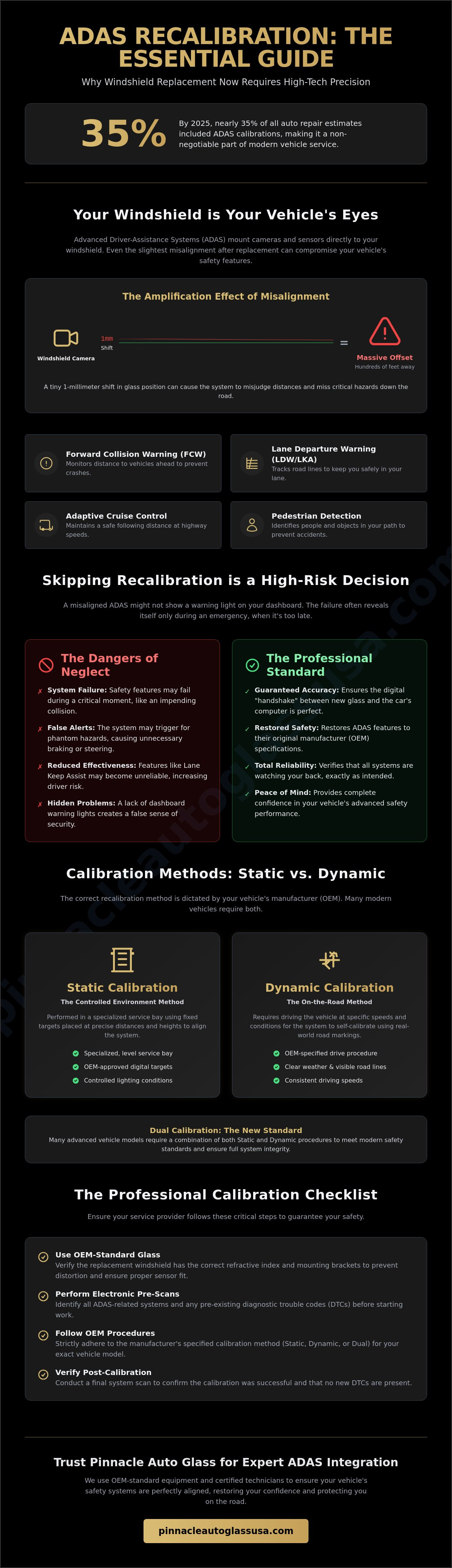
Did you know that by 2025, ADAS calibrations were included in nearly 35% of all auto repair estimates? This shift reflects a new reality where your windshield is no longer just a piece of glass; it's a vital housing for sophisticated cameras and sensors. If you've recently dealt with a crack or shatter, you likely have questions about ADAS recalibration after windshield replacement and why it's now a non-negotiable part of the repair process.
It's natural to feel frustrated by the technical jargon and the added complexity of a modern glass service. You deserve to know that your Automatic Emergency Braking and lane-departure warnings will function exactly as the manufacturer intended. This comprehensive 2026 resource provides a professional roadmap for restoring your vehicle's safety integrity. We'll explain the specific requirements of the latest state safety mandates, clarify the differences between calibration types, and show you how Pinnacle Auto Glass ensures your safety systems are perfectly aligned before you leave the shop. You'll gain the clarity needed to move from confusion to complete confidence in your vehicle's performance.
Key Takeaways
- Recognize how your vehicle's safety sensors depend on precise glass placement to monitor the road effectively.
- Distinguish between static and dynamic methods to understand the specific technical requirements for your vehicle.
- Understand why ADAS recalibration after windshield replacement is essential to prevent safety system failures during critical moments.
- Follow a professional checklist to verify that your service provider uses OEM-standard glass and performs necessary electronic pre-scans.
- Learn how to access specialized recalibration services for modern fleets and personal vehicles to maintain total safety compliance.
The Critical Link Between Windshield Replacement and ADAS Calibration
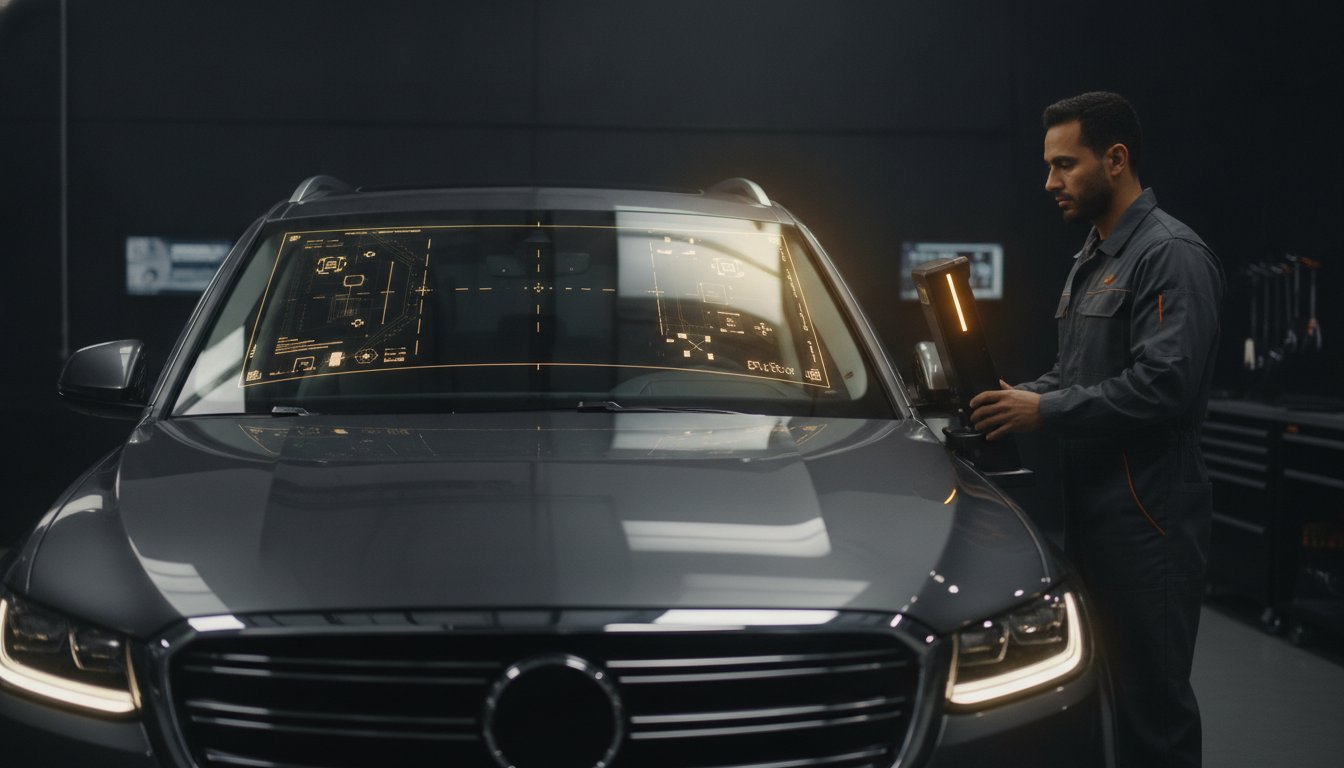
Modern vehicles are sophisticated computers on wheels. The windshield is no longer just a clear barrier; it's a structural component that houses the Advanced Driver-Assistance Systems (ADAS). Think of ADAS as the vehicle's brain. It processes real-time data to keep you safe on the road. Most cameras and sensors are physically mounted directly to the interior of the windshield glass or sit in a bracket behind it. Because these sensors are fixed to the glass, any change in the windshield's position or angle directly affects how the car "sees" its surroundings.
Precision is the most important factor during a glass service. When a technician performs a replacement, even a 1-millimeter shift in the glass positioning can misalign a camera's field of view. While 1 millimeter seems tiny, it creates a massive "offset" when projected hundreds of feet down the road. This discrepancy can cause your car to react to hazards that aren't there or, worse, miss ones that are. Since 2020, recalibration has become the industry standard for nearly all new vehicles to ensure these digital safety nets remain accurate and reliable.
Common ADAS Features Relying on Your Windshield
Many safety tools depend on the optical clarity and physical alignment of your front glass. These systems include:
- Forward Collision Warning (FCW): This system monitors the distance between you and the vehicle ahead to trigger emergency braking if a crash is imminent.
- Lane Departure Warning (LDW) and Lane Keep Assist (LKA): Cameras track painted road lines to alert you or steer you back if you drift out of your lane.
- Adaptive Cruise Control: This feature uses camera alignment to maintain a safe, consistent following distance at highway speeds.
- Pedestrian Detection: Sensors must be perfectly level to identify people or objects in your path, especially in low-light conditions.
Why 'Eye-Balling' It Doesn't Work
You can't verify sensor alignment just by looking at the camera lens. Recalibration requires mathematical precision and specialized digital targets. The glass itself also plays a role in system performance. Every piece of glass has a specific refractive index that allows cameras to see through it without distortion. If the glass isn't installed to exact OEM specifications, the sensors may struggle with light distortion or "ghost" images that confuse the vehicle's computer.
Don't assume your system is functional just because there are no warning lights on your dashboard. A system can be misaligned and still appear "active" to the driver. Without ADAS recalibration after windshield replacement, the system might only fail when you need it most during an emergency maneuver. Professional calibration ensures the digital handshake between the new glass and the vehicle's computer is perfect. It's the only way to guarantee your safety features are actually watching your back.
Static vs. Dynamic Recalibration: Understanding the Technical Requirements
Restoring your vehicle's safety features isn't a one-size-fits-all process. The specific method for ADAS recalibration after windshield replacement depends entirely on your vehicle's make and model. The Original Equipment Manufacturer (OEM) dictates the procedure. Technicians must follow these precise steps to ensure every sensor is active and accurate. In 2026, many advanced models now require "Dual Calibration," which involves completing both static and dynamic steps to meet modern safety standards.
Skipping these technical requirements leads to system failures. If you need assistance determining your vehicle's specific needs, you can contact a professional service provider for a detailed assessment. Using the wrong method or low-quality equipment can result in common mistakes in ADAS calibration, such as incorrect sensor alignment or system timeout errors.
Static Calibration: The Controlled Environment Method
Static calibration happens inside a specialized service bay. This method relies on physical targets placed at specific distances and heights around the vehicle. The environment must be strictly controlled to ensure success. Key requirements include:
- Level Flooring: Even a slight slope can throw off laser measurements.
- Controlled Lighting: Bright glares or deep shadows can prevent cameras from recognizing the calibration targets.
- Background Neutrality: Cluttered walls or moving objects in the shop can distract sensors during the process.
- Vehicle Prep: Technicians must verify tire pressure, fluid levels, and fuel tank capacity to ensure the car sits at its factory-specified height.
Dynamic Calibration: The Real-World Road Test
Dynamic calibration involves a sophisticated road test rather than a stationary setup. It is a critical part of ADAS recalibration after windshield replacement for many modern SUVs and sedans. A technician connects a handheld diagnostic tool to the vehicle's computer and drives the car under specific conditions. This process allows the CPU to "learn" the road environment through the new glass. Success depends on several external factors:
- Consistent Speeds: The vehicle must maintain a steady speed for a set distance.
- Clear Road Markings: Sensors need visible lane lines to lock in their position.
- Weather Conditions: Heavy rain, snow, or thick fog will often cause the calibration to fail.
This isn't a simple test drive. It's a data-logging exercise. The vehicle's computer analyzes thousands of data points to confirm the sensors are tracking objects and lanes correctly. Only after the diagnostic tool confirms a "success" status is the vehicle deemed safe for the road.
Why Skipping ADAS Recalibration Is a High-Risk Decision
Drivers often assume that if their vehicle handles normally on a standard commute, the safety systems are active. This is a dangerous misconception following a glass change. Skipping ADAS recalibration after windshield replacement creates a hidden danger that most drivers don't recognize until a split-second emergency occurs. The vehicle's computer may not trigger a dashboard warning light even if the camera's aim is skewed. This "delayed failure" scenario means your safety net is effectively gone when you need it most.
There are also significant legal and financial risks to consider. Fleet managers and individual owners face strict liability if an uncalibrated system contributes to a collision. By 2026, vehicle history reports and safety disclosures have become more detailed regarding sensor maintenance. Failing to document this service can significantly lower your vehicle's resale value. Many dealerships now refuse trade-ins that lack a certified calibration report following a windshield service.
Insurance and Liability Considerations
Most comprehensive insurance policies cover the cost of recalibration as a standard part of a glass claim. There is no financial reason to skip this step. However, the risk of a future claim denial is high. If an investigation proves that a collision occurred because of uncalibrated sensors, insurance carriers may cite owner negligence. Pinnacle Auto Glass works directly with major insurance carriers to ensure your vehicle meets all safety compliance standards. This coordination ensures the work is billed correctly and your safety record remains intact.
Safety System 'Hallucinations'
Misaligned sensors don't just fail to act; they can act incorrectly. This often results in "phantom braking." This occurs when the vehicle suddenly applies the brakes because it perceives an overhead bridge or a shadow as a solid object in its path. Similarly, a lane-keep system with poor alignment might steer you toward oncoming traffic while trying to "center" you in a lane it can no longer see accurately. System offset is the deviation between a vehicle's actual position on the road and its perceived position according to its sensors. Even a small offset makes these high-tech features a liability rather than an asset.
The Professional Calibration Checklist: What Your Service Provider Must Do
A professional service provider follows a rigorous, multi-step protocol. This ensures your vehicle returns to the road in peak condition. The process for ADAS recalibration after windshield replacement begins before the old glass is even removed. Technicians must perform a pre-scan to identify any existing fault codes or electronic issues within the safety modules. This baseline scan protects you from inheriting pre-existing problems and ensures the new installation starts with a clean slate.
Once the scan is complete, the physical work begins. A high-quality windshield replacement is the foundation of a successful calibration. The glass must meet or exceed OEM specifications for optical clarity; otherwise, the sensors cannot "see" through the material correctly. After the glass is set, the technician executes the specific recalibration method required by your vehicle's VIN. This might be static, dynamic, or a dual-calibration approach. Finally, a post-scan verifies that all modules are communicating without errors. You should receive a Digital Certificate of Calibration as proof that the work meets industry standards.
Verifying Technician Certification
Ask your provider about the equipment they use. Leading facilities utilize industry-standard tools from brands like Autel or Bosch, or they use direct OEM diagnostic software. Proper training is especially critical for lane departure system recalibration, as these sensors require extreme precision to track road markings. Many complex static calibrations are best performed in a shop. A controlled environment with level floors and perfect lighting ensures the sensors lock onto their targets without interference.
Post-Service Documentation
Never leave the shop without your Calibration Certificate. This document is a vital record for your glovebox. It proves to your insurance carrier and future buyers that the safety systems were professionally restored. This paperwork also protects you during any future warranty claims. Before you drive away, confirm that your dashboard is clear of all ADAS-related warning lights. A clean dash and a certified report provide the peace of mind that your vehicle is fully functional. If you are ready to ensure your vehicle's safety systems are perfectly aligned, schedule your professional recalibration service today.
Trusting Pinnacle Auto Glass for Expert ADAS Integration and Safety
Pinnacle Auto Glass provides a streamlined solution for modern vehicle owners. We combine precision glass installation with high-end diagnostic technology. This unified approach ensures that your ADAS recalibration after windshield replacement happens in a single, efficient appointment. You don't have to visit multiple shops to restore your vehicle's safety integrity. We use professional-grade tools to verify every sensor is functional before you return to the road. Our national footprint allows us to provide this consistent level of service to personal car owners and large-scale commercial operations alike. Our team stays updated on the latest software releases from all major manufacturers. We prioritize quality by using only industry-certified diagnostic targets. This prevents the need for costly return visits or secondary repairs.
Our expertise extends to the most advanced driver assistance features. We maintain a specialized focus on adaptive cruise control recalibration for modern fleets. This ensures that long-distance drivers can rely on their vehicle's speed and distance management systems without hesitation. By utilizing the latest software updates and OEM-compliant procedures, we guarantee that your vehicle’s "eyes" are perfectly aligned with its mechanical systems. We don't just replace glass; we restore your vehicle's digital safety net.
Commercial Fleet and Heavy-Duty Solutions
Fleet management requires a partner that understands commercial urgency. We offer customized calibration workflows for delivery vans, box trucks, and semi-trucks. Our technicians perform glass and tech services simultaneously to minimize vehicle downtime. Pinnacle Auto Glass supports national fleet managers by providing consistent, documented safety compliance across all vehicle types. This level of service keeps your drivers protected and your operations running smoothly. We recognize that every hour a truck is off the road is an hour of lost productivity. Our goal is to get your drivers back on the road safely and quickly. We provide detailed reporting for every vehicle in your fleet to simplify your maintenance records.
The Pinnacle Quality Guarantee
We follow a safety-first approach for every modern vehicle glass installation. This commitment includes using high-clarity materials and rigorous testing protocols. To make the process easier, we offer direct insurance billing support. This removes the financial friction often associated with ADAS recalibration after windshield replacement. You get a fully functional vehicle and a seamless administrative experience. We handle the paperwork so you can focus on the drive. Our technicians are ready to assist you with any questions regarding your vehicle's specific sensor requirements. We believe in transparency and efficiency. Don't compromise on your vehicle's safety technology.
Schedule your expert ADAS recalibration and windshield service today to ensure total road readiness.
Restoring Your Vehicle's Safety Standards
Modern driving safety depends on the seamless integration of hardware and software. You now understand that your windshield is a high-tech housing for sensors that require mathematical precision to function. Whether your vehicle needs static shop calibration or a dynamic road test, following manufacturer protocols is the only way to guarantee your safety features respond correctly in an emergency. Ensuring professional ADAS recalibration after windshield replacement is the final step in any successful glass repair. It protects your liability, preserves your vehicle's resale value, and most importantly, keeps you and your passengers safe.
Pinnacle Auto Glass provides the expertise needed to navigate these technical requirements. Our certified ADAS technicians use industry-leading diagnostic tools to restore your system's accuracy. We simplify the process with direct insurance billing and offer robust national commercial fleet support for businesses of all sizes. You don't have to manage these complexities alone. Our team is ready to provide the reliable service your modern vehicle deserves. Secure Your Vehicle's Safety—Book Your ADAS Recalibration with Pinnacle Auto Glass today. Drive with the confidence that your safety systems are perfectly aligned and ready for the road ahead.
Frequently Asked Questions
Is ADAS recalibration really necessary after every windshield replacement?
Yes, ADAS recalibration after windshield replacement is mandatory for any vehicle equipped with safety sensors. Even a slight installation variance can misalign the camera's field of view. OEM procedures require this step to ensure systems like Automatic Emergency Braking function correctly. Skipping this process leaves your safety features in an unverified state. It's the only way to confirm the digital systems match the physical glass placement.
How much does ADAS recalibration typically cost in 2026?
Industry reports indicate that recalibration costs fluctuate based on the specific technology in your vehicle. Factors like the number of sensors and whether the car requires static or dynamic methods influence the final total. Most insurance carriers recognize this as a standard safety expense. Because specialized tools and training are required, this service is billed separately from the physical glass installation. We coordinate with providers to ensure the process is transparent.
Will my auto insurance cover the cost of recalibration?
Most comprehensive insurance policies cover the full cost of recalibration when it's part of a glass replacement claim. Carriers prioritize safety and understand that uncalibrated sensors create liability risks. We handle the documentation and billing details directly with your insurer to simplify the process. This ensures your safety features are restored without unnecessary financial stress or out-of-pocket complications. It's a standard part of modern vehicle maintenance.
How long does the ADAS recalibration process take to complete?
The timeframe for completion generally ranges from one to three hours. Static calibrations require precise physical setup with targets and lasers, which takes time to align. Dynamic calibrations involve a road test where the vehicle's computer logs data while driving. Some modern 2026 models require both methods, which may extend the appointment. We aim for efficiency while ensuring every safety module communicates correctly and passes all diagnostic checks.
Can I drive my car if I choose to skip the recalibration?
You can physically operate the vehicle, but doing so without recalibration is highly discouraged. Your safety systems may be inactive or provide inaccurate feedback, increasing the risk of a collision. Some vehicles might also display persistent dashboard warning lights or disable certain features entirely. It's best to complete the service immediately to maintain your safety and protect your vehicle's resale value. Driving an unverified system creates unnecessary legal and physical risks.
What happens if my car isn't recalibrated correctly?
Incorrect calibration leads to system hallucinations like phantom braking or improper steering corrections. If the sensors are off by even a fraction of a degree, they might perceive an overhead shadow as a solid obstacle. This can cause the vehicle to react unpredictably in heavy traffic. Professional verification ensures the perceived road position matches the actual road position. This preventing dangerous technical errors and ensures your safety net is reliable when you need it.
Do all glass shops have the equipment to perform ADAS recalibration?
No, many standard glass shops don't have the necessary diagnostic equipment or controlled environments. Static calibration requires level floors and specific lighting that many mobile-only providers lack. We invest in professional-grade tools like Autel and Bosch to handle complex ADAS recalibration after windshield replacement. Choosing a qualified provider ensures the technician has the specific software needed for your vehicle's VIN and follows current manufacturer standards.
Can ADAS recalibration be done with a mobile service, or must I go to a shop?
It depends on your vehicle's specific requirements and the type of calibration needed. Dynamic calibrations are performed on the road and can often be done via mobile service. However, static calibrations require a controlled shop environment with specialized targets and neutral backgrounds. We determine the best path forward based on your manufacturer's guidelines. For maximum accuracy, many complex systems are best serviced in a dedicated facility where environmental variables are managed.


