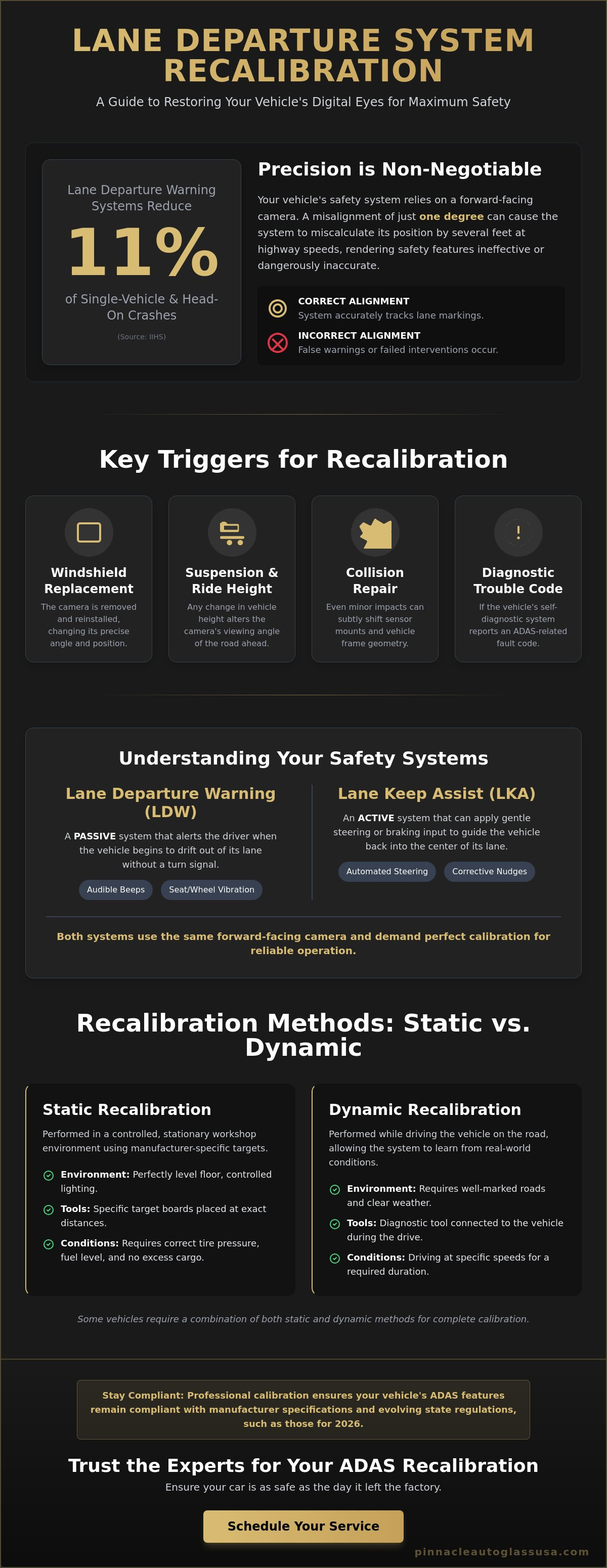
Did you know that lane departure warning systems reduce single-vehicle and head-on crashes by 11% according to the Insurance Institute for Highway Safety? This technology is a cornerstone of modern road safety, yet its effectiveness depends entirely on mathematical precision. If your camera is off by even a fraction of a degree, your safety net disappears. Professional lane departure system recalibration is the only way to ensure your vehicle's digital logic stays in sync with the physical road.
It's natural to feel uncertain after a windshield repair or a suspension adjustment. You might worry about the difference between static and dynamic methods or wonder if your insurance will cover the necessary technical work. This guide helps you master the technical requirements and safety standards for lane departure system recalibration so your vehicle remains road-ready. We'll explain the specific calibration processes, the impact of the latest 2026 state regulations, and the timeline required to restore your safety features to full manufacturer compliance. You'll gain a clear path forward to ensure your car is as safe as the day it left the factory.
Key Takeaways
- Learn why precise camera alignment is critical to keeping your lane-keep assist features functioning as intended.
- Understand the distinct requirements for static and dynamic calibration methods to choose the right service for your vehicle.
- Identify the primary triggers for lane departure system recalibration, including windshield replacement and ride height changes.
- Discover the professional protocols used to verify your vehicle’s safety systems, from initial pre-scans to final alignment checks.
- Ensure your ADAS features remain compliant with 2026 manufacturer specifications and state regulations.
Understanding Lane Departure Warning and the Need for Recalibration
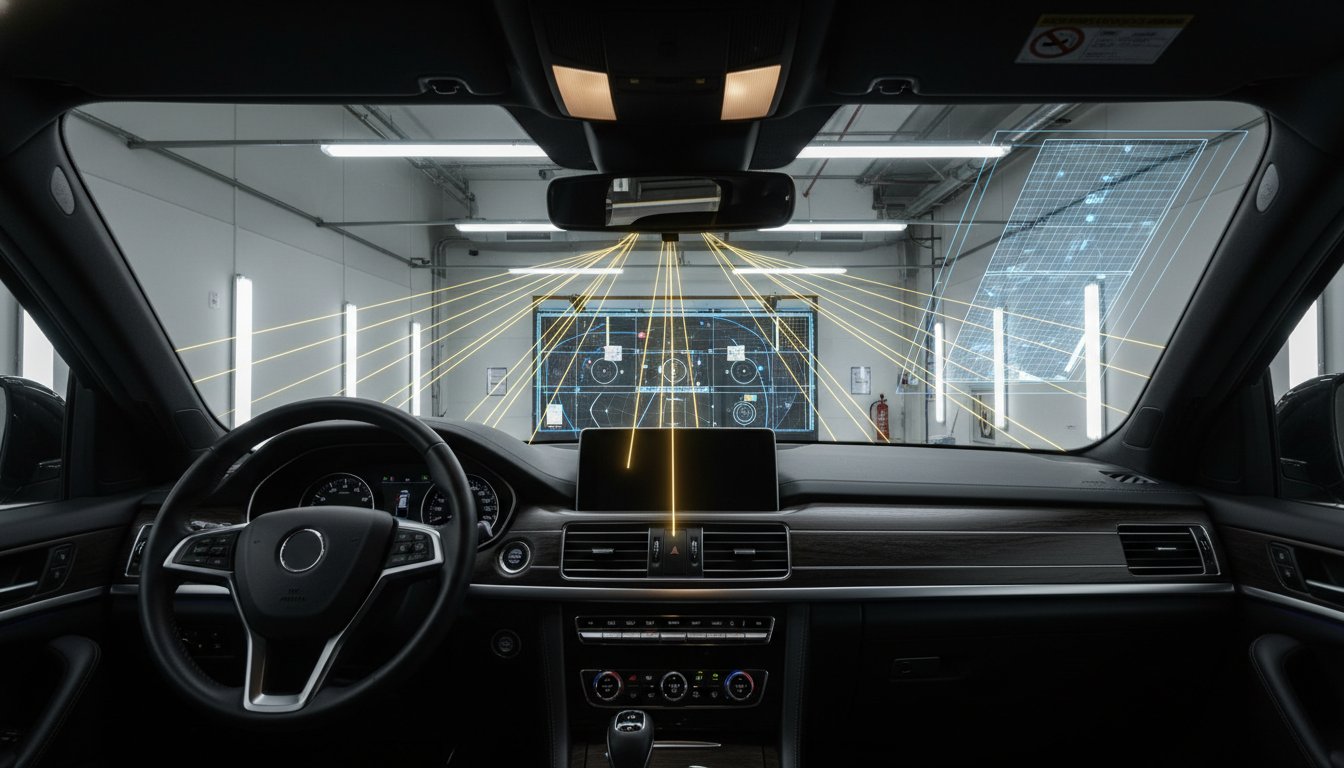
Modern vehicles rely on a complex network of sensors to keep drivers safe. At the heart of this network is the Lane Departure Warning System. This technology uses a forward-facing camera mounted behind the windshield to scan the road for lane markings and boundaries. While the software does the heavy lifting, the physical orientation of the camera provides the raw data. If the camera isn't perfectly aligned, the entire safety system fails to function correctly.
Professional lane departure system recalibration ensures the camera’s field of view matches the vehicle's centerline. This isn't just a minor adjustment. Even a one-degree offset can cause a massive error at highway speeds. At 70 miles per hour, a tiny misalignment can lead the system to believe the car is safely in its lane when it's actually drifting toward a barrier. Modern safety suites now integrate these cameras with active braking and steering. This means a miscalibrated camera doesn't just give a false warning; it could trigger an incorrect steering intervention or a sudden braking event.
LDW vs. LKA: Distinguishing the Safety Systems
Drivers often use these terms interchangeably, but they perform different functions. Lane Departure Warning (LDW) is a passive system. It provides audible beeps, steering wheel vibrations, or visual alerts when you drift. Lane Keep Assist (LKA) is an active system. It takes control of the steering to nudge the vehicle back into the lane. Despite these differences, both systems rely on the same forward-facing camera. Reliable operation for both requires identical levels of camera precision. Whether your car merely warns you or actively steers for you, lane departure system recalibration is the only way to maintain factory safety standards.
The Role of the Forward-Facing Camera
The camera acts as the vehicle’s eyes. It interprets lane markings, road edges, and even the distance to the car ahead in real-time. The vehicle’s software calculates trajectory based on the specific height and angle of the camera lens. When you replace a windshield or adjust the suspension, that physical position changes. Recalibration updates the vehicle’s internal software with the camera's new physical coordinates. This process ensures the digital logic and physical hardware are perfectly synchronized. Without this update, the software remains stuck on old data, which leads to system failures or deactivated safety features.
Static vs. Dynamic Recalibration: Restoring Your Safety System
Recalibrating a safety system isn't a one-size-fits-all procedure. Vehicle manufacturers establish strict protocols that technicians must follow to ensure the camera and software communicate accurately. Depending on your car's make and model, you'll require static calibration, dynamic calibration, or a combination of both. Pinnacle Auto Glass utilizes specialized diagnostic tools to perform these precise services, ensuring your vehicle meets every safety standard. This technical precision is vital because, as noted by the NHTSA on Driver Assistance Technologies, these systems are designed to prevent life-threatening errors, but they only work if the sensors are positioned correctly.
Understanding these methods helps clarify why professional service is mandatory. The industry is seeing a significant shift from mobile services to in-shop calibrations because of the strict environmental requirements needed for modern sensors. Professional lane departure system recalibration ensures that your car's safety features aren't just active, but accurate.
The Static Calibration Environment
Static calibration takes place inside a specialized service bay. This environment must be highly controlled to prevent even the slightest measurement error. Technicians require a perfectly level floor. Even a minor slope can throw off the camera's pitch. Lighting is equally critical; shadows or glare can prevent the camera from seeing the calibration targets correctly. We use manufacturer-specific target boards placed at exact distances from the vehicle to reset the system's logic.
Before the process begins, we verify specific vehicle parameters to ensure accuracy:
- Tire pressure must be set to factory specifications.
- The fuel tank often needs to be full or at a specific level.
- The vehicle must be empty of heavy cargo to maintain the correct ride height.
- The engine must be off, but the battery must maintain a steady voltage.
This level of detail is why states like Arizona and New York have passed legislation requiring shops to provide itemized descriptions of this work. It guarantees that the service meets or exceeds manufacturer specifications.
The Dynamic Calibration Process
Some vehicles require a road-based approach instead of, or in addition to, the shop-based method. Dynamic calibration involves driving the car under specific conditions so the system can learn its environment. A technician connects a handheld diagnostic tool to the OBD-II port to initiate the learning mode. The vehicle is then driven on roads with clear, visible lane markings at a consistent speed. The system monitors these markings to confirm the camera's alignment relative to the road's centerline.
Getting these steps right is a technical necessity, not a software preference. If you've recently had a windshield replaced or noticed a warning light, you can schedule your ADAS recalibration with our expert team. We ensure your lane departure system recalibration is performed to exact manufacturer standards so you can drive with confidence.
Key Trigger Events: When Is Recalibration Required?
Many vehicle owners mistakenly believe that safety sensors only need attention after a major collision. This assumption overlooks the precision required for these systems to function. Because the forward-facing camera is calibrated to a specific height and angle, even minor mechanical changes can disrupt its accuracy. A lane departure system recalibration is necessary whenever the physical relationship between the camera and the road is altered. Ignoring these triggers can lead to system deactivation or, worse, incorrect safety interventions while you drive.
Post-Windshield Replacement Standards
Windshield replacement is the most frequent reason for recalibration. The forward-facing camera is typically mounted directly to the interior of the glass. Even when using high-quality glass, every new pane has slightly different refractive properties than the original. These subtle differences change how light reaches the camera lens. Furthermore, the technician must remove the camera from its bracket during the glass installation. This physical movement necessitates a digital reset to confirm the camera's new "zero point." For more information on how glass quality impacts your vehicle's tech, see our guide on professional windshield replacement.
Maintenance and Mechanical Triggers
Mechanical work on your vehicle's chassis can be just as impactful as glass repair. Suspension work is a primary trigger. If you install a lift kit, lowering springs, or even new struts, the vehicle's "pitch" changes. If the nose of the car sits just half an inch lower than before, the camera’s view of the road shifts significantly. This change in ride height makes lane departure system recalibration a requirement to keep the software aligned with the pavement.
Wheel alignments and tire changes also play a role. Alignments often involve resetting the steering angle sensor. Since Lane Keep Assist (LKA) uses this sensor to determine how much steering input to apply, a mismatch between the camera and the sensor can cause the car to "ping-pong" between lanes. You should also consider recalibration if you:
- Change to a significantly different tire size, which alters the vehicle's stance.
- Experience a minor front-end collision or "fender bender" that could jar the camera mount.
- See an ADAS-related Diagnostic Trouble Code (DTC) or warning light on your dashboard.
- Have body work performed near the top of the windshield or the roofline.
Modern safety systems are highly sensitive. If you've performed any work that affects the vehicle’s height, wheel orientation, or windshield glass, a professional calibration check is the only way to ensure your safety features remain road-ready.
The Professional Recalibration Process: What to Expect
A professional lane departure system recalibration is a structured, technical service. It's far more involved than a simple sensor reset. Technicians follow a rigorous sequence to ensure the camera and software align perfectly with the road. This methodical approach guarantees that your vehicle's safety features operate exactly as the manufacturer intended. We prioritize accuracy at every stage to give you total peace of mind on the road.
The service begins with a diagnostic pre-scan. This step identifies any stored trouble codes or electrical faults that could prevent a successful calibration. After the scan, we prepare the vehicle by verifying its physical parameters. Technicians check tire pressure, fuel levels, and fluid levels to ensure the car sits at the correct factory height. Even a slight tilt can cause the camera to misread lane markings later. Once prepared, we use OEM-grade equipment to perform the physical calibration. This involves setting up specialized targets at precise distances and angles to guide the camera's logic reset.
Diagnostic Pre-Scans and Post-Scans
Pre-scans are vital because they reveal underlying issues that aren't always visible on the dashboard. They ensure the ADAS module is healthy before we start the work. After the calibration is finished, we perform a post-scan. This final diagnostic check confirms that the system is functioning within strict manufacturer tolerances. These reports serve as a digital "birth certificate" for your vehicle's safety systems. They provide essential documentation for your personal records and are often required for insurance claims. Having a clear paper trail proves that your safety features are fully restored and compliant with current standards.
Time and Equipment Requirements
Most lane departure system recalibration procedures take between 60 and 90 minutes. This timeframe allows for the careful setup of physical targets and the necessary software processing. We utilize industry-leading diagnostic platforms like Autel or Hella Gutmann to interface with your car's onboard computer. This specialized equipment is necessary to handle the complex data requirements of modern safety suites. While the camera alignment is unique, it requires the same level of technical expertise as adaptive cruise control recalibration. Both processes are essential for maintaining the integrity of your vehicle's driver-assistance technology.
Don't leave your safety to chance after a repair. You can contact us for expert ADAS recalibration to ensure your vehicle remains road-ready and fully protected.
Choosing Pinnacle Auto Glass for Expert ADAS Recalibration
Pinnacle Auto Glass acts as a seasoned professional for drivers across the country. We provide nationwide ADAS services for all vehicle makes and models. Our team understands that modern safety technology requires specialized attention. We don't just perform a generic reset. Our technicians are trained in the latest manufacturer-specific calibration protocols. This expertise ensures your safety features work exactly as designed. We prioritize your time and safety, moving you quickly from a technical need to a clear solution.
Operators of larger vehicles also find a reliable partner in our team. We provide dedicated fleet glass services and commercial truck glass support. This specialized focus ensures minimal downtime for business owners and commercial operators. Whether you manage one vehicle or a hundred, we prioritize efficiency and precision in every lane departure system recalibration we perform. We understand the high stakes of commercial safety and deliver results that keep your fleet compliant and road-ready.
Nationwide Service and Insurance Coordination
Dealing with insurance shouldn't be your job. We simplify the entire repair process by handling claims directly. Our team works with all major insurance carriers to cover the costs associated with ADAS recalibration. Because we maintain standardized pricing and procedures, you receive the same high-quality results across all our service areas. This consistency is a hallmark of our nationwide entity, giving you the focus of a local provider with the resources of a major leader.
We offer direct billing options for eligible comprehensive claims. This approach removes the financial guesswork and allows you to focus on getting back to your daily routine. We provide the itemized documentation required by current regulations in states like New York and Arizona. This transparency builds trust and ensures your insurer has all the facts needed to process your claim quickly. We act as your dependable guide through the administrative and technical hurdles of modern vehicle maintenance.
Commitment to Safety Standards
Safety is our primary metric for success. We follow strict Auto Glass Safety (ASG) and manufacturer guidelines for every service. The automotive industry changes fast, and our team stays ahead of the curve. We invest in continuous training so our technicians can handle 2026 model year technology with confidence. We don't cut corners because we know that a one-degree offset can have serious consequences at highway speeds.
A professional lane departure system recalibration is a mathematical necessity for your vehicle's safety logic. We use the right tools and the right environment to get the job done correctly. Don't risk your safety with unverified service providers or incomplete repairs. Contact Pinnacle Auto Glass today for a comprehensive ADAS safety check and ensure your vehicle remains road-ready and fully protected.
Secure Your Vehicle’s Safety for the Road Ahead
Maintaining your vehicle's safety systems is an ongoing responsibility that ensures your protection on every journey. This guide has detailed how professional lane departure system recalibration synchronizes your car's physical sensors with its digital safety logic. Precise alignment is the only way to avoid system failures or dangerous false interventions after you replace a windshield or adjust your suspension. By following manufacturer-specific protocols, you ensure that your driver-assistance technology remains a reliable safety net rather than a liability.
Pinnacle Auto Glass stands ready as your dependable partner in this technical field. Our manufacturer-trained ADAS technicians utilize OEM-grade equipment to provide nationwide service for both personal vehicles and commercial fleets. We simplify the administrative burden by offering direct insurance billing and comprehensive claim support to keep your experience efficient and stress-free. Take the next step to verify your vehicle’s integrity and restore your peace of mind.
Schedule your lane departure system recalibration with Pinnacle Auto Glass today to ensure your technology remains fully compliant and ready for the road. Drive with the confidence that comes from expert, professional care.
Frequently Asked Questions
Is lane departure system recalibration mandatory after a windshield replacement?
Yes, recalibration is mandatory following a windshield replacement. Most manufacturers require this service because the forward-facing camera is physically detached and reattached during the glass installation. Even small variations in glass thickness or camera positioning can lead to significant errors in lane detection. Skipping this step often results in the system deactivating or providing inaccurate safety alerts while you drive.
How long does the lane departure system recalibration process take?
A professional lane departure system recalibration typically takes between 60 and 90 minutes. This timeframe includes the initial pre-scan to check for system faults, the physical setup of calibration targets, and a final post-scan to verify success. Some vehicles requiring both static and dynamic methods may take longer. We prioritize accuracy over speed to ensure your safety features are fully restored to manufacturer specifications.
Will my auto insurance cover the cost of ADAS recalibration?
Most comprehensive auto insurance policies cover ADAS recalibration when it's required as part of a windshield replacement or collision repair. Since these systems are essential safety features, insurers recognize recalibration as a necessary part of the restoration process. We simplify this by working directly with major insurance carriers to manage the claims and billing. You should check your specific policy details for any deductible requirements.
Can I drive my vehicle if the lane departure system is not calibrated?
You can physically drive the vehicle, but it's not recommended until the system is calibrated. An uncalibrated camera may provide false warnings or, in vehicles with active steering, apply incorrect inputs that could lead to an accident. Many modern vehicles will disable ADAS features entirely and display a warning light if they detect a misalignment. Driving without these active safety nets increases your risk on the road.
What is the difference between static and dynamic recalibration?
Static recalibration occurs in a controlled shop environment using physical target boards and laser levels to reset the camera's logic. Dynamic recalibration requires a technician to drive the vehicle at specific speeds on roads with clear lane markings. The specific method needed depends entirely on your vehicle manufacturer's requirements. Some 2026 models and high-end brands may require both types of service to ensure full functionality.
Does a wheel alignment affect my lane departure warning system?
Yes, a wheel alignment directly impacts your lane departure and lane keep assist systems. Alignments change the steering angle sensor's data, which the vehicle uses to determine if it's traveling straight. If the camera and the steering sensor are out of sync, the lane keep assist feature may steer the car incorrectly. Performing a lane departure system recalibration after an alignment ensures all sensors are communicating accurately.
Will I get an error message if my camera needs recalibration?
You might not always see an error message or dashboard warning light. While some vehicles detect a major fault and disable the system, others may continue to operate with a slight misalignment. This is dangerous because the system may fail to alert you when you drift or provide haptic feedback at the wrong time. A professional diagnostic scan is the only way to confirm if your camera is functioning correctly.
Can any auto glass shop perform ADAS recalibration services?
No, only shops with specialized diagnostic equipment and manufacturer-trained technicians can perform these services. ADAS recalibration requires significant investment in tools like Autel or Hella Gutmann and a controlled environment with level flooring and specific lighting. Many general glass shops or mobile-only providers lack the facilities needed for static calibration. Choosing a qualified specialist ensures your safety systems meet every 2026 manufacturer standard.


