What if your car's most important safety system was off by just one degree, but it didn't bother to tell you with a dashboard light? Many drivers feel a sense of sticker shock when they see a line item for forward collision warning recalibration after a windshield replacement. It's natural to be skeptical of "software fees" or extra service charges when your vehicle seems to be driving perfectly fine. You might wonder if these requirements are truly necessary or just a way for shops to increase the final bill.
We understand that confusion. You want a vehicle that's safe and a service process that's transparent. You'll learn why recalibration is a physical alignment of safety geometry rather than a simple digital reset. We will debunk the most common industry myths that lead to safety failures in emergencies. This guide provides a clear look at how these systems function, why they require precision, and what you should expect from a professional service provider. We'll show you how to identify essential safety needs and avoid unnecessary confusion during your next service appointment.
Key Takeaways
- Understand that forward collision warning recalibration is a physical realignment of your vehicle's safety sensors, not just a simple software update.
- Discover how tiny misalignments in your camera's field of vision can lead to significant errors in how your car reacts to road hazards.
- Learn the practical differences between static and dynamic recalibration and why your specific vehicle model may require one or both methods.
- Identify the specific events that trigger a mandatory recalibration, including windshield replacement and minor front-end impacts.
- Recognize why accessing your vehicle's ADAS module requires specialized equipment and professional expertise to ensure total system reliability.
What is Forward Collision Warning Recalibration?
Recalibration is the specialized process of realigning the cameras and sensors that power your Advanced Driver Assistance Systems (ADAS). These components act as your vehicle's digital eyes. They constantly monitor the road to identify hazards, pedestrians, and other vehicles. Forward Collision Warning (FCW) specifically tracks the distance and closing speed of objects directly in front of you. If the system detects a potential impact, it alerts you to take action. Forward collision warning recalibration is the synchronization of safety hardware with vehicle geometry.
The process ensures that what the car "sees" digitally matches where the car is actually heading physically. If a camera is even slightly out of place, the data it sends to the vehicle's computer is flawed. This can lead to delayed warnings or missed detections. Proper calibration restores the factory settings required for these safety features to operate reliably. It's a fundamental step in maintaining the integrity of your vehicle's safety net.
The Myth: 'If the Light Isn’t On, the System is Fine'
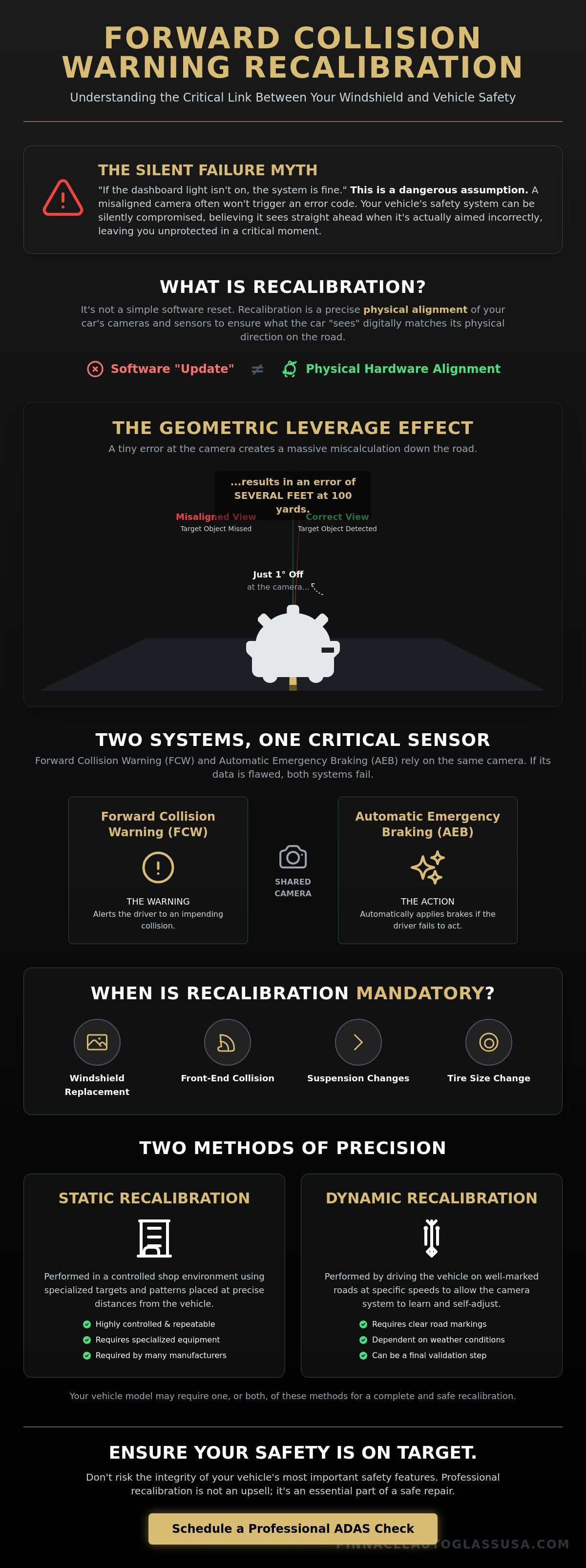
Many drivers assume their car will always alert them to a sensor issue. This isn't always the case. Sensors can be physically misaligned without triggering a Diagnostic Trouble Code (DTC) on your dashboard. Your car might not recognize that it's looking at the wrong angle. This creates a "blind" system that believes it is looking straight when it's actually angled toward the ground or the shoulder. In a critical moment, a 0.5-second window is often all you have to avoid an accident. If the system is misaligned, it may miss that window entirely, failing to provide the life-saving alert you expect. You can't rely on a dashboard light to tell you when your safety geometry is compromised.
FCW vs. AEB: Why Both Depend on Calibration
Understanding the difference between a warning and an action is vital for road safety. These features are core components of a modern Collision Avoidance System. While FCW alerts you to danger, Automatic Emergency Braking (AEB) physically applies the brakes if you don't react. Both systems usually share the same camera or radar hardware. If your camera provides inaccurate data, the AEB system cannot calculate the correct stopping distance. This lack of precision also affects lane departure system recalibration and other integrated safety tools. Performing a forward collision warning recalibration ensures that every safety layer in your vehicle works in perfect harmony to protect you.
The Physics of Misalignment: Why Millimeters Matter
Precision is not a suggestion in automotive safety. When we talk about forward collision warning recalibration, we are dealing with extreme geometric leverage. A camera shift of just one degree might seem insignificant at the mounting bracket. However, at a distance of 100 yards, that single degree causes the system to "look" several feet off-center. This discrepancy turns a reliable safety feature into a potential liability. Your car's computer makes decisions based on the data it receives. If that data is skewed by a fraction of an inch, the resulting reaction could be late or entirely misplaced.
Vehicle pitch and leveling also play critical roles in sensor accuracy. If your car isn't perfectly level during the service, your forward-facing radar will suffer from vertical inaccuracy. It might focus on the pavement or scan over the top of the vehicle ahead. This is why ADAS recalibration after windshield replacement is a non-negotiable requirement for maintaining safety glass integrity. The glass itself acts as a lens for the camera. Every windshield has a specific refractive index that dictates how light bends as it passes through to the sensor. If the glass quality is poor or the mounting is slightly off, the system's "vision" becomes blurred.
Adhering to SAE International's calibration standards ensures that these environmental and physical variables are accounted for. Professional technicians use these benchmarks to verify that every sensor is oriented exactly as the manufacturer intended. If you've recently had glass work done, it's wise to check your ADAS status to ensure your sensors are positioned correctly.
The Geometric Leverage Effect
Think of the sensor's field of view as an expanding cone. As the distance from your front bumper increases, the area covered by that cone grows significantly wider. A misaligned sensor often begins to track a car in the adjacent lane instead of the one directly in your path. This error creates a high risk of "false positives." Your vehicle might initiate unnecessary and dangerous emergency braking because it incorrectly identifies a nearby car as an immediate obstacle. This sudden deceleration can catch following drivers off guard and lead to rear-end collisions.
OE Specifications and Mounting Tolerances
Manufacturers define a strict "zero-point" for their specific safety suites. This serves as the baseline for all distance and speed calculations. Aftermarket glass sometimes lacks the precise mounting brackets found on OEM parts, which can easily throw off this baseline. This is why safe windshield replacement standards include such rigorous mounting checks. Even a tiny vibration or a loose bracket can compromise the system. Ensuring your hardware meets original equipment (OE) specifications is the only way to guarantee that your forward collision warning recalibration provides the protection you need on the road.
Static vs. Dynamic Recalibration: Which Does Your Car Need?
There is a common misconception that one calibration method is superior to the other. In reality, the vehicle manufacturer dictates the specific process required for your car. Forward collision warning recalibration is not a "one-size-fits-all" service. Some vehicles require a static procedure in a shop, while others need a dynamic drive on the road. A growing number of modern vehicles actually require a dual calibration. This involves completing both methods to ensure the safety system is fully functional.
The necessity of these precise procedures is highlighted in an IIHS study on ADAS repair complications. This research shows that even common repairs can compromise safety systems if they aren't handled with professional-grade precision. Whether your car needs a static or dynamic approach, the goal remains the same: total alignment of your safety hardware with the road ahead. Skipping these steps can leave your vehicle's most critical safety features in a degraded state.
The Static Calibration Environment
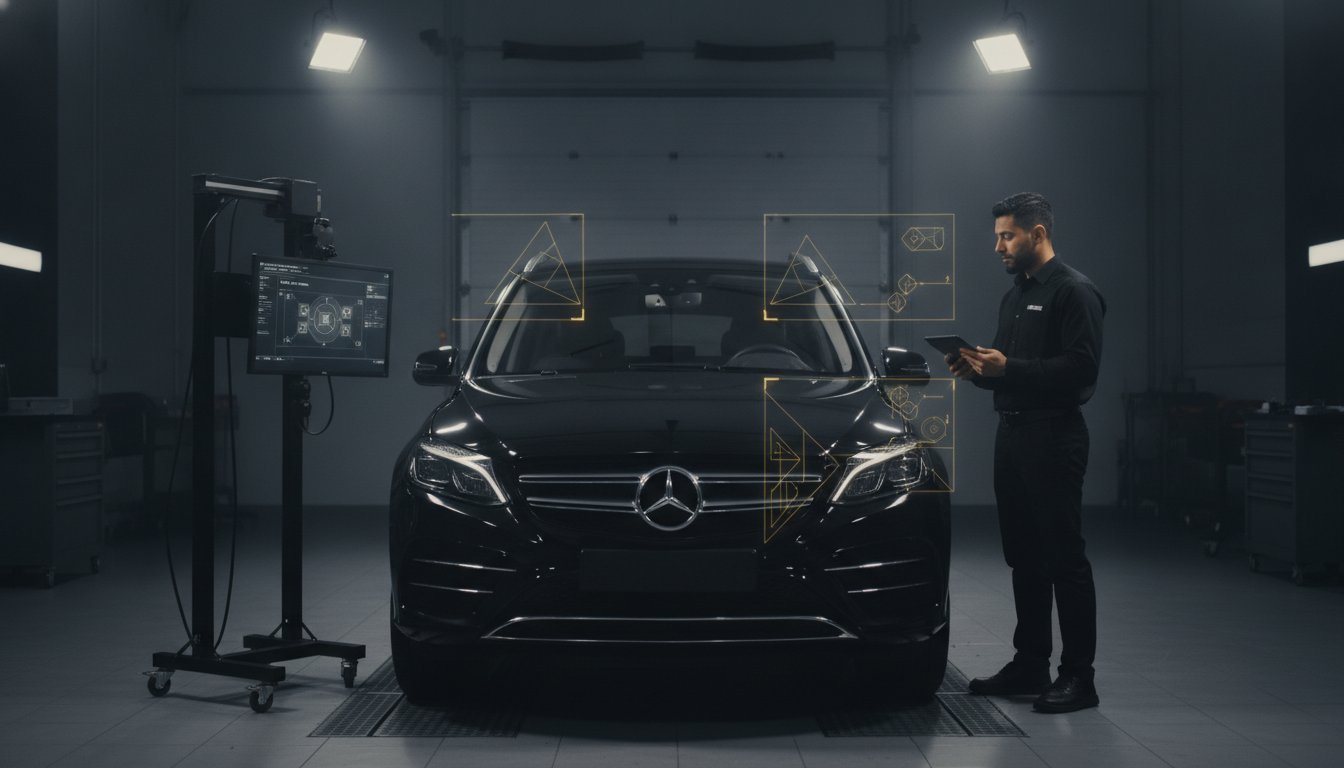
Static calibration takes place in a highly controlled workshop environment. This process uses specialized targets and high-precision lasers to align the sensors. The shop must meet strict criteria for level flooring and specific lighting conditions. Technicians also require a neutral background to prevent the camera from picking up visual "noise." These requirements mean you can't perform a proper calibration in a standard driveway or a home garage. The vehicle’s camera must "learn" to recognize specific geometric patterns on the targets to set its baseline accurately. This environment removes the variables of the outside world to ensure absolute precision.
The Dynamic Calibration Drive
Dynamic calibration involves a specific test drive using a diagnostic tool connected to the vehicle's computer. The car must be driven at consistent speeds on roads with clear, visible markings. During this drive, the vehicle's computer uses real-world landmarks and lane lines to set its horizon and calculate distances. This process relies heavily on ideal conditions. A dynamic calibration often fails if the weather is poor, the sun is too low, or the lane lines are faded. It's a methodical process that ensures the system reacts correctly to the actual environment you drive in every day. Without these specific parameters, the computer can't finalize the calibration sequence.
When is Forward Collision Warning Recalibration Required?
Many drivers believe their safety systems are permanent fixtures that never need adjustment. In reality, these systems are highly sensitive to any physical change in the vehicle's posture. A forward collision warning recalibration is required whenever a component affecting the sensor's field of vision is moved or modified. This includes routine services that many owners overlook. Maintaining the precise alignment of these sensors is the only way to ensure they function as intended during an emergency.
Specific events that trigger a mandatory recalibration include:
- Any windshield replacement involving a camera-mounted area.
- Minor collisions, such as a "fender bender" that disturbs the front grille or bumper.
- Suspension repairs or wheel alignments that alter the vehicle's stance.
- Changes to ride height, including new tire sizes or the installation of leveling kits.
If your vehicle has undergone any of these changes, your safety systems may be compromised. It's a standard requirement to book an ADAS recalibration to verify your sensors are still tracking the road correctly.
The Post-Windshield Replacement Mandate
When a technician replaces your glass, they must remove the camera from its original bracket and reattach it to the new windshield. Even a microscopic shift during this process can change the sensor's pitch or yaw. Minute variations in glass thickness or curvature can also distort the camera's view of the road. Skipping this step can have serious legal and insurance implications. Most insurance carriers require proof of calibration to finalize a glass claim. It's a matter of liability and ensuring the vehicle meets original safety standards for occupant protection.
Suspension and Alignment Changes
The "Thrust Angle" is a critical concept in vehicle geometry. It refers to the direction the rear wheels are pointing in relation to the center of the car. If your rear alignment is off, it forces the front of the car to compensate. This shift changes where your front-facing camera is looking. A sagging suspension or a leveling kit also tilts the sensor's horizon. Without a forward collision warning recalibration, your car might "see" the road surface as a stationary obstacle. This often leads to abrupt, unprompted braking that can startle the driver. Recalibration is the final, essential step in any comprehensive front-end repair or stance modification.
Professional ADAS Solutions: The Pinnacle Approach
Professional-grade diagnostic tools are mandatory to access a vehicle's ADAS module effectively. A successful forward collision warning recalibration relies on more than just physical alignment; it requires deep digital integration. These safety systems are protected by manufacturer firewalls that standard consumer tools simply cannot penetrate. We utilize advanced diagnostic platforms to communicate directly with your car's onboard computer. This allows our technicians to verify that every sensor is active and reporting data correctly. Without this professional level of access, a system might appear functional while remaining fundamentally misaligned.
Pinnacle Auto Glass is dedicated to restoring vehicle safety to exact factory specifications. We recognize that modern safety technology is a complex web of interconnected parts. Our certified technicians understand the specific nuances of adaptive cruise control recalibration and how it interacts with other front-facing systems. By providing a comprehensive service, we reduce downtime for both individual drivers and commercial fleets. We focus on getting you back on the road quickly with the confidence that your safety net is fully restored. Precision is our baseline for every vehicle we service.
Expertise vs. General Mechanics
Interpreting ADAS calibration reports requires specialized training that general mechanics often don't possess. A standard OBD-II scanner is useful for checking engine lights, but it's insufficient for safety system alignment. These sensors require specific environmental triggers and precise digital handshakes to finalize their setup. Our team specializes in this intersection of automotive glass and advanced technology. Handling both the physical glass replacement and the technical recalibration in one visit ensures total system integrity. It removes the need for multiple appointments and ensures your vehicle's safety is managed by experts who understand the entire hardware-software relationship.
Your Path to a Safer Drive
The final step in any professional service is verification. You should always receive clear documentation showing that the recalibration was successful. This report serves as proof that the system passed all manufacturer-mandated tests and is ready for real-world use. This documentation is also vital for insurance records and future vehicle valuations. The ultimate goal is the peace of mind that comes from knowing your FCW will act during a critical moment. You don't have to wonder if the technology will fail when you need it most. Take the proactive route for your safety. Schedule your professional ADAS assessment today to ensure your vehicle meets the highest standards of road readiness.
Secure Your Vehicle's Safety Future
Precision is the foundation of modern automotive safety. You now understand that even a minor shift in sensor alignment leads to significant errors at highway speeds. Whether your vehicle requires static or dynamic procedures, the goal is to ensure your "digital eyes" are perfectly synchronized with the physical road. Maintaining a regular schedule for forward collision warning recalibration is essential for any driver who values reliability and technical accuracy. It's the only way to guarantee that your vehicle's safety features operate exactly as the manufacturer intended.
Our team of expert ADAS certified technicians is ready to restore your vehicle to factory specifications. We provide nationwide service for personal and fleet vehicles, ensuring every car we touch meets the highest safety standards. You will receive comprehensive safety reporting with every service to verify your system's integrity. Schedule your professional ADAS recalibration with Pinnacle Auto Glass today. Drive with the confidence that your safety systems are ready to act when you need them most.
Frequently Asked Questions
Can I drive my car before the forward collision warning is recalibrated?
You can physically drive your vehicle before recalibration, but your safety systems will be unreliable or completely non-functional. The onboard computer may provide inaccurate warnings or fail to engage emergency braking during a critical moment. It is best to treat the vehicle as if it lacks these safety features until a professional completes the alignment. Avoid relying on any automated assistance until the service is finalized to ensure your safety on the road.
How much does forward collision warning recalibration usually cost?
The cost of the service depends on your vehicle's specific make and model and whether it requires static, dynamic, or dual calibration. Different manufacturers have unique requirements for specialized targets and proprietary diagnostic software. You should consult with an ADAS specialist to get an accurate estimate based on your car's specific safety suite. Most independent specialists offer competitive rates that are more accessible than traditional dealership fees for the same precision work.
Will my insurance cover the cost of ADAS recalibration?
Insurance providers typically cover the cost of the service when it is part of a covered repair, such as a windshield replacement. Since forward collision warning recalibration is a manufacturer-mandated safety requirement, it is generally treated as an essential part of the restoration process. We recommend checking with your insurance agent to confirm the specifics of your policy and any applicable deductibles. Most professional shops can assist with the documentation needed for your claim.
How long does a typical recalibration service take?
A typical recalibration service takes between one and two hours to complete. This timeframe varies based on whether the vehicle needs a static setup in a controlled shop environment or a dynamic drive on the road. Some complex systems requiring a dual calibration process may take slightly longer to finalize. We prioritize efficiency to minimize your downtime while ensuring every safety check is performed to factory standards with professional-grade diagnostic tools.
What happens if I choose to skip the recalibration after a windshield replacement?
Skipping recalibration leaves you with a system that may provide false alerts or fail to react during a collision. This creates a significant safety risk for you and your passengers because the camera's "vision" is no longer aligned with the vehicle's path. Additionally, you may face legal liability or insurance claim denials if an accident occurs and the safety systems were intentionally left uncalibrated. It is a non-negotiable step for maintaining vehicle roadworthiness.
Does every new car have a forward collision warning system that needs calibration?
Most new vehicles feature these systems, and a finalized NHTSA rule requires automatic emergency braking on all new passenger vehicles by September 2029. Currently, over 90% of new models include some form of forward-facing safety technology. If your car has a camera mounted behind the rearview mirror or sensors in the front grille, it likely requires professional calibration after specific repairs, suspension work, or changes to the vehicle's ride height.
Can any auto glass shop perform ADAS recalibration?
Not every shop has the specialized diagnostic tools and certified training required for ADAS services. Many general glass shops only handle the physical replacement and lack the precision targets or software needed for a successful forward collision warning recalibration. You should choose a provider that offers integrated glass and technology services. This ensures that your hardware and software are handled by experts who understand the entire safety ecosystem and follow OEM procedures.
Will a misaligned FCW system always show a warning light on the dash?
A misaligned system will not always trigger a dashboard warning light or a fault code. The vehicle's computer often assumes the camera is positioned correctly even if it is off by a few degrees. This is the danger of a "silent" failure where the system seems fine but misses critical obstacles. You cannot rely on your dashboard to confirm the accuracy of your safety sensors. Only a formal recalibration process can verify that the system is truly aligned.


