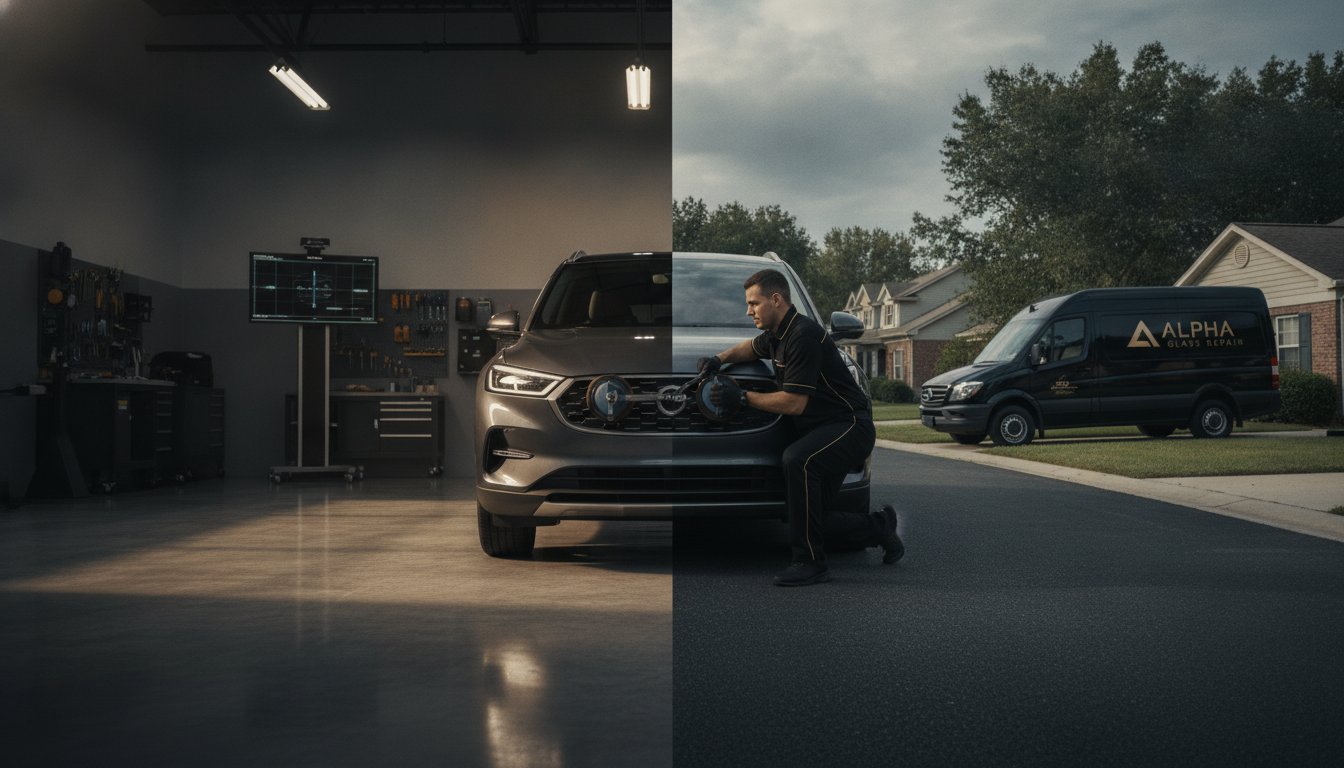
The most convenient way to fix your vehicle might be the one that compromises your safety systems. Most drivers choose mobile glass repair because it fits into a busy schedule without a trip to the shop. It's a logical choice when you want to minimize downtime. However, modern vehicle technology has changed the requirements for a successful repair. A windshield contributes up to 60% of your cabin's structural strength in a rollover accident. This means the environment where the work happens is just as important as the glass itself.
You deserve to know if an on-site service can actually meet the technical standards your car requires. Discover the critical differences between mobile and in-shop solutions so you can choose the safest, most efficient option for your vehicle. We'll examine how weather affects adhesive quality, why ADAS recalibration often requires a controlled shop environment, and how 2026 safety mandates in states like Texas and New York impact your repair choices. This guide provides the clarity you need to ensure your safety systems work exactly as intended.
Key Takeaways
- Learn how to minimize vehicle downtime by choosing professional on-site services for personal or fleet vehicles.
- Compare the technical requirements of mobile glass repair against in-shop environments to determine the safest option for your specific needs.
- Understand why ADAS recalibration is a non-negotiable safety step following any windshield replacement.
- Identify the essential vehicle details, such as VIN and safety features, required to streamline your next glass service appointment.
- Discover how specialized commercial glass solutions help logistics teams maintain delivery schedules and maximize uptime.
Understanding Mobile Glass Repair: Convenience Without Compromise
Mobile glass repair is a specialized service designed to bring professional windshield restoration and replacement directly to your location. Instead of rearranging your schedule to visit a facility, a certified technician arrives at your home or office with a fully equipped vehicle. The primary goal of this service is to minimize vehicle downtime. This is especially critical for professionals and families who can't afford to lose a car for a full day. Modern mobile units function as mobile workshops. They carry the same precision tools found in brick-and-mortar locations to ensure every installation meets factory safety standards.
Before you schedule an appointment, it's vital to assess the specific types of windshield damage your vehicle has sustained. Small chips can often be filled quickly, while larger cracks usually require a total replacement. Providing accurate details during the booking process allows the technician to arrive with the correct glass and materials. Clear communication upfront prevents delays and ensures the technician is prepared for your specific vehicle make and model.
The Scope of Mobile Services
Most standard glass needs are suitable for on-site resolution. Professional technicians can handle a wide range of tasks without needing a bay. Common mobile services include:
- Rock chip repair to prevent cracks from spreading.
- Full windshield replacement using high-quality glass.
- Side window replacement after a break-in or accident.
- Rear glass installation for cars, trucks, and SUVs.
Professional mobile units utilize high-grade urethane adhesives that cure quickly. These are the same industrial-strength bonding agents used in physical shops. The integrity of Vehicle glass is essential for the structural safety of your car. Using a mobile service doesn't mean you're getting a lower grade of material. It simply means the shop has invested in the logistics to bring that quality to your driveway.
Why Drivers Choose On-Site Repair
Convenience is the most obvious benefit. Safety is often the most important factor. Driving a vehicle with a severely cracked windshield is dangerous. Obstructed vision increases the risk of an accident. A compromised windshield may not provide adequate support during a collision. Professional mobile glass repair eliminates the need to drive a damaged vehicle through traffic. You also gain the benefit of oversight. You can speak directly with the technician at your own driveway or parking lot. This direct communication ensures all your questions are answered before the vehicle is returned to service. It's a transparent process that prioritizes your time and safety.
Mobile vs. In-Shop Service: A Comparative Analysis
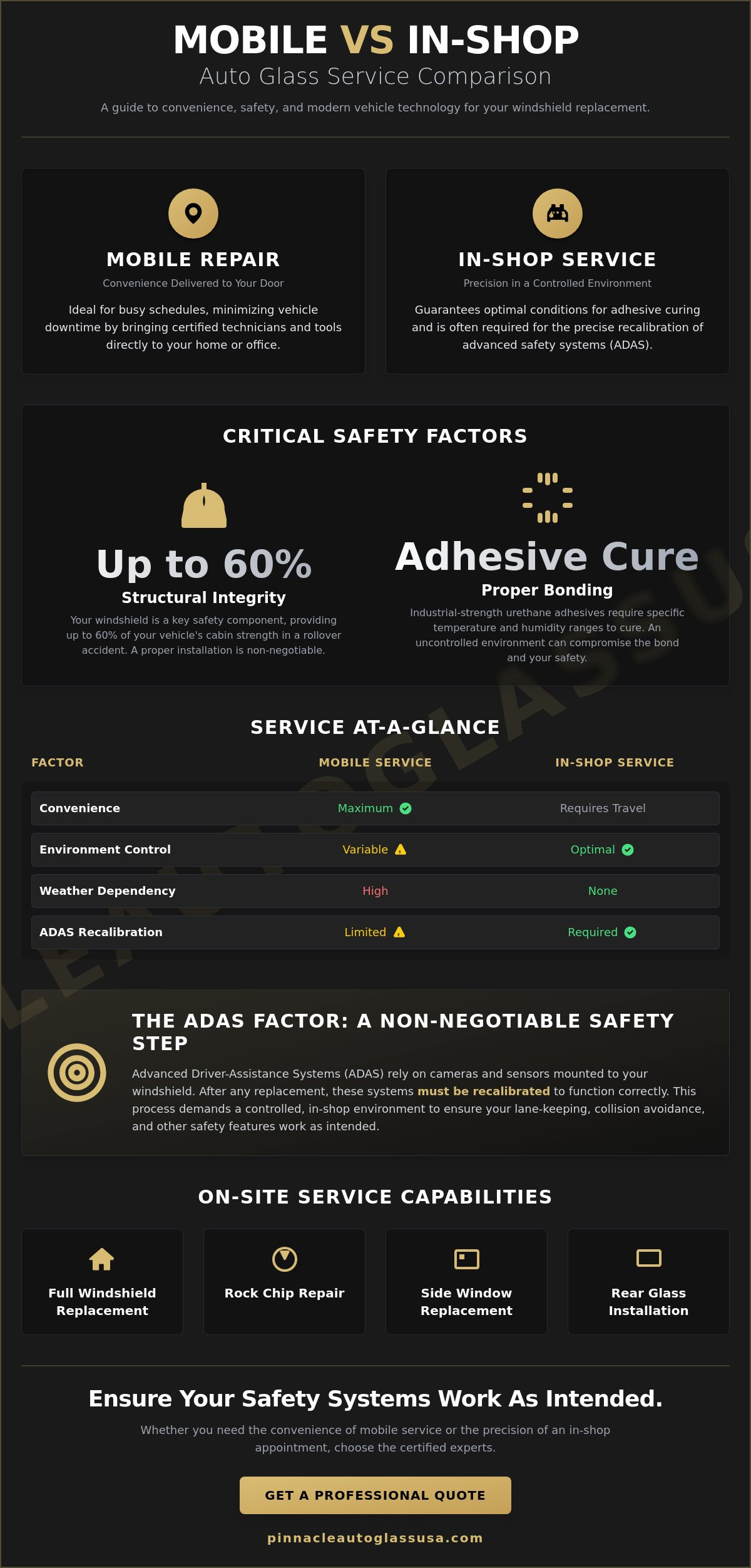
Choosing between a mobile unit and a physical shop depends on technical requirements and your personal schedule. A physical shop offers a controlled environment with level surfaces and stable lighting. Mobile service brings that same expertise directly to your driveway. Many drivers assume that mobile glass repair carries a premium surcharge. In reality, professional providers often price both options identically to ensure safety is accessible to everyone. The primary difference lies in environmental control rather than the quality of the glass itself.
Curing time is a major factor in the decision process. Adhesives require specific temperature and humidity ranges to bond correctly. A shop environment allows for consistent curing regardless of the weather outside. Mobile technicians must account for wind, dust, and direct sunlight during the installation. They often use specialized equipment to shield the work area from these variables. Following the Repair of Laminated Auto Glass Standard (ROLAGS) ensures that the structural integrity of the glass is restored according to industry safety benchmarks. This standard applies whether the work happens in a dedicated bay or on a curb.
Speed is another variable to consider. Mobile service is significantly faster for the vehicle owner because it eliminates the commute and the wait in a lobby. You can continue working or relaxing while the technician completes the job. However, in-shop service is more predictable for the technician. They have immediate access to every specialized tool and a steady power supply. If you need a fast resolution without leaving your home, you can request a quote for mobile service to see which option fits your vehicle's specific needs.
When In-Shop Service is Necessary
Some technical tasks require a brick-and-mortar facility. Static ADAS recalibration is a primary example. This process requires a perfectly level floor and precise distances for sensor target placement. A sloped driveway or a cramped parking garage won't provide the necessary accuracy. Extreme weather also dictates a shop visit. If it's raining or the temperature is below freezing, a mobile setup might not provide enough protection for the adhesive to cure safely. Luxury vehicles with complex panoramic roofs or specialized sensors often benefit from the heavy-duty equipment found only in a shop setting.
The Superiority of Mobile for Routine Fixes
Routine maintenance is where mobile glass repair excels. Rock chip repairs are quick and require minimal equipment. A technician can often complete the job in under 30 minutes at your office parking lot. Standard windshield replacements on vehicles without advanced sensors are also ideal for mobile work. It removes the logistical headache of finding a ride home from a shop. You simply hand over the keys and return to your day while the professional handles the rest.
The Role of ADAS Recalibration in Mobile Glass Services
Modern vehicles are essentially computers on wheels. When you replace a windshield, you're doing more than just swapping a piece of glass. You're moving the "eyes" of your car. Advanced Driver Assistance Systems (ADAS) rely on cameras and sensors mounted directly to the glass. If these components aren't perfectly aligned, features like lane-keep assist or automatic emergency braking won't function correctly. Professional mobile glass repair must include a strategy for ADAS calibration auto glass to keep these systems active. Skipping this step compromises your safety. A camera that's misaligned by even a single millimeter can result in a system that misses an obstacle by several feet on the road.
A common question from vehicle owners is whether a technician can accurately calibrate a car in a driveway. The answer depends entirely on your vehicle's specific technical requirements. Some systems are designed for on-site calibration, while others demand a specialized facility. A reputable provider will analyze your vehicle's VIN to determine the correct path forward. This prevents you from driving away with safety systems that are technically present but functionally blind. Adhering to the standards established by the Auto Glass Safety Council ensures that every technician follows strict protocols for sensor alignment and software verification.
Dynamic vs. Static Recalibration
Recalibration methods fall into two main categories. Dynamic recalibration is highly compatible with mobile service. The technician connects a diagnostic device to your car's computer and drives the vehicle at a specific speed on well-marked roads. The system "learns" its position relative to the environment during this drive. Static recalibration is more restrictive. it requires a perfectly level floor, controlled lighting, and physical targets placed at precise distances from the vehicle. Because most driveways are sloped or uneven, static calibration is typically performed in a shop. Mobile units excel at dynamic recalibration for many modern models, bringing the necessary software directly to your location.
Safety Standards for Mobile Tech
Precision is the priority for on-site services. Technicians must use advanced diagnostic tablets to interface with your car's onboard computer. This task requires specialized training to navigate complex safety software. It's not just about the installation; it's about the data. Every professional mobile glass repair should conclude with a comprehensive digital safety check. The technician verifies that the camera is securely seated and that the computer confirms all sensors are active. This rigorous process ensures your vehicle's safety features are ready to respond in an emergency.
Preparing Your Vehicle for a Mobile Glass Repair Appointment
Preparation is the key to a seamless service experience. While the technician brings the tools and expertise, you provide the workspace. A successful mobile glass repair appointment starts long before the service truck arrives in your driveway. You must ensure the vehicle is accessible and that all technical details have been verified to avoid part mismatches. This proactive approach minimizes downtime and ensures the technician can focus entirely on the quality of the installation.
Start by clearing any personal items from the dashboard and the front seats. The technician needs unobstructed access to the interior side of the windshield to properly set the glass and connect any sensors. You should also ensure a point of contact is available at the start and end of the appointment. This person will provide the keys, confirm the scope of work, and handle the final payment or insurance documentation. If you have your VIN ready and need to schedule, book your mobile glass repair today to secure your preferred time slot.
Environmental and Space Requirements
Technicians require a specific work environment to guarantee a safe installation. You should park the vehicle on a flat, level surface. Ensure there is at least 5 feet of clearance on all sides of the car. This space allows the professional to maneuver large pieces of glass safely without risking damage to the vehicle or surrounding property. Driveways and large parking lots are ideal, while cramped street parking should be avoided.
Weather also plays a critical role in the bonding process. High-grade urethane adhesives require specific temperature and moisture ranges to cure effectively. If rain or extreme heat is forecasted, a carport or garage is necessary to maintain a dry work area. If an indoor space isn't available, the appointment may need to be rescheduled to protect the integrity of the seal. Direct sunlight can also cause the glass to expand, so a shaded area is always preferred for better adhesive performance.
Information Your Technician Needs
Providing the correct vehicle data ensures the technician arrives with the right parts. Your Vehicle Identification Number (VIN) is the most reliable source of information. It identifies the exact trim level and factory-installed features. You should specifically note if your windshield includes:
- Rain sensors for automatic wipers.
- Lane departure warning cameras or other ADAS features.
- Heated glass elements or wiper de-icers.
- Heads-up display (HUD) projections.
Knowing these details prevents the frustration of a technician arriving with the wrong glass. You should also verify your insurance claim status beforehand. Having your claim number and insurance card ready speeds up the administrative process. This allows the technician to complete the digital safety checks and get your vehicle back on the road faster.
Professional Mobile Glass Solutions for Personal and Fleet Vehicles
Commercial logistics depend on every vehicle being road-ready. A cracked windshield on a delivery van or a semi-truck isn't just a safety hazard; it's a bottleneck for the entire supply chain. Specialized mobile glass repair addresses these high-stakes needs by bringing the shop to the fleet yard or the loading dock. This ensures that safety standards remain high without sacrificing the tight schedules required by national logistics providers. Whether you manage one car or a hundred, the goal remains the same: fast resolution with zero compromise on safety.
Managing a fleet requires a focus on efficiency and cost control. Sending a heavy-duty vehicle to a physical shop often results in "deadhead" miles. These are unproductive miles driven specifically for maintenance that consume fuel and driver hours. On-site service eliminates this waste. It allows technicians to perform windshield replacements while the vehicle is already stationary for loading or driver rest periods. Consistency is another major advantage. National logistics providers need the same high safety standards applied to every van in their network. Professional fleet services provide a unified approach to ADAS recalibration and glass quality. This ensures every vehicle meets federal safety regulations regardless of its location. Handling specialized glass for box trucks and heavy-duty vehicles requires specific equipment and expertise that standard consumer shops may lack.
Commercial and Fleet Management Benefits
Efficiency in fleet management is measured by uptime. When a vehicle is out of service, it's not generating revenue. On-site glass solutions allow for repairs to happen during scheduled downtime. This proactive maintenance prevents small chips from turning into costly, time-consuming cracks that take a vehicle off the road unexpectedly. It also simplifies the administrative side of vehicle care. Fleet managers can coordinate services across multiple regions through a single point of contact. This level of organization is essential for maintaining the operational integrity of a large-scale delivery network.
The Pinnacle Commitment to Quality
Choosing a partner for vehicle maintenance requires trust. Pinnacle Auto Glass acts as an authoritative expert for both individual owners and large-scale commercial clients. We prioritize technical accuracy in every installation. Our technicians use high-quality materials that meet or exceed original equipment standards. We understand that your time is valuable. Our scheduling process is designed to be fast and direct. You get a clear path forward without unnecessary delays. By acting as a seasoned professional partner, we simplify the complex task of maintaining vehicle safety systems. This organized approach ensures that no vehicle is left vulnerable due to glass damage. Don't let a small chip become a major logistical hurdle. Schedule your professional mobile glass repair today to keep your vehicle or your fleet moving safely.
Choose the Safest Path for Your Vehicle Recovery
Maintaining your vehicle's safety systems requires a balance of technical expertise and environmental control. You now have the information needed to decide between on-site convenience and the controlled setting of a shop. While on-site service offers a fast resolution to damage, it must be executed with precision to ensure your safety features remain functional. Whether you're managing a large-scale logistics network or a single car, the focus should always be on quality and structural integrity.
We provide national service coverage delivered by certified technicians. Our team specializes in both fleet and personal vehicle care, ensuring every installation meets rigorous safety benchmarks. Every windshield replacement we handle includes professional ADAS recalibration to keep your safety systems active and accurate. Don't let glass damage disrupt your operations. You can Get a Quote for Mobile Glass Repair to see how we simplify complex technical tasks for you. We look forward to getting you back on the road with total confidence.
Frequently Asked Questions
Can mobile glass repair be done in the rain or snow?
Mobile glass repair requires dry conditions to ensure the adhesive bonds correctly to the vehicle frame. Technicians cannot perform installations in active rain or snow without a covered area like a carport or garage. Moisture interferes with the chemical curing process of the urethane. If the weather is inclement and no shelter is available, your appointment will be rescheduled to maintain safety standards.
How long does a mobile windshield replacement take to dry?
The adhesive used during a windshield replacement typically reaches a Safe Drive-Away Time within 30 to 60 minutes. This period allows the high-grade urethane to bond sufficiently to hold the glass in place during a collision. Your technician will provide a specific time based on the humidity and temperature at your location. It's essential to respect this window to ensure your structural safety is not compromised.
Is there an extra fee for mobile glass service compared to in-shop?
Professional auto glass providers often offer mobile service at the same price as in-shop repairs to ensure safety is accessible. While some third-party sources mention potential surcharges, many national providers prioritize convenience to prevent drivers from operating vehicles with obstructed vision. You should verify your specific quote during the booking process to confirm that no hidden fees apply to your on-site service.
Do I need to be present for the entire mobile glass repair appointment?
You only need to be present at the beginning and the conclusion of the service visit. The technician requires you to provide the keys and confirm the vehicle details before the work starts. Once the installation is finished, you'll need to sign the final paperwork and handle any payment or insurance documentation. You don't need to supervise the entire process while the technician works.
Can you perform ADAS recalibration on a mobile basis?
Dynamic ADAS recalibration is frequently performed on a mobile basis using specialized diagnostic tools and a calibration drive. The technician connects a device to your vehicle's computer and drives it on well-marked roads to align the sensors. However, if your car requires static recalibration with physical targets and a level floor, you'll need to visit a physical shop for the most accurate results.
Will my insurance cover mobile glass repair services?
Most comprehensive insurance policies cover mobile glass repair as part of your standard glass coverage. In states like Florida, Arizona, Kentucky, and South Carolina, laws often mandate zero-deductible windshield replacement for policyholders. We work directly with major insurance providers to handle the claim process for you. This ensures the administrative side is as efficient as the physical repair itself.
What kind of warranty comes with mobile auto glass service?
Professional mobile services typically include a lifetime warranty that covers the workmanship and the materials used. This warranty protects you against air leaks, water leaks, or manufacturer defects in the glass for as long as you own the vehicle. If you encounter any issues with the seal or the installation quality, a technician will return to your location to resolve the problem at no additional cost.
How soon can I drive my car after a mobile windshield replacement?
You can usually drive your car 60 minutes after the technician completes the installation. This is the standard Safe Drive-Away Time required for modern adhesives to cure enough for road use. Driving too soon can cause the glass to shift, which might lead to leaks or the failure of safety sensors. Always wait for the technician's final confirmation before moving the vehicle.


