

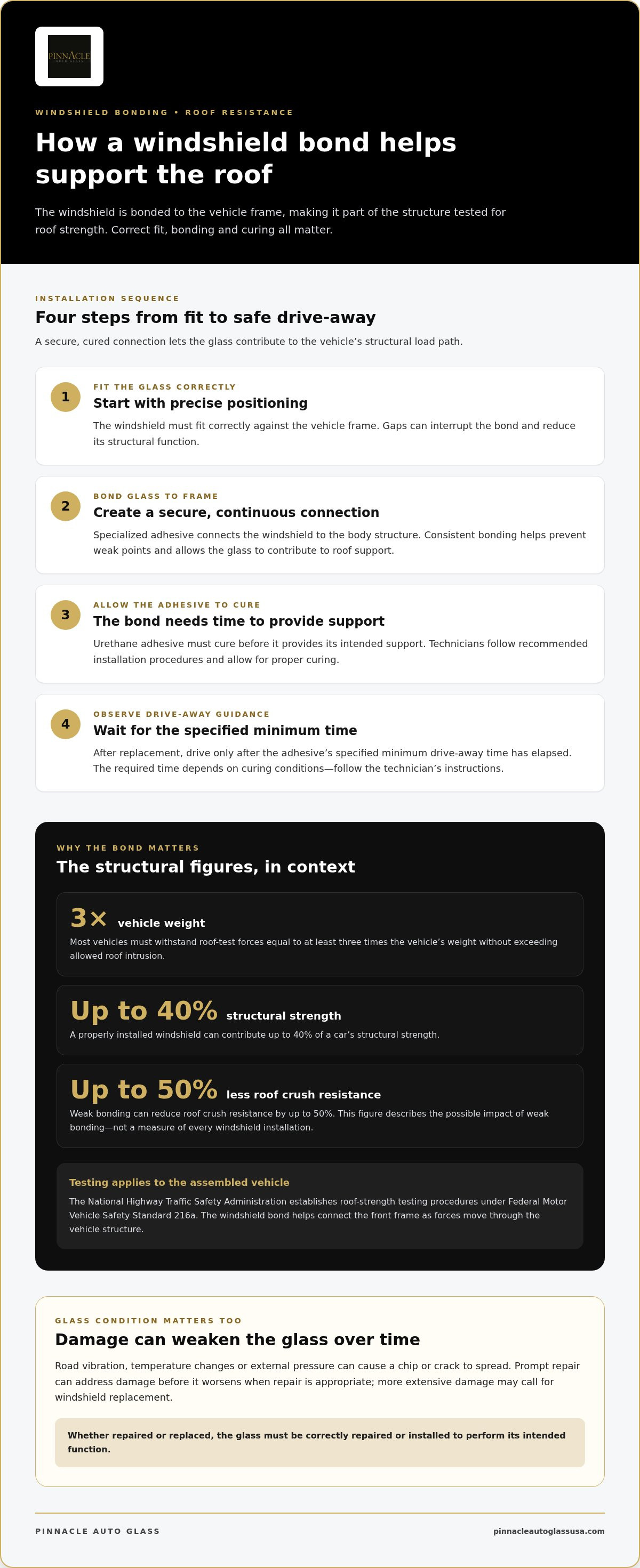
A windshield is part of the vehicle’s structural load path, not just a barrier against wind and debris. Most vehicles must withstand roof-test forces equal to at least three times the vehicle’s weight without exceeding the allowed roof intrusion. A weak or improperly installed windshield can reduce roof crush resistance by up to 50%, underscoring the importance of windshield structural integrity.
It’s easy to think of the windshield as simply a window, but its bonded connection to the frame also helps support the roof and maintain the passenger cabin during a crash. This article explains how that bond contributes to roof resistance, supports the cabin and airbag deployment, and why damage or poor installation can affect the vehicle’s structural load path. You’ll also learn when windshield repair may be appropriate and when replacement is needed.
Key Takeaways
- The windshield’s bonded connection helps transfer forces through the vehicle’s structural load path, including during a rollover.
- Proper installation and adhesive curing matter because the windshield must be securely bonded to the vehicle frame.
- The windshield supports the passenger cabin and provides a surface that helps airbags deploy as intended.
- Chips and cracks can worsen with road vibration and temperature changes, so prompt attention can help limit further damage.
- Learn how windshield repair, replacement, and ADAS recalibration address different glass and vehicle-system needs.
What Role Does the Windshield Play in Maintaining a Vehicle’s Roof Crush Resistance?
A windshield contributes to roof resistance through its adhesive bond with the vehicle frame. Roof-strength testing evaluates the fully assembled vehicle, so the windshield and its bond are part of the tested structure.
Most vehicles must withstand roof-test forces equal to at least three times the vehicle’s weight without exceeding allowed roof intrusion. A properly installed windshield can contribute up to 40% of a car’s structural strength. Weak bonding can reduce roof crush resistance by up to 50%, making installation quality a safety factor, not just a finish detail.
Installation Quality and Adhesive Bonding
Proper installation means fitting the windshield correctly and bonding it securely to the vehicle frame with specialized adhesive. The adhesive connects the glass to the body structure, allowing the windshield to contribute to roof support. During replacement, correct positioning and consistent bonding help prevent weak points. A precise fit matters because gaps can interrupt the bond and reduce its structural function.
Bond Strength and Curing
Urethane adhesive bond strength refers to the cured adhesive’s ability to hold the windshield against the frame. The adhesive must cure before it provides its intended support. Technicians follow recommended installation procedures and allow for proper curing rather than treating the glass as ready immediately after fitting. This matters on the road because an incomplete bond can compromise the windshield’s contribution to the vehicle’s structure.
Safety Standards for Installation
For roof-strength testing, the National Highway Traffic Safety Administration establishes procedures under Federal Motor Vehicle Safety Standard 216a. This standard addresses roof testing, while recommended installation procedures cover correct bonding and adhesive curing. After windshield replacement, drive only after the adhesive’s specified minimum drive-away time has elapsed. The required time depends on the adhesive’s curing conditions, so follow the technician’s instructions for that installation.
Roof-strength tests apply force to a fully assembled vehicle, not to the roof alone. The windshield’s bond helps connect the front frame, so the test reflects how vehicle components work together. If the bond fails, the glass can no longer help distribute loads across the front frame, and the roof may deform more. Proper installation supports the designed load path during a rollover.
Adhesive quality and curing work together. The adhesive must create a continuous bond, and it needs enough time to cure so that bond can hold. For example, an unevenly seated windshield or incomplete adhesive coverage can leave a weaker connection than a correctly fitted, fully bonded windshield. A compromised bond may also affect the glass’s support for airbags during deployment, so installation quality matters beyond roof-crush resistance.
Damage can also affect the windshield’s structural role. A chip or crack may spread with road vibration, temperature changes, or external pressure, weakening the glass over time. Prompt repair can address damage before it worsens when repair is appropriate. More extensive damage may call for windshield replacement to restore the glass-to-frame connection. Either way, the glass must be repaired or installed correctly to perform its intended function.
Windshield contribution to passenger-cabin structural integrity
A properly installed windshield helps stabilize the passenger cabin during collisions and rollovers. It can contribute up to 40% of a vehicle’s structural strength, though its role varies by structural measure.
Passenger-Cabin Structural Support
The windshield is a bonded part of the cabin structure that helps connect the front pillars and roof header. The Auto Glass Safety Council states that windshields account for 45% of a vehicle passenger cabin’s structural integrity. For occupants, that support matters because a stable cabin helps limit intrusion during a collision. The windshield also helps the cabin maintain its shape as forces move through the vehicle body.
Collision and Rollover Strength
During a collision, a properly installed windshield contributes to cabin stability and helps resist intrusion through the front opening. Laminated glass is designed to remain largely intact, which can help reduce the likelihood of occupant ejection in a rollover. A damaged windshield may shatter more readily, reducing its contribution to the vehicle’s structural strength. That’s why a small chip can matter beyond visibility if it grows and weakens the glass.
Roof Strength in a Rollover
In a rollover, the bonded windshield helps connect the A-pillars with the roof header and transfer some compression load across the front opening. A windshield can support up to 30% of a vehicle’s roof strength in a rollover. The National Highway Traffic Safety Administration establishes vehicle roof-strength testing procedures under Federal Motor Vehicle Safety Standard 216a. These procedures assess roof strength within the vehicle’s structural system.
Torsional Rigidity
Torsional rigidity describes how well a vehicle body resists twisting. The windshield’s bonded position across the front opening helps limit movement between the body’s sides. For example, when a wheel crosses an uneven road surface, the body experiences twisting forces. A secure windshield bond helps the glass and frame act together to support the body’s shape. A compromised bond can reduce that contribution and affect how forces travel through the cabin.
These figures describe different measures, not a single interchangeable score. The up-to-40% figure refers to overall structural strength, while the 30% figure concerns roof strength during a rollover. The Auto Glass Safety Council’s 45% figure relates to passenger-cabin structural integrity. Keeping those contexts separate helps explain how one component can contribute differently across vehicle structural tests and crash conditions.
If a chip or crack affects the glass, its condition can change how well it supports the cabin. A professional assessment can determine whether windshield repair is appropriate or whether replacement is needed. Prompt attention also helps prevent damage from spreading and further compromising the windshield’s structural contribution.
Windshield role in airbag deployment
A windshield provides a firm surface that helps support proper airbag deployment. Its position and bond matter because the passenger airbag and windshield work within the same front-cabin space. If the glass is loose or its bond is compromised, that support may be affected. This connection helps explain why windshield condition matters beyond visibility.
How the Windshield Supports Airbag Deployment
In many vehicles, the passenger airbag deploys from the dashboard and moves toward the occupant. The windshield acts as a rigid surface along that path. Its support helps the airbag open and position itself as designed, rather than moving without resistance. The airbag system and windshield therefore have related roles during a crash, even though the glass does not trigger deployment.
The airbag’s sensors and control system determine when deployment occurs. The windshield’s role begins as the cushion expands into the cabin. For example, a passenger-side airbag may use the windshield as a reaction surface as it moves toward the passenger. A secure bond helps maintain that surface. This makes proper windshield installation important to preserving the conditions the vehicle’s safety systems were designed for.
Why Glass Condition Matters
A crack, impact point, or weakened bond can affect how firmly the windshield stays in place. During a collision, the inflating airbag exerts force. If the windshield shifts or separates, it may not provide the same support. The exact outcome depends on the crash and vehicle design, but a compromised windshield can reduce its contribution to the airbag’s intended deployment.
Consider a vehicle with a crack spreading from an impact near the passenger side. The damage may affect the glass’s ability to stay intact under stress, while a poor earlier installation may weaken its connection to the frame. These are different problems, but both can affect the airbag’s support surface. An auto glass assessment considers the damage as well as the windshield’s fit and bond.
Installation and the Safety System
Windshield work must preserve the designed relationship among the glass, dashboard, and airbag. Correct positioning and a secure adhesive bond help keep the windshield stable. Adhesive also needs time to cure so the glass has a firm connection before the vehicle is driven. Rushing the process can undermine the support the windshield is meant to provide.
Treat windshield damage as a safety concern, especially if it spreads into the passenger’s view or affects the glass near its edges. A small chip can grow with road vibration or temperature changes. Addressing damage early helps prevent it from worsening. The windshield’s relationship with airbags is one reason auto glass condition matters to the vehicle’s overall safety system.
Effects of weak or improperly installed windshields
A compromised windshield can affect more than visibility. Cracks, weak adhesive bonds, and poor fit may reduce the glass’s structural support. Road vibration, temperature changes, and outside pressure can worsen existing damage. For example, a small chip may spread across the driver’s sightline, making driving more dangerous while weakening the glass.
Damage Can Grow and Reduce Protection
Windshield damage changes with its location, depth, and surrounding stress. A crack near the edge can affect the bonded area, while a chip in the driver’s view can interfere with visibility. Cracks larger than 6 inches are often beyond repair and reduce glass strength. Prompt assessment helps determine whether repair can address the damage or replacement is needed.
Consider a chip that expands after repeated temperature changes. The glass may become more susceptible to shattering in a collision, reducing its contribution to cabin stability. Laminated windshield glass is designed to remain largely intact, but damage can compromise that function. Address chips and cracks promptly, especially when they obstruct the road view.
Installation Problems Affect the Bond
Improper installation can leave gaps or weak points between the windshield and vehicle frame. These defects can reduce the windshield’s ability to support the structure and distribute crash forces. Glass that does not meet the vehicle manufacturer’s fit specifications can also be a concern. For example, an unevenly seated windshield may interrupt the seal along one edge.
Windshield removal and installation require attention to the existing frame and bond. A technician can assess the installation, seal integrity, and overall glass condition for potential concerns. Correct positioning and a sound adhesive bond help the windshield perform its intended function. Protection depends on both the glass and its connection to the frame, not simply on having glass in place.
Why Professional Assessment Matters
Professional technicians can distinguish repairable damage from conditions that call for replacement. They assess the crack’s size and location, its effect on visibility, and whether the windshield’s bond or seal is compromised. A chip away from the driver’s view presents a different issue from a spreading crack across the glass. These details guide the appropriate glass work.
After windshield replacement, correct installation and adhesive curing remain essential to structural support. A weak bond can affect how the windshield responds during a collision and may compromise its role in airbag deployment. Follow the technician’s drive-away instructions, which account for adhesive curing. This protects the bond while it develops the strength needed for the vehicle’s design.
Watch for spreading cracks, visible gaps, or a loose windshield edge. These signs need prompt attention because damage can worsen with road vibration and temperature changes. Timely repair can address suitable chips before they expand. When damage is extensive or affects structural support, replacement restores the glass-to-frame connection through a correctly fitted installation.
Windshield bonding as part of the vehicle’s structural load path
A vehicle’s structural load path is the route forces follow through connected body components. The bonded windshield is part of that route, joining the glass to the front frame. It is not an isolated safety feature. Its connection helps transfer loads across the front opening and links the windshield to the surrounding structure.
Think of the front opening as a gap between the A-pillars and roof header. A bonded windshield bridges that opening, helping the frame act as a connected structure. During roof compression, some load can pass through the bonded glass and into the front frame. The windshield’s contribution depends on its bond and fit, not just on the glass being present. This is where windshield structural integrity importance becomes practical: the bond helps determine whether the glass can support the vehicle’s designed load path.
Loads also travel through a vehicle during ordinary driving. A wheel crossing an uneven surface can twist the body, while a collision applies forces to multiple components. A secure windshield bond helps the body resist movement around the front opening. If the bond fails, the windshield no longer helps distribute loads across the front frame, and the roof may deform more.
A windshield is one component in a connected system. The roof, A-pillars, front frame, adhesive, and glass each have distinct roles. During a rollover, the windshield’s bonded edges can help transfer some roof-compression load. During a collision, the cabin structure must manage force while helping limit intrusion. The windshield contributes, but it cannot replace the strength of the surrounding frame.
Adhesive condition affects whether the glass stays connected to the body. A gap along the edge can interrupt the bond, while an improperly seated windshield may not connect evenly with its frame. Correct positioning and curing allow the adhesive to form its intended connection. A compromised bond can reduce the windshield’s role in the structural load path. That connection is central to windshield structural integrity importance because glass alone cannot transfer forces effectively without a sound bond.
Damage matters, too. A crack can weaken the glass, while damage near the edge may affect the bonded area. Temperature changes and road vibration can cause existing damage to spread. Repair can address suitable chips, but extensive damage may require replacement to restore the glass-to-frame connection. Keeping the windshield intact helps preserve its designed role in vehicle safety.
After windshield work, follow the technician’s instructions about adhesive curing before driving. That period allows the bond to develop the strength needed to hold the glass in place. If cracks, loose edges, or a visibly uneven fit concern you, arrange a windshield assessment to address the glass and its connection to the vehicle frame.
Pinnacle Auto Glass: Windshield Replacement
Pinnacle Auto Glass helps drivers address windshield damage that may affect visibility, fit, or the glass’s connection to the vehicle. Choose windshield repair for damage that can be repaired, or windshield replacement when the glass needs replacing. If the vehicle’s driver-assistance systems require attention after glass work, ADAS recalibration is also available.
A secure windshield bond is part of the vehicle’s structural load path, so don’t overlook cracks, chips, or signs of a poor fit. Pinnacle Auto Glass provides windshield services for individual vehicles and fleets. Contact Pinnacle Auto Glass to discuss your windshield needs, or visit pinnacleautoglassusa.com.
Make Your Next Windshield Decision Count
Understanding the importance of windshield structural integrity gives you a practical way to assess damage: consider not only what you can see, but also whether the glass remains securely connected to the vehicle. If a crack spreads, visibility worsens, or the windshield appears loose, prompt attention can help you choose an appropriate next step.
Pinnacle Auto Glass offers windshield repair and replacement, along with ADAS System Recalibrations after windshield replacement on vehicles equipped with ADAS. The right service depends on the glass damage and vehicle requirements. Contact Pinnacle Auto Glass to arrange service and get a clear plan for your vehicle’s glass and safety systems.
Contact Pinnacle Auto Glass today to discuss your windshield needs and take the next step with confidence.
Frequently Asked Questions
How does a windshield contribute to a vehicle's structural integrity?
A bonded windshield helps connect the vehicle’s front opening, contributing to cabin stability. Its role depends on the glass being intact and securely attached. For example, a damaged bond can affect how the windshield supports the surrounding frame during a crash. It also provides a rigid surface that helps support airbag deployment. The windshield works alongside other structural components; it doesn’t replace the roof or pillars.
How does the windshield help support the roof during a rollover?
During a rollover, the windshield’s bond helps connect the A-pillars and roof header across the front opening. That connection lets some roof-compression force transfer through the bonded glass and frame. The windshield is only one part of the structure, so it doesn’t carry the roof’s load alone. A loose edge or compromised bond can reduce the glass’s contribution when the vehicle structure is under stress.
How does a windshield affect airbag deployment and passenger protection?
The windshield provides a firm surface that helps support proper airbag deployment, particularly for the passenger-side airbag. It doesn’t trigger the airbag; the vehicle’s safety system controls deployment. If glass damage or a weak bond affects the windshield’s position, its support may be compromised. For vehicles with ADAS, we recalibrate the system after a windshield replacement to ensure all safety features function properly.
What are the signs that windshield damage compromises structural integrity?
Look for cracks, spreading chips, visible gaps at the glass edge, or a windshield that appears loose or uneven. A crack that reaches the edge may affect the bonded area, while damage in the driver’s sightline can reduce visibility. These signs don’t establish the full extent of structural impact, but they warrant prompt assessment. Note where the damage begins and whether it changes over time.
Can a cracked windshield cause a vehicle to fail a crash or safety inspection?
A crack can raise an inspection concern if it obstructs the driver’s view or breaches the applicable inspection criteria. Pass-or-fail rules depend on the inspection jurisdiction and the damage’s location and extent. Federal roof-strength procedures assess vehicle roof performance; they aren’t a universal post-damage inspection checklist. Before an inspection, assess whether the crack affects visibility and arrange repair or replacement if needed.
When should a windshield be repaired versus replaced for safety?
Repair may suit limited damage when the affected area can be restored without compromising visibility or the glass’s condition. Replacement is more appropriate when damage is extensive, reaches a critical area, or weakens the windshield’s support. Cracks larger than 6 inches are often beyond repair. A professional assessment should consider the damage’s size, location, depth, and effect on the driver’s view.
How does improper windshield installation affect structural integrity?
Improper installation can leave an uneven fit, incomplete adhesive coverage, or gaps between the glass and frame. These defects weaken the connection that helps the windshield contribute to cabin support and airbag deployment. After replacement, follow the installer’s instructions for adhesive curing and driving. If the glass looks misaligned or has a loose edge, have its fit and seal assessed rather than assuming the bond is secure.


