

A hairline crack that reaches the windshield’s edge isn’t a repair candidate: damage at the edge requires replacement, even when the crack is short. Cracks shorter than six inches may be repairable if they haven’t reached the edge, branched, or damaged the inner glass layer. That’s why repairing a crack at the edge of the windshield usually isn’t a matter of filling it with resin.
It’s understandable to hope a small line can be fixed before it spreads. But temperature changes, rough roads, trapped water, and door slams can put added stress on damaged glass. This guide explains why edge cracks are treated differently, when a longer crack may still be repairable, and why DIY kits can fall short. You’ll also learn how insurance coverage and the windshield’s structural role factor into the repair-or-replacement decision.
Key Takeaways
- A crack that reaches the windshield edge generally calls for replacement, even if it looks small. Damage near the edge is in a high-stress area.
- Temperature swings, rough roads, trapped water, and slamming doors can make a crack spread. Reduce added stress and arrange an assessment promptly.
- DIY kits are intended for small chips, not long or edge-reaching cracks. Tape may keep out moisture and debris temporarily, but it won’t repair the glass.
- Comprehensive insurance generally covers windshield damage, and some insurers waive the deductible for repairs. Review your policy to understand how coverage applies.
- Crack length alone doesn’t determine repairability. Branching, edge contact, and damage to the inner glass layer also matter.
Causes of windshield cracks spreading
A windshield crack grows when stress concentrates at its tip. Temperature swings can make the glass contract or expand unevenly, pulling on that weak point. For example, a car parked in direct sun may have hot glass, then encounter cold air or water. That sudden change can extend an existing line. A crack may stay stable for days in ideal conditions, then lengthen inches in minutes after temperature extremes or a rough-road impact.
Road vibration adds another kind of force. On a rough road, the vehicle frame flexes, and that movement can transfer stress to the windshield. A small bump or pothole can turn a short line into a longer one, especially if the crack already reaches a high-stress edge. Cold weather can increase the risk because glass contracts as temperatures drop. Water inside the crack can also freeze and expand, pushing the damaged edges apart.
Everyday actions matter, too. Slamming a vehicle door or trunk sends a pressure wave through the cabin and glass. If a crack is already under tension, that sudden pressure may encourage it to spread. Avoid forceful door closures while the damage remains. Don’t press on the glass or place objects against the cracked area, since added pressure can stress the same weak point.
State requirements differ. In many U.S. states, driving with a cracked windshield can be an offense if the crack impairs visibility; inspection concerns may also focus on whether the driver’s view is obstructed. Keep the crack out of your direct line of sight when assessing whether the vehicle is safe to drive, and don’t assume the damage is harmless just because it looks small.
To temporarily limit exposure before repair, park in a garage or shaded area to reduce heat buildup. Avoid rough roads, sudden temperature changes, and slamming doors. Clear packing tape over the crack can help keep out moisture and debris, but it doesn’t repair or strengthen the glass. Don’t wash the windshield with hot or cold water, and don’t push resin or other material into the crack as a temporary fix.
- Watch for changes in the crack’s length or branching after a temperature shift or road impact.
- Handle doors gently and choose smoother routes to reduce vibration and pressure on damaged glass.
- Use shade or a garage to limit heat buildup, and keep moisture and debris out temporarily with clear tape.
These steps can reduce added stress, but they can’t stop every crack from spreading. If a line grows several inches within hours, or expands visibly within a day, stop driving and arrange an immediate assessment. For edge damage, repairing a crack at the edge of the windshield may not be possible because the glass is under greater stress near its perimeter.
DIY repair kit limitations
Most windshield repair kits are designed for small chips, not long cracks. They’re not recommended for cracks longer than an inch or two. A kit may not inject resin evenly along a longer line, leaving sections untreated. The result can look filled near the impact point while the crack remains vulnerable farther along the glass.
Edge damage is a poor candidate for a do-it-yourself fix. A crack that has reached the glass edge requires replacement, even if it appears short. The edge is a stress-sensitive area, and a kit can’t restore the windshield’s original strength. Applying resin there may also make a later professional assessment more difficult.
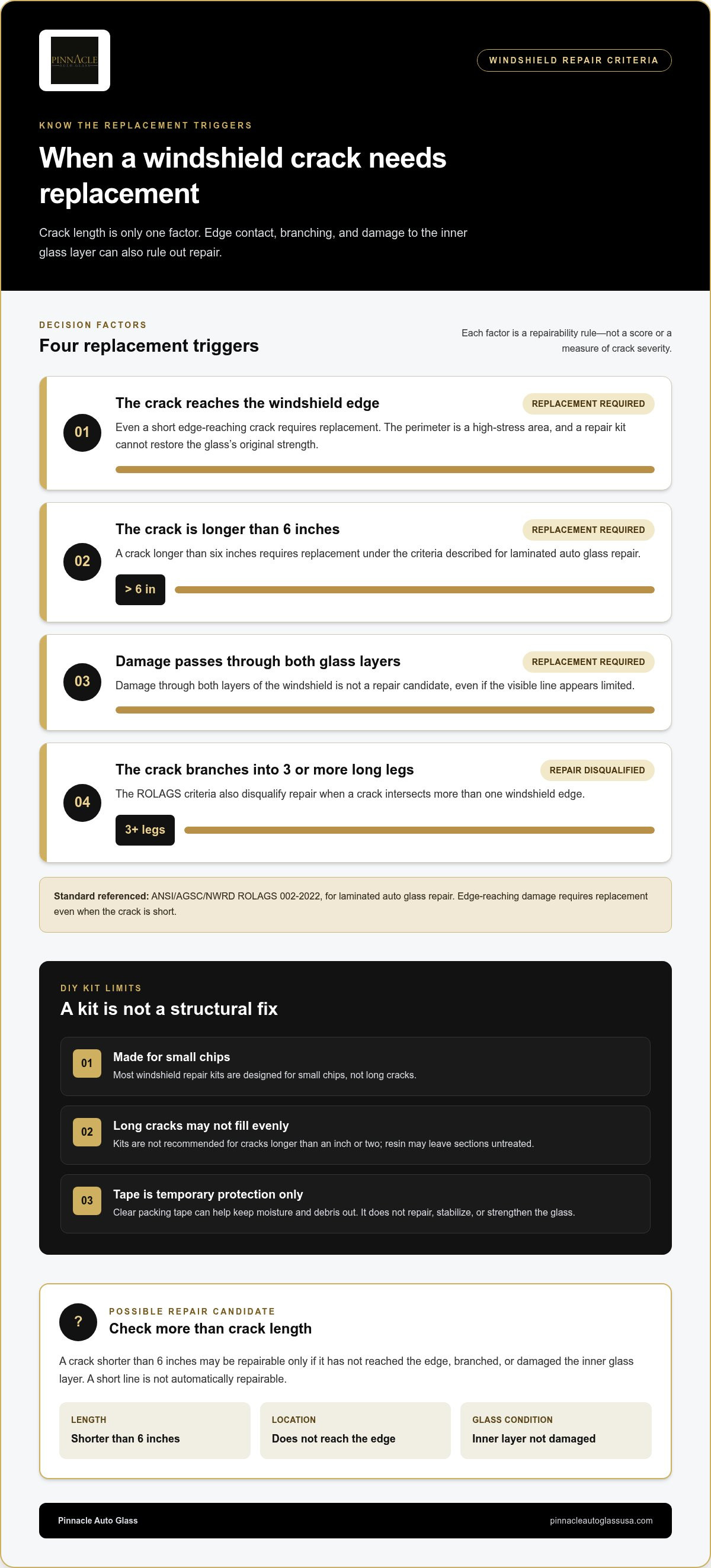
The ANSI/AGSC/NWRD ROLAGS standard for laminated auto glass repair is ROLAGS 002-2022. Under the criteria described for that standard, repair is disqualified when a crack branches into three or more long legs or intersects more than one windshield edge. A crack longer than six inches, one that reaches the glass edge, or damage that passes through both glass layers requires replacement.
Before using a kit, look closely at the crack under good lighting. Note whether it branches, reaches an edge, or appears to pass through the inner glass layer. A short line can still fail repair criteria if its pattern or location makes it unsuitable. Don’t rely on length alone, and don’t treat a kit’s instructions as a professional assessment of structural damage.
DIY application also depends on following the kit’s steps precisely. Dirt, moisture, or an incorrectly positioned applicator can interfere with resin placement. For example, forcing resin into a branching crack won’t reconnect separated glass or make an edge-reaching crack eligible for repair. Avoid pressing on the windshield or scraping at the damage while preparing the area.
Clear packing tape can temporarily keep moisture and debris out of a crack. It doesn’t repair the glass, stabilize the damage, or replace an assessment. Keep tape on the outer surface without pressing hard, and avoid using adhesives or household fillers that aren’t intended for windshield glass.
Use a DIY kit only for a small chip that fits its stated use and has no disqualifying features. If the damage is a long line, branches, reaches an edge, or affects both glass layers, replacement is the appropriate path. For damage that remains within repair criteria, professional windshield repair can address the crack using a controlled resin process rather than a consumer kit.
Insurance coverage considerations
In the United States, windshield damage is generally handled under comprehensive auto insurance, not collision coverage. Comprehensive coverage typically applies to damage from events other than a vehicle collision, while collision coverage concerns damage from a crash. For example, a stone striking the windshield while driving may fall under comprehensive coverage. The cause of the damage and the terms of the policy both matter.
Some insurers waive the deductible for windshield repair because repair costs less than full replacement. That doesn’t mean every crack qualifies for repair or that every policy waives the deductible. An edge-reaching crack may require replacement, so a waiver that applies to a repair may not apply to replacement. Read the glass coverage language and deductible details before choosing a route.
Start with your insurance declarations page and policy wording. Look for comprehensive coverage, glass-specific terms, deductible amounts, and any distinction between repair and replacement. Record the date and circumstances of the damage, then take clear photos from inside and outside the vehicle. A photo showing the crack’s position, length, and relationship to the windshield edge can help document the claim.
- Coverage type: Confirm whether comprehensive coverage applies to the reported cause, such as road debris.
- Deductible: Find the deductible for glass claims and whether the policy treats repair differently from replacement.
- Damage documentation: Photograph the crack and note whether it reaches an edge or affects the driver’s view.
- Claim process: Follow the insurer’s stated steps before authorizing work or submitting paperwork.
Keep the decision about repair or replacement separate from the coverage question. Insurance terms determine what may be covered; the crack’s location and condition determine which glass solution is appropriate. For instance, a policy may include a repair deductible waiver, but a crack that has reached the edge still calls for replacement under the repairability criteria described in this article.
Ask your insurer how it applies your specific glass coverage, deductible, and claim process. Use the terms in your policy rather than assuming another driver’s experience applies. If a representative describes coverage by phone, write down the date, the guidance given, and any claim reference provided. Keep receipts, photos, and claim communications together.
Before proceeding, compare the insurer’s explanation with the damage assessment and your policy wording. If the crack has grown since you took photos, document its current condition too. Clear records help connect the claim to the actual damage, while understanding the repair-versus-replacement distinction helps you discuss the correct type of work.
Structural risks of edge damage
A crack within roughly 2 to 3 inches of the windshield edge lies in a high-stress zone. If the crack reaches the edge, replacement is required under the repairability guidance covered here. A nearby crack may still be assessed for repair, but its location matters alongside its length, branching, and depth. A short line beside the frame isn’t automatically a safe repair candidate.
The edge area faces stress as the vehicle moves. Rough roads can flex the windshield frame and transfer movement to the glass. A crack near the perimeter may then extend from its tip or develop branches. For example, a line that appears unchanged while parked may lengthen after repeated vibration on a rough route. The location can make small changes more consequential.
Windshield glass is laminated, with an inner layer and an outer layer. Damage that passes through both layers requires replacement, not a surface repair. A driver may not be able to judge depth from a quick look outside. Check the crack from inside and outside, but don’t press the glass or insert a tool to test it. Those actions can add stress.
Edge cracks also need careful evaluation because resin repair depends on the damage pattern and access. A crack that touches the edge cannot be treated as though it ends within the glass. Branches, multiple-edge intersections, and inner-layer damage can also rule out repair. For example, a short crack that reaches the perimeter may be less suitable than a longer crack that remains away from it.
Before driving, note whether the crack enters the driver’s viewing area or has changed since you last checked. Avoid rough roads and abrupt temperature changes while arranging an assessment. If the line visibly grows within a day, stop driving and get the vehicle to a shop immediately. Don’t assume tape or a DIY kit can restore the glass’s strength.
When evaluating damage near the edge, record these details:
- Whether the crack touches the windshield perimeter or stops short.
- Whether it branches, crosses another crack, or intersects more than one edge.
- Whether the inner layer appears damaged, especially when viewed from the cabin.
- Whether the crack has grown after a temperature change or road impact.
Those observations help distinguish a repair candidate from damage that calls for replacement. For repairing a crack at the edge of the windshield, the deciding point is not simply how thin or short it looks. A crack that reaches the glass edge requires replacement, while nearby damage needs assessment based on its position and condition.
Repairing long windshield cracks
A long crack needs more than a quick visual check. Repairability depends on its length, branching, edge contact, and whether damage reaches the inner glass layer.
For a crack shorter than six inches, repair may remain possible only if it hasn’t branched, reached the glass edge, or damaged the inner layer. A crack over six inches or one that touches the edge requires replacement under the criteria covered here. The ANSI/AGSC/NWRD ROLAGS standard for laminated auto glass repair is ROLAGS 002-2022.
Steps for Crack Repair
First, a glass repairer assesses the crack’s length, location, branches, and depth. According to the U.S. Bureau of Labor Statistics, glass repairers clean and prepare the area, then stabilize cracks with clear resin. The repair process aims to fill the damaged channel and reduce its visibility, but it cannot make an edge-reaching crack suitable for repair.
Before an appointment, note where the crack starts and ends, and photograph it from inside and outside. Mention any recent growth or branching. Those details help distinguish a repair candidate from damage requiring replacement. Don’t apply a DIY resin kit first, since added material can complicate assessment.
Repair and Replacement Timing
There isn’t one fixed duration for every windshield job. Repair time depends on the crack’s pattern, preparation, and resin stabilization. Replacement timing depends on the vehicle and the installation process. For a windshield with ADAS, recalibration may also be needed, adding a separate step to the work.
Ask about the expected appointment duration and any post-installation driving instructions when arranging the work. Follow the installer’s guidance before moving the vehicle, since adhesive curing requirements affect when it can be driven safely. A growing crack shouldn’t be left untreated simply to fit a convenient schedule.
To find a reputable windshield shop near you, compare its assessment with recognized repair criteria, including ROLAGS 002-2022. A sound evaluation explains why the crack qualifies for repair or needs replacement, and considers edge contact, branching, and inner-layer damage. Choose a shop that clearly explains the recommended work and addresses ADAS recalibration when the vehicle requires it.
Use the assessment to make the repair-or-replacement decision, not crack length alone. If the damage reaches the edge, replacement is the appropriate route. For other long cracks, have the full pattern evaluated before choosing repair. Arrange a windshield damage assessment to identify the right next step.
Pinnacle Auto Glass: Windshield Replacement
Pinnacle Auto Glass helps drivers address windshield damage with repair or replacement, depending on the crack’s location and condition. If a crack reaches the glass edge, replacement is the appropriate route. For damage that remains repairable, windshield repair may be suitable. For vehicles with ADAS, we recalibrate the system after a windshield replacement to ensure all safety features function properly.
Share where the crack starts and ends, whether it branches, and whether it has grown. These details help clarify the next step. Pinnacle Auto Glass also provides Fleet Glass Services for commercial trucks and RVs.
Contact Pinnacle Auto Glass to discuss your windshield damage and the appropriate service.
Take the Next Step With Confidence
Make the decision with a clear record of the damage, not appearance alone. Note where the crack begins and ends, whether it has changed, and any features near the windshield, such as driver-assistance cameras. This gives the service team useful context and helps keep the conversation focused on the right solution. Deciding whether repairing a crack at the edge of the windshield is appropriate starts with identifying whether it actually reaches the glass edge.
Pinnacle Auto Glass offers windshield repair and replacement, as well as ADAS recalibration. Choose the next step based on the damage and the vehicle’s equipment. If the windshield needs replacement, we recalibrate ADAS systems when required. A clear discussion can help you move forward without guessing or attempting a temporary fix that doesn’t address the underlying damage.
Contact Pinnacle Auto Glass to discuss your windshield concerns and determine a practical next step.
Frequently Asked Questions
Can a Hairline Crack In a Windshield Be Repaired?
Sometimes, if the hairline crack hasn’t reached the glass edge, branched, or damaged the inner layer. A crack shorter than six inches may qualify, but length alone doesn’t settle the question. For example, a fine line that ends within the glass differs from one that touches the perimeter. Photograph the damage from inside and outside, then note any change before arranging an assessment.
How Fast Do Windshield Cracks Spread From the Edge?
There’s no fixed rate. A crack can stay stable for days in ideal conditions, then extend inches in minutes after a temperature extreme or rough-road impact. A stressed crack can grow several inches in hours. Photograph it beside a fixed reference, such as the windshield molding, so you can compare its length later. If it visibly grows within a day, stop driving and get the vehicle assessed immediately.
Is a cracked windshield covered by insurance?
Windshield damage is generally covered by comprehensive auto insurance rather than collision coverage. Some insurers waive the deductible for repair because it costs less than full replacement, but policy terms vary. Check your declarations page for glass-specific coverage, deductibles, and claim steps. For example, a repair waiver may not apply when damage calls for replacement. Keep photos and the damage date together with your claim records.
What Causes Cracks Near the Windshield Frame?
Impact, temperature changes, and movement can start or extend a crack near the frame. Rough roads flex the windshield frame, while cold can make glass contract. Water trapped in damage may freeze and expand. Even slamming a door or trunk can send pressure through the glass. A small stone impact near the perimeter, followed by a temperature drop, is one example of stresses combining around existing damage.
Will cold weather make my windshield crack worse?
Yes, cold temperatures can make windshield glass contract and add stress to an existing crack. Water inside the damage can freeze and expand, potentially extending the line. Avoid pouring hot water on icy glass, since a sudden temperature change can add further stress. Park in a garage or shade when practical, and avoid slamming doors until the damaged windshield has been assessed.
Can a crack at the edge of a windshield be repaired?
A crack that reaches the glass edge requires replacement under the repairability criteria described here. So, repairing a crack at the edge of the windshield usually isn’t an option, even if the line looks hair-thin. A nearby crack that stops short of the perimeter may be assessed differently. Its branches, length, and whether the inner glass layer is damaged also affect the decision.
What windshield crack size and location qualify for repair?
A crack shorter than six inches may qualify when it hasn’t branched, reached the glass edge, or damaged the inner layer. A crack longer than six inches or one touching the edge requires replacement under the criteria covered here. For example, a shorter line near the center may be a candidate, while a shorter edge-reaching line is not. Check both sides of the glass for signs of deeper damage.
Is windshield replacement safer than repairing an edge crack?
If a crack reaches the windshield edge, replacement is the appropriate option under the repairability criteria. Damage through both layers of laminated glass also requires replacement. The key distinction isn’t that replacement is always safer than repair; it’s whether the specific damage can be repaired appropriately. If a crack stops short of the edge and affects only the outer layer, repair may remain possible after assessment.


