
Your windshield is part of your vehicle’s rollover safety structure. Rollover protection and your windshield work together: a factory-sealed windshield provides about one-third of a passenger car’s roof support in a rollover, while reinforced A-pillars add protection around the windshield frame.
It’s easy to think of rollover protection as a roll bar or a system that deploys behind the seats. Those features matter, but the windshield’s condition and installation also affect how well the passenger compartment holds up in a crash.
Learn how factory and aftermarket rollover systems differ, why protection varies by vehicle, and what role the A-pillars play. This guide also explains how a damaged or improperly installed windshield can affect rollover protection, helping you understand the safety systems built into your vehicle.
Key Takeaways
- Identify the rollover system your vehicle was designed with; a deployable factory system and an aftermarket roll bar work differently.
- Use the vehicle’s make, model, and year to understand its factory protection. Convertible designs can differ, even within the same model line.
- Learn how reinforced A-pillars support the windshield frame and contribute to the vehicle’s rollover structure.
- Understand why a hardtop or roof-rail airbag may not serve the same role as qualifying rollover protection.
- After windshield replacement, ADAS cameras and sensors may need recalibration to function properly.
Factory and aftermarket rollover protection
Factory rollover protection is a vehicle’s original structure or system designed to help protect occupants if the vehicle rolls over. It may use a reinforced frame or a deployable system, so a convertible’s roof alone doesn’t show how it is protected.
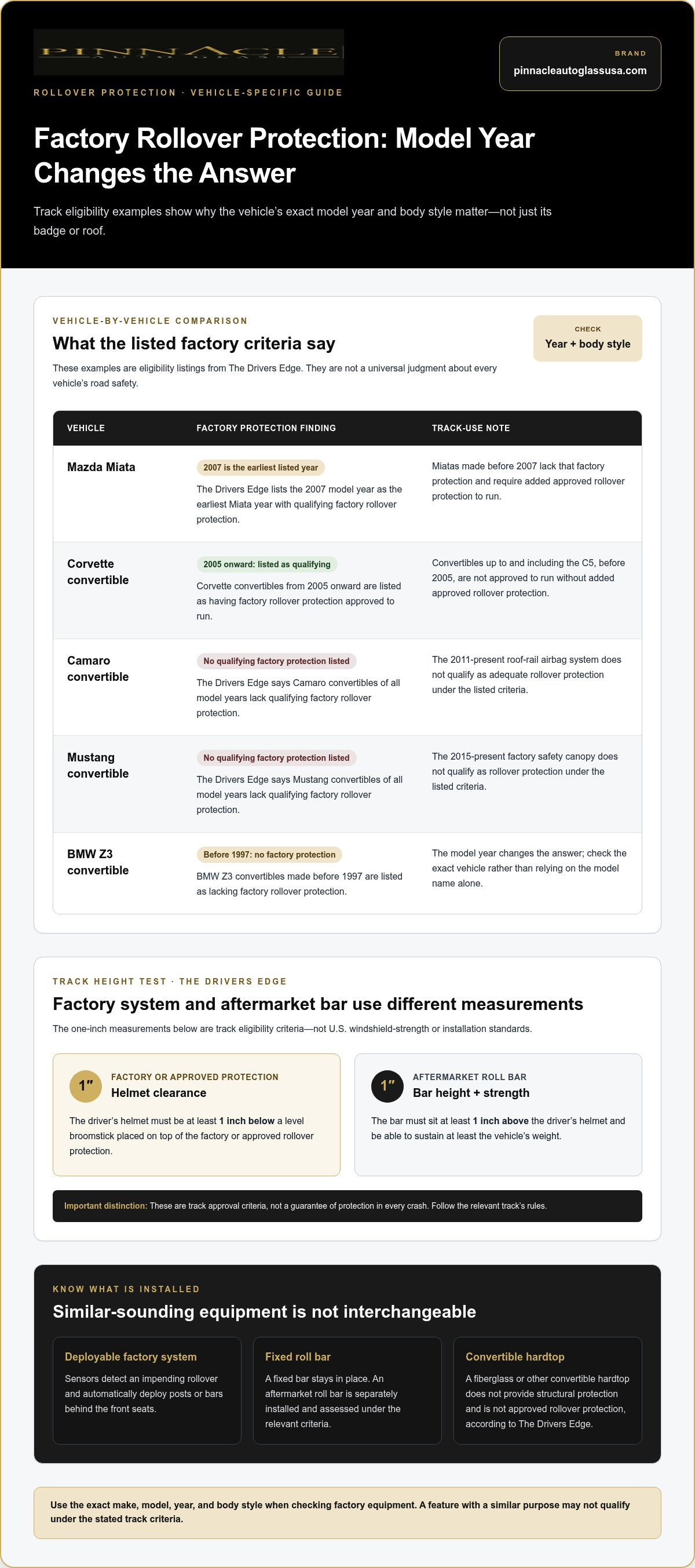
A factory deployable system uses sensors to detect an impending rollover and automatically deploys posts or bars behind the front seats, according to The Drivers Edge. This differs from a fixed roll bar, which stays in place. Neither type should be confused with a hardtop: fiberglass and other convertible hardtops do not provide structural protection and are not approved rollover protection, according to The Drivers Edge.
An aftermarket roll bar is a separately installed bar intended to provide rollover protection. For the Drivers Edge’s height test, an aftermarket roll bar must sit at least 1 inch above the driver’s helmet and be able to sustain at least the vehicle’s weight. These are track approval criteria, not a universal measurement for every vehicle or a guarantee of protection in every crash.
Factory protection is assessed differently. In The Drivers Edge height test, the driver’s helmet must be at least 1 inch below a level broomstick placed on top of the factory or approved rollover protection. The clearance test helps determine whether the protection extends high enough relative to the seated driver. Follow the relevant track’s rules, since passing a measurement does not identify every factor in a vehicle’s safety design.
Use these steps to understand what your convertible has:
- Identify whether the vehicle has a fixed factory structure or a system that deploys behind the seats.
- Don’t count a removable or fiberglass hardtop as rollover protection.
- For track use, compare the installed protection and driver’s helmet position with that track’s stated criteria.
The one-inch roll-bar measurements are track eligibility criteria, not U.S. windshield-strength or installation standards. Windshield requirements are separate from whether a rollover device meets a track’s criteria.
Insurance coverage for windshield replacement after rollover damage depends on the policy’s applicable coverage, deductible, and claim conditions. Review your policy terms to understand how it handles collision-related glass damage.
These distinctions matter because rollover protection and your windshield are related parts of vehicle safety, but they serve different roles. A roll bar or deployable system is designed for enhanced impact mitigation or occupant protection during a rollover. Pre-97 BMW Z3 convertibles are listed as lacking factory rollover protection.
General recommendations from trusted experts like Pinnacle Auto Glass advise repairing a damaged windshield rather than replacing it when repair is possible, to preserve the factory safety seal. A U.S. mandate requires autonomous emergency braking and collision avoidance systems as factory-standard equipment on vehicles manufactured in 2020 and later. After windshield replacement, ADAS sensors, cameras, and other included equipment must be calibrated so the system components work properly. ADAS is designed to assist drivers in making appropriate driving decisions.
Vehicle-specific factory rollover protection
Vehicle-specific factory rollover protection is protection built into a particular vehicle design and model year. A convertible’s make, model, and year can affect whether its factory system qualifies for track use. The examples below describe eligibility listed by The Drivers Edge, not a universal judgment about every vehicle’s road safety.
Mazda Miata model-year eligibility is whether a particular Miata has factory rollover protection approved for track use. The Drivers Edge lists the 2007 model year as the earliest Miata year with qualifying factory protection. Miatas made before 2007 lack that factory protection and require added approved rollover protection to run, according to The Drivers Edge.
Corvette convertible eligibility is the distinction between qualifying factory protection and the need for added approved equipment. The Drivers Edge lists Corvette convertibles from 2005 onward as having factory rollover protection approved to run. Convertibles up to and including the C5, before 2005, are not approved to run without added approved rollover protection. The model year matters here; the Corvette name alone doesn’t settle the question.
Qualifying factory protection means a system accepted for the stated track criteria, not simply a safety feature with a similar purpose. The Drivers Edge says Camaro convertibles of all model years lack qualifying factory rollover protection. Its 2011-present roof-rail airbag system does not qualify as adequate rollover protection. Mustang convertibles of all model years also lack qualifying factory protection. For Mustangs, the 2015-present factory safety canopy does not qualify, according to The Drivers Edge.
BMW Z3 factory protection refers here to whether the vehicle has qualifying protection from the factory. The Drivers Edge lists BMW Z3 convertibles made before 1997 as lacking factory rollover protection. That cutoff illustrates why a model name alone can mislead: a Z3’s production year changes the answer.
Check the specific vehicle before relying on factory equipment for track eligibility:
- Match the exact model year and body style, such as a pre-2005 C5 Corvette convertible.
- Identify the actual factory system; a Camaro roof-rail airbag or Mustang safety canopy doesn’t qualify under the listed criteria.
- Compare the vehicle with the applicable track requirements, especially if it is a pre-2007 Miata or pre-1997 BMW Z3.
These examples show why rollover protection and your windshield should be considered as part of the vehicle’s complete design. Factory rollover equipment varies by model year, while windshield-frame strength is a separate part of vehicle construction. The Drivers Edge’s eligibility details apply to the vehicles and criteria it lists. Use the exact model year and installed equipment when identifying a convertible’s factory protection.
Windshield-frame A-pillar protection
The windshield frame and glass work alongside other parts of a vehicle’s safety structure. Their contribution depends on the frame design, glass condition, and installation.
Windshield Structural Contribution
The A-pillars are the reinforced posts on either side of the windshield that connect the roof and vehicle body. Some cars use reinforced windshield frames as factory rollover protection, according to The Drivers Edge.
A properly installed windshield helps maintain passenger-compartment structure during a rollover and helps resist roof crush. It provides about one-third of a passenger car’s roof support in a rollover. The windshield also preserves 60% of the cabin’s structural integrity in a rollover, according to the supplied market facts. These figures describe different aspects of structural support, not a standalone guarantee of protection.
Laminated windshield glass combines glass and polymer layers. If it shatters, the polymer helps contain the glass instead of letting it break apart. The glass and its bond work with the A-pillars, so the windshield is not a substitute for reinforced posts or other rollover systems.
Cracks, chips, or poor installation are reasons to have windshield damage assessed. A damaged or improperly installed windshield may not provide needed rollover strength and may contribute to head or neck injuries or occupant ejection. Repair is generally preferred when the damage is repairable because it preserves the factory safety seal. An auto glass specialist can assess whether repair or replacement is appropriate.
Windshield replacement doesn’t itself deploy an airbag; airbag deployment is a separate vehicle safety function. For rollover protection, the key concern is whether the replacement windshield is properly installed and bonded.
Windshield Bonding During a Rollover
Windshield bonding is the adhesive connection that secures the glass to the vehicle frame. During a rollover, a factory-sealed, properly installed windshield helps support the passenger compartment and roof. Damaged or improperly installed glass may not provide the strength needed to help protect occupants.
Bonding matters because the windshield’s structural role depends on its connection to the frame, including the A-pillars. A crack or gap at the glass edge can warrant an inspection, but appearance alone doesn’t show whether the bond remains sound. Arrange an assessment after visible damage, especially if a rollover or impact affected the windshield or frame. Prioritize correct fit and installation rather than treating the glass as a separate, non-structural component.
How does a windshield contribute to rollover protection?
A windshield’s rollover contribution is the support and occupant containment its glass and frame provide during a rollover. According to the National Highway Traffic and Safety Administration (NHTSA), rollover crashes account for 3% of all collisions but 31% of total vehicular fatalities. The windshield works with the vehicle’s structure, rather than acting as a separate rollover system.
Laminated glass is windshield glass bonded with polymer layers that help hold broken glass together. In a crash, this construction can help limit glass fragments, lacerations, and punctures. The windshield also acts as a barrier against wind, weather, flying debris, bugs, and people. These functions matter in everyday driving and during a rollover, when occupants face impact and ejection risks.
Passenger-compartment support is the windshield’s contribution to maintaining the cabin’s structure during a crash. A properly installed windshield helps preserve that structure and resist the roof crushing inward during a rollover. A factory-sealed windshield provides about one-third of a passenger car’s roof support in a rollover. It can also help keep occupants from being thrown from the vehicle.
The windshield’s structural role changes with the type of crash. In a front-end collision, it preserves 45% of the cabin’s structural integrity. In a rollover, it preserves 60%. These figures describe different crash scenarios, not interchangeable measurements. They show why rollover protection and your windshield involve both the vehicle’s structural design and the glass condition.
Windshield condition is whether the glass remains intact and properly installed. Damage or poor installation may reduce the strength available to protect occupants during a rollover. It may also contribute to head and neck injuries or occupant ejection. Keep the glass free of cracks and have chips or cracks assessed by an auto glass specialist experienced in repair and replacement.
Use these practical checks after noticing damage:
- Look for chips, cracks, or visible separation near the windshield edge.
- Have an auto glass specialist assess the damage and determine whether repair is possible.
- Prioritize repair when appropriate, since it can preserve the factory safety seal.
A damaged windshield is more than a visibility concern. Its condition and installation affect its contribution to the cabin, roof support, and occupant retention. Address damage promptly, and consider the glass alongside the vehicle’s other rollover structures.
A car windshield is made of laminated glass and polymer layers designed to hold shattered glass together, helping prevent lacerations and punctures. This construction supports occupant protection, but works alongside the vehicle’s structure rather than replacing it. The glass condition and installation therefore remain relevant to the windshield’s contribution during a rollover.
Cracks or improper installation can reduce confidence in the windshield’s contribution, so have visible damage assessed by an auto glass specialist. Keeping the windshield properly installed and free of cracks helps preserve the protection it can provide in a rollover. Consider both the glass and its installation, rather than treating it only as a surface for visibility.
How much rollover strength does a windshield provide?
Windshield rollover strength is the glass-and-bond contribution to a vehicle’s cabin support during a rollover. A factory-sealed windshield provides about one-third of a passenger car’s roof support in a rollover. It also preserves 60% of the cabin’s structural integrity in a rollover. These figures describe related but distinct aspects of the windshield’s contribution, not a standalone rating for every vehicle.
Roof support describes how the installed windshield helps support the roof and passenger compartment. The glass works with the surrounding vehicle structure, including the windshield frame. Its contribution depends on the factory seal and proper installation. A damaged or improperly installed windshield may not provide the strength needed to protect occupants during a rollover. The glass cannot replace other structural components or rollover systems.
Cabin structural integrity refers to how well the passenger compartment retains its structure during a crash. The 60% figure describes the windshield’s role in a rollover, not a promise that the cabin will retain that amount of protection in every crash. Vehicle design, impact forces, glass condition, and installation all affect how the structure performs. A windshield with cracks or a compromised bond may not contribute as intended.
When assessing a damaged windshield, focus on its condition and how it is secured:
- Have chips and cracks assessed by an auto glass specialist experienced in windshield repair and replacement.
- Ask whether the damage can be repaired. Repair is generally recommended when possible because it preserves the factory safety seal.
- If replacement is needed, proper installation matters because the windshield’s structural contribution depends on its bond to the vehicle.
A small chip and a spreading crack both warrant assessment, but the damage’s location and extent affect the appropriate solution. Don’t treat visual appearance as a measurement of rollover strength. A clean-looking windshield can still be improperly installed, and whether damage is repairable depends on its actual condition. The key question is whether the glass and its bond can perform their structural role.
There is no single strength figure that describes every windshield or vehicle. The useful takeaway is the distinction between the windshield’s contribution and the total strength of the vehicle’s rollover structure. Keep the glass intact, address damage promptly, and prioritize a sound factory seal. If damage calls for new glass, schedule windshield replacement to restore the windshield’s structural connection to the vehicle.
Pinnacle Auto Glass: Windshield Replacement
Pinnacle Auto Glass repairs and replaces damaged vehicle windshields. After rollover damage, an assessment can help determine whether repair is appropriate or replacement is needed. A properly installed windshield supports the passenger compartment, so addressing damaged glass matters for more than visibility.
For vehicles with windshield-mounted ADAS cameras or sensors, recalibration is required after replacement. For vehicles with ADAS, we recalibrate the system after a windshield replacement to ensure all safety features function properly. Pinnacle Auto Glass provides ADAS System Recalibrations alongside windshield services.
If your windshield is cracked, damaged, or needs replacement after a rollover, contact Pinnacle Auto Glass to arrange windshield repair or replacement.
Make your next safety decision with confidence
Understanding rollover protection and your windshield can guide your next step: treat glass condition as part of vehicle safety, not just a visibility issue. If your windshield is damaged, note where the damage appears and whether it affects your view. Share those details when arranging an assessment so the repair decision can focus on the glass’s condition and the work required.
Pinnacle Auto Glass provides Windshield Repair and Windshield Replacement for damaged glass. If replacement involves windshield-mounted driver-assistance equipment, we also perform ADAS System Recalibrations. The right service depends on the windshield’s condition and whether repair is appropriate. Addressing the glass concern gives you a practical way forward without confusing windshield work with rollover-system repairs.
Take the next step by contacting Pinnacle Auto Glass about your windshield. A clear assessment can help you decide what to do next and keep your vehicle’s glass needs on track.
Frequently Asked Questions
How is a windshield properly installed to preserve structural integrity?
A windshield should be fitted and bonded securely using glass suited to the vehicle. The installer prepares the bonding surfaces, positions the glass correctly, and follows the adhesive’s setting instructions. Avoid washing the vehicle for at least 24 hours after replacement so the adhesive can fully set. If the vehicle has ADAS, recalibration may be needed after replacement to help its safety features function properly.


