Did you know your windshield provides up to 60% of your cabin's structural strength during a rollover accident? This statistic highlights why a proper installation is about more than just visibility. You've likely received conflicting information about how soon you can get back on the road. It's frustrating to balance the inconvenience of vehicle downtime with concerns about glass shifting or leaking. You need a definitive answer that prioritizes your safety and respects your schedule.
Understanding the safe drive away time windshield replacement professionals require is the final, non-negotiable step of a structural safety installation. Learn the critical science behind Safe Drive Away Time (SDAT) to ensure your vehicle remains structurally sound and your safety systems function correctly. This guide provides a clear breakdown of wait times based on the ANSI/AGSC/AGRSS 005-2022 standard, the specific risks of driving too early, and a practical checklist for post-replacement care.
Key Takeaways
- Understand why following the safe drive away time windshield replacement guidelines is essential to maintaining the structural integrity of your vehicle during a collision.
- Discover the science of moisture-cured adhesives and why environmental factors like humidity directly impact the time required for a secure bond.
- Learn how a properly cured windshield ensures that passenger-side airbags deploy correctly against the glass during an emergency.
- Identify specific post-installation steps, such as managing cabin air pressure and avoiding high-pressure car washes, to protect your new seal.
- Recognize the necessity of ADAS recalibration to ensure your vehicle's safety sensors and cameras function accurately after glass replacement.
What is Safe Drive Away Time (SDAT) for Windshields?
A windshield is much more than a transparent shield against the elements. It is a critical safety component that works in tandem with your vehicle's frame and airbag systems. Safe Drive Away Time (SDAT) is the mandatory period required for auto glass adhesive to reach sufficient strength to hold the glass in place during an accident. Following the specified Safe Drive Away Time (SDAT) is the only way to ensure the vehicle's structural integrity remains intact. This duration isn't a suggestion based on a technician's schedule. It is a strict safety requirement determined by the adhesive manufacturer's laboratory testing. Driving before this window expires can legally and physically compromise the vehicle, leading to catastrophic failure during a collision.
Adhering to the safe drive away time windshield replacement professionals recommend ensures your car meets federal safety standards. Technicians don't choose these wait times based on personal preference. Instead, they follow rigorous specifications tied to the specific high-viscosity polyurethane used during the installation. If you ignore these limits, the adhesive may fail to bond properly. A weak bond can cause the glass to shift, leak, or fail entirely when you need it most.
The Difference Between Safe and Minimum Drive Away Time
You might hear two different terms used during your service. Safe Drive Away Time (SDAT) is the industry standard for full structural integrity. This is the point where the adhesive is strong enough to meet all federal safety requirements. Minimum Drive Away Time (MDAT) is a term often used by adhesive brands to define the earliest possible moment a car could be moved without the glass falling out. However, MDAT is often about limiting manufacturer liability rather than ensuring maximum passenger safety. Pinnacle Auto Glass always prioritizes the most conservative safety window. We don't aim for the minimum because your safety deserves the safest possible result. We wait until the bond is indisputably secure.
Why a Windshield is More Than Just Glass
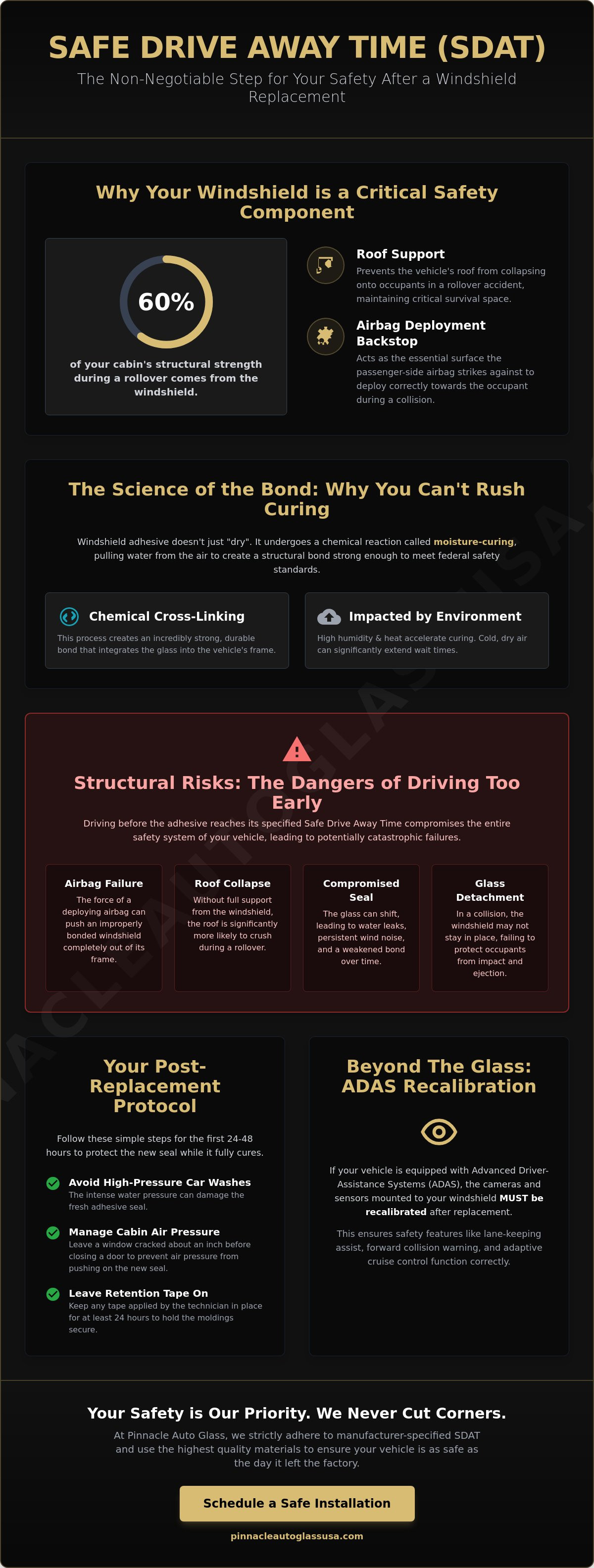
Your windshield acts as a structural pillar for the vehicle roof. In a rollover accident, the glass provides up to 60% of the cabin's structural strength, preventing the roof from collapsing on occupants. Beyond roof support, the windshield serves as the essential backstop for passenger-side airbag deployment. When an airbag fires, it strikes the glass with immense force before expanding toward the passenger. If the adhesive hasn't reached its SDAT, that force can push the entire windshield out of the frame. Federal Motor Vehicle Safety Standards, specifically FMVSS 212, require the glass to stay bonded during impact to ensure these safety systems work. A premature departure compromises this entire chain of protection.
The Science of Curing: Why You Can’t Rush the Bond
Curing is a complex chemical process, not a simple physical drying cycle. Modern windshield installations rely on high-viscosity polyurethane adhesives specifically designed for structural bonding. These specialized materials are moisture-cured, which means they actively pull water molecules from the surrounding air to initiate a hardening reaction. This chemical cross-linking creates the structural bond necessary to hold your glass in place during a high-speed impact. I-CAR defines minimum driveaway time as the specific period required for this adhesive to reach a strength that complies with Federal Motor Vehicle Safety Standards (FMVSS) 212 and 208. Without this deep-level strength, the glass cannot withstand the 1,000 plus pounds of force exerted by a deploying passenger airbag.
It's vital to remember that just because the adhesive feels dry to the touch doesn't mean it's cured for safety.
How Weather and Humidity Impact Your Wait
Since the adhesive depends on atmospheric moisture, your local environmental conditions dictate the speed of the cure. High humidity and warm temperatures provide the necessary water molecules and thermal energy to accelerate the chemical reaction. Conversely, cold and dry winter air can significantly extend the required safe drive away time windshield replacement experts mandate. Professional shops often mitigate these seasonal delays by using advanced adhesive technologies:
- Hot-pour urethanes: These are heated before application to ensure a consistent flow and faster initial set.
- Fast-cure adhesives: Specialized chemical formulas that reach structural strength in as little as 30 to 60 minutes.
- High-modulus urethanes: Designed for modern vehicles to provide extra stiffness and support for ADAS cameras.
If you're concerned about your vehicle's safety in extreme weather, our team at Pinnacle Auto Glass can explain which adhesive technology is best for your current climate.
The Risk of "Skinning Over" vs. Deep Curing
Adhesive beads cure from the outside in. The outer layer often "skins over" within minutes, creating a firm surface that looks finished to the untrained eye. However, the inner core of the bead remains soft and pliable for several hours after the initial installation. This soft core is the weakest link in your vehicle's safety chain. If you drive too soon, the vibrations from the road and wind pressure can cause this soft core to shift slightly. This movement often results in permanent seal failure, leading to annoying wind whistles or water leaks during the next rainstorm. Deep curing ensures the entire adhesive bead is a solid, unyielding structure that can support the weight of the vehicle roof.
Structural Risks: What Happens if You Drive Too Early?
Driving your vehicle before the adhesive has fully bonded transforms a critical safety feature into a liability. While the glass may look secure, the physical forces involved in a collision are extreme. A windshield that isn't properly anchored can become a projectile or fail to support the roof during a rollover. This is why following the safe drive away time windshield replacement experts mandate is essential for your protection. The Federal Motor Vehicle Safety Standard 212 establishes strict requirements for windshield retention to prevent occupants from being ejected. If you drive too early, you're effectively bypassing these federal safety protections.
When you ignore the recommended wait time, you risk the glass shifting within the frame. Even a movement of a few millimeters can compromise the entire installation. This instability is particularly dangerous in modern vehicles where the glass is integrated into the overall safety cage. For a deeper look at how glass affects your car's structure, you can read our Professional Windshield Replacement Guide. Waiting for the bond to set isn't just about convenience; it's about maintaining the manufacturer's original safety specifications.
The Airbag Backstop Effect
Most drivers don't realize that the passenger-side airbag relies on the windshield to function correctly. In a crash, the airbag deploys at high speed, striking the inside of the glass before expanding toward the passenger. The windshield acts as a structural backstop, directing the airbag's force and positioning it to catch the occupant. If the adhesive bond is still soft, the massive pressure of the airbag can push the entire windshield out of its frame. When the glass "pops," the airbag fails to deploy in the correct position, leaving the passenger unprotected. Adhering to the safe drive away time windshield replacement protocol ensures the bond is strong enough to resist these explosive forces.
Long-Term Damage: Leaks, Wind Noise, and Rust
Safety isn't the only concern when rushing the curing process. Driving a vehicle too soon exposes the fresh urethane to road vibrations and wind pressure. These forces cause the glass to shift slightly in the adhesive bed, creating microscopic gaps in the seal. Over time, these gaps lead to persistent water leaks and annoying wind whistles that are difficult to track down. More importantly, moisture trapped in these gaps can cause the metal frame of your vehicle to rust prematurely. This corrosion weakens the pinchweld where the glass attaches, making future replacements more difficult and expensive. Waiting the extra hour now prevents years of mechanical headaches and safety risks later.
The First 24 Hours: Your Post-Replacement Protocol
Reaching the official safe drive away time windshield replacement technicians specify is a major milestone, but it doesn't mean the curing process is finished. While the adhesive is strong enough for safe operation, it hasn't reached its maximum structural bond. The first 24 hours following your service are critical for protecting the seal and ensuring the glass settles perfectly. During this window, the urethane remains slightly pliable and vulnerable to internal pressure and external force. You must follow a specific protocol to prevent shifting, which can lead to long-term leaks or structural weakness.
To ensure your new windshield remains seated correctly, adhere to these immediate care instructions:
- Crack a side window at least one inch to equalize cabin pressure.
- Avoid slamming doors or the trunk, as this creates sudden air bursts.
- Leave all retention tape in place for the full 24-hour period.
- Drive carefully and avoid large potholes or jarring speed bumps.
The "Pressure Spike" Phenomenon
Modern vehicles are designed with highly airtight cabins to reduce road noise and improve climate control. This efficiency creates a unique challenge for a fresh windshield installation. When you close a car door, it creates a momentary but intense spike in air pressure inside the vehicle. If the windows are fully rolled up, this pressure looks for the path of least resistance to escape. In a fresh installation, that path is often through the wet adhesive bead. This "blow out" can push a section of the urethane out of the frame, creating a permanent pinhole leak. Cracking a window provides a necessary release valve for this air, protecting the integrity of your new seal.
Cleaning and Maintenance Restrictions
It's tempting to clean your car immediately after a service, but you must resist the urge to use a car wash. Automated car washes utilize high-pressure water jets and heavy mechanical brushes that can easily displace a windshield that hasn't reached its full cure. You should wait at least 24 to 48 hours before visiting a car wash. If you must clean the vehicle, a gentle hand wash is acceptable as long as you avoid the windshield area and the surrounding moldings entirely.
Additionally, you'll likely notice strips of blue painter's tape along the top of your glass. This is retention tape. It helps hold the glass and moldings in their precise positions while the adhesive "skins over" and gains initial strength. Removing this tape early can allow the glass to sag or the molding to pull away from the body. If you have questions about your specific installation or need to schedule a windshield replacement, our experts are ready to assist you with professional guidance and reliable service.
Beyond the Glass: Safety Standards and ADAS
Modern windshields are no longer just passive barriers. They serve as the primary mounting platform for Advanced Driver Assistance Systems (ADAS). These systems rely on high-precision cameras and sensors to manage critical functions like Lane Departure Warning and Automatic Emergency Braking. Because these cameras look through the glass, the position of the windshield must be perfect. If the glass shifts by even a single millimeter due to an inadequate safe drive away time windshield replacement, these safety systems can fail to engage or provide false alerts. Pinnacle Auto Glass ensures your vehicle's physical bond and electronic systems are verified before you return to the road.
Safety standards now dictate that ADAS Recalibration is a mandatory step following any glass replacement. A new windshield changes the camera's field of vision. Without recalibration, your car's safety tech is essentially blind or misaligned. We prioritize a comprehensive approach that treats the glass and the technology as a single, integrated safety unit.
Why Calibration is Part of Your Safety Window
Technicians cannot perform an accurate calibration until the glass is perfectly set in the urethane bed. If the adhesive is still soft, the weight of the camera or road vibrations can cause the glass to settle further after the calibration is "finished." This renders the calibration data useless. A true safe drive away includes the functional safety of your vehicle's technology, not just the glue. Driving with uncalibrated or misaligned safety sensors puts you at risk. Your car might not brake when it should, or it could steer you into another lane based on incorrect data. We wait for the adhesive to stabilize to ensure your tech works exactly as the manufacturer intended.
Choosing a Specialist Who Prioritizes Safety over Speed
The industry is full of high-volume glass shops that prioritize speed to increase daily job counts. These "fast-food" style operations often ignore the necessary safe drive away time windshield replacement requirements to move on to the next customer. Rushing the process is a liability. You should verify that your service provider uses OEM-quality adhesives and primers that meet or exceed national safety standards.
Pinnacle Auto Glass adheres to all rigorous safety protocols for both personal vehicles and fleet glass services. We use high-performance materials that provide a predictable and secure cure. Our process ensures that every vehicle, from a standard sedan to commercial truck glass, leaves our care with its structural and electronic integrity fully restored. Don't compromise your safety for a slightly faster turnaround. Choose a partner that understands the science behind the wait.
Prioritize Your Vehicle’s Structural Integrity
The wait following a windshield installation is a critical safety phase, not a mere inconvenience. You now understand that proper curing ensures the adhesive can support your vehicle's roof and manage the explosive force of an airbag. Integrating ADAS recalibration with your glass service is equally vital to keep your modern safety features functioning correctly. Following the precise safe drive away time windshield replacement technicians specify is the only way to guarantee your car remains structurally sound and roadworthy.
Pinnacle Auto Glass provides expert solutions for individual drivers and professional fleet and commercial glass needs. We maintain strict adherence to AGRSS and FMVSS standards to ensure every installation meets national safety requirements. Our certified ADAS recalibration specialists verify that your electronic safety systems are perfectly aligned before you leave. Don't leave your safety to chance with rushed service or skipped protocols.
Get a Professional Quote from Pinnacle Auto Glass Today and drive with total confidence.
Frequently Asked Questions
What is the standard Safe Drive-Away Time for most vehicles?
The standard safe drive away time windshield replacement technicians recommend is typically between 30 and 60 minutes when using modern fast-cure polyurethane adhesives. This window allows the adhesive to reach the initial structural strength required to meet federal safety standards. However, the exact time depends on the specific adhesive brand and the environmental conditions at the time of installation.
Can I drive my car immediately if the weather is hot and sunny?
No, you must still wait for the full duration specified by your installer even in ideal weather. While heat and humidity can accelerate the chemical curing process, the adhesive requires a specific amount of time to reach a stable state. Driving immediately exposes the fresh bond to wind resistance and road vibrations that can cause the glass to shift before it is secure.
Why do technicians put tape on the top of my new windshield?
Technicians use retention tape to hold the glass and surrounding moldings in their exact positions while the adhesive skins over. This tape prevents the windshield from sagging due to gravity or shifting during the initial curing phase. You should leave this tape in place for at least 24 hours to ensure the seal remains undisturbed and the glass stays perfectly aligned.
What happens if it starts raining right after my windshield is replaced?
Rain is generally not a concern because modern auto glass adhesives are moisture-cured, meaning they actually use water from the air to harden. Light rain can sometimes help the curing process move along. However, you should avoid driving at high speeds in a heavy downpour immediately after service, as the force of the water could potentially disturb the seal before it fully sets.
Is it safe to go through a car wash 12 hours after replacement?
It is not safe to use an automated car wash only 12 hours after your service. High-pressure water jets and heavy mechanical brushes can easily displace the glass or damage the fresh seal before it reaches its full structural bond. You should wait at least 24 to 48 hours before taking your vehicle through any automated wash system to protect your investment.
Why do I need to leave my window cracked after getting a new windshield?
Leaving a side window cracked about an inch prevents air pressure spikes from damaging the fresh adhesive. Closing a car door creates a sudden burst of pressure inside the airtight cabin. Without an open window to act as a release valve, this pressure can actually blow a hole through the wet adhesive bead, leading to permanent wind whistles and water leaks.
Does a mobile windshield replacement have a different wait time than in-shop?
The safe drive away time windshield replacement requires is identical for both mobile and in-shop services because the wait is based on the adhesive's chemical properties. The location of the work doesn't change the manufacturer's safety specifications for the urethane. However, in-shop installations provide a more controlled environment for curing during periods of extreme cold or very low humidity.
What should I do if I hear a whistling sound after driving away?
If you hear a whistling or rushing air sound, it indicates a small gap or pinhole in the adhesive seal. You should contact your service provider immediately to have the installation inspected and repaired. This noise usually means the glass shifted slightly or the adhesive bead was compromised before it reached its full structural strength, which can lead to water leaks if ignored.


