

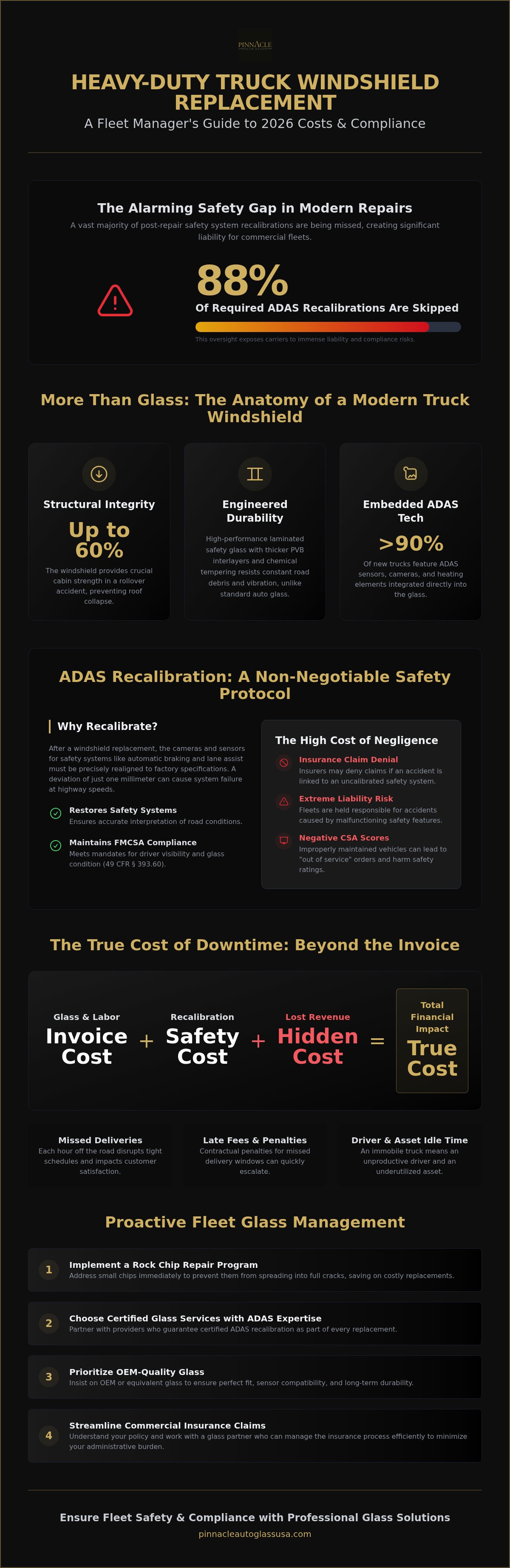
An estimated 88% of required ADAS recalibrations are skipped after glass repairs, creating significant liability risks for commercial carriers. You already know that a cracked windshield is more than a minor annoyance. It is a safety hazard that can lead to "out of service" orders and negative CSA scores. Managing your heavy duty truck windshield replacement cost requires looking beyond the price of the glass itself. You must account for the specialized labor needed for modern safety sensors and the potential for lost revenue when a vehicle is off the road.
We understand that unpredictable downtime affects your delivery schedules and tightens your margins. This guide provides a clear breakdown of what to expect when budgeting for glass maintenance in 2026. You will discover how ADAS requirements impact your total spend and how to navigate insurance claims efficiently. We also explore the structural role of the windshield, which provides up to 60% of cabin strength in a rollover accident. By the end of this article, you will have the data needed to minimize downtime and ensure your fleet remains fully compliant with FMCSA regulations.
Key Takeaways
- Understand how glass thickness and specialized manufacturing for commercial-grade durability influence the total heavy duty truck windshield replacement cost.
- Learn why ADAS recalibration is a non-negotiable safety requirement for modern fleets to protect against liability risks.
- Calculate the true impact of vehicle downtime on your bottom line, including lost revenue and potential late fees from missed delivery windows.
- Discover proactive strategies for managing fleet glass expenses, such as implementing rock chip repair programs and navigating commercial insurance claims.
- Ensure your fleet meets 2026 safety standards by integrating professional glass replacement with certified ADAS recalibration services.
Understanding the Factors of Heavy-Duty Truck Windshield Replacement Costs
Estimating a heavy duty truck windshield replacement cost requires more than checking a standard price list. Commercial glass isn't just larger; it's engineered for extreme durability. Most modern trucks use high-performance laminated safety glass designed to withstand constant road debris and vibration. This glass provides up to 60% of the cabin's structural strength during a rollover. Because of this, the materials and manufacturing standards are much higher than those for passenger vehicles. Every millimeter of thickness and every layer of interlayer bonding adds to the manufacturing expense.
Durability is the primary driver of cost for commercial glass. Unlike passenger vehicles, heavy-duty trucks face constant bombardment from gravel and debris on long-haul routes. Manufacturers use specialized chemical tempering and thicker PVB interlayers to prevent small chips from turning into spiderweb cracks. These high standards ensure the vehicle remains on the road longer, but they also increase the base price of the replacement unit. When you factor in the sheer surface area of a Freightliner or Kenworth windshield, the material costs alone far exceed those of a standard cargo van.
Class 8 Semi-Trucks vs. Standard Commercial Vans
A Class 8 semi-truck often features a two-piece split windshield. This design can lower individual part costs, but it requires precise alignment and specialized gaskets to prevent leaks. In contrast, a Ford Transit typically uses a large, single-piece unit. Heavy-duty applications rely on high-modulus sealants to handle the massive pressure of high-speed wind resistance. These units are heavy and difficult to maneuver, often requiring two technicians for a safe installation. This labor intensity is a major factor in the final heavy duty truck windshield replacement cost.
Why 2026 Technology Drives Higher Glass Estimates
By 2026, over 90% of new commercial vehicles come equipped with Advanced Driver Assistance Systems (ADAS). This technology is often integrated directly into the glass. Modern windshields now feature embedded heating elements to prevent ice buildup and rain sensors that automate wiper speed. Manufacturers are also shifting toward complex glass curvatures to improve aerodynamics. These technical additions mean that the glass itself is a critical electronic component, which naturally increases the replacement estimate. These integrated features require delicate handling during installation to avoid damaging sensitive electronics.
Technical Components: ADAS Recalibration and Glass Quality
Modern windshields are no longer just passive glass panels. They are sophisticated housing units for sensors that control automatic braking and lane-keeping assistance. When calculating your heavy duty truck windshield replacement cost, you must account for the specialized tools required to realign these systems. A camera that is off by just a few millimeters can cause a safety system to fail at highway speeds. This technical complexity is a major reason why commercial glass services have evolved so rapidly by 2026.
The Vital Role of ADAS Recalibration in Commercial Safety
Recalibration ensures that the cameras and sensors mounted on the glass accurately interpret the road ahead. Static recalibration happens in a controlled shop environment using specialized targets, while dynamic recalibration involves driving the truck at specific speeds to program the sensors. ADAS recalibration is a non-negotiable safety step that restores the vehicle's electronic safety features to their factory-specified tolerances.
Skipping this step is a massive liability. Research shows that 88% of required ADAS recalibrations are skipped after glass repairs. This creates significant risks for fleet operators. If an uncalibrated truck is involved in a collision, insurance claims may be denied. Beyond liability, carriers must stay compliant with FMCSA regulation 49 CFR § 393.60, which mandates specific standards for driver visibility and glass condition. Ensuring your fleet glass services include certified recalibration is the only way to maintain safety compliance.
OEM vs. Aftermarket Glass for Heavy-Duty Durability
Choosing the right glass brand affects the long-term heavy duty truck windshield replacement cost. Original Equipment Manufacturer (OEM) glass is produced by the same company that made the truck's original windshield. This ensures a perfect fit and identical optical clarity. High-quality aftermarket glass can be a cost-effective alternative, provided it meets the same structural benchmarks as the original part.
Optical clarity is critical for long-haul drivers who spend ten or more hours behind the wheel. Low-quality glass can have slight distortions that cause eye strain or interfere with camera sensors. These imperfections can lead to false alerts from lane departure systems, frustrating drivers and potentially causing them to ignore real warnings. Warranty coverage also varies between brands. Most OEM glass carries a robust manufacturer warranty, while aftermarket options depend on the provider's specific terms. Prioritizing glass that matches the original specifications reduces the likelihood of sensor errors and premature wear.
The True Cost of Downtime: Beyond the Invoice Price
When evaluating your heavy duty truck windshield replacement cost, the invoice from the glass provider is only part of the equation. For a Class 8 vehicle, the real expense often lies in the hours or days the truck is out of service. Research indicates that a grounded heavy-duty truck can cost a company between $448 and $760 per day in lost revenue. These figures do not include the secondary costs of missed delivery windows or potential late fees from frustrated clients. Every hour the wheels aren't turning, your fixed costs continue to accumulate without generating income.
Calculating Revenue Loss During Glass Service
Determining the opportunity cost per vehicle hour is essential for accurate budgeting. You must factor in the driver's idle wages and the fixed insurance and permit costs that continue even when the truck is stationary. If a replacement takes a full day due to complex ADAS repair and recalibration requirements, the total financial impact can easily double the initial glass estimate. Long-term client relationships also suffer when shipments are delayed. One missed delivery can jeopardize a multi-year contract, making the speed of service a critical business metric for any carrier.
Logistics and Mobile Service Efficiency
Choosing a provider that offers mobile service is the most effective way to mitigate these logistical losses. On-site replacement at your fleet yard or distribution center allows you to coordinate repairs during scheduled downtime. This prevents the need for a driver to transport the vehicle to a shop and wait for hours in a lounge. Mobile technicians can often perform the installation and recalibration while the driver is on a mandatory rest period or during loading. This approach turns a potential operational bottleneck into a routine maintenance task.
Centralized glass management simplifies logistics for national fleets. Instead of managing dozens of local vendors with varying quality standards, a single partner provides consistent pricing and reporting. This organization reduces the administrative burden on your dispatchers and ensures that every vehicle meets safety standards without disrupting the supply chain. Minimizing the time between damage identification and resolution is the key to controlling the total heavy duty truck windshield replacement cost across your entire operation. Efficient scheduling ensures that your drivers stay on their routes and your deliveries arrive on time.
Strategies to Manage and Reduce Fleet Glass Expenses
Controlling your heavy duty truck windshield replacement cost starts long before a crack appears. Effective fleet management focuses on prevention and strategic decision-making rather than reactive repairs. By implementing structured protocols, you can significantly reduce the frequency of full replacements and keep your vehicles on the road. Prevention is the key. Most glass damage is cumulative. A small chip today becomes a structural failure tomorrow if it isn't addressed immediately.
Insurance Claims and Deductible Management
Commercial insurance policies usually feature higher deductibles than personal auto plans. You should weigh the cost of the replacement against your deductible before filing a claim. If the total expense is close to your out-of-pocket limit, paying directly might prevent future premium hikes. It's also vital to verify that your "full glass" coverage includes ADAS recalibration. Some older policies don't account for the specialized labor required for modern sensors. Checking these details during your annual policy review prevents unexpected expenses when a truck is grounded. Clear communication with your agent ensures that safety tech is always covered.
Implementing a Proactive Rock Chip Repair Protocol
A proactive repair program is the most effective way to save money. A 15-minute windshield repair can stop a small chip from spreading across the entire glass surface. This prevents a full replacement and keeps the original factory seal intact. You should train your drivers to report chips during pre-trip inspections. Catching damage early is much cheaper than waiting for a crack to obstruct the driver's view. Prompt action is the difference between a minor maintenance task and a major operational delay. Windshield repair is a fraction of the cost of a full heavy-duty replacement and takes significantly less time to complete.
Implementing a driver inspection protocol is a low-cost strategy with high returns. Drivers should check for chips, pitting, and seal wear every time they step into the cab. This habit ensures that small issues don't escalate into FMCSA violations. Centralized billing and reporting also help manage expenses across a national fleet. Instead of managing dozens of local vendors, you get predictable pricing and consistent quality. This organization reduces the administrative burden on your dispatchers and ensures every vehicle meets safety standards. For reliable support across your entire operation, consider our professional fleet glass services to streamline your maintenance workflow.
Professional Fleet Glass Solutions with Pinnacle Auto Glass
Pinnacle Auto Glass specializes in managing the complexities of heavy-duty commercial vehicles. We provide expert windshield replacement for every major make and model, including Freightliner, Kenworth, and Peterbilt. Our team understands that a single grounded vehicle impacts your entire supply chain. By combining technical expertise with operational efficiency, we help you control the total heavy duty truck windshield replacement cost across your entire fleet. We don't just swap glass; we restore the full structural and electronic integrity of your vehicle. Efficient management is the only way to lower the long-term heavy duty truck windshield replacement cost for high-mileage fleets.
Nationwide Support for Commercial Logistics
Large-scale fleet operations require more than just a local repair shop. You need a partner that offers consistent service quality regardless of where your trucks are located. Our dedicated commercial support team provides a stable, nationwide solution that maintains the focus of a localized provider. We prioritize results and organization to simplify your maintenance workflow.
- Simplified centralized billing to reduce administrative overhead.
- Detailed reporting for every glass service performed across the fleet.
- Reliable scheduling that respects your strict operational timelines.
- Consistent pricing structures for national logistics partners.
This organized approach ensures that your dispatchers spend less time on maintenance logistics and more time on delivery coordination. We act as a dependable guide for your maintenance department, ensuring that every vehicle in your network meets the same high safety standards. Our goal is to provide immediate answers to your most urgent glass problems.
Streamlined ADAS and Glass Replacement Services
Safety compliance is our top priority. Our technicians are certified in the latest 2026 recalibration technologies. We ensure that every lane departure warning and forward collision system is perfectly aligned before the truck returns to service. Using high-quality glass sourcing is essential for vehicle longevity. We only install glass that meets or exceeds OEM specifications, ensuring that your safety sensors function exactly as the manufacturer intended. This precision prevents the liability risks associated with skipped calibrations.
Our mobile services are specifically designed to minimize downtime. We meet your drivers at fleet yards or distribution centers to perform replacements and recalibrations on-site. This eliminates the need for costly vehicle transport and keeps your routes active. To optimize your maintenance budget and ensure fleet-wide safety compliance, you can Contact Pinnacle for a fleet glass assessment today. Our team is ready to provide a solution-oriented plan tailored to your specific logistical needs.
Optimize Your Fleet Maintenance for 2026 and Beyond
Managing fleet expenses requires a strategic balance between high-quality materials, precise technical calibration, and logistical efficiency. You now understand that the true heavy duty truck windshield replacement cost involves both the initial invoice and the hidden price of vehicle downtime. By prioritizing proactive repairs and certified recalibration, you protect your drivers and your bottom line from unnecessary risks. Safety compliance is no longer optional; it is a fundamental requirement for modern logistics and fleet management.
Pinnacle Auto Glass stands ready as your dedicated commercial fleet specialist. We provide nationwide mobile service and professional ADAS recalibration to keep your operations moving without interruption. Our team focuses on speed and reliability, ensuring your vehicles remain fully compliant with federal safety standards while significantly reducing time off the road. We understand the pressure of delivery windows and the importance of structural integrity in heavy-duty applications. Trust a partner that values your time as much as you do.
Get a Professional Quote for Your Fleet Glass Needs today. Let us handle the technical complexities so you can focus on your delivery schedules. We are here to ensure your fleet stays safe, compliant, and productive.
Frequently Asked Questions
How much does a semi-truck windshield replacement cost in 2026?
The final price for a semi-truck windshield depends on the specific make and model, such as a Freightliner or Kenworth. Factors like the size of the glass and whether you need a one-piece or two-piece design significantly influence the quote. While base glass is a major component, the complexity of modern safety sensors also plays a role in the total heavy duty truck windshield replacement cost.
Is ADAS recalibration mandatory after replacing a truck windshield?
Vehicle manufacturers mandate ADAS recalibration after every windshield replacement to ensure safety systems like automatic emergency braking function correctly. Safety cameras rely on precise alignment with the glass to interpret road conditions. Failing to recalibrate these systems can lead to inaccurate warnings or system failures. It's a critical safety step that protects your drivers and your company from liability risks on the road.
How long does it take to replace a heavy-duty truck windshield?
A standard heavy-duty windshield replacement usually takes between two and four hours to complete. This timeframe includes the removal of the damaged glass, the installation of the new unit, and the required adhesive cure time. If your vehicle requires ADAS recalibration, the process may take longer depending on whether a static or dynamic procedure is necessary. Efficient scheduling helps minimize your vehicle's total time out of service.
Can a cracked semi-truck windshield be repaired instead of replaced?
You can often repair a cracked windshield if the damage is smaller than 3/4 of an inch and located outside the driver's critical viewing area. Cracks that intersect with other cracks or are larger than a small coin generally require a full replacement for safety and legal compliance. Promptly addressing minor chips prevents them from spreading and helps you avoid the higher heavy duty truck windshield replacement cost associated with a new installation.
Does commercial insurance cover the cost of ADAS recalibration?
Most comprehensive commercial insurance policies cover the cost of ADAS recalibration when it's performed as part of a necessary windshield replacement. Since recalibration is a manufacturer-mandated safety requirement, insurers typically treat it as a standard part of the repair process. You should verify your specific deductible and coverage limits with your agent to ensure your policy accounts for modern safety technology and labor.
What happens if I don't recalibrate my truck's safety cameras?
Skipping recalibration can cause your truck's safety cameras to provide false alerts or fail to engage during a critical event. Even a slight misalignment can prevent lane departure warnings and collision avoidance systems from working as intended. This creates a significant safety hazard and increases your liability if an accident occurs. Maintaining properly calibrated sensors is essential for meeting FMCSA visibility and safety standards.
Are mobile windshield replacements safe for heavy-duty trucks?
Mobile windshield replacements are completely safe when performed by certified technicians using professional-grade tools and adhesives. Technicians can replicate shop conditions at your fleet yard or distribution center to ensure a secure bond and proper seal. This service is a primary solution for reducing downtime because it allows repairs to happen during scheduled rest periods or loading times without requiring a trip to a service center.
What is the difference between OEM and aftermarket glass for fleets?
OEM glass is produced by the original manufacturer to the exact specifications of your truck's factory windshield. This ensures the highest level of optical clarity and a perfect fit for integrated sensors. High-quality aftermarket glass is a cost-effective alternative that meets standard safety benchmarks but may have slight variations in brand or warranty. Choosing the right option depends on your fleet's specific durability needs and budget.


