
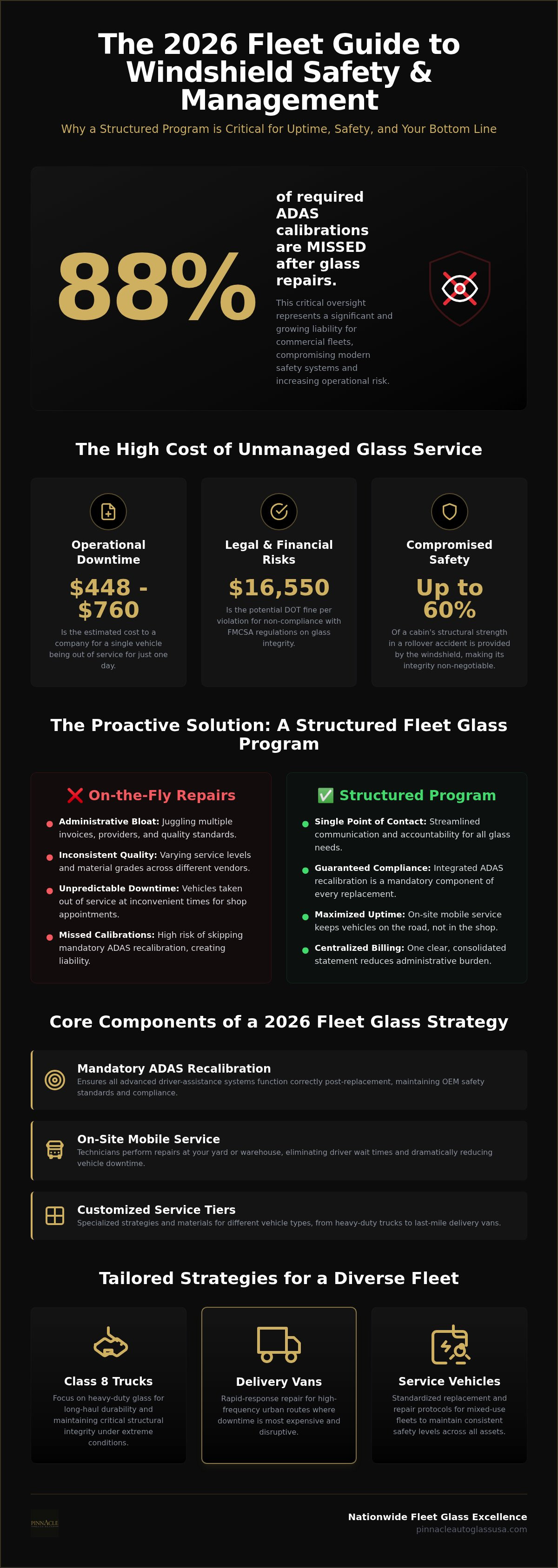
Industry studies in 2026 reveal that 88% of required ADAS calibrations are missed after glass repairs. This statistic represents more than just a technical oversight; it's a significant liability for your commercial fleet. You already manage tight delivery schedules and rising operational costs. Dealing with unscheduled downtime or inconsistent billing from multiple service providers makes your job harder. Implementing a structured fleet windshield replacement program is the most effective way to eliminate these variables and protect your bottom line.
This 2026 management guide explains how a professional program minimizes vehicle downtime and ensures full ADAS safety compliance. You'll learn how to establish a single point of contact for all glass needs while reducing total operational costs. We'll show you how to achieve predictable turnaround times and guaranteed recalibration for every vehicle in your fleet. It's time to simplify your glass management and focus on your core business operations. This guide provides the roadmap to a more reliable and safety-conscious fleet.
Key Takeaways
- Standardizing glass maintenance through a structured agreement eliminates administrative bloat and ensures consistent service quality across all vehicles.
- A professional fleet windshield replacement program provides centralized billing and customized service tiers for both heavy-duty trucks and light delivery vans.
- Integrated ADAS recalibration is a mandatory component of modern fleet safety to maintain compliance and ensure the proper function of driver assistance systems.
- Developing specialized repair strategies for different vehicle types, from semi-trucks to last-mile delivery vans, minimizes logistical disruptions and downtime.
- Partnering with a single-source nationwide provider ensures your fleet receives professional, no-nonsense service that respects commercial timelines and safety standards.
The Operational Impact of a Fleet Windshield Replacement Program
A fleet windshield replacement program is a structured service agreement that standardizes glass repair, replacement, and safety recalibration for commercial vehicles. Instead of treating glass damage as an isolated emergency, this program incorporates maintenance into the broader scope of fleet management. Relying on "on-the-fly" repairs often leads to administrative bloat, as managers must juggle multiple invoices and varying quality standards from different providers. A centralized program eliminates these inconsistencies by providing a single point of contact and predictable service protocols.
Reducing the Total Cost of Ownership (TCO) for fleet vehicles requires a strategic approach to maintenance. While the price of the glass itself is a factor, the hidden costs of administrative time and vehicle downtime are often more significant. In 2026, industry data shows that a single day of a vehicle being out of service can cost a company between $448 and $760. By establishing a fleet windshield replacement program, businesses can lock in service standards that prioritize efficiency and long-term vehicle health. In the 2026 safety landscape, windshields are no longer just glass; they are critical sensors that house the cameras and hardware for advanced safety systems.
Reducing Fleet Downtime Through Proactive Management
Maximizing uptime is the primary goal of any logistics operation. A structured program utilizes standardized scheduling protocols that prioritize commercial vehicles to keep them on the road. Mobile service is a cornerstone of this efficiency, as it allows technicians to perform repairs at your yard or warehouse. This eliminates the need for drivers to wait at a shop, directly reducing fleet downtime with mobile glass repair. When repairs are handled on-site during scheduled idle times, the impact on delivery windows is virtually non-existent.
Liability and Risk Mitigation for Modern Fleets
Driving commercial vehicles with compromised glass carries heavy legal and financial risks. Under FMCSA regulations (49 CFR § 393.60), cracks larger than 3/4 of an inch in the driver's field of vision are considered violations. As of 2026, DOT compliance fines can range from $1,099 to $16,550 per violation. A professional program ensures that every replacement meets federal motor vehicle safety standards and provides the necessary documentation for insurance audits. Because a windshield contributes up to 60% of a cabin's structural strength in a rollover accident, maintaining glass integrity is a non-negotiable safety requirement for protecting your drivers and your brand reputation.
Core Components of a 2026 Fleet Glass Strategy
Efficiency in fleet management depends on streamlined logistics. A robust fleet windshield replacement program moves beyond reactive repairs by implementing centralized billing and account management. This structure allows multi-vehicle operations to consolidate paperwork. It reduces the administrative burden on your dispatch team. You get one clear statement instead of dozens of fragmented receipts from various local shops.
Not all vehicles require the same approach. Last-mile delivery vans face high-frequency stop-and-go risks. Semi-trucks deal with heavy-duty structural demands. Customized service tiers ensure your fleet receives the correct materials and attention:
- Class 8 Trucks: Specialized heavy-duty glass for long-haul durability and structural integrity.
- Delivery Vans: Rapid-response repair for high-frequency urban routes where downtime is most expensive.
- Service Vehicles: Standardized replacement for mixed-use fleets to maintain consistent safety levels.
These tiers ensure hardware meets all Federal Motor Vehicle Safety Standards. Integrating professional windshield repair into your strategy saves money by addressing minor chips before they spread. If you're ready to scale your maintenance strategy, fleet glass services offer the reliability you need.
Standardized Pricing and Transparent Costing
Surprise invoices disrupt annual budgets and complicate financial reporting. A strategic program uses pre-negotiated fleet rates to provide transparency across every service call. This predictability is essential for calculating accurate per-mile operating costs for your entire operation. Fixed-rate glass programs provide the financial stability needed to forecast annual maintenance expenses with total accuracy in 2026.
Reporting and Analytics for Fleet Managers
Data is a powerful tool for cost control and risk mitigation. Modern programs provide a digital service history for every vehicle in the fleet. You can track damage frequency to identify high-risk routes or specific drivers who may need safety feedback. Utilizing this reporting allows you to improve vehicle glass longevity through better route planning and proactive maintenance. When a "Vehicle Off Road" (VOR) emergency occurs, priority dispatching ensures your assets return to service without unnecessary delay.
The ADAS Factor: Why Calibration is Non-Negotiable
Modern windshields act as the eyes of your vehicle. In 2026, Advanced Driver Assistance Systems (ADAS) rely on cameras and sensors mounted directly behind the glass. These systems control vital safety functions like automatic emergency braking and lane keep assist. A professional fleet windshield replacement program must treat glass and technology as an integrated unit. If the camera alignment is off by even a fraction of a millimeter, the safety systems won't respond correctly to road hazards. This misalignment can lead to delayed reactions or total system failure during a collision event.
Every effective program should include ADAS calibration auto glass as a bundled service. Fleet managers need to distinguish between static and dynamic recalibration. Static calibration happens in a controlled shop environment using specialized targets and laser levels. Dynamic calibration requires driving the vehicle at specific speeds for a set duration to allow the system to learn the road. Some 2026 models require both methods to ensure full system functionality. Skipping this step leads to lane departure failures and emergency braking malfunctions, creating unacceptable risks for your drivers and your business.
Ensuring System Integrity Post-Installation
Precision is the difference between a safe vehicle and a liability. Shops that only swap the glass without calibrating the sensors leave your fleet vulnerable. These glass-only providers are a significant risk for modern commercial operations. ADAS recalibration is a safety requirement, not an optional upgrade. Proper alignment ensures that the camera sees the road exactly as the manufacturer intended. This prevents the system from miscalculating distances or failing to recognize lane markings during heavy traffic or poor weather conditions.
Certifications and Technician Expertise
Handling 2026 vehicle technology requires specialized training. Hiring a certified auto glass technician guarantees that the person working on your fleet understands the nuances of sensor integration. Organizations like the Auto Glass Safety Council set the standards for these complex procedures. Technicians must follow strict verification steps to confirm recalibration success before the vehicle returns to service. This expertise protects your fleet from technical malfunctions and ensures that your safety investments actually perform when they're needed most. Relying on certified professionals is the only way to maintain the structural and electronic integrity of your commercial vehicles.
Implementing a Program Across Diverse Vehicle Types
Managing a mixed fleet requires a fleet windshield replacement program that understands the mechanical and operational differences between vehicle classes. A delivery van navigating city alleys faces different hazards than a semi-truck on a cross-country haul. Your program must adapt to these specific needs to ensure consistent uptime across the entire operation. Standardizing these processes across mixed-model fleets creates a predictable maintenance cycle that supports your entire logistics network.
Heavy-Duty Glass Requirements
Class 7 and 8 trucks require specialized hardware that goes beyond standard automotive glass. Sourcing OEM-quality glass is essential to maintain the structural integrity of these large cabs. Large commercial windshields experience unique stress points due to the sheer size of the glass and the vibrations of heavy-duty engines. Mobile installation techniques are the preferred solution for these assets. Moving a semi-truck to a service center is often impractical and expensive. Specialized technicians perform on-site replacements at your terminal. This ensures the vehicle is ready for its next long-haul assignment without unnecessary mileage. If you need reliable support for your heavy-duty assets, our commercial truck glass services provide the expertise required for large-scale hardware.
Last-Mile Delivery Challenges
Urban delivery fleets operate in high-risk environments where glass damage is frequent. High-mileage vans are constantly exposed to road debris in construction zones and congested city streets. To keep these vehicles on the road, scheduling repairs during off-peak hours is a critical strategy. Performing maintenance while vans are loading or during driver shift changes prevents missed delivery windows. Rapid professional windshield replacement is the only way to maintain tight logistics schedules in the last-mile sector.
Box trucks and regional haulers also require a balance between durability and quick turnaround. These vehicles often bridge the gap between heavy-duty and light-commercial needs. A customized program tracks the specific glass requirements for every model in your fleet. This prevents delays caused by incorrect parts. It ensures that every technician arrives with the right tools for the job. By addressing the specific needs of each vehicle type, you eliminate the guesswork that leads to extended downtime.
The Pinnacle Advantage: Nationwide Fleet Glass Excellence
Pinnacle Auto Glass acts as a dependable guide for commercial operators by offering a single-source solution for replacement, repair, and ADAS recalibration. Our professional, no-nonsense approach respects your fleet timelines. We understand that every hour a vehicle sits idle is lost revenue. Our nationwide reach ensures that your trucks receive the same high standard of care in every region. This consistency is essential for maintaining a safe and compliant fleet. By choosing a fleet windshield replacement program through Pinnacle, you consolidate your glass management under one authoritative expert.
Many local providers lack the infrastructure to support multi-state operations. They often struggle with the technical requirements of modern safety systems or consistent billing across different territories. Pinnacle solves these issues with a stable, nationwide entity that maintains the focused attention of a localized provider. We prioritize efficiency and customer needs above all else. Our team jumps straight to the core of your glass problems to provide immediate resolutions. This directness reflects our commitment to your operational success and long-term safety.
Getting Started with a Fleet Assessment
Transitioning to a professional program shouldn't disrupt your daily operations. We've streamlined the onboarding process to get your fleet compliant quickly. Our methodical flow moves you through three essential steps to establish a reliable foundation:
- Step 1: Inventory Review. We conduct a thorough assessment of your current glass health across all vehicle types. This identifies immediate safety risks and establishes a baseline for future maintenance needs.
- Step 2: Customizing Protocols. We define service levels and pricing structures that fit your specific budget. This ensures you only pay for the services your unique fleet requires without surprise fees.
- Step 3: Workflow Integration. We align our billing and reporting systems with your existing administrative processes. This eliminates the paperwork headaches often associated with managing multiple vendors.
Why Logistics Leaders Choose Pinnacle
Reliability is the foundation of a successful partnership. Logistics leaders choose Pinnacle because we focus on expert-level technical execution and predictable results. We have a proven track record with both heavy-duty commercial truck fleets and high-frequency delivery van operations. Our fleet windshield replacement program is designed to simplify complex technical tasks for the vehicle owner. We act as a partner that values your time and provides immediate answers to urgent problems. Contact Pinnacle Auto Glass to start your fleet program today.
Future-Proofing Your Fleet Operations
A robust fleet windshield replacement program is a strategic asset that protects your drivers and your bottom line. By standardizing glass maintenance, you eliminate the administrative friction of managing multiple vendors and unpredictable invoices. You also ensure that every vehicle remains compliant with 2026 safety standards, particularly regarding the mandatory requirements of ADAS recalibration. These systems are integral to modern logistics and require precise technical execution to remain effective.
Pinnacle Auto Glass provides the specialized commercial truck glass expertise needed for mixed-model fleets. Our certified ADAS recalibration technicians ensure your safety systems function exactly as intended after every replacement. With a national service footprint, we offer the consistency and professional reliability that logistics leaders demand. We act as a dependable partner, simplifying technical tasks so you can focus on your core delivery objectives. Our no-nonsense approach ensures that your assets spend more time on the road and less time in the shop.
Optimize your fleet safety and uptime with Pinnacle Auto Glass. Take the first step toward a more efficient, safety-conscious operation today. We're ready to help you secure your fleet's future on the road.
Frequently Asked Questions
What are the primary benefits of a fleet windshield replacement program?
A fleet windshield replacement program reduces vehicle downtime and ensures consistent safety compliance across your entire operation. It provides predictable turnaround times and centralized management for all glass needs. This structure eliminates the administrative burden of dealing with multiple local shops. It ensures every vehicle meets FMCSA standards for glass integrity and visibility. By standardizing your approach, you protect your drivers and reduce long-term operational costs.
How does a fleet program handle ADAS recalibration for different vehicle makes?
Our technicians use specialized diagnostic equipment to perform ADAS recalibration for various vehicle makes and models. We follow manufacturer-specific protocols to ensure cameras and sensors align perfectly with the new glass. Whether your fleet uses Ford delivery vans or Freightliner semi-trucks, we handle both static and dynamic recalibrations. This guarantees that safety systems like lane departure warnings function correctly regardless of the vehicle manufacturer or hardware configuration.
Can a fleet program include both on-site mobile service and in-shop repairs?
Yes, a comprehensive program includes both mobile and in-shop service options to maximize fleet uptime. Technicians perform most repairs and replacements at your yard or warehouse to minimize logistical disruptions. If a specific ADAS recalibration requires a controlled shop environment, we coordinate the scheduling to ensure the vehicle returns to service quickly. This flexibility allows you to manage maintenance around your delivery windows and keep your assets moving.
Is there a minimum number of vehicles required to join a fleet glass program?
There is generally no strict minimum number of vehicles required to establish a service agreement. We customize programs for small local delivery teams and large national logistics carriers alike. The primary goal is to provide professional glass management that scales with your business needs. We assess your fleet size and damage frequency to create a service protocol that provides the most value for your specific commercial operation.
How does centralized billing work for a national fleet glass account?
Centralized billing consolidates all glass service expenses into a single, transparent account statement. Instead of processing dozens of individual invoices from different providers, your accounting team receives one organized report. This system tracks service dates, vehicle IDs, and specific work performed across your entire national footprint. It simplifies financial reporting and makes it easier to track the total cost of ownership for your fleet glass assets.
What is the typical turnaround time for a commercial truck windshield replacement?
Most commercial truck windshield replacements are completed within two to four hours, depending on the complexity of the ADAS recalibration. We prioritize "Vehicle Off Road" (VOR) emergencies to ensure your assets return to service as soon as the adhesive has cured to safety standards. By scheduling repairs during off-peak hours or planned downtime, we help your fleet maintain its delivery commitments without experiencing significant operational delays.
How do I know if my fleet insurance covers the cost of a formal glass program?
You should review your comprehensive policy or consult with your provider to confirm specific glass coverage details. Many commercial insurance policies cover windshield replacement and repair, including the technical costs of ADAS recalibration. A formal program often simplifies the claims process by providing standardized documentation and direct billing options. Our team assists with the necessary paperwork to ensure your fleet remains compliant with all insurance and safety requirements.


