
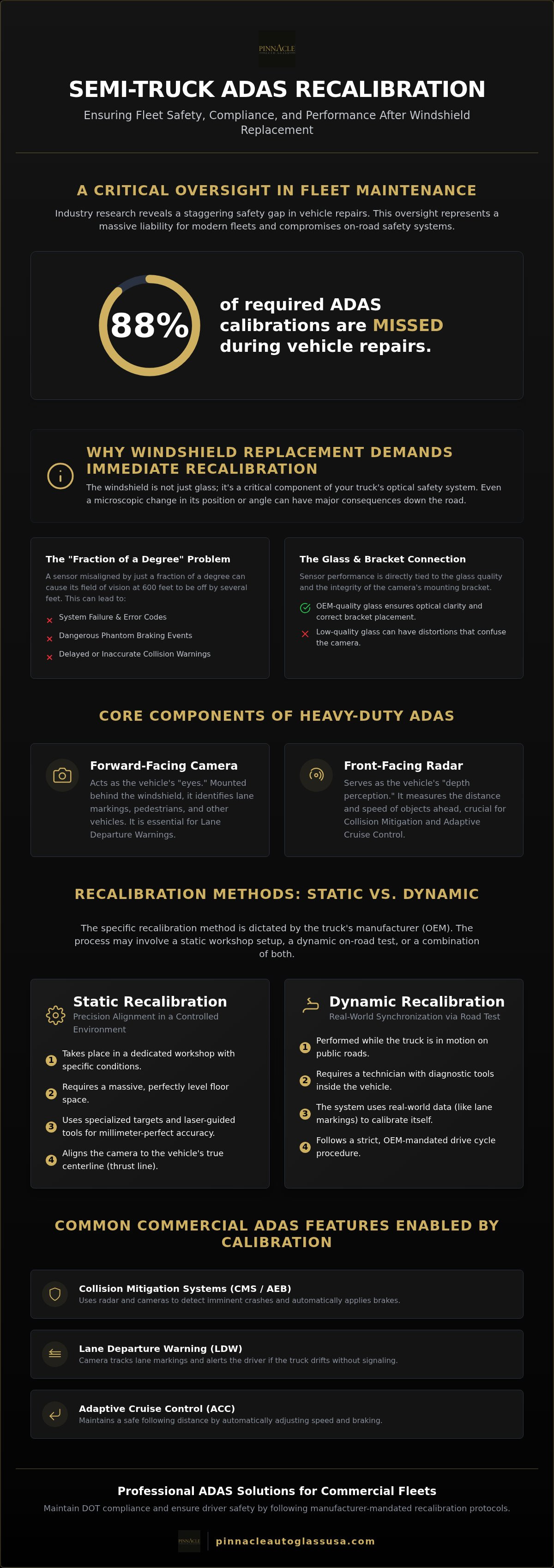
Industry research indicates that 88% of required ADAS calibrations are missed during vehicle repairs. This is a staggering figure that represents a massive liability for modern fleets. If your vehicle features a forward-facing camera, a windshield replacement is only half the job. You must perform a semi truck ADAS recalibration to ensure that safety systems like collision mitigation and lane-departure warnings function as intended. Even a fraction of a degree in misalignment can lead to system failure or dangerous phantom braking events.
We understand that every hour your truck sits in a shop is lost revenue. You might feel overwhelmed by the technical differences between Detroit Assurance and Bendix systems or worried about meeting the latest 2026 FMCSA safety standards. This guide simplifies the entire process. We'll explain how heavy-duty recalibration works, why it's essential for maintaining DOT compliance, and how to minimize downtime after glass service. You will learn the specific steps needed to keep your drivers safe and get your equipment back on the road without unnecessary delays.
Key Takeaways
- Identify the core components of heavy-duty ADAS, including forward-facing cameras and radar sensors, to better manage fleet safety technology.
- Differentiate between static and dynamic calibration methods to understand the specific servicing requirements for your Class 8 trucks.
- Learn why every windshield replacement requires a professional semi truck ADAS recalibration to avoid sensor misalignment and system failure.
- Explore mobile recalibration solutions that minimize vehicle downtime and keep your logistics operations moving efficiently.
- Maintain strict DOT compliance and ensure driver safety by following manufacturer-mandated recalibration protocols.
What is Semi Truck ADAS Recalibration?
In the world of heavy-duty logistics, Advanced Driver-Assistance Systems (ADAS) are no longer luxury features. For Class 8 trucks, these systems represent a sophisticated network of sensors designed to prevent accidents and reduce driver fatigue. Semi truck ADAS recalibration is the technical process of aligning these sensors to ensure the vehicle's computer sees the road exactly as it is. Without this precision, the safety net fails.
Most modern tractors rely on three primary components: forward-looking cameras, front-facing radar, and occasionally LiDAR. The camera is typically mounted behind the upper portion of the windshield. It acts as the vehicle's eyes, while the radar serves as its depth perception. Because the camera looks through the glass, the windshield is effectively part of the sensor's optical path. If a sensor is off by even a fraction of a degree, its field of vision at 600 feet could be off by several feet. This misalignment leads to delayed braking or dangerous false alerts.
Common Commercial ADAS Features
Heavy-duty systems like Detroit Assurance and Bendix Wingman provide specific layers of protection. These features rely on perfectly calibrated data to make split-second decisions on the highway. They don't just assist the driver; they act as a fail-safe for the entire fleet.
- Collision Mitigation Systems (CMS) and AEB: These use radar and cameras to detect objects. If a crash is imminent, the system applies the brakes automatically to reduce impact severity.
- Lane Departure Warning (LDW): Cameras track lane markings. The system alerts the driver or provides steering assistance if the truck drifts without a turn signal.
- Adaptive Cruise Control (ACC): This maintains a safe following distance by adjusting throttle and braking based on the speed of the vehicle ahead.
The Relationship Between Glass and Sensors
Glass quality is a primary factor in sensor performance. Low-quality aftermarket glass often suffers from optical distortion or inconsistent curvature. These imperfections can trick the camera, causing it to misinterpret distances or road lines. When performing a semi truck ADAS recalibration, technicians must account for the clarity and thickness of the glass to ensure the software can process images correctly.
Mounting brackets also play a vital role. Most cameras are secured to the windshield via a factory-bonded bracket. If this bracket is even slightly crooked on a new windshield, the camera's baseline is compromised. Using OEM-quality glass ensures that these brackets are positioned according to the manufacturer's exact specifications. This reduces the risk of calibration errors and keeps your fleet compliant with 2026 safety standards.
Static vs. Dynamic Recalibration for Heavy-Duty Vehicles
Not all safety systems are serviced the same way. The specific method for semi truck ADAS recalibration is dictated by the Original Equipment Manufacturer (OEM), not the technician. Understanding ADAS repair and recalibration requirements is vital for fleet managers who need to maintain safety standards. Depending on the make and model of your truck, the process will involve a static environment, a dynamic road test, or a combination of both.
The choice between these methods depends on the type of sensors installed. Forward-facing cameras often require different protocols than bumper-mounted radar units. While some systems can be calibrated in a shop, others need real-world data to synchronize properly. Using the wrong method or skipping a required step can lead to system errors that sideline your equipment.
The Static Recalibration Process
Static recalibration takes place in a highly controlled workshop environment. This process is a game of millimeters. Technicians use specialized heavy-duty targets and laser-guided alignment tools to reset the sensors. For a Class 8 vehicle, this requires a massive, dedicated footprint. The shop floor must be perfectly level, and the lighting must be consistent to prevent shadows from confusing the camera's lens.
Precision is the priority here. Technicians don't just look at the camera; they take measurements from the rear axle to establish the vehicle's true centerline, also known as the thrust line. This ensures the camera is aimed exactly where the truck is heading, not just where the cab is pointed. If the shop space is too cramped or the targets aren't positioned perfectly, the calibration will fail, leaving the driver with a non-functional safety system.
The Dynamic Recalibration Process
Dynamic recalibration is performed while the truck is in motion. The technician connects a diagnostic tablet to the vehicle's OBD-II port and initiates a "learning" mode. The driver then follows a specific driving profile on the road. This usually involves maintaining a steady speed on a highway with clear lane markings and visible roadside objects. The system uses this live data to map its surroundings and confirm that its sensors are reading the environment correctly.
A typical dynamic session for a semi truck takes between 30 and 60 minutes. However, it's heavily dependent on external factors. Success requires good weather and optimal road conditions. If it's raining, snowing, or if the road has faded paint, the sensors may not be able to lock onto the necessary markers. This can force a restart of the entire process, adding to vehicle downtime. Many modern trucks, especially those with integrated systems like Detroit Assurance, now require a static setup followed by a dynamic road test to ensure total accuracy.
Choosing a service provider with the right equipment for both methods is essential for keeping your fleet on schedule. If you need assistance determining the requirements for your vehicles, the team at Pinnacle Auto Glass can guide you through the process for your specific make and model.
Why Windshield Replacement Requires Immediate ADAS Re-Alignment
A windshield replacement is more than a simple glass repair; it's a mechanical disruption to your truck's safety architecture. On most Class 8 tractors, the forward-facing camera is mounted directly to the interior of the glass. When the old windshield is removed, the camera is detached from its factory position. Even if the technician reinstalls it into the same bracket on a new piece of glass, the physical geometry has changed. A semi truck ADAS recalibration is necessary to account for these microscopic shifts in pitch, yaw, and roll.
Manufacturer mandates from industry leaders like Bendix, WABCO, and Detroit Assurance are clear. These companies require a full system recalibration every time a windshield is replaced or the camera is disturbed. These aren't suggestions. They are strict operational requirements designed to keep the system within its engineered safety tolerances. Skipping this step means the truck is no longer operating according to the manufacturer's safety specifications.
The most dangerous scenario for a fleet is the "blind system" risk. Many drivers and fleet managers assume that if the dashboard is free of error lights, the ADAS is functioning correctly. This is a false sense of security. A system can be misaligned enough to process data incorrectly without being "broken" enough to trigger a fault code. In this state, the truck's computer "thinks" it is seeing the road clearly, but its depth perception and lane tracking are fundamentally flawed.
The Safety Risks of Misalignment
When sensors are out of alignment, the consequences on the road are immediate and dangerous. Misaligned radar units can trigger "phantom braking" events. This happens when the system incorrectly identifies an overhead sign or a vehicle in an adjacent lane as a direct obstacle, slamming on the brakes at highway speeds. Other risks include:
- Lane Departure Failures: The camera may fail to recognize road markings or provide alerts too late for the driver to react.
- Inaccurate Following Distances: Adaptive Cruise Control may miscalculate the gap between vehicles, leading to unsafe tailgating or sudden decelerations.
- Collision Mitigation Delays: The Automatic Emergency Braking (AEB) might not engage during a true critical event because the sensor's "vision" is pointed too high or too low.
Legal and Financial Implications
Operating a truck with an uncalibrated safety system carries heavy legal weight. In the event of an accident, plaintiffs' attorneys often look for gaps in maintenance records. If a fleet cannot produce a certificate of semi truck ADAS recalibration following a windshield replacement, it faces massive liability. This negligence can lead to "nuclear verdicts" and permanent damage to a company's reputation.
Beyond litigation, non-compliance affects your CSA scores and DOT safety ratings. Inspectors are increasingly aware of ADAS requirements. Proper documentation proves that your fleet prioritizes safety and follows federal maintenance guidelines. For a deeper look at the technical standards governing these systems, see our ADAS Calibration and Auto Glass: The Complete 2026 Reference Guide. Maintaining these records is a simple way to protect your bottom line and your drivers.
Minimizing Fleet Downtime During the Recalibration Process
In the logistics industry, time is the most valuable asset. Every hour a Class 8 tractor sits idle in a service bay is an hour of lost revenue and disrupted schedules. Fleet managers often view semi truck ADAS recalibration as a secondary task that adds hours to a repair, but it doesn't have to be a bottleneck. By choosing a provider that specializes in commercial glass, you can integrate safety system alignment directly into your maintenance workflow.
Efficiency starts with preparation. Before a technician arrives, ensure the vehicle meets the manufacturer's pre-calibration requirements. These steps prevent "failed" sessions that force a truck back to the start of the queue. Essential checklist items usually include:
- Full Fuel Tank: Most systems require a specific vehicle weight to establish the correct ride height.
- Proper Tire Pressure: Uneven tires can tilt the sensors by a fraction of a degree, causing calibration failure.
- Standard Load: Some manufacturers specify that the truck should be empty, while others require a specific load profile.
- Fluid Levels: All fluids should be topped off to maintain the vehicle's design geometry.
Streamlining the Service Workflow
The most effective way to reduce downtime is to combine windshield replacement and recalibration into a single service window. Coordinating these tasks separately often leads to the truck being moved between different facilities, which consumes fuel and driver hours. A specialized provider can perform both services on-site or at a dedicated hub, ensuring the truck is back on the road in hours rather than days. For more on optimizing these logistics, read our guide on Reducing Fleet Downtime with Mobile Glass Repair.
The Importance of Certified Technicians
Not all glass shops are equipped to handle semi truck ADAS recalibration for heavy-duty systems. General automotive mechanics often lack the specific software and high-precision targets required for Bendix or Detroit Assurance systems. Certified technicians bring specialized diagnostic tools that interface directly with the truck's ECU, providing a comprehensive service report for your maintenance logs. This documentation is vital for proving compliance and maintaining the vehicle's resale value. You can learn more about why hiring a certified auto glass technician is critical for your fleet's long-term safety and liability protection.
Managing a nationwide fleet requires a partner that understands the urgency of commercial timelines. If you're looking to simplify your glass maintenance and safety compliance, contact Pinnacle Auto Glass today to schedule your next fleet service.
Professional ADAS Solutions for Commercial Trucking Fleets
Pinnacle Auto Glass understands the technical demands of modern logistics. We provide specialized expertise in semi truck ADAS recalibration for fleets across the country. Our team doesn't just replace glass; we ensure the entire safety system is restored to factory specifications. This comprehensive approach protects your drivers and your company's bottom line. We act as a dependable guide through the complexities of heavy-duty safety technology.
Our nationwide service network allows us to support fleets of all sizes. We understand that a truck in Florida has the same safety requirements as one in Washington. Our technicians stay updated on the latest software updates for Bendix, WABCO, and Detroit Assurance systems. This ensures that every semi truck ADAS recalibration we perform meets the specific needs of your vehicle's make and model. We provide the stable, professional support of a national entity with the focused attention of a local service provider. We offer both mobile and in-shop recalibration to maximize your operational flexibility.
Why Fleets Partner with Pinnacle
Managing a fleet's safety compliance is a full-time job. Pinnacle acts as your partner in this process. We don't just provide a service; we provide peace of mind. Our direct billing options mean your drivers don't have to handle payments on the road. We work closely with insurance providers to streamline the claims process for commercial accounts. This results in less stress for your office staff and faster turnaround times for your equipment.
We adhere to the most rigorous recalibration standards in the industry. Our technicians use professional-grade diagnostic tools to ensure every sensor is perfectly aligned. We prioritize getting your drivers back on the road safely. We know that reliability is the foundation of your business. Our solution-oriented approach focuses on quality and efficiency to minimize your vehicle downtime.
Schedule Your Fleet Recalibration
Ready to secure your fleet? Our team is standing by to provide a transparent, detailed quote for your commercial ADAS needs. We provide a full digital report after every calibration. This report includes the specific measurements and system confirmations required for your maintenance records. These documents are vital if you ever face a DOT audit or an insurance inquiry. They provide a clear paper trail of your commitment to safety.
Our process is fast-paced and direct. We move you quickly from identifying a need to implementing a solution. Don't leave your fleet's safety to chance or uncertified providers. Trust the experts who specialize in heavy-duty equipment. Contact Pinnacle Auto Glass for professional semi truck ADAS services and experience a higher standard of fleet glass management.
Secure Your Fleet with Precision Recalibration
Maintaining a safe and compliant fleet in 2026 requires more than just standard maintenance. It demands a commitment to technical precision. Every windshield replacement on a modern Class 8 vehicle must be followed by a professional semi truck ADAS recalibration. This process ensures that collision mitigation and lane-departure systems function exactly as the manufacturer intended. Skipping this step isn't just a safety risk; it's a significant liability for your business and your drivers.
Pinnacle Auto Glass provides the specialized expertise needed to keep your operations moving. Our certified heavy-duty ADAS technicians use advanced diagnostic tools to restore system accuracy quickly. We offer nationwide commercial fleet support and provide comprehensive post-service calibration reports for your compliance files. By integrating these services into your workflow, you reduce vehicle downtime and protect your bottom line on every mile of the road.
Take the next step in fleet safety management. Schedule your professional semi truck ADAS recalibration today and ensure your equipment remains road-ready. We're here to help you navigate these technical requirements with confidence and efficiency.
Frequently Asked Questions
Is ADAS recalibration required every time a semi truck windshield is replaced?
Yes, recalibration is mandatory after every windshield replacement. The forward-facing camera is physically attached to the glass, and even a slight shift during installation changes its field of vision. Manufacturers like Bendix and Detroit Assurance require this step to ensure safety systems function within engineered tolerances. Skipping this process leaves your drivers and equipment at risk.
How long does a semi truck ADAS recalibration typically take?
Most recalibrations take between one and three hours to complete. The exact time depends on whether your specific model requires a static setup, a dynamic road test, or both. Static procedures involve setting up targets in a controlled shop environment, while dynamic sessions require driving the truck at highway speeds for a set duration to allow the system to learn the road.
Can I drive my truck if the ADAS system is not recalibrated?
You shouldn't drive a truck with an uncalibrated system. An unaligned sensor might misinterpret road data, leading to "phantom braking" or a total failure of collision mitigation features. This creates a dangerous environment for the driver and significant legal liability for the fleet owner. It's best to keep the vehicle out of service until the safety systems are verified.
Does insurance cover the cost of semi truck ADAS recalibration?
Most commercial insurance policies cover the cost of semi truck ADAS recalibration when it's performed alongside a windshield replacement. Since recalibration is a manufacturer-mandated safety requirement, it's typically processed as part of the glass claim. We recommend checking your specific policy details or speaking with your fleet's insurance representative to confirm your coverage limits.
What is the difference between Bendix and WABCO recalibration?
The primary differences lie in the software protocols and physical targets used during the process. Bendix systems often require specific board targets and precise floor markings for static alignment in a shop. WABCO systems frequently rely more heavily on dynamic "learning" modes during a road test. Our technicians use specialized diagnostic tools compatible with both major platforms to ensure accuracy.
Will my dash display an error if the camera is misaligned?
No, your dashboard will not always display an error light if the camera is misaligned. Sensors can be off by a fraction of an inch and still operate, but they will provide inaccurate data to the truck's computer. This "blind system" state is dangerous because the driver assumes the safety features are working correctly when they are actually compromised.
Can ADAS recalibration be done at my fleet yard?
Yes, mobile technicians can perform semi truck ADAS recalibration at your fleet yard or logistics hub. This requires a large, level area and specific lighting conditions to ensure the sensors can read the targets accurately. Mobile service is an excellent way to minimize downtime and keep your tractors in rotation without the need for extra travel to a service center.
What happens if I skip recalibration after a windshield repair?
If the repair is a simple chip fix located far from the sensor's field of vision, recalibration is usually not required. However, if the glass was replaced or the sensor was disturbed, skipping recalibration is a violation of manufacturer safety standards. It compromises the accuracy of your emergency braking and lane-keeping systems, significantly increasing the risk of on-road incidents and legal exposure.


