
Paying hundreds of dollars extra for a car manufacturer's logo on your glass won't actually make your vehicle any safer in a collision. It's a common misconception that choosing anything other than factory-branded glass compromises your security. When you are weighing the choice between an OEE vs OEM windshield, you are often looking at the exact same product from the same production line, just without the branded markup. This is the industry's open secret. OEE glass provides the same structural integrity and ADAS compatibility as OEM glass at a fraction of the cost.
We understand that you want the best for your vehicle, especially when your safety systems depend on it. With over 65% of modern repairs now requiring ADAS calibration, you need to know that your lane-keep assist and automatic emergency braking will still work perfectly after a replacement. This guide clears the confusion by comparing the technical and financial differences between these two options for 2026. You will learn how to maintain federal safety standards, ensure successful ADAS recalibration, and lower your repair costs without sacrificing quality. We provide the facts you need to make a confident, cost-effective decision for your personal car or commercial fleet.
Key Takeaways
- Learn the technical differences between an OEE vs OEM windshield and why the lack of a brand logo does not mean a reduction in quality.
- Discover why OEE glass is often manufactured on the same production lines as factory glass to provide identical structural integrity.
- Understand the critical role of factory-bonded camera brackets in ensuring your ADAS safety systems function correctly after a replacement.
- Find out how to navigate insurance claims and identify if your policy requires a specific endorsement for branded glass.
- Identify why professional installation standards and technician expertise are the most important factors for your vehicle's long-term safety.
Defining the Terms: OEM, OEE, and Aftermarket Glass
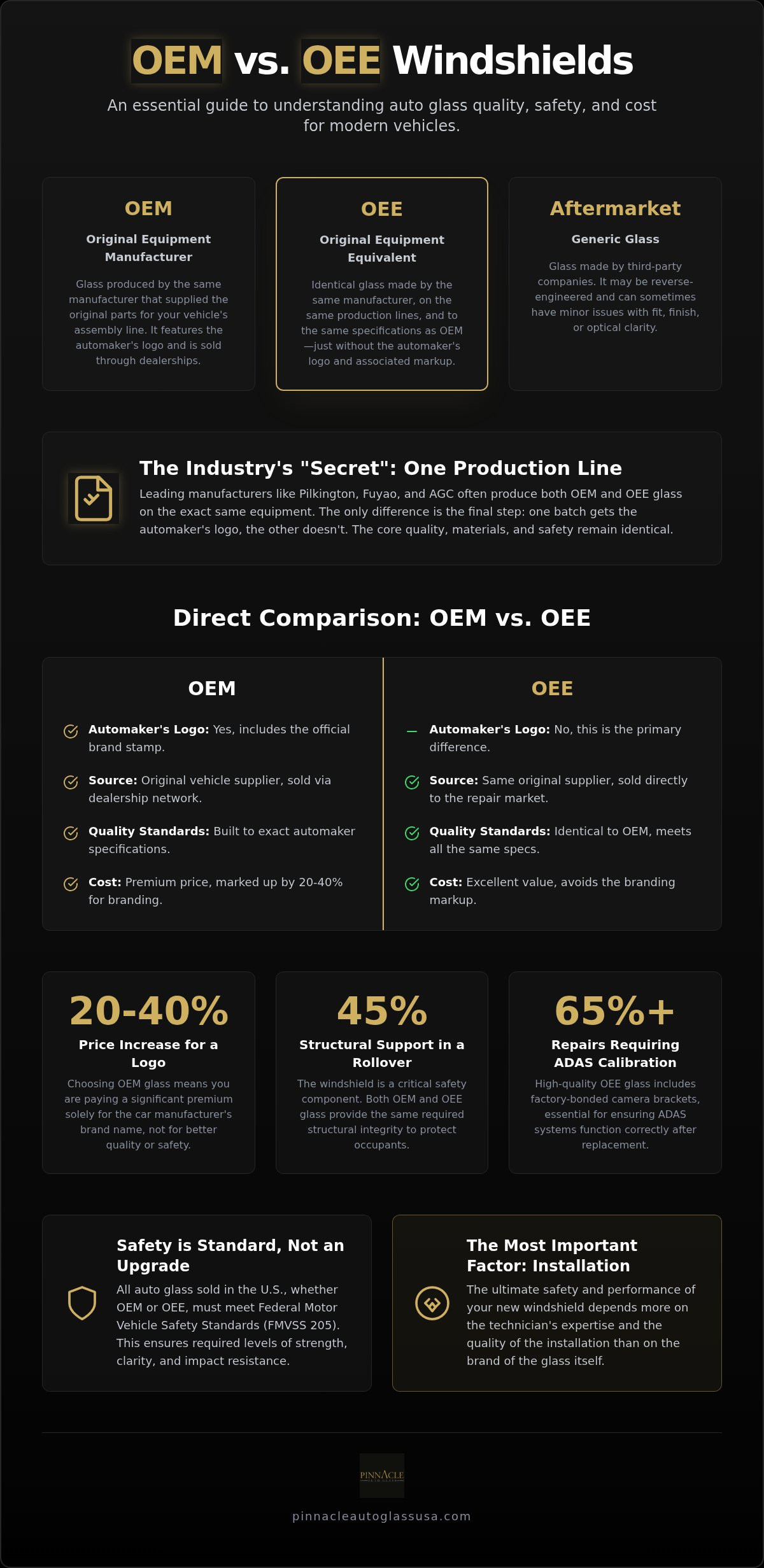
Understanding the terminology is the first step toward a smart investment. An Original Equipment Manufacturer (OEM) windshield is produced by the same contractor that supplied the glass for your vehicle's assembly line. It features the automaker's logo and is built to their exact specifications. Original Equipment Equivalent (OEE) glass is manufactured by those same companies using the same molds and production standards. The primary difference is the absence of the brand logo. While both are technically aftermarket products, OEE is a premium tier that stands apart from generic third-party glass.
When comparing an OEE vs OEM windshield, the word "equivalent" is your guarantee of quality. It indicates that the glass meets the same thickness, curvature, and clarity standards as the original part. Generic aftermarket glass, by contrast, is often reverse-engineered by companies that don't have access to the original factory blueprints. This can lead to minor fitment issues or optical distortions that interfere with your driving experience. By choosing OEE, you ensure that the glass maintains the structural integrity your vehicle requires without the branded price tag.
The Role of the Logo in Glass Pricing
The vehicle manufacturer's logo acts as a branding seal that significantly impacts the final price. Licensing agreements between car brands and glass giants like Pilkington, Vitro, or AGC allow the automaker to charge a premium. You can expect the logo to add 20% to 40% to the cost of the glass without changing its physical properties. Choosing OEE means you aren't paying for the brand's marketing costs. The absence of a logo does not mean the absence of quality; it simply means the glass is sold directly by the manufacturer rather than through a dealership network.
FMVSS Standards: The Floor for All Glass
Every windshield sold in the United States must meet strict safety requirements regardless of the brand. These Federal Motor Vehicle Safety Standards (FMVSS) ensure that the glass provides adequate protection during a collision. All automotive glass must pass rigorous impact, penetration, and structural tests to be legal for road use. Specifically, FMVSS 205 is the primary safety standard for automotive glazing, regulating the transparency and strength of the materials used in your vehicle. Whether you choose OEM or OEE, you are receiving a product that meets these essential federal safety benchmarks.
The Manufacturing Science: Why OEE is Often Identical to OEM
Many drivers assume OEE is a lower-quality imitation of factory glass. This is a common misconception. Large-scale glass manufacturers like Fuyao, Pilkington, and AGC often produce both types on the same production lines. They use the same raw materials, chemical compositions, and furnaces. The primary difference occurs at the final stage of production. One batch receives the car manufacturer's logo while the next does not. Because the core manufacturing process remains unchanged, the structural performance of the glass stays consistent.
The Polyvinyl Butyral (PVB) interlayer is the most critical safety component in any windshield. This plastic layer sits between two sheets of glass to prevent shattering during an impact. High-quality OEE glass utilizes the same PVB specifications as OEM glass to meet Federal Motor Vehicle Safety Standard 205. This ensures the windshield provides the necessary structural support, which accounts for up to 45% of a vehicle's integrity in a rollover accident. You get the same level of protection regardless of the brand stamped on the corner.
Modern vehicles also rely on acoustic glass technology to maintain a quiet cabin. This involves a specialized sound-dampening PVB layer. OEE manufacturers replicate these acoustic properties to ensure you don't experience increased road noise. There is also a persistent myth that OEE glass is thinner or lighter than OEM. In reality, glass thickness is strictly regulated. A significant change in thickness would compromise the safety rating and prevent the glass from fitting correctly into the vehicle's frame. When choosing an OEE vs OEM windshield, you are receiving a product built to the same weight and durability standards.
Molds and Tooling Specifications
Precision is vital for a successful installation. OEE manufacturers often use the same Computer-Aided Design (CAD) data and molds as OEM contractors. This ensures the curvature of the glass matches your vehicle's frame exactly. A perfect fit is necessary to prevent wind whistles and water leaks. While the glass quality is identical, the final seal depends on professional windshield replacement to ensure these tight tolerances are maintained during the install.
Optical Clarity and Distortion Control
Manufacturers use the float glass process to ensure zero distortion. Molten glass is floated on a bed of molten tin to create a perfectly flat surface. High-tier OEE maintains the same refractive index as factory glass. This prevents the "wavy" effect that can cause driver fatigue or poor night visibility. By using the same cooling and polishing techniques, OEE provides the same crystal-clear view as the glass that originally came with your car.
OEM vs. OEE: A Direct Comparison for Modern Safety Systems
Modern vehicles function as mobile sensor arrays. By 2026, the choice between an OEE vs OEM windshield has become a technical decision rather than just a cosmetic one. Your windshield is no longer just a piece of glass; it's a critical component of your Advanced Driver-Assistance Systems (ADAS). Cameras mounted behind the rearview mirror must "see" through a specific area of the glass with zero distortion to manage lane-keep assist and emergency braking. High-quality OEE glass is designed to meet these exact optical tolerances, ensuring the camera’s field of vision remains clear and accurate.
The camera bracket is often the deciding factor in successful calibration. OEM glass comes with a factory-bonded bracket already attached. High-tier OEE manufacturers also pre-bond these brackets to the glass using the same precision alignment tools used in factory settings. Lower-quality aftermarket brands often require technicians to glue a bracket on manually, which increases the risk of misalignment. MOTOR's analysis of OEM vs. aftermarket glass confirms that OEE parts are engineered to provide the same fit and finish as branded components, making them a reliable choice for high-tech vehicles.
ADAS Recalibration Compatibility
As of early 2026, over 65% of all collision repairs require ADAS calibration. If the glass has even a minor refractive error, the camera may fail to calibrate or, worse, provide inaccurate data to the safety computer. Choosing ADAS calibration auto glass is mandatory for any replacement involving these sensors. While OEM is often the default recommendation from dealerships, OEE glass provides a successful calibration path because it maintains the same refractive index and clarity as the original part. It's a safe way to maintain your vehicle's safety features without the branded markup.
Structural Integrity and Airbag Deployment
Safety extends beyond software. A windshield provides up to 45% of a vehicle's structural integrity in a rollover crash. It also serves as the essential backstop for the passenger-side airbag. When the airbag deploys, it strikes the windshield and bounces toward the passenger. If the glass or the adhesive fails, the airbag won't deploy at the correct angle. OEE glass meets the identical structural requirements as OEM, ensuring that the glass stays bonded to the frame during high-pressure events. This structural parity is why OEE is widely accepted by safety experts and insurance carriers alike.
Luxury vehicles also rely on specific glass treatments to maintain their premium feel. You should consider these features when selecting your replacement:
- Acoustic Interlayers: These sound-dampening layers keep the cabin quiet by blocking wind and road noise.
- Solar Coatings: Specialized UV protection and heat rejection layers prevent your interior from fading and reduce the load on your air conditioning.
- Hydrophobic Finishes: Some OEE and OEM options include coatings that shed water quickly to improve visibility during heavy rain.
Insurance and Cost: Navigating the Claims Process
Insurance carriers prioritize cost-efficiency and safety standards when approving glass claims. Most standard policies default to OEE glass because it provides identical structural performance at a lower price point. If you prefer the branded logo, check your policy for an "OEM Endorsement." This specific add-on ensures the insurer pays the full cost for factory-branded parts. Without this endorsement, you may have to pay the price difference out-of-pocket. This gap can range from $200 to over $400 depending on your vehicle model. Understanding the financial breakdown of an OEE vs OEM windshield helps you avoid surprises during the billing process.
You also have a legal "Right to Repair." Many insurance companies will suggest a specific glass network or preferred provider, but you aren't legally required to use them. You have the freedom to choose any qualified specialist for your installation. This legal standing ensures you can select a provider that prioritizes high-quality materials and certified ADAS recalibration over the insurer's bottom line. It's your vehicle and your safety on the line.
When is OEM Truly Necessary?
Dealerships often claim that using non-OEM glass voids your vehicle warranty. This is generally false. Under the Magnuson-Moss Act, a manufacturer cannot void your warranty just because you used an equivalent aftermarket part. However, lease returns are a different story. Some lease contracts specify that the vehicle must be returned with all original branded parts, including the windshield. Check your agreement before scheduling a replacement to avoid end-of-lease penalties. For rare or exotic vehicles, OEE options may not exist, making OEM the only viable choice for a proper fit and finish.
Managing Your Glass Insurance Claim
Filing a claim doesn't have to be a complex task. Start by contacting a professional glass specialist who can handle the insurance paperwork on your behalf. They will verify your coverage and determine if you live in a state with a "deductible waiver," which allows for a zero-cost replacement. Once the claim is approved, the shop sources the glass and coordinates the installation. To help you plan your budget for non-covered scenarios, consult our guide on how much does windshield replacement cost in 2026.
Professional guidance makes the difference between a smooth claim and a frustrating expense. If you need help determining which glass type your policy covers, request a professional glass consultation to receive a clear assessment of your options and a direct path forward.
The Pinnacle Standard: Quality Glass and Expert Installation
The quality of your windshield is only half of the safety equation. Even a factory-branded part will fail to protect you if the installation is handled incorrectly. When you are deciding between an OEE vs OEM windshield, remember that the technician's skill and the quality of the adhesive are just as critical as the glass itself. We prioritize professional standards to ensure that every replacement restores your vehicle's structural integrity. Our team exclusively sources high-tier OEE and OEM materials, refusing to use budget aftermarket glass that might compromise your security or visual clarity.
Post-installation safety checks are a non-negotiable part of our service. We verify the bond of the high-grade urethane and ensure the glass is perfectly seated to prevent leaks, wind noise, or structural failure. Whether you are managing a single personal vehicle or a large commercial fleet, our approach remains consistent. We combine premium materials with rigorous technical execution to provide a reliable, long-term solution that meets all federal requirements. Your safety depends on a perfect seal, and we have the expertise to deliver it.
Comprehensive ADAS Recalibration
Recalibration is the final, essential step of a modern glass replacement. Your vehicle's safety systems rely on precise camera angles that can shift during a windshield swap. We use industry-leading tools to perform both static and dynamic recalibrations, ensuring your sensors are fully functional before you return to the road. This commitment to technology is a core part of our professional windshield replacement standards. We don't just replace the glass; we restore your entire safety environment to factory specifications.
The Professional Choice for Fleet and Personal Vehicles
Time is a valuable asset, especially for commercial operations. We specialize in minimizing downtime for fleets by sourcing the correct OEE vs OEM windshield quickly and performing efficient services that get your drivers back to work. Our status as auto glass specialists comes from our ability to handle complex technical tasks with a focus on immediate results. We act as a dependable guide for vehicle owners, simplifying the replacement process through expert organization and national service capability.
Don't leave your safety to chance with unverified glass or amateur installation. Schedule your expert windshield replacement with Pinnacle Auto Glass today.
Secure Your Vehicle with Expert Glass Solutions
Choosing between an OEE vs OEM windshield shouldn't be a source of stress. Both options provide the structural integrity and optical clarity required for modern driving. While the OEM logo carries a premium price, OEE glass offers an identical manufacturing standard. It satisfies both insurance providers and federal safety requirements. The most important factor isn't the stamp on the glass. It's the precision of the installation and the accuracy of the ADAS recalibration that follows.
We act as your dependable guide through the replacement process. Our team prioritizes your safety by using only high-tier glass materials and employing certified ADAS recalibration experts. With our nationwide professional service, we ensure your vehicle is restored to factory safety specifications with minimal downtime. You can drive with confidence knowing your safety systems and structural support are fully intact. Take the next step toward a clear and secure view today.
Get a Professional Windshield Replacement Quote from Pinnacle Auto Glass
Frequently Asked Questions
Is OEE glass as strong as OEM glass?
Yes, OEE glass provides the same structural strength as OEM glass. Both must meet Federal Motor Vehicle Safety Standard 205 for impact resistance and clarity. Because OEE is manufactured using the same molds and polyvinyl butyral interlayers, it offers identical protection during a collision or rollover accident. It maintains the vehicle's structural integrity without the brand markup.
Will using OEE glass void my vehicle manufacturer warranty?
No, installing an OEE windshield will not void your vehicle warranty. Federal law, specifically the Magnuson-Moss Act, protects consumers by preventing manufacturers from mandating branded parts for repairs. As long as the glass meets safety standards and is installed professionally, your warranty remains fully intact. You have the right to choose the glass that fits your budget.
Does insurance always cover the cost of an OEM windshield?
Insurance providers usually cover OEE glass by default because it is considered a part of like kind and quality. Most standard policies will only pay for a branded OEM windshield if you have a specific OEM endorsement. If you don't have this coverage, you may be responsible for paying the price difference between the OEE and OEM options.
Why is OEM glass more expensive than OEE if they are the same?
The higher cost of OEM glass is primarily driven by branding and licensing fees. Vehicle manufacturers charge a premium for the right to stamp their logo on the glass. Since OEE glass is produced by the same manufacturers but sold without the automaker's trademark, it avoids these extra costs. You are paying for the brand name rather than a difference in material quality.
Can my ADAS systems be calibrated with OEE glass?
Yes, your safety systems can be successfully calibrated with high-quality OEE glass. These windshields are engineered to match the refractive index and optical clarity of factory parts. When comparing an OEE vs OEM windshield for a 2026 vehicle, the precision of the camera bracket and the technician's skill during recalibration are the most important factors for system performance.
How can I tell if my replacement glass is OEM or OEE?
You can identify the glass type by checking the "bug" or the permanent brand stamp in the corner of the windshield. OEM glass features the vehicle manufacturer's logo, such as Ford or Toyota. OEE glass displays the name of the glass manufacturer, such as Pilkington or Fuyao, along with a DOT code, but it will not have the car brand's logo.
What happens if I return a leased car with OEE glass?
You should review your lease agreement carefully before choosing your glass. Some leasing companies require the vehicle to be returned with all original branded components to avoid penalties. If your contract mandates factory-branded parts, an OEE windshield could result in an additional charge at the end of your lease term. Verification of these terms is essential.
Is aftermarket glass the same thing as OEE glass?
OEE is a premium tier within the broader aftermarket category. While all OEE glass is aftermarket, not all aftermarket glass is OEE. Generic aftermarket brands are often reverse-engineered and may have slight variations in fit or clarity. OEE glass is manufactured to be an exact equivalent to the original equipment, ensuring a perfect match in safety and performance.


