
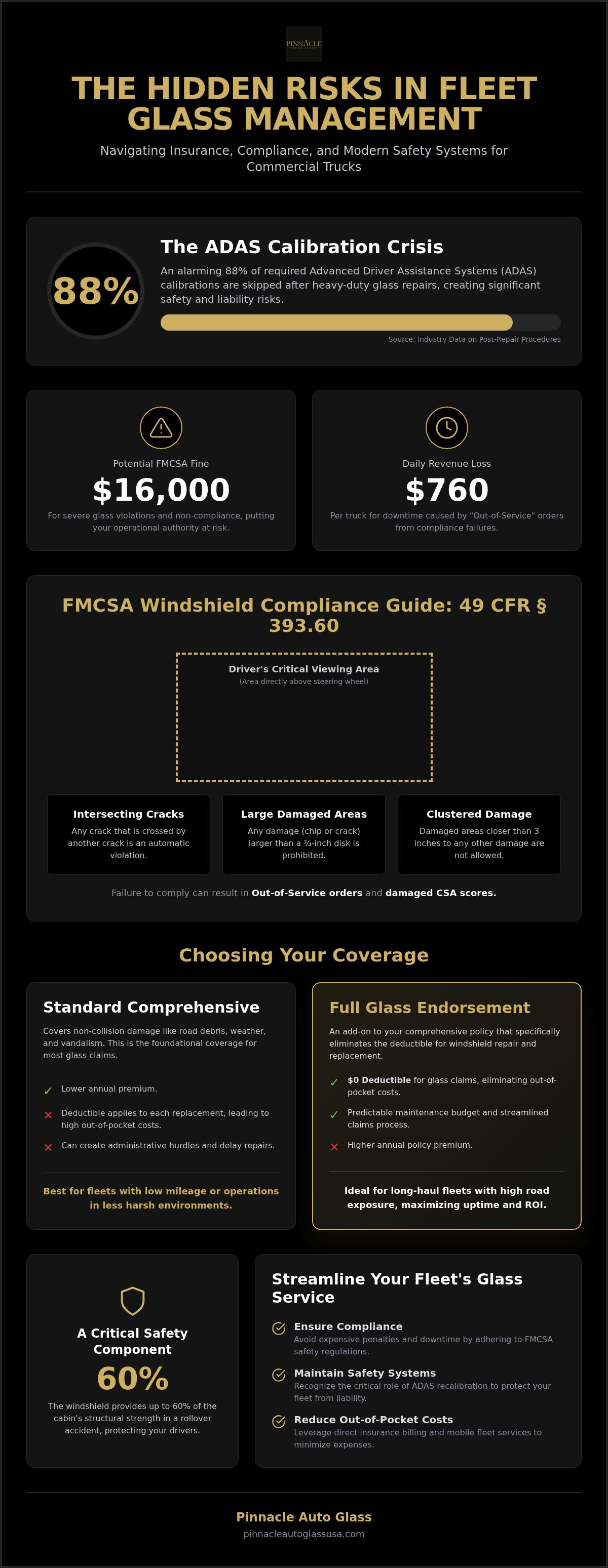
Did you know that 88% of required Advanced Driver Assistance Systems (ADAS) calibrations are skipped after heavy-duty glass repairs? For a fleet manager in 2026, a simple chip is no longer just a cosmetic issue. It's a potential $16,000 FMCSA fine or a safety system failure waiting to happen. Effectively managing commercial truck windshield insurance coverage requires more than just filing a claim. It demands a clear strategy to handle high deductibles and the technical requirements of modern vehicle safety technology.
You already know that every minute of downtime directly impacts your bottom line. With daily revenue losses for a single truck reaching up to $760, you can't afford to have a vehicle sidelined by red tape or compliance issues. This guide provides the tools you need to minimize out-of-pocket expenses while ensuring your fleet remains safe and legal. We will examine current FMCSA 49 CFR § 393.60 standards, explain the impact of glass claims on your risk rating, and show how professional mobile services can restore your operational authority quickly.
Key Takeaways
- Compare standard comprehensive and full glass policies to select the most cost-effective commercial truck windshield insurance coverage for your operations.
- Navigate FMCSA safety regulations to ensure every vehicle in your fleet remains compliant and avoids expensive roadside penalties.
- Recognize the critical role of ADAS recalibration in maintaining modern safety systems and protecting your fleet from liability risks.
- Streamline your claims process with a clear documentation strategy that moves trucks from the side of the road back into service faster.
- Leverage direct insurance billing and mobile fleet services to eliminate administrative hurdles and reduce out-of-pocket repair costs.
What Is Commercial Truck Windshield Insurance Coverage?
Commercial glass insurance isn't a standalone policy. It is a specific provision within a broader commercial auto policy designed to protect specialized fleet assets. Unlike personal policies, Vehicle insurance in the United States for commercial entities must account for the unique scale and expense of heavy-duty equipment. A standard Class 8 truck windshield is significantly larger and more complex than a passenger car's glass. These components are engineered for extreme durability to withstand thousands of miles of road vibration and wind pressure; however, their replacement cost is substantially higher due to the sheer volume of glass and the labor-intensive installation process required for semi-trucks. Having the right commercial truck windshield insurance coverage is essential for logistics companies that need to keep their vehicles moving without facing sudden, massive repair bills.
Comprehensive vs. Collision Coverage for Trucks
High-speed road debris, extreme weather, and vandalism are the primary culprits for glass damage. These incidents typically fall under the comprehensive portion of your insurance policy. Comprehensive coverage protects your fleet from non-collision risks that are often unavoidable on the highway. Most glass claims are filed under this umbrella because they don't involve an actual accident with another vehicle.
- Road Debris: Rocks or gravel kicked up by other vehicles can cause immediate chips or cracks.
- Weather Events: Hail, falling branches, or extreme temperature shifts can compromise glass integrity.
- Vandalism and Theft: Damage caused during an attempted break-in or intentional act is covered here.
Collision coverage only applies if the glass is broken during a crash with another vehicle or a stationary object. For most fleet managers, maintaining a robust comprehensive policy is the most effective way to manage the frequent costs of windshield maintenance.
FMCSA and DOT Glass Safety Standards
Compliance is the primary driver for glass maintenance in the trucking industry. The Federal Motor Carrier Safety Administration (FMCSA) maintains strict rules under 49 CFR § 393.60. These regulations mandate that the area directly above the steering wheel must be clear of obstruction. Any crack that is intersected by another crack is an automatic violation. Additionally, damaged areas that cannot be covered by a 3/4-inch disk, or those closer than 3 inches to another damaged area, are prohibited.
Ignoring these standards is a major risk. A cracked windshield can lead to "Out-of-Service" orders during a roadside inspection, effectively halting your delivery. Fines for these violations range from $250 to $16,000 depending on the severity and history of the fleet. Beyond the financial penalty, the windshield provides up to 60% of the cabin's structural strength in a rollover accident. Proper insurance ensures you can fix these issues immediately, protecting both your CSA safety score and your drivers.
Types of Insurance Policies for Commercial Fleet Glass
Selecting the right commercial truck windshield insurance coverage requires a balance between monthly premium costs and the financial impact of a grounded vehicle. Most standard commercial auto policies include comprehensive coverage, which serves as the foundation for glass protection. However, the way a policy handles heavy-duty glass can vary significantly based on endorsements and fleet size. For large logistics operations, a Combined Single Limit (CSL) policy might be used to provide a broad pool of coverage for property damage, including glass, rather than separating limits for different types of claims. This ensures that even high-cost specialized windshields are covered under the main policy umbrella as long as they meet FMCSA insurance requirements for financial responsibility.
The Full Glass Endorsement Explained
A "Full Glass" endorsement is an optional add-on that eliminates the deductible for windshield repair and replacement. While this increases the annual premium, the ROI for long-haul trucking is often high. Trucks that spend thousands of miles on the road each week face a near-certainty of road debris damage. In states like Florida, Kentucky, and South Carolina, insurers are legally prohibited from charging a deductible for windshield claims if the driver has comprehensive insurance. For fleets operating outside these "zero-deductible" states, adding this endorsement prevents a single rock chip from turning into a major out-of-pocket expense. It's a strategic move for managers who want to keep maintenance costs predictable.
Understanding Deductibles for Semi-Truck Glass
Standard commercial deductibles for heavy-duty vehicles often range from $500 to $1,000. This can be a barrier to quick action when a small crack appears. Most insurers will waive the deductible entirely if the glass can be repaired rather than replaced. This is a deliberate incentive to fix chips before they spread. Once a crack exceeds the size of a quarter, a full replacement becomes necessary, and the deductible applies. Managers must weigh the cost of the deductible against the total repair price. If the deductible is $1,000 and the replacement is only slightly more, it may be better to pay out of pocket to avoid a claim on the fleet's loss run report. If you're unsure how your current policy applies to your vehicles, Pinnacle Auto Glass can help you navigate the details of your coverage.
For larger organizations, fleet management policies often provide bulk glass coverage. These policies are tailored to companies with dozens or hundreds of units. They often feature aggregate deductibles or self-insured retentions. This allows the company to handle minor glass issues internally while relying on the insurance carrier for catastrophic losses or fleet-wide damage events. Understanding these nuances helps you choose a policy that supports both your safety goals and your budget.
ADAS Recalibration: The Hidden Cost in Insurance Claims
Modern commercial trucks are rolling technology hubs. Most heavy-duty vehicles manufactured after 2020 feature advanced safety systems like Lane Departure Warning and Forward Collision Mitigation. These systems rely on cameras and sensors mounted directly behind the windshield. When a piece of glass is replaced, the precise alignment of these sensors is disturbed. Even a fraction of a millimeter of deviation can cause the system to misread the road. This leads to dangerous errors or total system failure. This makes ADAS calibration auto glass a critical part of any repair. Despite its importance, industry data shows that 88% of required calibrations are skipped after glass repairs. This neglect creates a massive liability gap for fleet managers and logistics companies.
The cost of recalibration is often a surprise during the claims process. It is a specialized service that requires specific software and targets to reset the vehicle's computer. Because this technology is integrated into the glass, the insurance industry has had to adapt. In 2026, most carriers recognize recalibration as a necessary expense. However, if your commercial truck windshield insurance coverage isn't structured correctly, these hidden costs can lead to unexpected out-of-pocket expenses. Ensuring your policy specifically accounts for the technical labor of calibration is essential for maintaining a modern fleet.
Why Recalibration is Mandatory for Insurance
In 2026, the insurance industry has shifted its stance on safety technology. Carriers no longer view recalibration as an optional convenience. Instead, it's a requirement for maintaining valid coverage and safety ratings. Insurers prioritize these standards to prevent future accidents that lead to massive jury awards, often called "nuclear verdicts." If a truck is involved in a collision after a windshield replacement and the sensors weren't calibrated, the carrier may deny the claim. They could even hold the fleet owner liable for negligence. ADAS recalibration is a non-negotiable safety step in commercial glass. By ensuring every camera is perfectly aligned, you protect your drivers and keep your fleet's risk rating low.
Documentation for Insurance Approval
Filing a claim for a high-tech windshield requires more than just a repair receipt. Insurance adjusters now demand a "Certificate of Calibration" to prove the work was performed to OEM specifications. Without this document, the claim may remain open or be partially denied. This certificate serves as a legal record that the safety systems are functional. We understand the administrative burden this places on fleet managers. Pinnacle Auto Glass manages the technical paperwork and direct billing for these services, ensuring your fleet meets safe windshield replacement standards. We provide the necessary proof of calibration to your insurer immediately. This transparency speeds up the reimbursement process and ensures your truck returns to the road in a fully compliant condition.
How to File a Commercial Truck Glass Insurance Claim
The moment a driver notices a crack, the clock starts ticking on both safety and compliance. Filing a claim for commercial truck windshield insurance coverage shouldn't be a secondary thought. It's a critical operational step. Drivers should immediately pull over when safe to document the damage. Take clear, high-resolution photos of the crack from multiple angles. Capture the vehicle's VIN plate and the current odometer reading. This documentation is vital for the insurance adjuster and helps prevent claim disputes later. Once the damage is recorded, the driver must notify the fleet manager or the company's insurance agent to verify policy specifics.
Choosing the right service provider is the next major decision. You need a certified auto glass technician who understands the intricacies of heavy-duty vehicles. A qualified shop will handle the direct billing to your insurance carrier. This removes the administrative burden from your office. Look for providers that offer mobile service. This allows the repair to happen at a terminal, a warehouse, or even a truck stop. Minimizing the truck's time off the road is the priority. Finally, ensure the technician performs a full safety check and the necessary ADAS recalibration before the vehicle returns to service.
Step-by-Step Claims Checklist
- Document the damage: Take photos of the glass and the VIN number immediately.
- Verify coverage: Confirm if your policy includes a 'Full Glass' endorsement to waive the deductible.
- Check for ADAS: Ensure the service shop can perform recalibration on-site to avoid a second appointment.
- Confirm billing: Verify the shop can bill your commercial insurance carrier directly.
Managing Claims for Multiple Vehicles
For fleet managers, handling glass claims for dozens of vehicles can become a full-time job. Streamlining this process requires a strategic partnership. Establishing a preferred vendor relationship is the most effective way of reducing fleet downtime with mobile glass repair. A dedicated provider learns your fleet's specific needs and billing requirements. They can track the frequency of claims across your entire roster. This data is useful for identifying high-risk routes where road debris is common. Monitoring these trends helps you manage your long-term insurance premiums more effectively. If you need to start a claim for your fleet today, contact our commercial glass experts for immediate assistance.
Why Choose Pinnacle Auto Glass for Your Fleet Insurance Needs
Managing commercial truck windshield insurance coverage shouldn't be a logistical nightmare for your operations team. Pinnacle Auto Glass serves as a dedicated partner for fleet operators nationwide. We handle the entire claims process from the initial report to the final invoice. Our team maintains established relationships with all major commercial insurance carriers. This allows for seamless direct billing that keeps your accounting department focused on core operations rather than tracking down repair receipts. We understand the specific technical requirements of heavy-duty glass. Our expertise ensures that every replacement meets the rigorous safety and durability standards required by the modern logistics industry.
Our national reach means you receive consistent service quality regardless of where your trucks are located. Whether you manage a local delivery fleet or a long-haul carrier, we provide the specialized knowledge necessary for heavy-duty truck glass. We don't just replace glass; we manage the technical integration that modern trucks demand. This includes professional ADAS recalibration for every vehicle equipped with safety sensors. By choosing a provider that handles both the physical installation and the computer calibration, you reduce the risk of safety system failures and insurance claim denials. We act as a single point of contact for all your glass maintenance needs.
The Pinnacle Professional Advantage
Our technicians are specialists in the commercial sector. They understand that a semi-truck isn't just a larger car. We use high-quality glass that meets or exceeds OEM specifications to ensure maximum cabin strength. This commitment to quality prevents premature failures and ensures your fleet remains compliant with federal safety regulations. We also focus on reducing the administrative burden for fleet managers. Our expert claim handling team knows exactly what documentation insurers require. We provide the necessary certificates of calibration and detailed repair logs immediately. This transparency speeds up the approval process and ensures your loss run reports remain accurate and professional.
Mobile Solutions for National Fleets
Downtime is a profit killer in the transportation world. We bring our specialized workshop directly to your yard or job site. Our mobile units are fully equipped to perform professional windshield repair and replacement on your schedule. This flexibility is essential for maintaining tight delivery windows. You don't have to worry about the logistics of moving a grounded truck to a glass shop. We come to you, perform the work, and calibrate the safety systems in one visit. This level of organization simplifies your maintenance strategy and helps lower your total cost of ownership over time. Professional service isn't just about fixing a crack; it's about protecting your drivers and your bottom line. Contact Pinnacle Auto Glass for Expert Fleet Services to secure a reliable partner for your commercial glass and insurance needs.
Secure Your Fleet’s Future on the Road
Managing a fleet in 2026 requires a proactive approach to maintenance and regulatory compliance. You've learned how the right commercial truck windshield insurance coverage protects your bottom line by covering high-tech glass and mandatory ADAS recalibration. By prioritizing full glass endorsements and documented safety standards, you reduce the risk of FMCSA fines and operational downtime. A cracked windshield is no longer just a repair. It is a critical safety and compliance event that requires expert handling.
Pinnacle Auto Glass provides the specialized support your logistics business needs to stay mobile. We offer national fleet support and direct billing to all major insurers to keep your administrative tasks simple. Our technicians are certified ADAS recalibration experts who ensure every truck returns to service in peak safety condition. Don't let glass damage stall your deliveries or impact your safety scores.
Schedule Your Commercial Glass Service with Pinnacle Auto Glass Today. Keep your trucks moving and your drivers safe with professional glass management that works as hard as you do.
Frequently Asked Questions
Does commercial truck insurance cover windshield chips?
Yes, windshield chips are typically covered under the comprehensive portion of your commercial policy. Most insurers prefer to pay for a chip repair rather than a full replacement because it's more cost-effective. They often waive the deductible for these minor repairs to encourage immediate action. This prevents small chips from spreading into large cracks that require more expensive intervention. It's a standard practice that helps you maintain your fleet's safety without significant out-of-pocket costs.
Will filing a glass claim for my semi-truck increase my insurance premiums?
A single glass claim is unlikely to increase your premiums, but frequency matters. Insurance carriers generally view glass damage as a no-fault incident. However, if your fleet files multiple claims in a short period, it could negatively impact your overall risk rating. Consistent claims might lead to higher premiums during your next policy renewal because they indicate high road exposure. It's best to monitor your claim history across the entire fleet to stay ahead of potential rate hikes.
What is the difference between full glass coverage and comprehensive for trucks?
Comprehensive coverage requires you to pay a deductible before the insurer covers the remaining cost of a replacement. In contrast, a full glass endorsement removes the deductible entirely for glass-only claims. This is a strategic addition to your commercial truck windshield insurance coverage that makes maintenance costs more predictable. It's particularly valuable for long-haul fleets that face frequent road debris damage and want to avoid constant deductible payments.
How long does a commercial truck windshield replacement take with insurance?
A professional windshield replacement typically takes between two and four hours to complete. This timeframe includes the removal of the old glass, the installation of the new unit, and the necessary adhesive cure time. If your truck features advanced safety technology, you must also factor in the time required for precise ADAS recalibration. Scheduling mobile service can help you manage this window without moving the truck to a shop, which keeps your delivery schedule on track.
Is ADAS recalibration covered by my commercial insurance policy?
Yes, most commercial insurance policies cover ADAS recalibration as part of a legitimate windshield replacement claim. Carriers recognize that these safety systems are essential for preventing accidents and reducing liability. Because recalibration is an OEM requirement for the vehicle to function safely, it's viewed as a non-negotiable part of the repair process. Always ensure your technician provides a certificate of calibration to submit with your claim documentation for full reimbursement.
Can I choose my own glass shop for a commercial insurance claim?
You have the legal right to choose any glass shop you prefer for your insurance claim. While insurers may suggest a preferred provider, they can't force you to use a specific vendor. Choosing a shop that specializes in heavy-duty trucks ensures that the technicians understand the scale and technical requirements of your fleet. This autonomy allows you to prioritize quality and specialized expertise over the insurer's cost-saving recommendations.
What happens if I drive a commercial truck with a cracked windshield?
Driving with a cracked windshield can result in significant FMCSA fines or an Out-of-Service order. Federal regulations prohibit cracks in the critical area of the glass that might obstruct the driver's view. Beyond legal penalties, a damaged windshield compromises the structural integrity of the cabin during a rollover. It can also cause your safety sensors to malfunction, creating a dangerous situation for the driver and other motorists on the road.
Does insurance cover mobile glass repair for fleets?
Yes, insurance policies generally cover mobile glass repair services for commercial fleets. Carriers understand that moving a heavy-duty truck to a physical shop is often inefficient and expensive. Mobile service is the standard solution for reducing downtime and keeping your logistics moving. Most specialized glass providers can bill your insurance carrier directly for these mobile visits, ensuring a seamless experience for your fleet manager and your accounting department.


