

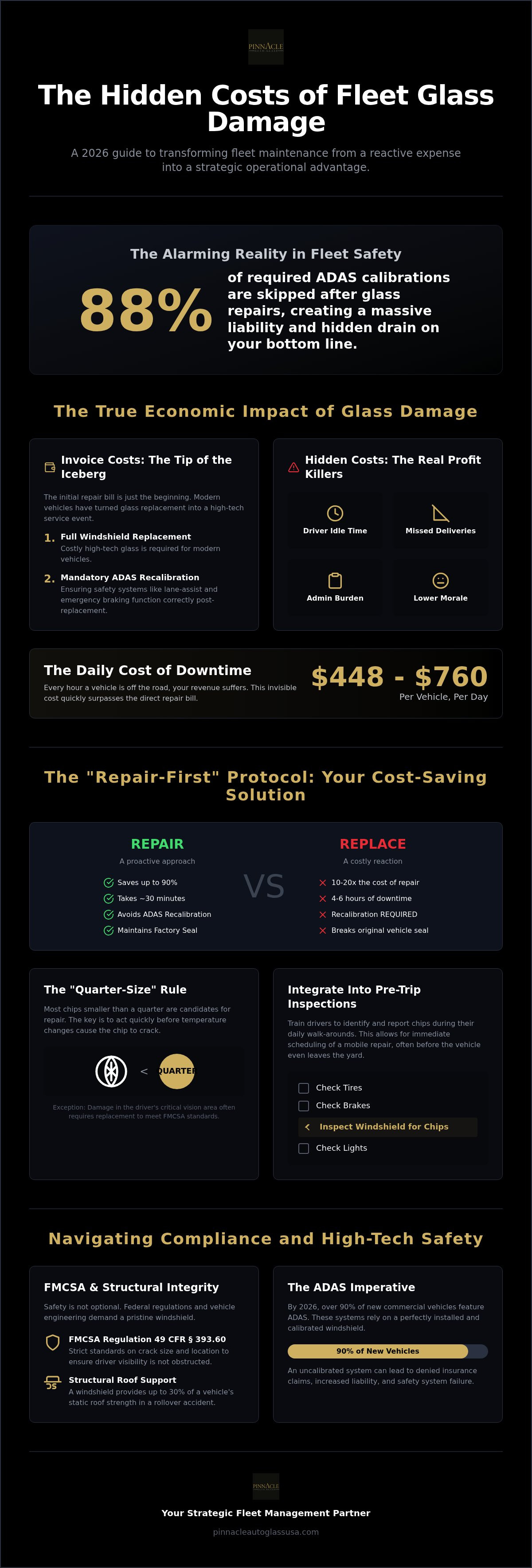
Did you know that 88% of required ADAS calibrations are currently skipped after glass repairs? This staggering figure represents a massive liability and a hidden drain on your bottom line. Most fleet managers view glass damage as an unavoidable headache marked by unpredictable downtime and rising technical complexity. You're likely dealing with the administrative burden of managing multiple claims while worrying about FMCSA compliance. We understand that reducing fleet windshield replacement costs feels like a moving target when modern safety systems and specialized glass requirements keep driving prices higher.
It's time to stop reacting to cracks and start managing your glass as a strategic asset. This 2026 guide provides a roadmap to transform your maintenance from a constant expense into a streamlined operational advantage. We'll cover how to implement repair-first protocols to catch chips before they fail and how to manage ADAS recalibration without losing days of productivity. You'll discover how mobile services and centralized vendor partnerships can lower your annual spend, reduce vehicle downtime, and ensure every van or heavy-duty truck in your fleet meets rigorous safety standards.
Key Takeaways
- Calculate the true economic impact of glass damage by accounting for hidden costs like driver idle time and missed deliveries.
- Implement a standardized decision matrix for reducing fleet windshield replacement costs through proactive resin injection and "repair-first" protocols.
- Manage the technical complexity of ADAS recalibration to ensure safety systems and sensors function with pinpoint accuracy.
- Minimize operational disruptions by utilizing mobile glass services and scheduling maintenance during off-peak hours.
- Simplify administrative burdens by partnering with a specialized provider capable of servicing everything from delivery vans to semi-tractors.
The True Economic Impact of Fleet Glass Damage in 2026
Managing a fleet requires looking past the line items on a repair invoice. The true cost of glass damage is rarely just the price of the glass itself. It's a Total Cost of Ownership (TCO) calculation that accounts for every minute a vehicle stays off the road. When you ignore a small chip, you aren't just delaying a repair; you're inviting a massive expense. A simple repair that takes 30 minutes can quickly spiral into a full windshield replacement and ADAS recalibration event. This shift can increase your costs by 10 or 20 times the original repair price. Focus on reducing fleet windshield replacement costs by addressing damage before it spreads across the laminated safety glass.
Modern vehicle technology has changed the math for every fleet operator. In 2026, over 90% of new commercial vehicles feature integrated ADAS systems. These sensors rely on the windshield to "see" the road. A single crack in the wrong place can disable lane departure warnings or emergency braking. This makes the average replacement ticket much higher than it was just a few years ago. You're no longer just buying glass; you're servicing a high-tech sensor housing.
Soft Costs: The Hidden Profit Killers
Downtime is your most expensive invisible cost. According to 2026 industry research, the daily cost of fleet downtime ranges between $448 and $760 per vehicle. If a delivery van or box truck is out of service for 4-6 hours for a glass swap, you've lost half a day of revenue. These soft costs quickly outpace the direct repair bill. Consider these cascading factors:
- Missed delivery windows that damage long-term client relationships.
- Driver idle time where you pay wages for zero actual productivity.
- The administrative burden of processing individual claims and coordinating multiple vendors.
- Decreased driver morale when operating vehicles that feel neglected or unsafe.
Compliance and Liability Risks
Safety is a legal requirement, not a suggestion. The Federal Motor Carrier Safety Administration (FMCSA) maintains strict standards under regulation 49 CFR § 393.60 regarding windshield integrity. Cracks cannot exceed specific size limits or obstruct the driver's direct line of sight. If a vehicle is in an accident with an uncalibrated ADAS system, your insurance claims could be denied and your premiums could skyrocket. Liability increases significantly when safety systems aren't functioning as intended. Beyond visibility, the windshield is a vital structural component. A cracked windshield can contribute up to 30% of a vehicle's static roof strength, making it essential for driver protection during a rollover accident.
Implementing a 'Repair-First' Protocol to Lower Costs
Every fleet manager wants to cut expenses without cutting corners. A "Repair-First" protocol is the most effective tool for reducing fleet windshield replacement costs. Professional windshield repair can save up to 90% compared to the cost of a full replacement. This isn't just about the price of the glass. It is about avoiding the mandatory ADAS recalibration that must accompany almost every new windshield installation in 2026. Catching a chip early keeps the original factory seal intact and the vehicle on the road.
Professional technicians use high-grade resin injection to fill the break. This material bonds with the glass at a molecular level and restores its structural integrity. It prevents the chip from expanding into a spiderweb crack that requires a total swap. To make this work, you must integrate glass checks into every Pre-Trip Inspection (PTI). When drivers identify damage during their morning walk-around, you can schedule a mobile repair before the vehicle even leaves the yard. If you need a partner to handle these rapid responses, specialized fleet glass services can streamline the process for your entire team.
The 'Quarter-Size' Rule for Fleet Repairs
In 2026, most chips smaller than a quarter are prime candidates for repair. However, location is the deciding factor. If damage is in the "critical vision area" directly in front of the driver, replacement is often necessary to meet FMCSA windshield condition regulations. Temperature fluctuations are the biggest enemy of a repairable chip. Blasting the AC in summer or the defroster in winter puts massive thermal stress on the glass. This can turn a stable $75 repair into a $1,000 replacement event in seconds.
Training Drivers for Early Detection
Drivers are your first line of defense against rising maintenance budgets. Provide them with simple visual guides to identify different types of damage like bullseyes, stars, or pits. Encourage them to report these through your fleet management app immediately. You might even incentivize early reporting with small rewards. Catching a chip while it is still repairable is a win for the driver's safety and your annual budget. For more details on the technical side of these saves, read our Professional Windshield Repair: A Comprehensive 2026 Guide to Safety and Savings. Clear communication ensures that small chips don't become large-scale operational failures.
Navigating ADAS Recalibration and High-Tech Glass Expenses
By 2026, a windshield is no longer just a piece of glass. It is a sophisticated housing for cameras and sensors. Over 90% of new commercial vehicles now feature Advanced Driver Assistance Systems (ADAS). This technology makes every glass swap a complex technical event rather than a simple mechanical fix. If you want a real strategy for reducing fleet windshield replacement costs, you must account for the precision required during installation. Even a slight misalignment of the glass can cause sensors to fail or provide inaccurate data to the driver.
Choosing the right glass quality is essential for sensor accuracy. Low-grade glass often contains distortions that the human eye might miss but a camera cannot ignore. These imperfections can lead to system malfunctions. Strategic recalibration is a non-negotiable part of modern maintenance. Many operators think they save money by skipping this step, but research shows that 88% of required calibrations are currently ignored. This is a dangerous false economy. It increases your liability and the risk of a catastrophic collision. A properly calibrated system ensures your safety features work exactly as the manufacturer intended.
Logistics for commercial vans and trucks differ based on the calibration type required. Static calibration happens in a controlled bay using specific targets. Dynamic calibration involves driving the vehicle at set speeds under specific conditions. Costs for these services typically range from $150 to $600 depending on the complexity of the vehicle. Bundle these services with your replacement to minimize downtime and ensure your fleet remains compliant with modern safety standards.
The Role of ADAS in Fleet Safety
Lane departure warnings and automatic emergency braking rely entirely on the camera's view through the windshield. If the sensor is misaligned by even a fraction of a degree, it can trigger "phantom braking" or fail to engage during a true emergency. These system failures create significant risks for your drivers and other road users. For a deep dive into the technical requirements, consult our ADAS Calibration and Auto Glass: The Complete 2026 Reference Guide. Protecting your team starts with verified sensor accuracy.
Optimizing Recalibration Workflow
Efficiency is the key to managing a high-tech fleet. Ensure your glass vendor offers same-day recalibration during the windshield replacement appointment. This prevents the need for secondary visits and gets your vehicles back on the road faster. Certified ADAS technicians using OEM-standard equipment provide the reliability your business needs. Using specialized understanding ADAS recalibration and vehicle glass safety protocols ensures your fleet longevity and reduces the likelihood of repeat service calls. Demand a partner who treats glass as a high-tech safety component.
Operational Strategies for Minimizing Downtime
Maximizing vehicle uptime is the most direct path to reducing fleet windshield replacement costs. While earlier sections focused on the technical requirements of glass maintenance, operational strategy addresses the logistical "how." In 2026, savvy fleet managers use telematics data to identify high-risk routes where road debris is most prevalent. By rerouting vehicles or adjusting following distances on these stretches, you can physically reduce the frequency of glass damage. Additionally, scheduling glass service during off-peak hours ensures that maintenance never competes with your delivery schedule. Working during nights or weekends allows your fleet to remain productive during peak revenue hours.
Leveraging Mobile Glass Repair
Mobile service is your primary tool for eliminating the hidden costs of glass repair. In the past, a windshield replacement often required two drivers: one to drop the vehicle off at a shop and another to provide a ride back to the yard. This doubles your labor expense for a single repair. Mobile units bring the shop directly to your fleet yard or job site. In 2026, mobile ADAS recalibration units have become a standard part of fleet logistics. These units allow for full technical service without moving the vehicle an inch. This convenience keeps your drivers on their assigned routes and prevents unnecessary mileage. For a deeper look at these logistical wins, read our guide on Reducing Fleet Downtime with Mobile Glass Repair: A Strategic Guide for 2026.
Strategic Vendor Consolidation
Managing dozens of local glass shops creates massive administrative friction and inconsistent results. Consolidating your glass vendors allows you to leverage volume pricing and standardized billing across your entire operation. A single point of contact for national fleet operations ensures that every region follows the same warranty terms and quality standards. This integration reduces "invoice friction" by simplifying your fleet management system data entry. When you use one partner, you ensure that every vehicle receives the same high-quality glass and certified recalibration service. If you are looking to streamline your operations, consider our fleet glass services to manage your entire inventory with one reliable partner. This approach turns a scattered maintenance task into a controlled, predictable business process.
Pinnacle Auto Glass: Your Strategic Fleet Management Partner
Pinnacle Auto Glass provides national-scale fleet glass services that prioritize your bottom line. We specialize in heavy-duty commercial trucks, box trucks, and nimble delivery vans. Our approach focuses on reducing fleet windshield replacement costs through data-driven management and technical precision. We don't just swap glass. We handle the entire technical ecosystem, including certified ADAS recalibration for every modern vehicle in your inventory. This end-to-end service is vital for maintaining safety standards and reducing your liability profile in 2026.
Managing a large fleet means managing high volumes of paperwork. We simplify this through streamlined claims processing and customized reporting. Our systems integrate with your existing fleet management software to eliminate manual data entry and "invoice friction." You get a clear, organized view of your glass spend and maintenance history without the administrative headache. We project the image of a stable, nationwide entity while maintaining the focused attention of a localized service provider. This ensures consistent pricing and quality across your entire service area.
Why Fleet Managers Choose Pinnacle
We follow a strict "Repair First" protocol whenever safety standards allow. If a chip can be safely fixed according to FMCSA guidelines, we fix it. This keeps your original factory seals intact and prevents the need for a more expensive replacement. Our technicians aren't generalists. They are highly trained experts specialized in heavy-duty commercial glass and the specific structural requirements of large-scale transport vehicles. We understand that a semi-tractor has different glass needs than a delivery van. For a full look at our specialized capabilities, see our Commercial and Fleet Glass Management Solutions.
Getting Started with a Fleet Assessment
Effective cost control begins with total visibility. We offer a comprehensive fleet assessment to audit your current glass spend and identifying immediate savings opportunities. This process highlights recurring issues in your maintenance cycle and uncovers hidden downtime costs. We'll help you set up a customized maintenance schedule that aligns with your operational flow. This ensures repairs happen during your fleet's off-peak hours rather than during peak revenue windows. Take the first step toward a more efficient, proactive maintenance strategy. Contact Pinnacle Auto Glass for a Fleet Consultation today to optimize your glass management for the year ahead.
Mastering Your 2026 Fleet Glass Strategy
Strategic glass management is no longer a luxury for modern fleets. It is a necessity for maintaining profitability and safety. You've learned that reducing fleet windshield replacement costs requires a commitment to "repair-first" protocols and precise ADAS recalibration. By catching small chips before they spread and ensuring your safety sensors are perfectly aligned, you protect your drivers and your budget. Integrating mobile service into your workflow eliminates the hidden labor costs of vehicle drop-offs and keeps your trucks moving.
Pinnacle Auto Glass acts as your dependable guide. We bring specialized commercial and semi-truck expertise directly to your yard. Our team provides certified ADAS recalibration and mobile glass repair to eliminate fleet downtime and simplify your administrative burden. We handle the technical complexity so you can focus on your core business goals.
Optimize your fleet glass maintenance with Pinnacle Auto Glass today. Let's transform your glass expenses into a controlled operational advantage.
Frequently Asked Questions
How much can a proactive repair strategy actually save a fleet?
A proactive repair strategy can save a fleet up to 90% compared to the total cost of a full replacement. By fixing chips immediately, you avoid the high price of new glass and the mandatory technical labor involved in recalibrating safety sensors. This approach is the most effective method for reducing fleet windshield replacement costs while keeping your vehicles on the road without major interruptions.
Is ADAS recalibration required every time a windshield is replaced?
Yes, recalibration is mandatory for almost all 2026 vehicle models following a windshield replacement. Advanced Driver Assistance Systems rely on cameras and sensors mounted directly to the glass. If the windshield is swapped, these sensors must be realigned to ensure features like emergency braking and lane keep assist function accurately. Skipping this step creates significant liability and safety risks for your drivers.
Does insurance usually cover fleet windshield repairs without a deductible?
Many commercial insurance policies offer a specific glass endorsement that covers repairs with a $0 deductible. Insurance providers often waive the deductible for resin-based repairs to encourage fleet managers to fix damage before it requires a full replacement. Review your specific policy to see if you have a "full glass" provision that eliminates out-of-pocket costs for minor chip repairs.
What are the FMCSA requirements for windshield cracks in 2026?
Under FMCSA regulation 49 CFR § 393.60, commercial vehicles cannot have any cracks or chips in the area directly in front of the driver. Cracks outside the driver's line of sight are also restricted based on their size and proximity to other damage. Maintaining clear visibility is a legal requirement. Failure to meet these standards can result in vehicles being placed out of service during inspections.
How long does a typical mobile fleet windshield replacement take?
A standard mobile replacement for a delivery van or truck usually takes between 60 and 90 minutes. If the vehicle requires ADAS recalibration, you should plan for an additional 30 to 60 minutes depending on whether it is a static or dynamic process. Our technicians prioritize efficiency to ensure your vehicle is ready for its next shift with minimal disruption to your daily schedule.
Can semi-truck windshields be repaired, or must they always be replaced?
Semi-truck windshields can be repaired using professional resin injection if the damage is caught while it is still a small chip or star. This is a critical tactic for reducing fleet windshield replacement costs on heavy-duty equipment. As long as the damage is outside the driver's critical vision area and meets size limits, a repair can restore the glass to its original structural strength.
What is the difference between static and dynamic recalibration for commercial vehicles?
Static recalibration is performed in a specialized service bay using physical targets and laser equipment to align the sensors. Dynamic recalibration requires a technician to drive the vehicle at specific speeds on the road so the camera can "learn" its surroundings. Some 2026 commercial models require a "dual" calibration that involves both shop-based targets and a test drive to ensure full system compliance.
How does mobile service impact the manufacturer warranty on new fleet vehicles?
Professional mobile glass service does not void your manufacturer warranty. Provided the replacement glass meets OEM standards and the ADAS sensors are recalibrated by certified technicians, your vehicle's warranty remains intact. Using a specialized fleet provider ensures that all work is documented and performed to the high technical standards required by modern automotive manufacturers and safety regulators.


