
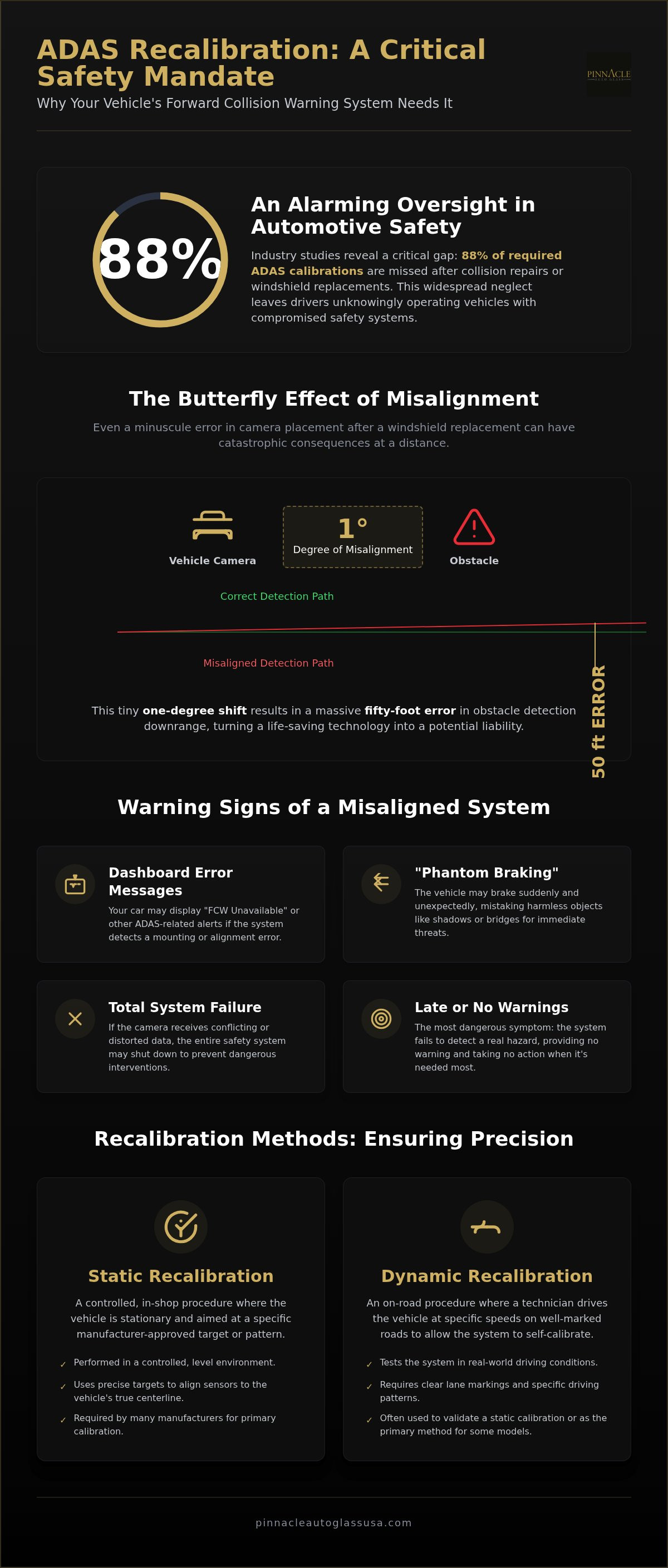
Industry studies in 2026 indicate that 88% of required ADAS calibrations after collision repairs are being missed. If you've just replaced your glass, you're likely facing high service quotes and confusing technical jargon. It's frustrating to deal with an extra step when you just want your car back on the road. However, forward collision warning recalibration isn't just a recommendation. It's a critical safety requirement. Your vehicle's camera and radar systems rely on precise physical alignment to function. Even a tiny shift during a windshield replacement can cause "phantom braking" or system failure.
You deserve to know that your family or employees are protected by a system that works. This guide explains why forward collision warning recalibration is a non-negotiable step for your safety and how it secures your vehicle's integrity. We'll break down the technical necessity of this service, help you navigate insurance reimbursement complexities, and show you how to ensure your safety tech remains a reliable partner on the road.
Key Takeaways
- Understand the technical process of aligning your vehicle's sensors to its true centerline for optimal safety performance.
- Learn why forward collision warning recalibration is a mandatory requirement following any windshield replacement to prevent dangerous detection errors.
- Discover how a minor one-degree shift in camera placement can result in a massive fifty-foot error in obstacle detection downrange.
- Differentiate between static and dynamic recalibration methods to ensure your vehicle is serviced according to manufacturer specifications.
- Identify the critical warning signs of sensor misalignment, such as dashboard error messages and "phantom braking" incidents.
What is Forward Collision Warning Recalibration?
Forward collision warning recalibration is the technical process of aligning a vehicle’s advanced safety sensors with its true centerline. It’s a digital handshake between your car's hardware and its software. Most drivers don't realize their vehicle relies on a sophisticated Collision Avoidance System to stay safe. This system uses a front-facing camera, usually mounted behind the rearview mirror, to scan the road ahead. If this camera is even slightly out of place, the entire safety net fails. The recalibration ensures that the camera's field of vision matches the vehicle's actual path of travel, preventing dangerous blind spots in the safety logic.
This technology serves as the first line of defense. It continuously monitors the distance and speed of vehicles in front of you. When the system detects a high risk of impact, it triggers a Forward Collision Warning (FCW). This alert is designed to give you the split second needed to react. In many 2026 models, this warning is tethered to Automatic Emergency Braking (AEB). If you don't hit the brakes fast enough, the car does it for you. This synergy is only possible when the sensors are perfectly calibrated to recognize hazards in real time.
The Technology Behind Forward Collision Warning
Modern vehicles use either monocular or binocular camera systems to "see." Monocular systems use a single lens to identify objects, while binocular systems use two lenses to perceive depth, much like human eyes. These cameras calculate the "time to collision" by analyzing how quickly objects grow in size within the frame. This pixel-level data is sent to the vehicle's Electronic Control Unit (ECU). The ECU then cross-references this with radar data to confirm a threat. This process, known as sensor fusion, allows the car to distinguish between a harmless shadow and a stopped car. Without proper forward collision warning recalibration, the ECU receives conflicting data, which can lead to system shutdowns.
Warning vs. Intervention Systems
It's vital to understand the difference between a warning and an intervention. An FCW is an alert, often a flashing light on the dash or an audible beep. It tells you to pay attention. AEB is an intervention where the car physically takes control of the brakes. If your forward collision warning recalibration is skipped after a windshield change, these systems might "see" a phantom obstacle or miss a real one. With the 2026 safety standards pushing for more autonomous features, having a misaligned system is a significant liability. Precision isn't optional; it's the standard for modern road safety.
Why Windshield Replacement Requires Recalibration
When you replace a windshield, you aren't just swapping out a piece of glass. You're altering the environment of your vehicle's safety sensors. Most modern cars house a camera directly behind the rearview mirror. This camera is a core component of NHTSA recommended safety technology. During the replacement process, technicians must physically remove this camera from its mounting bracket. Even if the camera is reattached perfectly, the new glass may have slight variations in thickness or curvature. These minute changes alter how the camera "sees" the road, making forward collision warning recalibration a mandatory safety step.
The math behind vehicle safety is unforgiving. A camera that is misaligned by just one degree can result in a fifty-foot error in obstacle detection downrange. This means your car might think an obstacle is fifty feet further away than it actually is. In a high-speed scenario, that distance is the difference between a safe stop and a collision. Original Equipment Manufacturer (OEM) standards require a full system check whenever structural glass is disturbed to account for these variables. Skipping this step leaves your safety systems guessing.
The Camera-Glass Relationship
Your vehicle's camera looks through a specific, transparent window in the windshield frit. This black ceramic border is designed to protect adhesive from UV rays, but it also frames the camera's field of view. If the glass is poor quality or the installation is off by a few millimeters, the camera's vision becomes obstructed. High-quality professional windshield replacement ensures the glass clarity meets the exact specifications required by the sensor. Aftermarket glass with uneven thickness can distort light, leading to "ghost" images that confuse the safety processor. This is why a tech check must follow every installation.
Millimeter Precision and Safety Margins
Safety sensors operate within extremely tight margins. If the system detects a mounting error, it may trigger a dashboard warning light and shut down entirely. In other cases, it might stay active but produce "false positives," where the car brakes for shadows or overpasses. Angular deviation is the primary cause of ADAS failure in 2026. This deviation occurs when the sensor's pitch, yaw, or roll is slightly out of sync with the vehicle's chassis. To keep your system functioning as intended, you should trust experts who handle both the glass and the tech. If you need a reliable solution, consider scheduling your next service with Pinnacle Auto Glass to ensure total alignment.
Static vs. Dynamic Recalibration: Two Essential Methods
Recalibration isn't a one-size-fits-all procedure. Depending on your vehicle's make and model, technicians use either static or dynamic methods; sometimes, they must perform both. These advanced safety features complicate repairs because they require specialized environments and high-tech diagnostic tools. For a successful forward collision warning recalibration, the vehicle must be returned to its factory-specified alignment. In 2026, diagnostic software has become more integrated, allowing technicians to verify that every sensor communicates correctly with the vehicle's central computer before you leave the shop.
Choosing the right method depends entirely on the manufacturer's requirements. Some vehicles are designed to be calibrated in a stationary position, while others need real-world data to reset. Using the wrong method or skipping a required step can lead to system errors or total sensor failure. Professional glass shops now use 2026-grade diagnostic tablets that automatically identify which procedure your specific VIN requires, removing the guesswork from the safety process.
Static Calibration: The Controlled Environment
Static calibration happens within a specialized service bay. This environment must be meticulously controlled to ensure accuracy. The floor must be perfectly level, and the lighting must be uniform to prevent shadows that could confuse the camera's optical sensors. Technicians set up physical, laser-aligned targets at precise distances and heights around the vehicle. These targets act as a fixed reference point for the camera to reset its internal parameters. Because this process involves high-precision measurements, the expertise of a certified auto glass technician is essential. If the targets are off by even a few millimeters, the system won't align with the car's true path of travel.
Dynamic Calibration: Real-World Testing
Dynamic calibration takes the process out of the shop and onto the road. This method involves connecting a diagnostic tool to the vehicle's OBD-II port and initiating a "learning" mode. The vehicle then learns the road environment during a controlled drive. For a successful dynamic forward collision warning recalibration, the weather must be clear and the road markings must be visible. Heavy rain, snow, or faded lane lines can interrupt the learning phase and force a restart. Most 2026 vehicle models require a drive of 15 to 25 minutes at consistent speeds, usually between 40 and 60 MPH, to fully map the camera's surroundings and confirm the system is ready for use.
How to Tell if Your FCW System Needs Recalibration
Your vehicle's safety system is designed to be self-aware, but it isn't foolproof. While a glowing icon on your dashboard is a clear indicator, many drivers experience subtle performance issues first. If you've recently had a wheel alignment or suspension work performed, your forward collision warning recalibration might be compromised. These mechanical changes alter the vehicle's ride height or steering angle, which directly affects where the camera is looking. Even without a warning light, a system that was calibrated for a different suspension geometry will eventually struggle to track the road correctly.
Pay attention to how your car behaves in clear conditions. If your system deactivates during light rain or at twilight, the sensors are likely struggling to process visual data. This often happens when the camera's "vision" is slightly skewed, forcing the computer to shut down rather than provide inaccurate data. Delayed warnings are another red flag. If your car only alerts you when you're dangerously close to the leading vehicle, the system's "time to collision" calculations are off. You shouldn't wait for a near-miss to address these performance gaps.
Visual and Audible Warning Signs
Modern 2026 vehicles use standardized diagnostic icons to alert you to sensor issues. Look for a "Check ADAS System" or "FCW Unavailable" message in your instrument cluster. Sometimes these lights are intermittent, appearing only when you hit a bump or reach highway speeds. Don't ignore a light that disappears; it often indicates a mounting bracket that has loosened or a sensor that is on the verge of failure. If the FCW system fails to initialize when you start the engine, the vehicle's internal self-test has detected a calibration error that needs immediate professional attention.
Performance Anomalies and Safety Risks
The most dangerous sign of a misaligned sensor is "phantom braking." This occurs when your car suddenly slows down for no visible reason, often misinterpreting overhead signs or shadows as physical obstacles. This happens because the camera is tilted too high or low. You might also notice "system drift," where the car stops tracking the lane ahead or fails to recognize a vehicle merging into your path. These symptoms indicate a critical failure in the system's logic. These risks require an immediate ADAS calibration and auto glass professional inspection to restore your safety margins. If your vehicle is showing any of these signs, you should contact Pinnacle Auto Glass for a precision diagnostic check today.
Professional ADAS Solutions with Pinnacle Auto Glass
Pinnacle Auto Glass simplifies the technical demands of modern vehicle maintenance. We provide a comprehensive service that integrates windshield replacement with precision recalibration. Our team understands that your safety tech is only as good as its last alignment. By choosing a single provider for both your glass and your sensors, you ensure a seamless transition from installation to road-ready status. We specialize in forward collision warning recalibration to keep your vehicle's most critical safety features functioning at peak performance. This all-in-one approach eliminates the need for multiple appointments and ensures that your safety system is verified before you return to the road.
Our technicians are certified and trained on the latest 2026 vehicle safety platforms. We use advanced diagnostic tools to reset your sensors according to strict OEM standards. This expertise extends to both individual vehicle owners and large-scale commercial operations. If you manage a fleet, our specialized fleet glass services provide the consistency and reliability you need to keep your employees safe. We maintain a nationwide reach while providing the personalized care of a local service provider. Our team stays current with the evolving 2026 safety regulations to ensure every vehicle we service meets the highest industry benchmarks.
Certified Expertise for Personal and Commercial Vehicles
Pinnacle’s commitment to OEM-standard recalibration protocols is the foundation of our service. We recognize that commercial truck glass and passenger vehicle windshields require different technical approaches. Our technicians are equipped to handle the unique sensor configurations found in both personal cars and heavy-duty fleet vehicles. By using a single provider for glass and technology resets, you reduce the risk of communication errors between different service shops. We provide a stable, dependable solution for those who manage multiple vehicles and require a uniform safety standard across their entire fleet. Our nationwide infrastructure allows us to deliver this high-quality service regardless of your location.
Streamlining the Insurance and Service Process
Navigating insurance claims for ADAS services can be frustrating. Many insurance companies now require specific, detailed documentation for forward collision warning recalibration reimbursement. We streamline this process by handling the technical reports and paperwork required for your claim. Our goal is to minimize your vehicle's downtime through efficient, professional scheduling and fast-paced service. Choosing Pinnacle Auto Glass means choosing a partner that prioritizes your time and your safety. We act as a dependable guide through the complexities of modern vehicle safety, ensuring your family or your business remains protected on every journey.
Secure Your Vehicle’s Future Safety
Maintaining your vehicle's safety systems is a continuous responsibility that goes beyond simple glass repairs. Skipping forward collision warning recalibration after a windshield replacement puts your safety at risk. Modern 2026 vehicles require millimeter precision to function correctly. Whether your car needs static targets in a controlled shop or a dynamic road test, the goal remains the same: total alignment. Recognizing early warning signs like phantom braking or dashboard alerts allows you to act before a system failure occurs.
Pinnacle Auto Glass provides the expertise needed to manage these complex technical requirements. Our certified ADAS technicians follow OEM standard calibration protocols for every service. We offer nationwide commercial and personal support to ensure your vehicle or fleet remains compliant with modern safety standards. You don't have to navigate these technical challenges alone. Our team is here to provide the professional care your vehicle deserves.
Ensure your safety—schedule your professional ADAS recalibration with Pinnacle Auto Glass today. We're ready to help you get back on the road with total confidence.
Frequently Asked Questions
Is forward collision warning recalibration really necessary after a windshield replacement?
Yes, recalibration is a non-negotiable safety step. When a technician removes the camera from the old glass and mounts it to the new one, its orientation changes. Even a microscopic shift can cause the system to miscalculate distances or fail to engage during an emergency. This service ensures your car's safety logic matches its new physical environment.
How much does forward collision warning recalibration typically cost in 2026?
Costs for this service vary based on your vehicle's make, model, and the specific recalibration method required. High-end luxury vehicles with multi-sensor arrays often require more intensive labor than standard models. You should check with your service provider for a specific quote tailored to your vehicle's technology package and diagnostic requirements.
How long does the recalibration process take?
The process typically takes between 30 minutes and two hours. Static recalibration requires precise setup in a controlled bay; dynamic recalibration involves a road test that can be affected by traffic and weather conditions. If your vehicle requires both methods to meet 2026 safety standards, you should plan for a longer service window.
Will my auto insurance cover the cost of ADAS recalibration?
Most insurance policies cover ADAS recalibration as part of a comprehensive glass claim. Since manufacturers mandate this service for safety compliance, insurers generally recognize it as a necessary repair cost. We recommend verifying your specific coverage limits with your agent; however, professional glass shops usually handle the documentation for you.
Can I drive my car if the forward collision warning system is not calibrated?
You shouldn't drive a vehicle with an uncalibrated safety system. An unaligned sensor can lead to "phantom braking" or a complete system shutdown while you are on the road. This leaves you without the protection of your forward collision warning recalibration and other critical driver-assist features when you need them most.
What is the difference between static and dynamic recalibration?
Static recalibration uses physical targets and lasers in a specialized service bay to reset sensor parameters while the car is stationary. Dynamic recalibration requires a technician to drive the vehicle on the road at specific speeds to "learn" the environment. Your vehicle's manufacturer determines which method is necessary for your specific model.
Does every new windshield require a recalibration of the safety cameras?
If your vehicle is equipped with a camera-based safety system, recalibration is required after every windshield replacement. The camera's vision is calibrated to the specific optical properties and mounting angle of the glass. Installing new glass introduces variables that only a professional digital reset can account for to ensure passenger safety.
Can any auto glass shop perform ADAS recalibration?
Not every shop has the equipment or training to perform ADAS services. Recalibration requires specialized 2026 diagnostic software and precision target systems that many general repair shops don't carry. You should choose a provider like Pinnacle Auto Glass that employs certified technicians trained specifically in forward collision warning recalibration and safety tech.


