
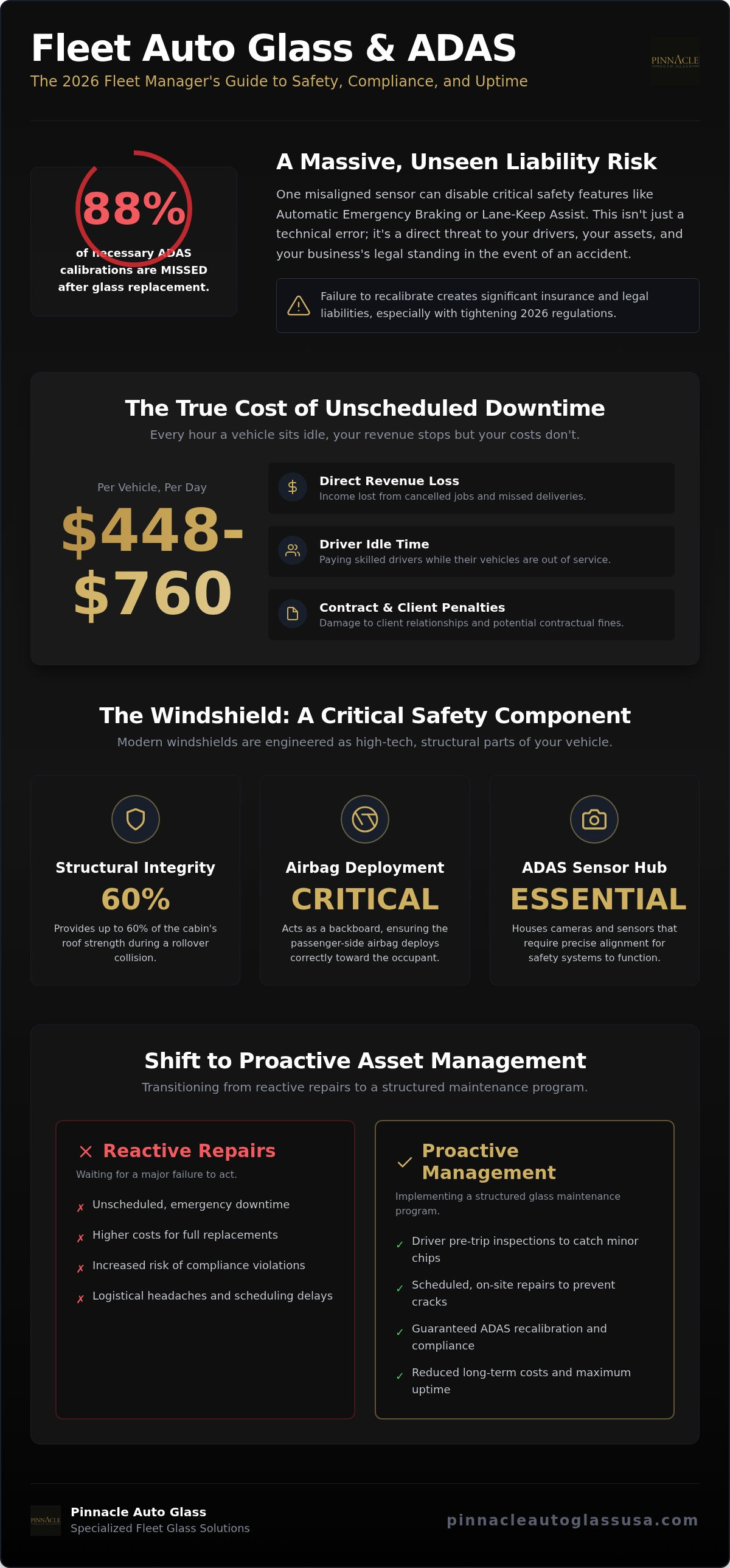
Did you know that as many as 88% of necessary safety system calibrations are missed after a collision or glass replacement? For a commercial fleet, that isn't just a technical oversight; it's a massive liability risk. Maintaining modern vehicles in 2026 requires more than just a quick glass swap. You need specialized fleet ADAS recalibration services to ensure every camera and sensor functions exactly as the manufacturer intended. One misaligned sensor can lead to the failure of automatic emergency braking, putting your drivers and your business at risk.
Managing a fleet is complicated enough without worrying if a faulty lane-keep assist will cause the next accident. You're likely dealing with rising downtime costs, which can reach $760 per day per vehicle, and the administrative headache of juggling multiple glass claims. We understand that every hour a truck sits in the shop is revenue lost. This guide will show you how professional fleet auto glass management protects your drivers and ensures full ADAS compliance. We'll explore the latest 2026 regulations and explain how a single-source partner keeps your commercial vehicles on the road safely while minimizing scheduling delays.
Key Takeaways
- Learn how a transition from reactive repairs to a structured asset management program preserves vehicle structural integrity and reduces long-term costs.
- Understand the critical role of fleet ADAS recalibration services in meeting 2026 safety standards and managing rising insurance liability.
- Compare the efficiency of mobile on-site repairs for logistics hubs against the technical requirements of in-shop service for heavy-duty vehicles.
- Establish proactive maintenance schedules and driver inspection protocols to catch minor glass damage before it causes unscheduled downtime.
- Identify the advantages of working with a single-source partner specializing in semi-truck, box truck, and delivery van glass solutions.
Optimizing Fleet Reliability through Professional Auto Glass Management
Auto glass management has evolved far beyond simple chip repairs. For modern commercial operations, it's now a specialized form of asset management. Your fleet's windshields are no longer just pieces of glass; they're high-tech components that house complex sensors. In 2026, industry standards for Class 8 trucks require extreme precision for camera sensor tolerances. Even a slight vibration or improper installation can trigger a system failure. Professional fleet ADAS recalibration services are now a non-negotiable part of the maintenance cycle. High-performing fleets treat glass as a critical safety asset to ensure maximum operational uptime.
The True Cost of Fleet Downtime
Downtime is a direct hit to your bottom line. When a delivery van or semi-truck sits in a repair bay, you're losing more than just the cost of parts. Industry research indicates that unscheduled downtime can cost between $448 and $760 per day for each vehicle. This includes the immediate loss of revenue and the ongoing expense of driver idle time. Secondary costs are often harder to quantify but equally damaging. Missed delivery windows lead to client dissatisfaction and potential contract penalties. A proactive management program identifies minor chips during pre-trip inspections. Fixing these small issues immediately prevents them from becoming major replacements that require hours of labor and recalibration.
Glass as a Structural Safety Component
The windshield is a primary safety feature of the vehicle's cabin. It provides significant structural support, contributing up to 60% of the roof's strength during a rollover. It also ensures that the passenger-side airbag deploys correctly by providing a solid surface for it to bounce off. If the glass is cracked or improperly installed, these protections vanish. Beyond structural integrity, clear glass is essential for meeting federal visibility standards. Drivers must have an unobstructed view to navigate heavy traffic safely. Advanced driver-assistance systems rely on this clear field of vision to function. Professional fleet glass management is a comprehensive safety and logistics strategy that protects drivers, assets, and the bottom line.
Total asset management means looking at the big picture. It involves tracking the history of every piece of glass in your fleet. This data helps identify recurring issues, such as specific routes causing more rock chips. By utilizing professional fleet ADAS recalibration services, you ensure that every vehicle returning to service is fully compliant with modern safety mandates. This systematic approach reduces liability and keeps your drivers protected behind the wheel.
Advanced Safety Systems: ADAS Recalibration for Commercial Fleets
Commercial safety technology is no longer an optional add-on. By August 2026, over 90% of new commercial vehicles come equipped with advanced driver assistance systems. These systems rely on cameras and sensors mounted behind the windshield to "see" the road. When you replace a windshield, the camera's angle of view changes by fractions of a millimeter. This shift is enough to render safety features useless or, worse, dangerous. Professional fleet ADAS recalibration services reset these sensors to factory specifications, ensuring the vehicle reacts correctly to hazards. It's the only way to guarantee your safety tech is actually working.
Neglecting this step creates significant legal and financial risks. The "ADAS Functionality and Integrity Act" (H.R. 7389), which passed the House Committee on Energy and Commerce in May 2026, signals a move toward strict federal calibration standards. State laws are already catching up. Many state legislatures are implementing regulations that require facilities to inform customers about calibration requirements or face civil penalties. If an uncalibrated fleet vehicle is involved in a collision, the owner faces massive liability. Insurance companies are also paying closer attention. While ADAS repairs can add up to 37% to the cost of a claim, insurers now require documented proof of recalibration for reimbursements. Industry studies suggest that 88% of necessary calibrations are currently missed, making this a critical area for fleet oversight.
Critical ADAS Features in Modern Trucks
Modern trucks depend on three primary systems that require absolute precision. Lane Departure Warning (LDW) monitors road markings and alerts drivers if they drift. Forward Collision Warning (FCW) scans the distance between vehicles to prevent rear-end impacts. Perhaps most critical is Automatic Emergency Braking (AEB). The NHTSA has finalized a rule requiring AEB on all new passenger vehicles by September 2029, and many commercial manufacturers are already meeting these standards. A misaligned sensor in any of these systems can lead to "ghost braking" or a failure to stop when needed. Using professional fleet ADAS recalibration services ensures these features remain reliable safeguards rather than liabilities.
The Recalibration Process for Commercial Vehicles
The workflow for logistics fleets begins with a pre-scan to identify existing fault codes. Technicians then perform either a static or dynamic recalibration. Static procedures use specialized targets in a controlled shop environment. Dynamic procedures involve driving the vehicle at specific speeds on clearly marked roads. Using OEM-quality glass is vital for this process. Low-quality glass often has distortions that interfere with camera clarity, making a successful calibration impossible. For a deeper dive into these technical requirements, consult our ADAS calibration auto glass guide. If you're managing a high-volume fleet, you need a partner that integrates these technical steps into a seamless service. You can rely on Pinnacle Auto Glass to handle the heavy lifting of compliance and safety.
Strategic Evaluation: Mobile vs. In-Shop Fleet Glass Services
Choosing between mobile and in-shop service is a logistical decision that directly impacts your fleet's turnaround time. Mobile repairs offer maximum flexibility for busy logistics hubs. In contrast, shop-based services provide the controlled environment required for the most complex technical procedures. Modern fleet managers must evaluate each vehicle's specific needs to balance speed with technical precision. High-quality fleet ADAS recalibration services often dictate which path is most appropriate for a specific truck or van.
Mobile Repair: Reducing Fleet Logistics Friction
Mobile glass service is designed to eliminate the friction of traditional repair cycles. You don't need to coordinate chase vehicles or burn extra driver hours for glass drop-offs. Technicians can meet your drivers at weigh stations, shipping depots, or corporate yards. This allows repairs to happen during mandatory rest periods or scheduled downtime. It's a highly efficient way to handle standard windshield replacements and dynamic recalibrations. For many operations, reducing fleet downtime with mobile glass repair is the most effective way to keep freight moving without interruption. This on-site approach ensures that minor glass damage doesn't derail a tight delivery schedule.
In-Shop Excellence for Special Equipment
While mobile service is convenient, certain scenarios require the stability of a dedicated facility. In-shop service is often the safer choice for heavy machinery, custom commercial builds, and complex heavy-duty glass installations. Controlled environments are essential for high-tech glass bonding. Extreme temperatures or humidity can interfere with the curing process of professional-grade adhesives. Shop environments also provide the level flooring and specific lighting conditions required for static fleet ADAS recalibration services. These procedures involve placing large, specialized targets at precise distances from the vehicle's sensors. If your fleet includes specialized equipment with multi-sensor arrays, a shop-based environment ensures every safety system is verified under optimal conditions.
Weather is another critical factor. Rain, snow, or high winds can prevent a mobile technician from performing a safe installation. A shop provides a dry, temperature-controlled space that guarantees the structural integrity of the repair. If a vehicle requires a complex, multi-stage recalibration, the shop environment allows technicians to work with specialized diagnostic tools that may not be easily portable. By choosing the right environment for each repair, you ensure your safety systems remain compliant while maximizing the lifespan of your glass assets. This strategic approach keeps your fleet reliable and your drivers protected in any operating environment.
Maximizing Efficiency: Implementing a Fleet Glass Maintenance Program
Reactive maintenance is a gamble that costs your business money. Waiting for a windshield to shatter leads to emergency repairs and missed delivery windows. A structured preventative glass maintenance schedule allows you to catch damage before it escalates. This approach reduces the frequency of full replacements. It also limits how often you need to schedule fleet ADAS recalibration services. By managing glass as a predictable maintenance item, you gain control over your budget. Volume pricing and consolidated accounts lower the per-unit cost of service across your entire fleet.
Standardizing Fleet Inspections
Establishing a standardized inspection protocol is the first step toward efficiency. Drivers should perform pre-trip checks that specifically target glass condition. They need to look for small bullseyes or star breaks that technicians can easily fix on-site. Consult our windshield repair guide to understand the specific criteria for fixing chips versus replacing the entire pane. Drivers must also be trained to recognize ADAS warning lights. A chip or heavy dirt in front of a camera lens can disable safety features. Catching these issues at the depot prevents a vehicle from being sidelined during a high-priority route.
Administrative Ease for Fleet Managers
Administrative efficiency is a major outcome of a professional glass program. Coordinating glass repairs for dozens of vehicles is a heavy lift for any office. Partnering with a single provider simplifies this through dedicated account management. You receive consolidated billing and reporting. This is essential for accurate tax records and maintenance audits. This centralized data helps you track the total cost of ownership for every vehicle in your inventory.
Streamlining the insurance claim process is equally important. A consolidated account allows for simultaneous processing of multiple claims. This reduces the paperwork burden on your staff. You also benefit from priority scheduling for your most important vehicles. This ensures that fleet ADAS recalibration services are finished quickly. You get your trucks back in service with verified safety compliance. Contact Pinnacle Auto Glass to establish a commercial account and simplify your fleet operations today.
Comprehensive Fleet Glass Solutions with Pinnacle Auto Glass
Managing a modern fleet requires a partner who understands that every minute counts. Pinnacle Auto Glass isn't just a service provider; we're a logistics ally. We specialize in high-stakes environments where safety and uptime are the primary metrics of success. Our team combines national-level expertise with a direct, no-nonsense approach to maintenance. We provide the technical precision required for modern fleet ADAS recalibration services alongside the heavy-duty glass expertise needed for large-scale operations.
Heavy-Duty and Commercial Truck Specialization
Class 8 trucks and logistics fleets face unique challenges on the road. The sheer size of the glass and the high vibration levels of heavy-duty engines demand superior installation techniques. We use only OEM-quality materials to ensure maximum durability and sensor compatibility. This is critical for maintaining the tight tolerances required by 2026 industry standards. Whether you operate box trucks or a national delivery van network, we have the specialized tools to handle the job correctly the first time. You can learn more about our commitment to quality in the pinnacle auto glass brand overview. We focus on the technical details so your drivers can focus on the road.
Partnering for Long-Term Success
Success in fleet management comes down to organization and reliability. Getting started with a Pinnacle fleet account is a straightforward process designed to remove administrative friction. We handle the heavy lifting of insurance claims and documentation. This addresses the common headache of managing multiple glass claims simultaneously across different vehicles. Our integrated fleet ADAS recalibration services are baked into our workflow, ensuring every vehicle meets safety mandates before it leaves the yard. We offer:
- Priority scheduling for critical path vehicles to minimize downtime.
- Consolidated billing and reporting for clear maintenance records.
- Direct insurance claim handling to reduce your office's paperwork burden.
- Mobile and in-shop options tailored to your fleet's specific geography.
Our commitment to quality and safety is backed by rapid response times. We know that a truck sitting in a bay is a truck that isn't making money. We've built our service model around the needs of professional fleet managers who value results over excuses. By centralizing your glass management, you gain a transparent view of your maintenance costs and safety compliance. Pinnacle Auto Glass provides the reliability fleets need to stay operational.
Securing Your Fleet's Future on the Road
Modern fleet management requires a balance between rapid logistics and technical precision. Moving away from reactive repairs toward a structured maintenance program is the most effective way to protect your bottom line. By prioritizing professional fleet ADAS recalibration services, you ensure your drivers remain protected by the latest safety technology while meeting strict 2026 compliance standards. A single-source partner simplifies the administrative burden of insurance claims and scheduling, allowing your team to focus on delivery targets instead of repair delays.
Pinnacle Auto Glass provides the specialized expertise needed for heavy-duty glass replacement in semi-trucks and box trucks. Our dedicated account management ensures your logistics remain streamlined and your safety systems are verified for every mile. Don't let unscheduled downtime or liability concerns slow your operations. Contact Pinnacle Auto Glass for a Fleet Service Consultation to see how our professional solutions keep your commercial vehicles moving safely. We're ready to help you build a more resilient and compliant fleet today.
Frequently Asked Questions
How does fleet auto glass service differ from standard auto glass repair?
Fleet services focus on operational efficiency and asset management rather than one-off repairs. We provide specialized scheduling and administrative support that individual consumers don't require. This includes managing multiple glass claims and providing consolidated reporting for tax and maintenance audits. Our goal is to minimize downtime and simplify the logistics of keeping a large number of vehicles road-ready at all times.
Is ADAS recalibration always necessary for commercial fleet vehicles?
Recalibration is mandatory after any windshield replacement or repair involving the camera's field of vision. Modern safety systems like automatic emergency braking rely on perfect sensor alignment to function correctly. Our specialized fleet ADAS recalibration services ensure your trucks meet all 2026 safety standards before returning to the road. Skipping this step creates significant liability risks for your business if a collision occurs.
Can you perform windshield replacements for semi-trucks on-site?
We provide mobile service capabilities for heavy-duty commercial vehicles, including semi-trucks and box trucks. Technicians can meet your drivers at shipping hubs, weigh stations, or your own corporate yard. This eliminates the need for chase vehicles and helps you manage driver hours more effectively. It's a convenient solution that allows glass work to happen during a driver's mandatory rest period or scheduled downtime.
How quickly can a fleet vehicle be back on the road after a windshield replacement?
Most vehicles are back in service within two to four hours after a replacement. This timeframe accounts for the safe drive-away time of the adhesive and the completion of necessary recalibration. We prioritize scheduling for your Critical Path vehicles to ensure your logistics operations suffer minimal disruption. Our technicians work efficiently to get your assets back on the road without compromising safety or quality.
What are the billing options for companies with large vehicle fleets?
We offer consolidated billing and dedicated account management for our commercial clients. This streamlines your internal bookkeeping by providing a single monthly report for all maintenance activities. We also handle the insurance claim process directly to reduce the administrative burden on your staff. This approach makes it much easier to track the total cost of ownership and maintenance history for your entire fleet.
Does Pinnacle Auto Glass use OEM or aftermarket glass for commercial trucks?
We utilize OEM-quality glass for all commercial truck replacements to ensure maximum durability and safety. High-quality glass is necessary for sensor compatibility, as distortions in cheaper aftermarket glass can interfere with safety cameras. This standard helps maintain the structural integrity of your Class 8 trucks over long distances. It also ensures that your ADAS features function exactly as the vehicle manufacturer intended.
How do I know if my fleet vehicle’s glass can be repaired or if it needs replacement?
Repairs are typically possible for small chips or bullseyes that haven't yet spread into cracks. If the damage is in the driver's critical field of vision or exceeds the size of a quarter, a full replacement is usually necessary. Catching these issues early through preventative inspections can save the cost of a full replacement. It also avoids the additional time required for recalibration after a new installation.
What certifications should I look for in a fleet glass service provider?
You should seek providers with verified expertise in fleet ADAS recalibration services and heavy-duty glass. A professional partner should use industry-standard diagnostic equipment and follow OEM-specific workflows. Look for a company that offers both mobile and in-shop options to handle different technical requirements. They should also provide documented proof of compliance for your insurance records and liability protection.


