
A cracked windshield on a personal vehicle is an inconvenience. A cracked windshield on a semi-truck hauling freight across three states is a compliance violation, a safety liability, and a revenue loss event rolled into one. Managing auto glass for commercial vehicles is a fundamentally different challenge than handling a single-car repair, and fleet managers who treat it as a commodity task pay for that assumption in downtime, failed DOT inspections, and inconsistent ADAS system performance.
You already know the pressure. One vehicle sidelined for a glass repair can cascade into missed delivery windows, driver scheduling conflicts, and billing headaches across multiple repair vendors in different regions. The frustration is real, and it's common across fleets of every size.
This guide cuts through the complexity. You'll learn how to evaluate commercial truck glass standards, understand ADAS recalibration requirements, and build a service strategy that keeps your fleet moving and your safety systems fully operational. From heavy-duty semi-truck windshields to multi-vehicle scheduling, here's what every fleet manager needs to know heading into 2026.
Key Takeaways
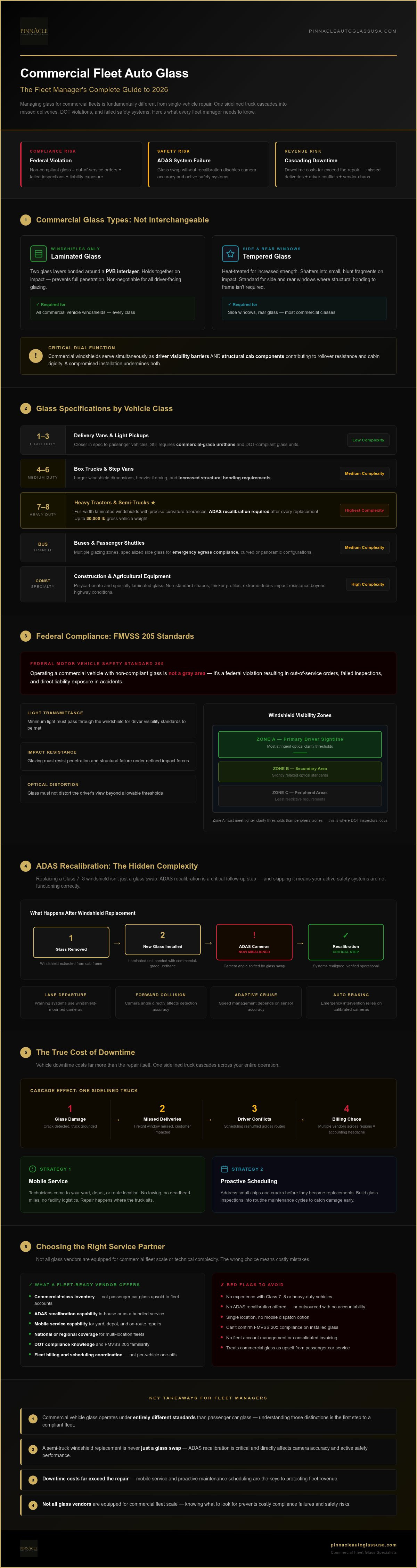
- Auto glass for commercial vehicles operates under entirely different standards than passenger car glass—understanding those distinctions is the first step to building a compliant, road-ready fleet.
- Replacing a semi-truck windshield isn't just a glass swap; ADAS recalibration is a critical follow-up step that directly affects camera accuracy and active safety system performance.
- Vehicle downtime costs far more than the repair itself—strategic mobile service and proactive maintenance scheduling are the keys to protecting your fleet's revenue.
- Not all glass vendors are equipped to handle the scale or technical complexity of commercial fleet work—knowing what to look for in a service partner can prevent costly mistakes.
- From heavy-duty semi-truck windshields to multi-vehicle fleet coordination, this guide gives fleet managers a clear framework for making smarter, faster glass maintenance decisions in 2026.
Understanding the Scope of Auto Glass for Commercial Vehicles
Auto glass for commercial vehicles isn't a scaled-up version of passenger car glass. It's an entirely different category of engineered glazing, built to withstand high-mileage punishment, extreme temperature cycling, and the structural demands of vehicles that can weigh upward of 80,000 pounds at full load. Treating it like standard replacement glass is a mistake that shows up quickly, either on the road or at a DOT inspection.
Commercial glazing serves two distinct functions that passenger glass rarely has to balance simultaneously: maintaining driver visibility under harsh operating conditions and contributing to the structural integrity of the cab or cargo body. In box trucks and delivery vans especially, the windshield isn't just a barrier against wind and debris. It's an active component in the vehicle's rollover resistance and cabin rigidity. A compromised installation or substandard glass unit undermines both.
The two primary glass types in commercial applications are laminated and tempered, and they're not interchangeable by application:
- Laminated glass is used in windshields across virtually all commercial vehicle classes. It bonds two glass layers around a polyvinyl butyral (PVB) interlayer, which holds the glass together on impact and prevents full penetration. This is non-negotiable for driver-facing glazing.
- Tempered glass is heat-treated to increase strength and shatters into small, relatively blunt fragments on impact. It's standard for side and rear windows in most commercial vehicles, where structural bonding to the frame isn't required.
Large-format windshields found on Class 7 and Class 8 tractors present an additional challenge: sheer surface area. A windshield spanning the full width of a semi cab creates significantly more flex stress during highway operation than a compact car windshield. That means the glass thickness, urethane adhesive specification, and installation technique all carry greater consequence.
DOT and ANSI Standards for Commercial Glazing
Federal Motor Vehicle Safety Standard 205 (FMVSS 205) governs the glazing materials used in commercial vehicles sold and operated in the United States. It establishes requirements for light transmittance, impact resistance, and optical distortion, and it defines "critical areas" of the windshield where visibility standards are most stringent. Zone A, the primary driver sightline area, must meet tighter optical clarity thresholds than the peripheral zones. Operating a commercial vehicle with glass that fails these standards isn't a gray area. It's a federal violation that can result in out-of-service orders, failed inspections, and liability exposure in the event of an accident.
Class 1 through Class 8: Glass Needs by Vehicle Type
Glass specifications scale with vehicle class, and the differences are significant:
- Class 1-3 (light-duty vans and pickups): Delivery vans in this range use glass that's closer in spec to passenger vehicles, though commercial-grade urethane and DOT-compliant units are still required.
- Class 4-6 (medium-duty box trucks and step vans): Larger windshield dimensions, heavier framing, and increased structural bonding requirements distinguish this category.
- Class 7-8 (heavy-duty tractors and semis): Full-width laminated windshields with precise curvature tolerances. ADAS integration is increasingly common in this class, adding recalibration requirements to every replacement.
- Passenger transport (buses and shuttles): Multiple glazing zones, specialized side glass for emergency egress compliance, and often curved or panoramic configurations.
- Construction and agricultural equipment: Polycarbonate and specialty laminated glass with non-standard shapes, thicker profiles, and resistance to debris impact far beyond highway conditions.
Each category demands a different glass unit, a different installation protocol, and a vendor with the right inventory and technical capability to back it up.
Specialized Solutions for Heavy-Duty Trucks and Logistics Fleets
Semi-trucks operate in conditions that stress every component of the vehicle, and the windshield absorbs more of that punishment than most fleet managers account for. At highway speeds, a Class 8 tractor generates significant aerodynamic pressure across the full cab face. Add constant drivetrain vibration from diesel engines, temperature swings between cold overnight parking and heated cab interiors, and high-frequency road vibration transmitted through the chassis, and you have a glazing environment that exposes any weakness in the glass unit, the seal, or the adhesive bond.
Older fleet models often feature a two-piece windshield design, split vertically at the center post. These configurations were common on earlier Peterbilt, Kenworth, and International cab-over designs. They're simpler to source individually but create a structural vulnerability at the center join, and the seal between the two panels is a chronic leak point on high-mileage vehicles. Modern one-piece curved windshields eliminate that join entirely, improving both structural rigidity and optical clarity across the full driver sightline. If your fleet still runs two-piece configurations, seal inspection should be a standing item on every preventive maintenance cycle.
Adhesive quality is non-negotiable in long-haul applications. The urethane used to bond a semi windshield must maintain its elasticity across extreme temperature ranges while resisting the constant flex stress of a moving chassis. Substandard adhesive fails gradually, allowing moisture intrusion that damages cab electronics, insulation, and interior trim long before the driver notices a visible gap. The cost of a cab water damage repair dwarfs the cost of a correct installation the first time.
Stocking glass for a diverse fleet is its own logistics challenge. A mixed fleet running Freightliners, Volvos, Macks, and International LTs requires access to multiple windshield SKUs simultaneously. A vendor that stocks only the most common units will leave you waiting on special orders when a less common model goes down. Prioritize service partners with broad commercial inventory or verified rapid-sourcing capability across the full range of auto glass for commercial vehicles your fleet operates.
Semi-Truck Windshield Replacement: Beyond the Glass
Replacing a Class 7 or Class 8 windshield isn't a one-technician job. The sheer size and weight of a full-width laminated unit requires a coordinated two-technician installation to position the glass correctly without stressing the frame or compromising the adhesive bed. Specialized removal tools, including long-reach cold knives and powered cut-out tools, are required to extract the old unit cleanly without damaging the pinch weld or surrounding trim. OEM-quality glass matters here because dimensional tolerances on large-format windshields are tight; an off-spec unit creates fitment gaps that no amount of urethane can compensate for long-term.
Weather-stripping and gasket condition deserve equal attention during any replacement. Deteriorated gaskets on door glass and vent windows allow cab pressurization issues that affect windshield seal performance. A complete inspection of all cab glazing seals during a windshield replacement catches secondary problems before they become separate service events.
Last-Mile Delivery: Van and Box Truck Considerations
Urban delivery environments are brutal on glass. Stop-and-go traffic, tight parking maneuvers, low-clearance structures, and constant exposure to road debris from city streets create a damage frequency that long-haul fleets rarely match. Sprinter vans, Ford Transits, and Ram ProMasters are workhorses in last-mile logistics, and each platform has distinct glass specifications that require the right unit and the right installation protocol.
Sprinters in particular present a fitment complexity because of the multiple wheelbase and roof height configurations Mercedes-Benz produces. A high-roof extended Sprinter doesn't share glass with a standard-roof short-wheelbase unit. Ordering errors here cost time and money. Fleets running high volumes of these vehicles benefit significantly from a service partner with platform-specific inventory and technicians experienced in van glass replacement. For a closer look at managing delivery van windshield replacement without disrupting your dispatch schedule, mobile service options are worth evaluating as a core part of your maintenance strategy.
If your fleet spans multiple vehicle classes and platforms, connect with a commercial glass specialist who can assess your full inventory and build a service plan that matches your operational footprint.
ADAS Recalibration: The Hidden Complexity of Commercial Glass
Modern commercial vehicles are rolling sensor platforms. Forward-facing cameras, radar units, and lidar arrays work in concert to power safety systems that actively intervene in collision scenarios. When a windshield gets replaced on a 2026 Class 8 tractor, those systems don't automatically reset to factory accuracy. The glass itself is part of the optical path. Change the glass, and you change the reference point for every camera mounted behind it.
The geometry matters precisely. A forward-facing camera calibrated to the original windshield reads pitch, yaw, and roll relative to a fixed mounting position. Even a fractional shift in glass angle or thickness, well within normal manufacturing tolerance variation between units, can push camera orientation outside the acceptable range for accurate object detection. On a vehicle traveling at highway speeds with a full load, that deviation isn't academic. It's the difference between a Forward Collision Warning system that triggers at the right moment and one that triggers late, or not at all.
Skipping recalibration after a windshield replacement creates direct liability exposure for fleet owners. If a vehicle is involved in an accident and post-incident analysis reveals that the ADAS system was operating outside calibration spec, the fleet operator faces a difficult position. The glass was replaced. The recalibration wasn't completed. That sequence is documented in service records, and it's exactly the kind of detail that surfaces in litigation. Completing a recalibration and retaining the report isn't optional. It's risk management.
Critical Safety Systems in Modern Commercial Fleets
Forward Collision Warning and Lane Departure Warning are the two most camera-dependent systems in commercial vehicle ADAS packages. FCW calculates closing distance to objects ahead and initiates alerts or automatic braking. LDW monitors lane markings and alerts the driver to unintended drift. Both systems rely on a precisely aimed camera with a known field of view. On 2026 model commercial platforms, these systems are tightly integrated with electronic braking and steering inputs, which means a miscalibrated camera doesn't just affect an alert tone; it affects active vehicle control. For a complete technical breakdown of how recalibration intersects with auto glass for commercial vehicles, the ADAS calibration and auto glass reference guide covers the full scope of requirements across vehicle classes.
The Recalibration Process for Commercial Vehicles
Commercial ADAS recalibration isn't the same workflow used on passenger cars. Heavy-duty platforms require larger calibration targets, greater floor space for static procedures, and OEM-specific diagnostic software that communicates directly with the vehicle's electronic control modules. Two recalibration methods apply depending on the platform and system type:
- Static recalibration is performed in a controlled indoor environment. The vehicle is positioned at a precise distance from a manufacturer-specified target pattern, and the camera is aligned using software until it meets OEM tolerance values. This method requires a level floor, adequate lighting, and sufficient clear space around the vehicle, conditions that demand a properly equipped facility.
- Dynamic recalibration is completed on the road. The vehicle is driven at a specified speed over a defined distance while the system uses real-world lane markings and environmental data to self-correct. Some platforms require dynamic recalibration as a follow-up step after static procedures.
Technicians performing this work on commercial platforms need hands-on experience with heavy-duty diagnostic tools and the specific OEM software for each vehicle make. A completed recalibration report, documenting the procedure performed, the system values before and after, and the technician's sign-off, is the only way to confirm the job is actually done. Glass replacement without that report isn't a complete service event. Don't accept it as one.
Minimizing Fleet Downtime: Mobile Repair and Strategic Maintenance
The glass repair itself is rarely the most expensive part of a commercial vehicle breakdown. The real cost is everything around it: the driver sitting idle, the delivery window missed, the customer relationship strained, and the dispatcher scrambling to cover a gap in the route schedule. When you account for those downstream effects, a single sidelined vehicle can cost a fleet operation far more than the service invoice reflects.
That framing changes how smart fleet managers approach glass maintenance. The goal isn't just to fix glass cheaply. It's to fix it without stopping the vehicle longer than necessary. Every strategy in this section is built around that objective.
The Benefits of Professional Mobile Glass Service
Mobile service eliminates the two biggest time sinks in commercial glass repair: towing and driver transport. When a technician comes to your depot, distribution center, or job site, the vehicle stays in your operational environment. Drivers don't lose hours navigating to a service location. Dispatch doesn't need to arrange a pickup. The repair happens during a natural break in the route cycle, and the vehicle goes back into service the same day.
Quality doesn't have to be sacrificed for convenience. Professional mobile installations for auto glass for commercial vehicles require controlled conditions: stable ambient temperature ranges for urethane cure, protected work areas that prevent wind-driven contamination during adhesive application, and level ground for proper glass seating on larger units. Qualified mobile technicians arrive equipped to manage those variables. For a detailed breakdown of how to structure this into your operations, the guide on reducing fleet downtime with mobile glass repair covers the logistics and scheduling frameworks worth building into your 2026 maintenance plan.
Preventive Glass Maintenance for Fleet Managers
The most effective downtime reduction strategy is catching damage before it requires a full replacement. A chip addressed within the first few days stays a chip. Left alone, thermal cycling and road vibration drive cracks outward until the windshield is beyond repair eligibility.
Build a brief glass inspection into your drivers' pre-trip checklist. Key items to flag:
- Any chip or star crack in the primary driver sightline (Zone A)
- Edge cracks longer than an inch, which spread faster than center damage
- Seal separation or visible gaps around the windshield perimeter
- Pitting or hazing across the wiper sweep area that reduces visibility
The general guideline used across the industry: if the damage fits within the area of a standard quarter coin and sits outside the driver's direct sightline, a windshield repair is likely still viable. Once a crack extends beyond that threshold, replacement becomes the only compliant option. Catching damage in the repair window is consistently the lower-cost, lower-downtime outcome.
For fleets managing dozens or hundreds of vehicles, periodic glass audits conducted by a commercial glass specialist add another layer of protection. A technician walking your yard can identify developing issues that drivers overlook during pre-trip checks, flagging units that need attention before they become out-of-service events.
Centralized scheduling matters equally for national or multi-depot operations. Working with a single service partner who can coordinate glass maintenance across multiple locations eliminates the vendor fragmentation that creates billing inconsistencies, inconsistent service quality, and gaps in your maintenance records. One point of contact, one service standard, one documentation trail.
Connect with a commercial fleet glass specialist to build a proactive maintenance schedule that matches your fleet's size, routes, and vehicle mix.
Partnering with Pinnacle Auto Glass for National Fleet Success
Fleet managers don't need another vendor relationship to manage. They need a service partner who understands the operational stakes of commercial glass work and delivers consistent results across every vehicle in the fleet, regardless of location. That's the distinction Pinnacle Auto Glass is built around: nationwide reach without the impersonal, one-size-fits-all approach that leaves fleet managers chasing answers from a call center.
Every job is handled by certified auto glass technicians with hands-on experience in commercial applications. That matters more than it might sound. Commercial glass work carries consequences that passenger car repairs don't: DOT compliance requirements, structural bonding specifications, and ADAS recalibration protocols that directly affect active safety system performance. Sending a generalist technician to a Class 8 tractor isn't a cost-saving measure. It's a liability waiting to surface.
Pinnacle's approach to auto glass for commercial vehicles is built on two non-negotiables: safety and accuracy. Every windshield replacement includes a full assessment of ADAS recalibration requirements. Every completed recalibration is documented with a technician sign-off report. DOT compliance isn't treated as a checkbox. It's the baseline standard for every commercial install.
Quality Standards and Professionalism
The materials used on every commercial job meet OEM specifications. High-grade urethane adhesives rated for the temperature cycling and flex stress of heavy-duty applications. Glass units sourced to dimensional tolerances that ensure proper fitment without compensating gaps. These aren't premium upgrades. They're the standard Pinnacle applies to every commercial vehicle it services.
Fleet insurance claims add another layer of complexity that Pinnacle handles directly. The process is streamlined to minimize the administrative burden on fleet managers:
- Direct coordination with commercial and fleet insurance carriers
- Documentation prepared to meet carrier requirements for multi-vehicle claims
- Service warranties that cover workmanship and materials, giving fleet operators a clear path if issues arise post-installation
That warranty coverage isn't just a reassurance. It's a practical protection for fleets that can't afford to revisit the same repair twice.
Getting Started with Your Commercial Account
Setting up a recurring fleet maintenance partnership with Pinnacle is a straightforward process. Bring your vehicle inventory, your operational footprint, and your current pain points. The focus from the first conversation is on your bottom line: reducing downtime, maintaining compliance, and building a service schedule that fits how your fleet actually operates.
There's no complex onboarding process. One point of contact. One service standard applied across your entire fleet. One documentation trail that holds up at inspection.
If you're managing a fleet and want a service partner who treats commercial glass work with the technical seriousness it requires, contact Pinnacle Auto Glass to schedule a consultation and build a maintenance plan that keeps your fleet moving and your safety systems fully operational.
Keep Your Fleet Compliant, Moving, and Ready for What's Ahead
Auto glass for commercial vehicles is a safety-critical system, not a routine maintenance item. The decisions you make around glass replacement, ADAS recalibration, and service scheduling directly affect DOT compliance, driver safety, and your fleet's revenue continuity. Those stakes don't leave room for guesswork or underqualified vendors.
Three things matter most heading into 2026: working with certified ADAS recalibration experts who document every procedure, choosing a service partner with nationwide mobile service capability to protect your uptime, and holding every installation to DOT-compliant heavy-duty glass standards. Cut corners on any one of those, and the downstream costs will exceed what you saved.
Your fleet doesn't have to absorb unnecessary downtime or compliance risk. The right service partner handles the complexity so you don't have to manage it vendor by vendor, location by location.
Schedule your commercial glass service with Pinnacle Auto Glass and put a consistent, compliant maintenance strategy behind every vehicle in your fleet.
Frequently Asked Questions About Auto Glass for Commercial Vehicles
How Much Does Windshield Replacement Cost for a Semi-Truck?
Semi-truck windshield replacement costs vary significantly based on the make, model, cab configuration, and whether ADAS recalibration is required after the install. A two-piece windshield on an older cab-over design sits at a different price point than a one-piece curved unit on a current Class 8 tractor. Contact a commercial glass specialist directly for an accurate quote based on your specific vehicle and fleet volume, since multi-vehicle accounts often carry different pricing structures than single-unit repairs.
Do Commercial Vehicles Require Special Glass Compared to Passenger Cars?
Yes, and the differences are substantial. Auto glass for commercial vehicles must meet FMVSS 205 federal standards, which govern optical clarity, impact resistance, and light transmittance thresholds that passenger car glass isn't always tested to at the same level. Commercial windshields also use higher-specification urethane adhesives rated for the flex stress, temperature cycling, and structural bonding demands of heavy-duty vehicles. Using non-compliant glass on a commercial vehicle isn't just a quality issue; it's a federal violation that can trigger out-of-service orders at inspection.
How Long Does a Commercial Windshield Replacement Take to Complete?
Most commercial windshield replacements are completed within two to four hours, depending on vehicle class and cab configuration. Class 8 tractor replacements take longer than van or box truck installs because the larger glass units require a two-technician crew and more precise adhesive bed preparation. After installation, the vehicle must observe a safe drive-away time to allow the urethane to cure sufficiently before road use. Your technician will confirm the specific window based on the adhesive product used and ambient temperature conditions.
Can ADAS Recalibration Be Done On-Site for Commercial Fleets?
Dynamic recalibration can be performed on the road and doesn't require a fixed facility, making it compatible with on-site or mobile service scenarios. Static recalibration is more demanding. It requires a level surface, controlled lighting, adequate clear space around the vehicle, and manufacturer-specified target patterns positioned at precise distances. Some commercial platforms require static procedures before dynamic follow-up steps. Whether on-site recalibration is viable depends on your depot's physical setup and the specific OEM requirements for each vehicle in your fleet.
Is It Legal to Drive a Commercial Vehicle with a Cracked Windshield?
It depends on the crack's location and severity. Federal Motor Carrier Safety Administration regulations prohibit operating a commercial vehicle with glazing that obstructs the driver's view, and many states have additional requirements. A crack in Zone A, the primary driver sightline area defined under FMVSS 205, is grounds for a DOT out-of-service order during a roadside inspection. Edge cracks and chips outside the sightline may be evaluated differently, but any damage that compromises structural integrity or visibility should be addressed before the vehicle returns to service.
What Is the Difference Between Static and Dynamic Recalibration for Trucks?
Static recalibration is performed indoors with the vehicle stationary. The camera is aligned to a manufacturer-specified target at a precise distance using OEM diagnostic software until it meets factory tolerance values. Dynamic recalibration is completed on the road, where the system uses real-world lane markings and environmental data to self-correct while the vehicle is driven at a defined speed over a set distance. Some commercial platforms require both methods in sequence. The vehicle make, model year, and ADAS system type determine which procedure applies.
Does Insurance Typically Cover Commercial Glass Repair and Replacement?
Most commercial auto insurance policies include glass coverage under comprehensive provisions, though deductibles, coverage limits, and claim procedures vary by carrier and policy structure. Fleet policies often handle glass claims differently than individual vehicle policies, sometimes with per-vehicle or aggregate limits that affect how multi-vehicle repairs are processed. Working with a glass service provider experienced in commercial insurance coordination simplifies the documentation and claim submission process. Confirm your specific coverage terms with your carrier before scheduling service.
How Can I Set Up a National Account for My Commercial Fleet?
Setting up a national fleet account starts with a conversation about your vehicle inventory, operational footprint, and current maintenance challenges. A commercial glass specialist will assess your fleet's make and model mix, geographic service needs, and repair frequency to build a maintenance plan that fits your operation. The goal is a single service standard applied consistently across all locations, with centralized documentation and one point of contact for scheduling and billing. Reach out to Pinnacle Auto Glass to discuss your fleet's requirements and get a plan in place.


