
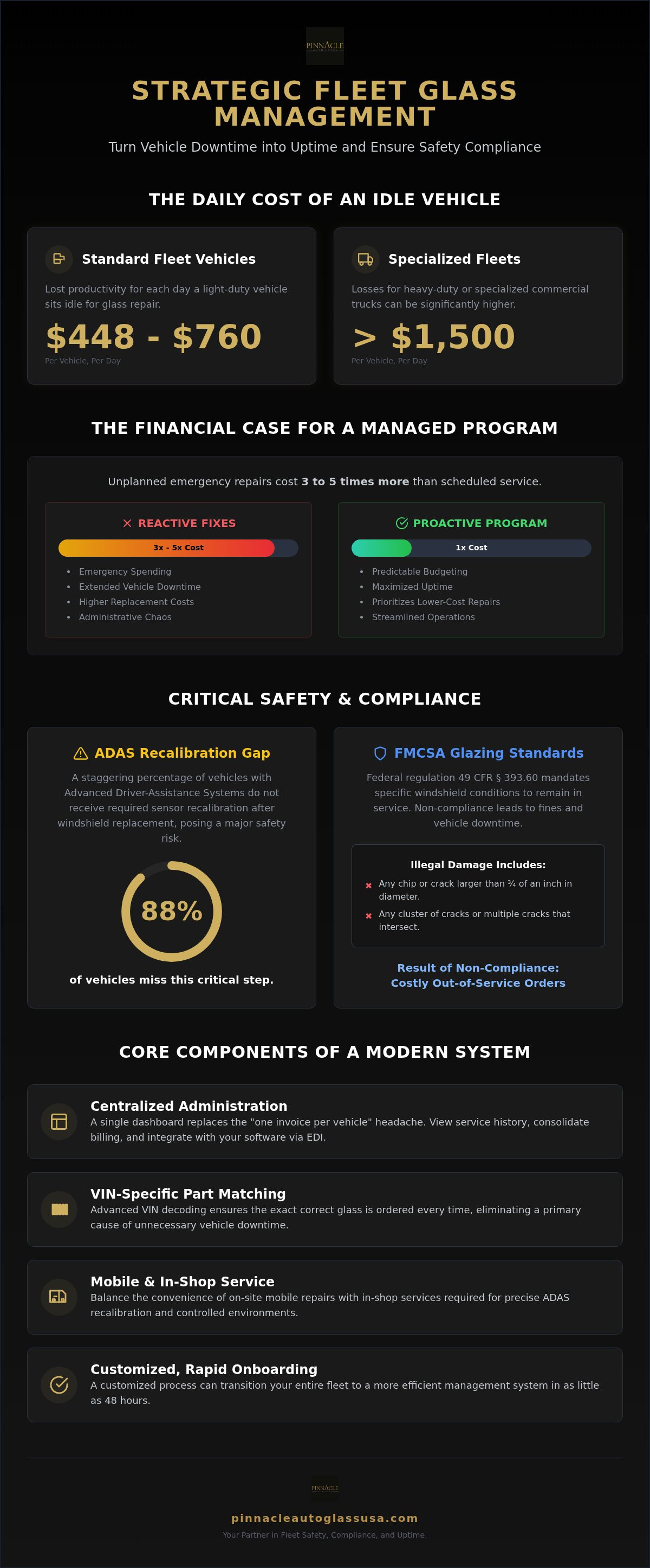
Every day one of your vehicles sits idle for a glass repair, it costs your operation between $448 and $760 in lost productivity. For specialized fleets, those losses can exceed $1,500 per day. You need a reliable fleet glass repair program that prioritizes uptime and safety over simple fixes. Managing multiple service locations and complex billing shouldn't be your full-time job. You deserve a solution that streamlines these tasks so you can focus on your core business goals.
It's frustrating when maintenance schedules fall apart because of a single cracked windshield. You're likely concerned about the liability of modern safety systems, especially since 88% of vehicles requiring ADAS recalibration don't receive it. This guide provides a clear roadmap to 2026 standards. You'll learn how to establish a single point of contact for windshield replacement and commercial truck glass. We'll also detail how to maintain federal safety compliance and create predictable maintenance workflows that protect your bottom line and ensure driver safety.
Key Takeaways
- A strategic fleet glass repair program reduces vehicle downtime and ensures your operation remains compliant with federal safety regulations.
- Centralized administration and VIN-specific part matching eliminate billing confusion and prevent costly ordering errors.
- Balance mobile repairs for on-site convenience with in-shop services to ensure precise ADAS recalibration and sensor functionality.
- Staying current with FMCSA glazing requirements prevents out-of-service orders and maintains high safety standards across your entire fleet.
- Learn how a customized onboarding process transitions your vehicles to a more efficient management system in as little as 48 hours.
Scaling Fleet Operations: The Strategic Role of a Glass Repair Program
A fleet glass repair program is a systematic approach to maintaining vehicle glass integrity through scheduled maintenance and rapid response. It isn't just a service. It is a logistical framework that ensures every vehicle in your inventory remains road-ready. Effective Fleet management requires moving away from reactive fixes and toward a proactive strategy.
Neglecting minor glass damage has immediate regulatory consequences. Under federal regulation 49 CFR § 393.60, commercial vehicles cannot operate with intersecting cracks or chips larger than 3/4 of an inch. These issues lead to FMCSA non-compliance and costly out-of-service orders. Beyond the fines, a compromised windshield weakens the vehicle's structural integrity. In many commercial cabins, the glass provides significant support during a rollover. Maintaining this structural component is a non-negotiable safety requirement. Moving to a proactive model ensures your drivers stay safe and your fleet stays on the road.
Defining Your Fleet's Glass Needs
Every fleet has unique requirements based on its vehicle mix and operational territory. A fleet of light-duty delivery vans faces different risks than one utilizing heavy-duty semi-trucks. You must assess your specific vulnerabilities to build an effective program. Consider these factors:
- Vehicle Types: Identifying the specific needs for standard windshields versus specialized commercial truck glass.
- Route Analysis: Mapping high-risk routes where gravel or debris frequently cause rock chips and cracks.
- Downtime Impact: Calculating the cost of an idle vehicle, which typically ranges from $448 to $760 per day according to 2026 industry data.
The Financial Case for a Managed Program
Proactive maintenance is significantly more cost-effective than emergency replacement. Data from the American Trucking Associations indicates that unplanned repairs cost three to five times more than scheduled service. By catching a small chip early, you avoid the higher expense of a full windshield replacement. A fleet glass repair program is a tool for operational continuity. It allows your team to:
- Reduce long-term maintenance costs by prioritizing windshield repair over full replacements.
- Streamline insurance claims by working through a single, preferred provider.
- Consolidate billing to reduce administrative overhead across multiple service locations.
Transitioning to a managed model provides the predictability your budget needs. It replaces chaotic, emergency spending with a controlled and reliable workflow that protects your bottom line.
Essential Components of a Modern Fleet Glass Management System
A successful fleet glass repair program operates as a cohesive system rather than a collection of random service calls. It requires a blend of administrative efficiency and technical precision to keep your operations moving. When you move beyond basic repairs, you gain control over your maintenance budget and vehicle availability. This systematic approach ensures that every replacement or repair is documented, accurate, and performed with your fleet's specific needs in mind.
Streamlining the Billing Process
Accounting teams often face a significant administrative burden when managing glass services. Processing a separate invoice for every chip repair or replacement is inefficient and prone to error. A modern management system eliminates the "one invoice per vehicle" headache by consolidating all activity into a single, comprehensive dashboard. You can view your entire service history and current spend at a glance. For large-scale logistics firms, electronic data interchange (EDI) options allow for automated billing that integrates directly with your existing software. This transparency is vital for staying compliant with Federal Motor Carrier Safety Regulation § 393.60. Clear reporting on repair frequency and glass spend helps you identify high-risk routes or driver habits that may be driving up your costs.
Technical Accuracy in Glass Procurement
Ordering the wrong part is a primary cause of unnecessary vehicle downtime. Modern vehicles utilize complex glass configurations that vary significantly even within the same model year. Advanced VIN decoding tools are essential for identifying the exact glass required for each specific vehicle in your fleet. This accuracy is particularly critical for modern windshield replacement standards. Most commercial vehicles now feature Advanced Driver Assistance Systems (ADAS) that rely on cameras mounted directly to the glass. Using the wrong part or low-quality aftermarket glass can lead to sensor malfunctions or calibration failures. Your program should prioritize technical accuracy to ensure that every vehicle returns to service with its safety systems fully functional and compliant with manufacturer specifications.
Efficiency also depends on how you schedule these technical tasks. We align repairs with your vehicle "dwell time" at the depot or job site to avoid interrupting your delivery windows. Priority service ensures that your most critical assets receive immediate attention. If you want to reduce the complexity of your current maintenance routine, you can explore our fleet solutions to see how we simplify these logistics. By focusing on centralized administration and technical precision, you create a workflow that supports long-term operational health.
Mobile Repair vs. In-Shop Service: Maximizing Fleet Uptime
Choosing between mobile and in-shop service is a critical decision for any fleet manager. This choice impacts your "ready-rate" and overall operational efficiency. A robust fleet glass repair program utilizes both service models to balance speed with technical necessity. It isn't just about convenience. It's about matching the repair environment to the technical requirements of the vehicle.
Mobile service excels at resolving immediate issues like rock chips or standard windshield replacement on older assets. It eliminates the need for drivers to transport vehicles to a facility, which saves fuel and labor hours. However, in-shop service remains the gold standard for complex installations and static ADAS recalibration. While mobile units can perform dynamic calibrations, static procedures require a controlled environment with specific lighting and perfectly level floor space. Choosing in-shop for these tasks ensures your safety systems meet federal standards without environmental interference.
The impact on downtime metrics is significant. Mobile repairs typically take hours, whereas in-shop appointments might require a vehicle to be out of rotation for a full day. For a commercial fleet, where downtime costs between $448 and $760 per day, every hour matters. A strategic partner provides consistent quality across a national service area, ensuring your vehicles receive the same high standard of care whether they're at a local depot or across the country.
When to Choose Mobile Glass Repair
Mobile windshield repair is the ideal choice for delivery vans and box trucks that face frequent rock chips on high-traffic routes. By bringing the shop to the vehicle, you reduce the logistical burden on your dispatchers. To ensure a successful mobile appointment, your site must meet specific requirements:
- Level Ground: Essential for the proper setting of the glass and adhesive.
- Overhead Clearance: Necessary for large commercial assets and technician equipment.
- Weather Protection: Shelter from rain or extreme temperatures is required for the adhesive to cure correctly.
The Strategic Advantage of Mobile Solutions
Smart managers are reducing fleet downtime with mobile glass repair by integrating service windows into daily dispatching. Instead of pulling a vehicle off the road during peak hours, you can schedule repairs during driver rest periods or overnight shifts. This proactive approach maintains a high "ready-rate" for the fleet, ensuring that your assets are always available when demand spikes. It turns maintenance from a disruption into a background process that supports your bottom line. By leveraging mobile solutions for routine fleet glass services, you keep your drivers on their routes and your cargo moving without delay.
Safety and Compliance: Managing ADAS Recalibration and Federal Standards
Safety is no longer just about clear vision. In 2026, it is about sensor alignment. Every windshield replacement on a modern commercial vehicle requires precise ADAS recalibration. A comprehensive fleet glass repair program must account for these safety systems to keep your drivers safe and your company protected. If a camera is misaligned by even a fraction of a degree, critical systems like automatic emergency braking may fail or activate unexpectedly.
Compliance with 49 CFR § 393.60 is mandatory for all interstate carriers. This regulation dictates how damage is assessed and where safety technology can be mounted on the glass. Devices must be placed within specific zones, such as no more than 8.5 inches from the top or 7 inches from the bottom of the wiper sweep area. Failing to follow these rules results in out-of-service orders during inspections. It also creates a significant safety gap for your operators.
Documenting every service is your best defense against liability. With an estimated 88% of vehicles requiring recalibration currently going without it, the legal risk is high. You need a partner that provides a "Recalibration Certificate" for every vehicle. This document serves as proof of safety during DOT inspections and protects your business in legal scenarios. Always insist on using certified auto glass technicians who understand the complexities of commercial fleet glass services.
Understanding the Recalibration Process
Recalibration for heavy-duty and commercial vehicles involves two primary methods: static and dynamic. Static calibration occurs in a controlled shop environment using specialized targets and lasers. Dynamic calibration is performed by driving the vehicle at specific speeds on clearly marked roads. Because of these technical requirements, ADAS calibration auto glass is the most critical safety step in 2026. Without this process, your safety features are effectively offline.
Regulatory Standards for Commercial Glass
All glass used in your fleet must meet FMVSS No. 205. This federal standard ensures the glass provides adequate impact resistance and visibility. Even a small crack in the wrong location can disrupt the functionality of Lane Departure Warning systems by refracting light or obscuring the camera's view. ADAS failure due to improper glass installation is a major liability risk. States like Arizona now mandate that repair facilities inform customers about these requirements, with penalties of up to $2,500 per incident for violations. To ensure your vehicles meet these rigorous standards, you can request a safety compliance review for your fleet today.
Partnering for Success: Implementing Your Pinnacle Fleet Solution
Implementing a fleet glass repair program shouldn't be a months-long project. It requires a partner that understands the urgency of your operations and the technical demands of 2026 vehicle standards. We don't believe in one-size-fits-all solutions. Your specific vehicle mix and route density dictate how we structure your service plan. Whether you manage a fleet of heavy-duty semi-trucks, last-mile delivery vans, or specialized equipment, our team provides the technical expertise required for high-stakes commercial environments.
Our 48-hour onboarding process removes the administrative barriers that often delay essential maintenance. We utilize centralized management tools that give you real-time visibility into every service request. This technology ensures that your data is organized and your billing remains predictable. It's about creating a partnership that feels like a seamless extension of your own maintenance department. We focus on the logistics of glass so you can focus on the logistics of your cargo.
Your Fleet Onboarding Checklist
To ensure a smooth transition, we follow a structured path to get your vehicles into our system. This organized approach prevents delays when a driver eventually reports a crack or chip. We require specific data to build your profile:
- Vehicle Roster: Providing a complete list of VINs and vehicle types to ensure accurate glass procurement from day one.
- Billing Preferences: Setting up your centralized profile and aligning with your insurance carrier's requirements.
- Service Locations: Identifying your primary depots and typical job site regions for efficient dispatching.
- Primary Point of Contact: Establishing who has the authority to approve emergency repairs and replacements.
Long-Term Fleet Health and Maintenance
A successful program is proactive, not just reactive. We recommend scheduling quarterly glass audits to catch damage before it escalates. Small chips are easily resolved with a professional windshield repair, saving you the cost and downtime of a full replacement. These audits help identify patterns, such as specific routes that cause frequent damage, allowing you to adjust your strategy accordingly.
Training your drivers is equally important. They're your first line of defense. When drivers understand how to report glass damage immediately, they help prevent intersecting cracks that lead to FMCSA violations. This culture of reporting ensures your fleet stays compliant and your safety systems remain operational. Our team is ready to guide you through every step of this process to ensure your fleet reaches its maximum efficiency.
Contact Pinnacle Auto Glass to start your fleet program today!
Take Control of Your Fleet Maintenance Strategy
Your fleet's efficiency depends on more than just fuel and tires. It requires a resilient strategy for glass maintenance that prioritizes safety and minimizes downtime. By implementing a proactive fleet glass repair program, you transform a common maintenance headache into a streamlined operational advantage. You've seen how centralized billing, precise VIN matching, and verified ADAS recalibration protect both your drivers and your bottom line.
Maintaining federal compliance doesn't have to be a burden. We provide the specialized commercial and heavy-duty glass solutions your fleet needs to stay on the road. With our expert ADAS recalibration and nationwide service capability, your vehicles receive consistent, high-quality care regardless of their location. It's time to stop reacting to cracks and start managing your assets with precision.
Our team is ready to help you build a customized workflow that supports your specific business goals. Contact Pinnacle Auto Glass for a Fleet Program Consultation today to secure your operation for the road ahead. We look forward to helping your fleet reach its full potential.
Frequently Asked Questions
What is a fleet glass repair program and how does it work?
A fleet glass repair program is a systematic logistical framework designed to manage auto glass maintenance across multiple vehicles. It works by centralizing administration and providing priority scheduling through a single point of contact. This approach moves your operations from reactive, emergency fixes to a proactive maintenance model. It ensures every vehicle remains road-ready while reducing the administrative burden on your dispatch and accounting teams.
How much downtime should I expect for a commercial windshield replacement?
You should generally expect between two to four hours of downtime for a standard windshield replacement. This timeframe includes the physical installation and the necessary cure time for the adhesive to reach its safe drive-away point. If your vehicle requires static ADAS recalibration, the process may take longer to ensure all sensors are perfectly aligned. We provide clear communication on expected completion times to help you adjust your dispatch schedules.
Is ADAS recalibration required for all commercial vehicle glass replacements?
Recalibration is mandatory whenever a windshield containing safety sensors or cameras is replaced. These systems rely on precise camera angles to function correctly. Even a slight shift during installation can cause safety features like automatic emergency braking or lane-departure warnings to fail. We perform these calibrations to ensure your fleet remains compliant with manufacturer specifications and federal safety standards.
Can you provide mobile glass services for semi-trucks and heavy equipment?
We provide comprehensive mobile services for a wide range of commercial assets, including semi-trucks, box trucks, and heavy equipment. Our technicians travel directly to your depot, warehouse, or job site to perform repairs and replacements. This service model is designed to maximize your uptime by eliminating the need for drivers to transport vehicles to a shop. It keeps your cargo moving and reduces unnecessary labor costs.
How do fleet glass programs handle insurance claims and billing?
A professional fleet glass repair program simplifies the financial side of maintenance by consolidating invoices into a centralized digital dashboard. We work directly with your insurance carrier to process claims and verify coverage, which eliminates the "one invoice per vehicle" headache for your accounting department. This transparency allows you to track your total glass spend and repair frequency with ease.
Are your technicians certified to work on advanced safety systems?
Our technicians are highly trained and certified to handle the complexities of modern automotive safety systems. They possess the expertise required to perform both static and dynamic ADAS recalibrations for various commercial makes and models. We prioritize ongoing training to stay ahead of evolving vehicle technology. This ensures that every repair or replacement meets the rigorous safety requirements of the logistics industry.
What happens if a commercial vehicle fails a DOT glass inspection?
A failed DOT inspection typically results in an out-of-service order, which legally prevents the vehicle from operating until the glass is repaired or replaced. This leads to immediate lost revenue and potential fines for your business. Our program is designed to prevent these scenarios through regular audits and rapid response times. We help you address minor chips before they become inspection failures.
Do you offer national coverage for large-scale logistics fleets?
We provide nationwide service capability to support large-scale logistics fleets operating across multiple regions. This ensures your vehicles receive the same high standard of fleet glass services regardless of where they are currently routed. You benefit from consistent pricing, centralized reporting, and a dependable service network that understands the unique needs of national transport operations.


