
The shape of a windshield break can offer clues, but it can’t tell you by itself whether the glass is repairable. If you’re comparing bullseye vs star break vs combination crack, the patterns can be confusing at first glance. A break’s appearance may also change as temperature shifts and road vibration put stress on the glass.
This guide explains how to recognize a bullseye’s circular appearance, a star break’s radiating lines, and a combination crack’s mix of features. You’ll also learn what to document, including the damage’s approximate size and location, whether the lines reach an edge, and whether the break appears to be spreading. These details can help you describe what you see to a technician.
Most importantly, the pattern alone doesn’t determine whether repair or windshield replacement is appropriate. Size, location, extent, and the vehicle all matter, so don’t rely on appearance or guesswork to make the call. If the damage is growing, affects your view, or you’re unsure what you’re seeing, arrange a professional assessment. A technician can inspect the windshield and discuss a practical next step.
Key Takeaways
- Compare the rounded shape of a bullseye, the radiating lines of a star break, and the mixed features of a combination crack.
- Understand why temperature changes, vibration, and further impacts can affect existing windshield damage.
- See why a break’s pattern alone can’t determine whether repair or replacement is appropriate.
- Use the bullseye vs star break vs combination crack distinctions to describe what you see, then share clear details with a technician.
- Find out what to note and how to arrange a professional assessment when the damage is unclear or changing.
Bullseye vs. Star Break vs. Combination Crack: What Does Each Pattern Look Like?
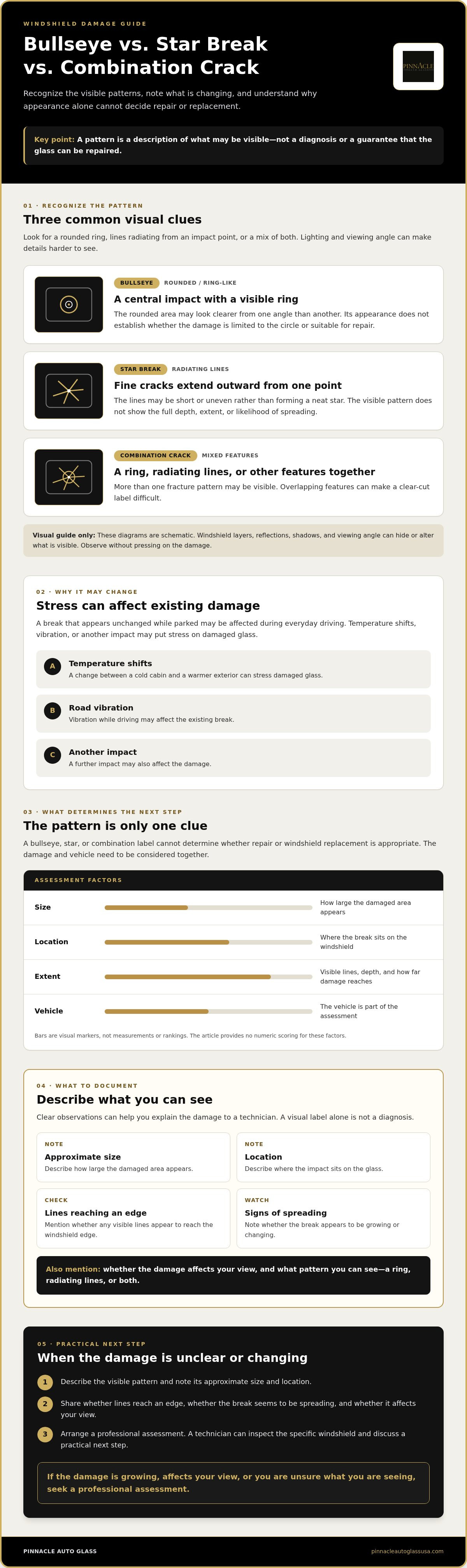
The quickest visual distinction is the shape: a bullseye has a rounded or ring-like impact area, a star break has fine lines radiating from a central point, and a combination crack shows features of more than one pattern. These terms describe what may be visible on the glass. They don’t show the full extent of the damage or confirm whether it can be repaired.
Windshields are made with laminated safety glass, so an impact can cause damage within the layers that isn’t obvious from outside. Patterns may be faint, overlap, or look different depending on lighting and viewing angle. If you’re checking the glass, look for the central impact area and note any visible rings or lines without pressing on the damage.
| Pattern | Appearance and visual clues | What the label cannot determine |
|---|---|---|
| Bullseye | A rounded impact area, often with a visible ring around the center. | Whether the damage is limited to that circle or suitable for repair. |
| Star break | Fine cracks or lines extending outward from one impact point. | How deep or extensive the damage is, or whether it may spread. |
| Combination crack | A mix of features, such as a central impact area with both a ring and radiating lines. | Which features extend beneath the surface or what service the vehicle needs. |
How to recognize a bullseye break
A bullseye break is a rounded impact pattern with a central point and a ring-like area around it. The circle may look clear from one angle and harder to see from another. Reflections, shadows, and changing light can make its edges seem more or less distinct. A rounded appearance is a useful description, but it doesn’t establish whether repair is suitable. The damage needs to be assessed in context.
How star breaks and combination cracks differ
A star break has fine lines radiating outward from its impact point. The lines may be short or extend unevenly, so the pattern doesn’t always look like a neat star. A combination crack includes more than one fracture pattern, such as radiating lines alongside a rounded or enclosed area. In practice, features can overlap, making a clear-cut label difficult.
For the bullseye vs star break vs combination crack comparison, focus on what you can actually see: a ring, lines spreading from a point, or both. Note where the impact sits and whether any lines appear to extend outward or reach an edge. Share those observations with a technician, but don’t treat a quick visual label as a diagnosis. An inspection is needed to understand the damage fully.
Why Bullseye, Star, and Combination Damage Can Change Over Time
A windshield break starts where an object strikes the glass. From that impact point, the damage may show an enclosed ring, lines extending outward, or a mix of features. These visible details help describe the break, but they don’t always reveal how far the damage extends beneath the surface.
Pattern names describe appearance, not a guaranteed repair outcome. In the bullseye vs star break vs combination crack comparison, each label can help a technician understand what you’re seeing. None confirms whether repair is suitable or whether replacement should be considered.
What the impact point and fracture lines can reveal
The impact point is the area where the glass was struck. A ring around it can create a bullseye-like appearance, while fine lines radiating outward can form a star pattern. Some breaks show both. These clues describe the visible fracture, not necessarily its full depth or extent. Reflections and viewing angle can also make fine damage harder to spot, so an apparently simple shape may not show every feature.
Windshields use laminated glass, with layers designed to help the glass hold together if it breaks. The federal motor vehicle glazing standard sets requirements for automotive glazing, but it doesn’t determine how an individual damaged windshield should be handled. A technician needs to examine the specific break and vehicle.
Why a small-looking break still deserves attention
A chip that appears unchanged while parked may be affected by conditions during everyday driving. For example, temperature shifts between a cold cabin and a warmer exterior can stress damaged glass. Road vibration or another impact may also affect the existing break. That doesn’t mean every chip will spread, and its appearance alone can’t predict what will happen next.
Pay attention to changes. If the break grows, interferes with your view, or causes concern, avoid putting unnecessary stress on the glass and arrange an assessment. Don’t press on the damaged area or treat a visual check as confirmation that it’s stable.
A professional inspection can clarify the visible damage and help determine an appropriate next step. For guidance on windshield repair and replacement, contact Pinnacle Auto Glass and describe what you’ve noticed.
Which Windshield Breaks May Be Repairable? Compare the Factors That Matter
A bullseye, star break, or combination pattern can help describe windshield damage, but the label alone can’t determine whether repair is appropriate. A technician considers the break’s size, location, depth, age, and the vehicle’s requirements. Repair guidance can also vary, so there isn’t one universal size cutoff that applies to every windshield.
For more background on repair considerations, see Professional Windshield Repair: A Comprehensive 2026 Guide to Safety and Savings. Use any guide as general information, not a diagnosis. The technician needs to assess the actual glass and vehicle before recommending repair or replacement.
How damage location and extent affect the assessment
Location matters, especially if damage is in the driver’s viewing area, where clear visibility is essential. The technician may also consider how many fractures are present, how far they extend, whether they intersect, and whether the damage reaches an edge. A small-looking impact can have lines that are difficult to see in a photo.
Share a clear image if it helps explain what you’re seeing, but don’t rely on a photo alone to settle repairability. Lighting, angle, and the limits of a picture can hide details. If you take a photo, include enough of the windshield to show the damage’s position, then take a closer image of the visible pattern. An in-person assessment lets a technician examine the damage directly and consider the windshield as a whole.
When replacement or additional vehicle checks may be needed
Some damage won’t be suitable for repair after inspection. In those cases, windshield replacement may be considered. The decision can also depend on vehicle-specific requirements, including equipment installed near or on the windshield. If the vehicle has driver-assistance cameras or sensors affected by glass installation, ADAS recalibration may be needed.
For more on replacement procedures and vehicle technology, consult Professional Windshield Replacement: The Complete Safety and Technology Guide. The Auto Glass Safety Council’s replacement safety standard provides information about practices for windshield replacement. Ask the technician what assessment and any required follow-up procedures apply to your vehicle.
When comparing bullseye vs star break vs combination crack, treat the pattern as one useful observation, not a verdict. A professional assessment can help clarify whether windshield repair or replacement is the appropriate next step.
What to Do After a Bullseye, Star, or Combination Crack
Take a few practical steps before arranging an assessment. Don’t try to test the damage yourself. A clear description and a few details about your vehicle can help a glass technician understand what needs to be checked.
- 1. Document what you see. From a safe, stationary position, take a clear photo of the damage. Note when you first noticed it, its approximate location, and whether it appears to have changed.
- 2. Avoid stressing the glass. Don’t press, probe, or tap the damaged area. Avoid applying unverified repair materials, which may complicate a professional inspection.
- 3. Arrange an assessment. Share your observations with a glass technician and ask what next steps may be appropriate.
What information to share with a glass technician
Describe the visible pattern without needing to diagnose it. Mention whether you see a rounded impact area, lines extending from a point, or a mix of features. Include the damage’s approximate location and whether it seems to be changing. Share your vehicle’s year, make, and model, plus whether a driver-assistance camera or sensor is mounted near the windshield. This information can help the technician consider vehicle-specific needs.
How to prepare for a professional assessment
Ask whether the glass may be suitable for repair or whether replacement should be considered. The answer depends on an inspection, not the pattern name or a photo alone. When arranging service, ask whether mobile or in-shop care is available for your location. You can also read Why Hiring a Certified Auto Glass Technician is Critical for Vehicle Safety for more background on choosing professional help.
The bullseye vs star break vs combination crack distinction can help you explain what you see, but it can’t settle the repair decision. Pinnacle Auto Glass provides windshield repair and replacement, with ADAS recalibration when needed after glass installation. Request a windshield damage assessment to discuss the damage and possible next steps.
Get a Professional Assessment for Windshield Break Damage
A bullseye, star break, or combination crack describes the damage’s visible pattern. It doesn’t decide whether the windshield can be repaired or needs replacement. That recommendation depends on an examination of the break and the vehicle, including its size, location, extent, and any vehicle-specific requirements.
What a professional inspection helps clarify
A technician can examine the glass directly to identify the pattern, check how far the damage extends, and consider where it sits on the windshield. This helps determine whether windshield repair is appropriate or whether replacement should be considered. A photo or a pattern name can help explain the issue, but neither reveals every detail of the glass.
The inspection can also account for equipment fitted to the vehicle. If windshield replacement is needed, a vehicle with driver-assistance cameras or sensors may require additional checks. ADAS recalibration is performed when required after glass installation, not automatically for every vehicle.
How to take the next step with Pinnacle Auto Glass
When you contact Pinnacle Auto Glass, share your vehicle’s year, make, and model, along with a brief description of the damage. Note its approximate location and whether it appears to have changed. These details can help the team understand what you’re seeing and discuss appropriate service options.
Options depend on the vehicle, the damage, and service availability for your location. Pinnacle Auto Glass provides windshield repair and replacement, with mobile and in-shop care available. Confirm current availability for your location when you reach out. If replacement is needed, ask whether your vehicle requires ADAS recalibration after installation.
The bullseye vs star break vs combination crack distinction is a useful starting point, not a final diagnosis. Get the damage assessed before deciding what to do next. Contact Pinnacle Auto Glass to discuss your windshield and explore available service options. A technician can help you understand the next step without assuming the pattern alone determines the outcome.
Take the Guesswork Out of Windshield Damage
A bullseye is rounded, a star break has lines radiating from its impact point, and a combination crack includes more than one pattern. In the bullseye vs star break vs combination crack comparison, these names help describe what you see, but they don’t determine whether the glass can be repaired. Damage location, extent, and vehicle requirements all matter.
Document what you notice and arrange a professional assessment if the damage is changing, affecting your view, or difficult to identify. A technician can examine the windshield and discuss whether repair or replacement is appropriate for your vehicle. If replacement requires it, ADAS recalibration may also be needed after installation.
Pinnacle Auto Glass provides windshield repair and replacement for personal and commercial vehicles. Share your vehicle details and describe the damage to discuss service options. Contact Pinnacle Auto Glass about your windshield damage to arrange a professional assessment.
Frequently Asked Questions
What is the difference between a bullseye break and a star break?
A bullseye has a rounded or ring-like area around the impact point, while a star break has fine lines radiating outward from it. These patterns can be easy to tell apart when clearly visible, but lighting, viewing angle, and overlapping fractures can make them harder to distinguish. The appearance is a useful description for a technician, not a full assessment of the damage or a decision about whether repair is suitable.
What is a combination crack in a windshield?
A combination crack is windshield damage that shows more than one fracture pattern, such as a rounded impact area with lines radiating from it. The features may overlap, and the damage might not form a neat or obvious shape. Describe the visible details rather than relying on a label alone. A technician can examine the glass directly to understand the damage’s extent and consider whether repair or replacement is appropriate.
Can a star break in a windshield be repaired?
A star break may be repairable, but its pattern alone can’t confirm that. A technician will consider factors such as its size, location, depth, extent, and the vehicle’s requirements. The damage may be less suitable for repair if it obstructs the driver’s view or extends across the glass, but each case needs assessment. Share what you can see and arrange a professional inspection to learn whether repair or replacement should be considered.
Is a bullseye windshield chip worse than a star break?
Not necessarily. The names describe visible patterns, but they don’t rank damage or determine its seriousness. A rounded bullseye may have damage that isn’t obvious from its surface, and a star break’s lines may vary in number and extent. Location, depth, size, and the vehicle all affect the assessment. Don’t judge which is worse by shape alone. Have a technician examine the windshield, especially if the damage is changing or affects your view.
What happens if a small windshield break starts spreading?
Spreading means the visible damage is changing, but it doesn’t reveal by itself how extensive the break is or what service is needed. Temperature changes, road vibration, or another impact may affect damaged glass. Avoid pressing or probing the area, note when you noticed the change, and arrange a professional assessment. If the damage interferes with your view or concerns you, don’t rely on its original small appearance to judge whether it should be examined.
Can I identify a combination crack from a photo?
A photo may show clues, such as a ring around an impact point alongside lines extending outward, but it can’t confirm the full damage. Reflections, lighting, camera angle, and fractures that are difficult to see may affect what appears in the image. Take a clear photo from a safe, stationary position and share it as context with a glass technician. The windshield itself needs direct assessment to determine the extent and discuss suitable next steps.


