
A windshield chip or crack doesn’t automatically mean a commercial vehicle will fail inspection. The DOT inspection windshield requirements depend on where the damage is, what form it takes, and whether it affects the driver’s view. There’s no single crack-size rule that decides every case.
It’s understandable to want a clear pass-or-fail threshold, especially when vehicle downtime can disrupt operations. Federal rules in 49 CFR § 393.60 set requirements for commercial-vehicle windshields, including the condition of the driver’s viewing area. Those standards differ from rules that may apply to personal vehicles, and inspectors assess the windshield in context.
This guide explains the federal baseline, the kinds of damage and visibility concerns an inspector may consider, and why a chip’s location matters. You’ll also get practical steps for documenting damage and deciding when professional repair or replacement may be appropriate. If replacement is needed on an ADAS-equipped vehicle, recalibration may also be part of returning its safety systems to proper operation.
Key Takeaways
- DOT inspection windshield requirements apply to covered commercial vehicles, not automatically to every passenger car.
- Federal rules, including 49 CFR 393.60, address windshield condition, while inspection criteria and context also matter.
- Don’t rely on one crack-size rule. Damage location and its effect on the driver’s view can be important.
- Before an inspection, record where the damage is, whether it’s spreading, and how it affects visibility.
- Professional windshield repair or replacement can address glass damage. Camera-based ADAS may need recalibration after replacement.
What DOT Inspection Windshield Requirements Apply to Your Vehicle?
DOT inspection windshield requirements are federal motor-carrier safety standards for covered commercial motor vehicles. They don’t automatically apply to every passenger car. Whether they apply depends on the vehicle’s operation and regulatory coverage, while state rules may set separate requirements.
“DOT inspection” often refers to a commercial-vehicle inspection conducted under federal motor-carrier safety rules. It isn’t the same as a routine vehicle check or a state-mandated inspection. For windshields, a key federal rule is 49 CFR § 393.60, which sets requirements for commercial-vehicle glazing and windshield condition. The applicable criteria depend on the vehicle and inspection context.
Which vehicles are covered by federal commercial-vehicle rules?
Coverage isn’t determined by ownership or size alone. A privately owned truck used for a covered commercial operation may be subject to different rules than a similar vehicle used only for personal purposes. Vehicle type, how it’s used, and the details of the operation can all matter.
The Federal Motor Carrier Safety Administration (FMCSA) administers federal motor-carrier safety regulations. Before applying a federal windshield standard to a particular vehicle, review current FMCSA guidance and the relevant regulations for its use and operation. Don’t assume that a vehicle is covered or exempt based only on its appearance or who owns it.
How do DOT inspections differ from state vehicle inspections?
Federal motor-carrier rules and state vehicle inspection laws are separate sources of requirements. A commercial vehicle may be subject to applicable federal standards as well as state rules. A personal vehicle, by contrast, isn’t automatically subject to commercial motor-carrier windshield requirements simply because it travels on public roads.
State inspection programs and windshield laws can vary by state and vehicle category. There isn’t one national state-inspection rule that applies to every personal car or commercial vehicle. Check current requirements from the relevant state agency for the vehicle’s registration and operation, alongside federal guidance if the vehicle is used in a regulated commercial operation.
Keep the distinction clear: federal rules define requirements for covered commercial vehicles, while state rules may address inspections and roadworthiness more broadly. If you’re unsure which framework applies, identify how the vehicle is used, then review current official guidance. That’s a more reliable starting point than assuming every windshield chip is judged under the same rule.
What Federal Rules Govern Commercial Vehicle Windshields?
For covered commercial vehicles, 49 CFR § 393.60 is the central federal rule for windshield glazing and condition. It addresses the glazing that must be used and identifies damage restrictions in the driver’s viewing area. These are related but distinct questions: compliant glazing material doesn’t automatically mean a damaged windshield meets the condition standard.
What does 49 CFR 393.60 say about windshield glazing?
The regulation requires buses, trucks, and truck-tractors to have a windshield mounted around the full periphery of the glazing. For vehicles manufactured on or after December 25, 1968, windshield glazing must meet Federal Motor Vehicle Safety Standard No. 205. Read the current Federal Rules for Commercial Vehicle Windshields for the full text, including detailed provisions and exceptions.
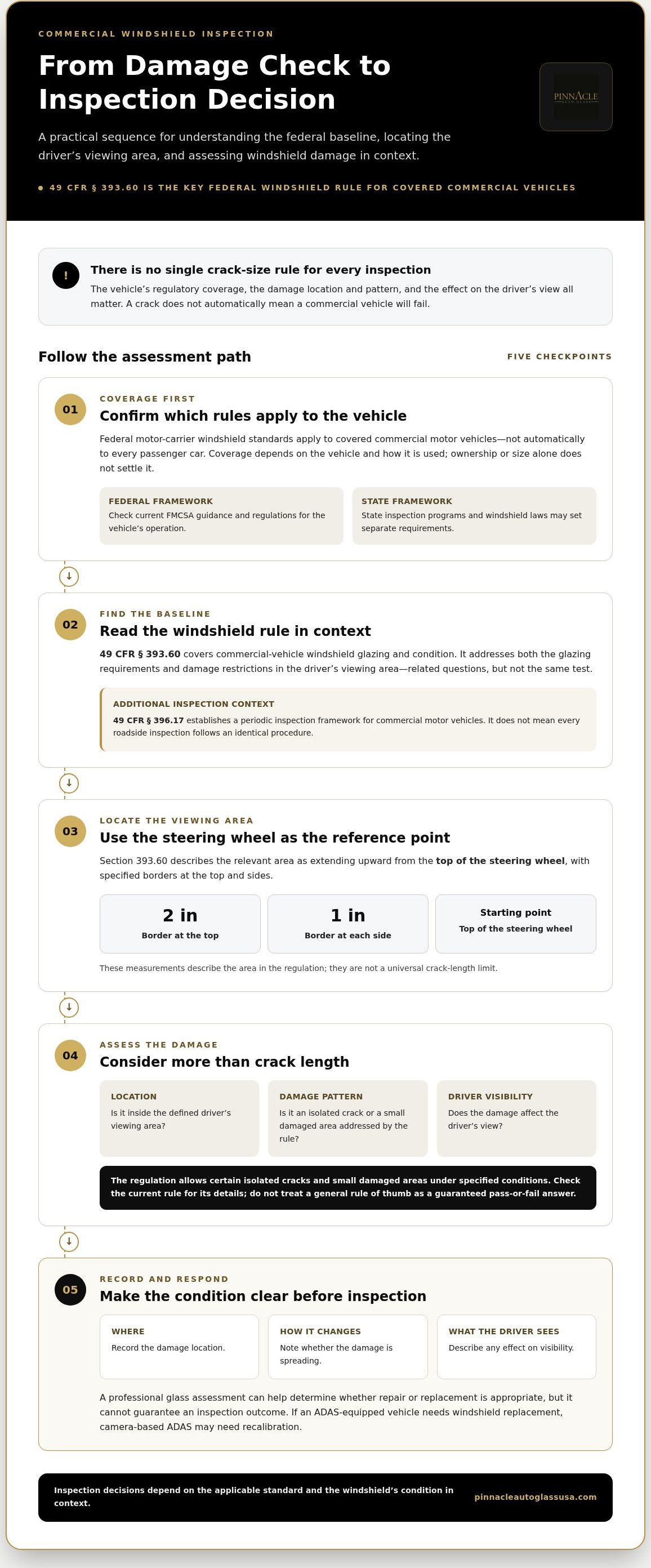
Material compliance is only one part of the standard. Section 393.60 also addresses windshield condition in the area extending upward from the top of the steering wheel to a two-inch border at the top and one-inch borders at the sides. The regulation allows certain isolated cracks and small damaged areas under specified conditions. Those details matter: the federal rule doesn’t reduce every windshield decision to a single crack-length limit.
How do inspection criteria address windshield condition?
Section 396.17 establishes a periodic inspection framework for commercial motor vehicles. It’s relevant to required vehicle inspections, but that doesn’t mean every roadside inspection follows an identical procedure. The vehicle’s applicable standards and the type of inspection shape what gets assessed. Federal regulation text, inspection procedures, and out-of-service criteria are related, but they aren’t interchangeable.
In practice, an inspector may assess whether the windshield meets applicable condition requirements, including whether damage lies in the defined viewing area. The DOT inspection windshield requirements therefore call for more than a quick glance at crack length. Location, damage pattern, and the specific governing criteria matter. Don’t treat a general online rule of thumb as a guaranteed pass-or-fail answer.
For a damaged commercial windshield, compare its condition with the current eCFR language and consider whether the driver’s view is affected. A professional glass assessment can help determine whether repair or replacement is appropriate, without guaranteeing an inspection outcome. Pinnacle Auto Glass provides commercial truck glass services to address windshield damage.
Can a Cracked Windshield Fail a DOT Inspection? Location Matters
A crack doesn’t automatically mean a commercial vehicle will fail, and there isn’t one simple crack-length limit that settles every inspection. Under 49 CFR § 393.60, the driver’s viewing area has specific condition requirements and stated allowances for certain cracks and small damaged areas. The vehicle, damage location, and inspection criteria all matter.
Does crack location matter more than crack length?
Location can change how damage affects the driver’s view. Federal rules define a viewing area that extends upward from the top of the steering wheel, with borders at the top and sides of the windshield. Within this area, the regulation allows a crack that isn’t intersected by another crack. It also allows a damaged area small enough to be covered by a 3/4-inch disc, provided it’s at least 3 inches from another similarly damaged area.
These are specific conditions in the federal rule, not a universal formula for every kind of damage or inspection. For example, a short crack near the driver’s line of sight may deserve attention even if it appears minor, while damage outside that area may raise different concerns. Neither example alone predicts an inspection result. The applicable rule and the actual condition of the glass still need to be considered.
Can a chip or windshield obstruction create a compliance concern?
Yes. A chip can scatter light or distract the driver, and a crack can spread or create distortion. Objects mounted on the glass can also obstruct the view when the windshield itself is undamaged. Federal provisions address the placement of certain devices, including antennas and vehicle safety technology. J. J. Keller explains these considerations in its guide to Rules for Mounting Devices on Windshields.
| Condition | Why it matters |
|---|---|
| Damage in the defined viewing area | Check it against the federal condition requirements and any applicable allowances. |
| Damage outside that area | Location alone doesn’t establish a pass or fail; assess visibility and applicable criteria. |
| Mounted device or other obstruction | Consider whether placement interferes with the driver’s view or conflicts with relevant provisions. |
Use the table as a starting point, not an inspection decision. If damage causes glare, distortion, or a blocked sightline, arrange a professional assessment and address the glass as needed. A glass professional can evaluate repair or replacement options, but no assessment can guarantee an inspection outcome.
How to Assess Windshield Damage Before a DOT Inspection
A quick, consistent check helps drivers describe windshield damage and decide what needs attention. It doesn’t replace an official inspection or determine compliance. Use these steps to record what you observe, then arrange professional assessment if damage affects visibility or safe operation.
What should drivers check and record?
- 1. Check from the driver’s seat. Look through the windshield in your normal driving position. Note whether a chip, crack, or other damage interferes with a clear view of the road, signs, mirrors, or surrounding traffic.
- 2. Record the damage location. Describe where it sits, such as near the driver’s line of sight, at the edge of the glass, or elsewhere. If useful, take a photo from inside and outside the vehicle to document its position.
- 3. Note its size and visible changes. Record the approximate shape and extent of the damage, whether cracks branch from it, and whether it appears to have spread since the last check. Don’t treat a measurement or photo as proof that the windshield meets the DOT inspection windshield requirements.
- 4. Describe the visibility impact. Note glare, distortion, light scattering, or any obstruction that makes it harder to see clearly. Include relevant context, such as the vehicle’s use and the type of inspection approaching.
- 5. Report and retain the record. For fleet vehicles, use a consistent process for drivers to report damage and share photos or notes with the person responsible for maintenance. A repeatable record helps track changes and supports timely decisions.
Keep the notes factual. Avoid declaring a windshield “safe” or “compliant” based only on a visual self-check. For more on technician expertise and vehicle safety, read this certified auto glass technician guide.
When should windshield damage be assessed professionally?
Arrange a professional assessment if damage is spreading, obstructs the driver’s view, creates noticeable distortion, or raises concern about safe operation. Repair suitability depends on factors such as the damage’s location and characteristics, along with vehicle-specific needs. A visual check can document the issue, but it can’t establish which repair option is appropriate.
Don’t wait for an inspection result if the glass is affecting visibility. A professional can assess whether windshield repair or replacement is the practical next step. The windshield repair and safety guide offers more on repair considerations. For an assessment and appropriate glass-service options, schedule windshield damage service.
What to Do If Windshield Damage Raises an Inspection Concern
If windshield damage may affect visibility or safe operation, address the glass concern before relying on an inspection result. The DOT inspection windshield requirements don’t make repair or replacement a guaranteed pass. The right option depends on the damage, the vehicle, and the applicable criteria. A professional assessment can help you decide what to do next.
Should you repair or replace a windshield before inspection?
Repair may be appropriate for some damage, while other conditions call for replacement. A technician can assess the damage’s location and characteristics, its effect on visibility, and vehicle-specific considerations. Don’t choose repair simply because it seems like the quickest route to an inspection. The priority is restoring clear vision and addressing the glass condition appropriately.
Replacement may be considered when damage isn’t suitable for repair or the windshield’s condition makes replacement the practical option. The decision should account for the vehicle’s requirements, not just the inspection date. The complete windshield replacement safety guide explains more about replacement considerations and safety.
Neither repair nor replacement guarantees a particular inspection outcome. Inspection decisions depend on the vehicle and the criteria that apply. Use glass service to address the windshield’s condition, not as a shortcut around an official inspection.
Why can ADAS recalibration matter after replacement?
Some vehicles have camera-based Advanced Driver Assistance Systems (ADAS), with cameras or sensors mounted at or near the windshield. These systems support driver-assistance features, and windshield replacement can affect the camera’s position or view. Depending on the vehicle’s requirements, recalibration may be needed after installation so the system can function as intended.
Include ADAS needs in the replacement decision. Replacing glass without considering the vehicle’s camera systems can leave an important step unaddressed. The ADAS calibration reference guide has more information.
Pinnacle Auto Glass provides windshield repair and replacement, commercial truck glass services, and ADAS recalibration for personal and commercial vehicles. Share the damage location, visible changes, and any visibility concerns to support a focused assessment. Arrange windshield glass service to address the damage and determine the appropriate next step for your vehicle.
Take the Next Step Toward Clear, Compliant Glass
The DOT inspection windshield requirements depend on whether federal commercial-vehicle rules apply, where damage is located, and whether it affects the driver’s view. A single crack-size rule can’t determine every inspection outcome. Document the damage, review the criteria that apply to your vehicle, and arrange a professional assessment if visibility or safe operation is a concern.
Repair or replacement should address the windshield’s condition, not serve as a shortcut to a guaranteed pass. If replacement is needed, vehicles with camera-based ADAS may also require recalibration according to their specific requirements.
Pinnacle Auto Glass provides windshield repair and replacement for personal and commercial vehicles, ADAS recalibration, and fleet and commercial truck glass services. Schedule professional windshield repair or replacement with Pinnacle Auto Glass to discuss the right next step for your vehicle.
Frequently Asked Questions
Does DOT require windshield inspections?
Federal rules include windshield requirements for covered commercial motor vehicles, but that doesn’t mean every personal vehicle receives a federal DOT inspection. The applicable DOT inspection windshield requirements depend on the vehicle’s coverage and the inspection context. State inspection and roadworthiness rules may apply separately. Identify how the vehicle is used, then review current federal regulations and relevant state guidance instead of relying on a single nationwide summary.
Can a cracked windshield pass a DOT inspection?
It depends on the vehicle, the damage location, its effect on visibility, and the criteria that apply. A crack doesn’t automatically mean a vehicle will fail, but damage that interferes with the driver’s view can raise a safety or inspection concern. Document what you see and arrange a professional assessment if vision is affected. An online checklist can help you prepare, but it can’t determine an official inspection result.
What size crack will fail a DOT inspection?
There isn’t one crack-length threshold that answers every inspection question. Federal rules include specific conditions for certain cracks and damaged areas in the driver’s viewing area, but they must be read in context. Vehicle coverage and applicable inspection criteria matter too. Before relying on a measurement, compare it with the current rule that applies to the vehicle. If damage affects visibility, arrange an assessment rather than waiting for inspection.
Do DOT windshield requirements apply to passenger cars?
Federal motor-carrier windshield rules apply to vehicles and operations within their scope, not automatically to every personal passenger car. State laws and inspection programs may set separate requirements, which can vary by state and vehicle category. Consider both the vehicle’s use and its classification. Then consult current federal guidance if it’s used in a covered commercial operation, and review relevant state requirements for inspections and roadworthiness.
Does a DOT marking on windshield glass mean it will pass inspection?
No. A glazing mark relates to the glass material and its applicable certification standard. It doesn’t prove the windshield is currently free from damage, that the driver’s view is unobstructed, or that the vehicle will pass an inspection. Inspectors assess applicable condition and safety criteria separately. If you’re unsure what a marking indicates, check current official glazing standards and assess the windshield’s present condition as well.
Can windshield damage put a commercial vehicle out of service?
It can raise an inspection concern, particularly if damage or an obstruction affects the driver’s view, but not every chip or crack automatically results in an out-of-service decision. The outcome depends on the vehicle, the circumstances, and the applicable criteria. Address damage that affects visibility or safe operation promptly. For a specific vehicle, consult current official inspection guidance and arrange professional glass assessment where appropriate.
Does windshield replacement require ADAS recalibration?
Sometimes. Vehicles with cameras or sensors mounted at or near the windshield may require recalibration after replacement, depending on the vehicle’s system and requirements. Follow the applicable vehicle-specific procedures before relying on driver-assistance features. Pinnacle Auto Glass provides windshield replacement and ADAS recalibration for personal and commercial vehicles. Include any camera-based safety systems in the replacement discussion so the necessary next steps can be addressed.


