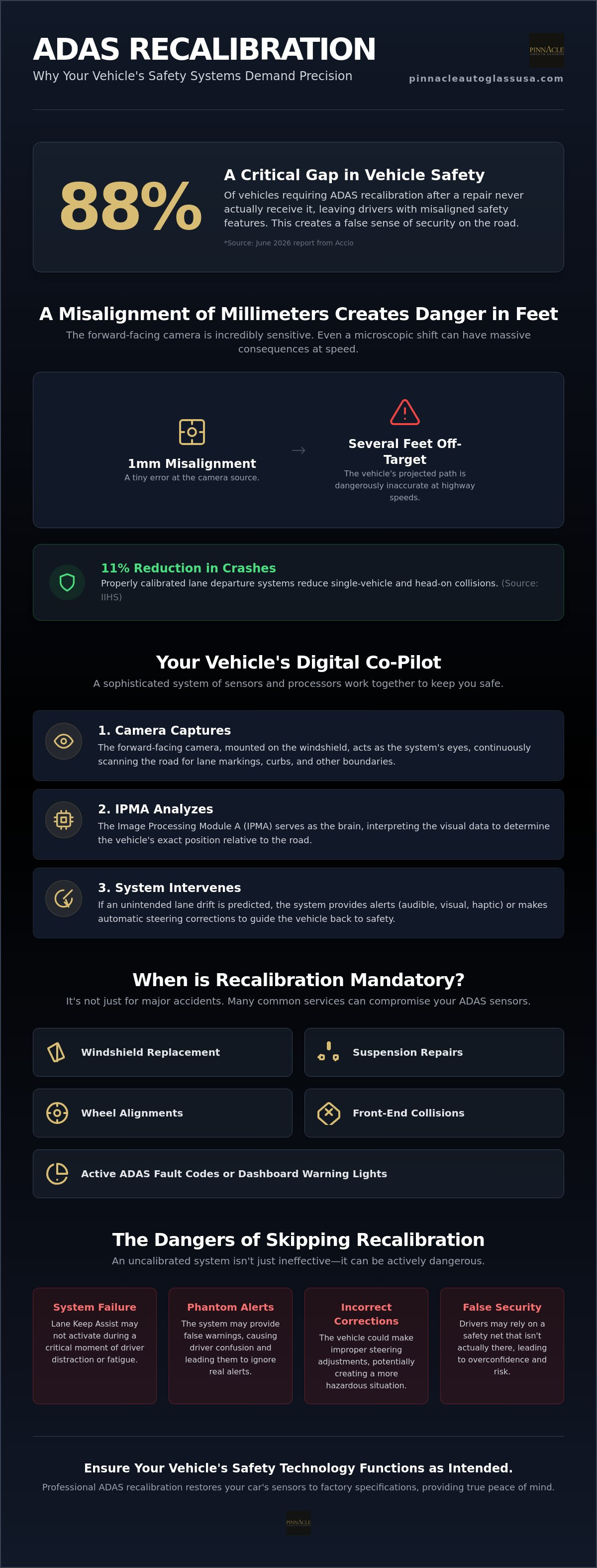
Did you know that 88% of vehicles requiring ADAS recalibration after a repair never actually receive it? According to a June 2026 report from Accio, this massive gap in service leaves thousands of drivers relying on safety features that are technically misaligned. Research from the Insurance Institute for Highway Safety shows that properly calibrated lane departure systems reduce single-vehicle and head-on crashes by 11%. A camera that's off by just a fraction of a degree can fail to detect a lane departure until it's too late. Professional lane keep assist recalibration is the only way to ensure your car's internal sensors and the Image Processing Module A (IPMA) are communicating correctly.
It's frustrating to deal with technical jargon when you're worried about the reliability of your safety systems or the high costs of dealership service. We agree that you deserve absolute certainty that your car is safe to drive. This guide explains why recalibration is a mathematical necessity and how our professional service restores your vehicle's technology to factory specifications. You'll learn the difference between static and dynamic processes, understand the latest safety regulations, and find out exactly what happens during a professional calibration session to keep your vehicle centered and secure.
Key Takeaways
- Understand why aligning your forward-facing camera to factory specifications is essential for the reliability of your safety systems.
- Identify the specific maintenance events, such as windshield replacement or suspension work, that make lane keep assist recalibration a mandatory requirement.
- Learn the differences between controlled static shop environments and dynamic road-based calibration methods required by various manufacturers.
- Discover the dangerous consequences of minor camera misalignments and how they lead to phantom alerts or system failure at highway speeds.
- Find out how professional diagnostic equipment ensures your vehicle's technology functions exactly as intended by the original manufacturer.
What is Lane Keep Assist Recalibration and Why is it Necessary?
Lane keep assist recalibration is the technical process of resetting and aligning the parameters of your vehicle's Advanced Driver Assistance Systems (ADAS). It ensures that the digital information captured by sensors matches the physical reality of the road ahead. Most modern vehicles use a forward-facing camera mounted on the interior of the windshield, typically behind the rearview mirror. This camera acts as the primary sensor for Lane Keeping Assist technology, which helps drivers stay within their designated path.
Even a microscopic shift in the camera's orientation can drastically alter its field of vision. When the camera is misaligned by a single millimeter, the projected path of the vehicle can be off by several feet once you reach highway speeds. Proper calibration ensures that the vehicle accurately identifies lane markings, curbs, and other boundaries in real-time. Without this precision, the safety systems cannot make the correct split-second decisions required to keep you in your lane.
The Role of the Forward-Facing Camera
The forward-facing camera is essentially the vehicle's eyes. It continuously scans the pavement for painted lines, reflective markers, and physical road edges. This visual data is vital for both Lane Departure Warning (LDW) and Lane Keeping systems. The Image Processing Module A (IPMA) serves as the central brain that interprets this visual data to determine the vehicle's position relative to the road.
- The camera captures high-resolution images of the road environment.
- The IPMA analyzes the distance between the tires and the lane lines.
- Software algorithms predict if the vehicle is about to drift based on its current trajectory.
How ADAS Enhances Driver Safety
Advanced Driver Assistance Systems provide a critical layer of protection for every driver on the road. These systems are specifically designed to reduce the likelihood of side-swipe accidents, which are often caused by driver fatigue or momentary distraction. By monitoring the vehicle's position, the system can intervene before a dangerous situation escalates.
- Haptic feedback, such as steering wheel vibrations, alerts the driver to unintended drifting.
- Audible warnings provide immediate notification if the vehicle crosses a lane line without a turn signal.
- Automatic steering corrections can gently nudge the vehicle back into its lane to prevent a collision.
This technology acts as a safety net, but it's only effective if it's accurate. A system that isn't properly calibrated provides a false sense of security. This is why professional verification is essential after any service that affects the camera's position or the vehicle's alignment.
Critical Triggers: When Does Your Vehicle Need LKA Recalibration?
Many drivers mistakenly believe that lane keep assist recalibration is only necessary after a major accident. In reality, several routine maintenance tasks and minor incidents can compromise your vehicle's safety sensors. Modern Advanced Driver Assistance Systems are incredibly sensitive. Any change to the vehicle's physical structure or geometry can throw the camera off its intended axis. If your car no longer centers itself properly or provides delayed warnings, a calibration check is likely overdue.
There are five primary triggers that necessitate a professional system reset:
- Completion of a windshield replacement or removal.
- Suspension repairs, including the installation of leveling kits or new shocks.
- Standard wheel alignments that alter the vehicle's thrust angle.
- Front-end collisions, even if no visible damage occurs to the camera housing.
- Active ADAS fault codes or persistent dashboard warning lights.
Windshield Replacement and Tech Integration
The relationship between your glass and your safety technology is absolute. When you undergo a windshield replacement, the forward-facing camera must be detached and reinstalled on the new pane. Every piece of glass has slightly different refractive properties. The camera must be taught how to "see" through the new material to maintain accuracy. Brackets on aftermarket glass might also vary slightly from OEM standards, which shifts the camera's baseline. Because of these variables, glass replacement and recalibration are inseparable services that must be performed together to ensure system integrity.
Mechanical Changes and Vehicle Geometry
Your safety systems rely on a stable "pitch" and "yaw" to understand where the road is located. Changes to your tires or suspension height directly affect the angle at which the camera scans the pavement. For example, installing a suspension leveling kit tilts the camera upward, causing it to look too far ahead and miss immediate lane markings. Similarly, replacing a steering rack can change how the car interprets a "straight ahead" position. A standard wheel alignment focuses on the tires, but it's incomplete without an ADAS check to ensure the sensors agree with the new mechanical alignment. If you've recently modified your ride height or steering components, you should consult a specialist to verify your sensor alignment.
Even minor front-end bumps can jar sensors out of their precise housing. While the bumper might look fine, the delicate brackets holding your ADAS hardware can shift. This leads to "phantom" alerts where the car brakes or steers unexpectedly. Don't ignore dashboard warning lights or subtle changes in how your car handles lane drifts. These are clear indicators that your technology is no longer operating within factory specifications.
Static vs. Dynamic Recalibration: Understanding the Process
The method used for lane keep assist recalibration isn't a matter of preference for the technician. Instead, the specific process is strictly dictated by original equipment manufacturer (OEM) standards. Depending on your vehicle's make and model, the system may require a static process, a dynamic process, or a combination of both. Precision is the priority in every scenario. We follow these manufacturer-specific protocols to ensure your safety systems are restored to their original factory accuracy.
The Controlled Environment of Static Calibration
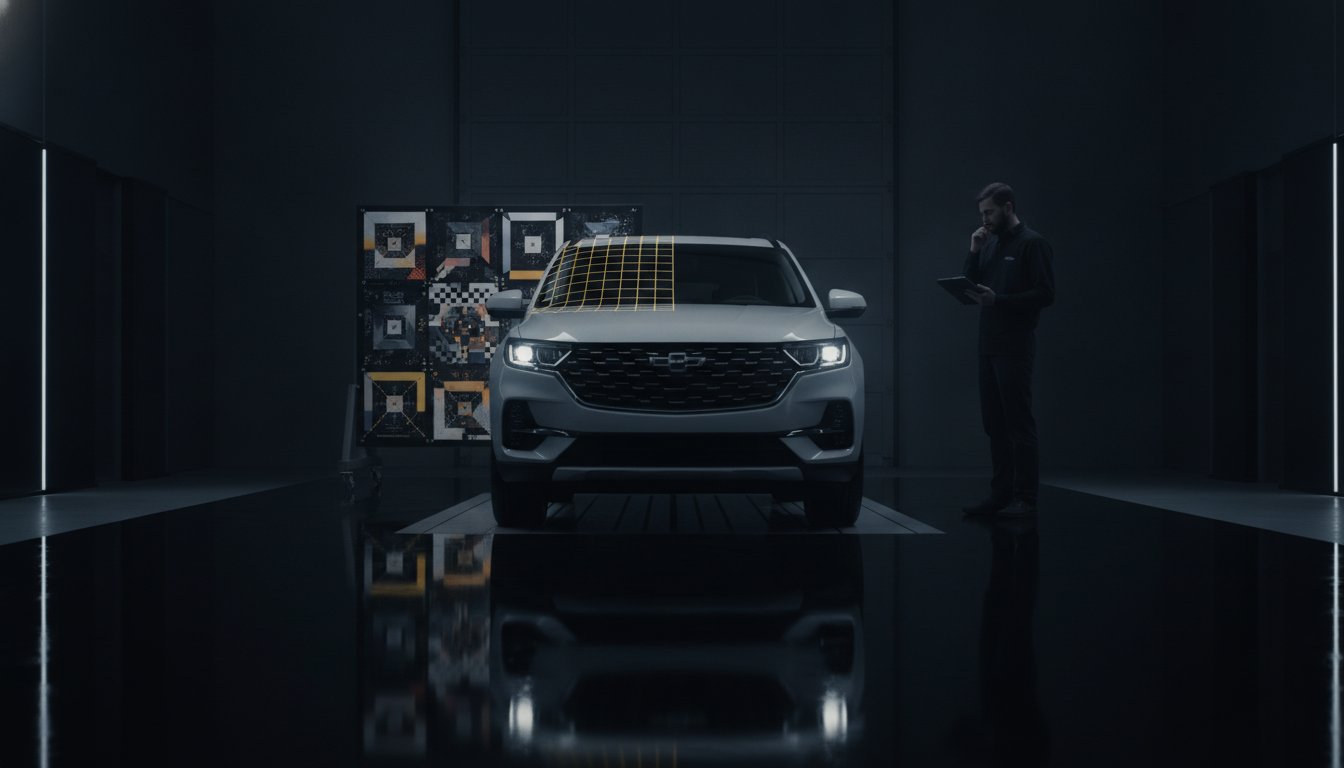
Static calibration takes place inside a specialized service bay designed to meet rigorous technical requirements. This process requires a perfectly level floor. Even a slight incline can throw off the mathematical calculations the camera uses to determine its position. Technicians also maintain specific lighting conditions to prevent sensor glare, which can interfere with the camera's ability to read targets. If the room is too dark or has too much direct sunlight, the sensors may fail to initialize.
During this phase, technicians set up laser-guided targets at precise distances and heights around the vehicle. These static targets act as a vision test for the car's computer, allowing it to establish a reliable baseline for its field of vision. The vehicle is connected to a diagnostic computer through the OBDII port, which guides the technician through the alignment. Once the computer recognizes these specific patterns, it locks in the new alignment settings and confirms the sensors are centered.
Dynamic Calibration on the Open Road
Dynamic calibration moves the process from the shop to the open road. During this procedure, the vehicle's computer learns by identifying actual road markers and physical boundaries during a live test drive. This isn't a standard drive around the block. It requires the vehicle to maintain specific speeds for a set duration on roads with clearly visible lane markings. The system needs to "see" a consistent environment to verify its internal logic.
Success depends heavily on external factors. Clear weather and high-contrast road lines are necessary for the camera to distinguish the path accurately. Heavy rain, snow, or faded paint can prevent the system from completing the learning phase. Throughout the drive, the technician uses a specialized diagnostic tool plugged into the vehicle's onboard computer. This tool monitors the system in real-time, ensuring the camera is successfully mapping the environment and storing the correct data points before the service is finalized.
The Necessity of Dual-Point Calibration
While some older systems only need one method, many modern vehicles now require a "dual-point" calibration. This means the car must pass the static vision test in the shop before it can be taken out for the dynamic road test. This multi-step approach provides the highest level of accuracy for complex ADAS setups. Skipping one half of a dual-point requirement can lead to system errors or a total failure of the lane-keeping features. Ensuring your lane keep assist recalibration is performed according to these specific manufacturer steps is the only way to guarantee your vehicle's safety net is fully operational.
The Risks of Skipping Recalibration: Safety and Liability
Choosing to ignore lane keep assist recalibration after a repair is more than a technical oversight; it's a significant safety risk. Modern vehicles rely on a delicate balance of software and hardware to keep you safe. When that balance is disrupted, the very systems designed to prevent accidents can become a source of danger. Precision is non-negotiable. If your sensors aren't perfectly aligned, your car is essentially operating with blurred vision, making it impossible for the safety computer to provide accurate assistance.
The Physics of Calibration Error
Small errors at the sensor level grow exponentially over distance. This is known as the magnification effect. A camera that's misaligned by just one millimeter at the windshield can be off by several feet once its field of vision extends 60 to 100 feet down the road. At highway speeds of 60 MPH, this discrepancy means your vehicle might not detect a lane departure until you've already drifted into another lane.
In some cases, a miscalibrated system might "see" a vehicle in the adjacent lane as being directly in your path. This leads to phantom braking or sudden, unexpected steering corrections. It's physically impossible for a human to "eyeball" the correct camera position. Technicians must use digital diagnostic tools to verify that the camera's horizontal and vertical axes are set to factory specifications. Without these tools, there's no way to guarantee that your lane-keeping features will intervene correctly during a drift.
Insurance and Liability Considerations
Skipping this essential service also carries financial and legal weight. Most insurance policies cover the cost of recalibration as a standard part of a glass claim. Since ADAS repairs can add up to 37% to the total cost of collision repair according to AAA, insurance companies are well aware of the necessity. You can learn more about how these factors influence your total investment in our guide on windshield replacement cost.
If you're involved in an accident and it's discovered that required safety services were skipped, you may face serious liability issues. Post-accident investigations often involve pulling data from the vehicle's computer. If the logs show that a windshield was replaced but the camera was never reset, it could void certain insurance claims or manufacturer warranties. To protect your vehicle and your passengers, you should schedule a professional recalibration immediately following any major glass or suspension work. Ensuring your technology is verified by experts is the only way to maintain your vehicle's safety integrity and your peace of mind on the road.
Pinnacle Auto Glass: Expert ADAS Recalibration Services
Pinnacle Auto Glass provides certified ADAS recalibration for all major vehicle makes and models. We understand that your time is valuable. That's why we offer a seamless experience by combining windshield replacement and recalibration into a single appointment. This integrated approach ensures your vehicle is road-ready the moment you leave our shop. Our team manages the technical complexity so you don't have to visit multiple locations to restore your safety features.
We work directly with your insurance provider to handle the necessary paperwork for your safety services. Most insurance carriers recognize the critical nature of these calibrations and cover them as part of your glass claim. Our staff coordinates the billing and documentation, allowing you to focus on your schedule while we ensure your vehicle meets factory safety standards.
Certified Technicians and Advanced Equipment
Our technicians use state-of-the-art diagnostic equipment that meets or exceeds OEM standards. We stay current with the latest ADAS software updates for 2026 models, ensuring that even the newest safety technologies are handled with precision. Choosing specialized auto glass specialists is significantly more efficient than a separate dealership visit. We focus specifically on glass and sensor integration, which allows us to perform your lane keep assist recalibration with a level of expertise that general repair shops often lack.
Nationwide Reliability for Personal and Fleet Vehicles
We provide consistent, high-quality service for individual drivers and large-scale commercial fleets. Our comprehensive fleet glass services and commercial truck glass expertise help fleet operators reduce downtime and maintain strict safety protocols. Whether you drive a personal sedan or manage a nationwide logistics team, our focus on reliability remains the same. We prioritize accuracy in every calibration to prevent the phantom alerts and system failures discussed earlier in this guide.
Don't leave your safety to chance after a glass repair or mechanical adjustment. Contact us today for a comprehensive quote on your glass and calibration needs. We are ready to assist you in maintaining the integrity of your vehicle's safety technology and ensuring your peace of mind on the road.
Secure Your Precision on the Road
Maintaining your vehicle's safety technology is a continuous responsibility that extends well beyond basic glass repairs. You now understand that even a minor windshield replacement or suspension adjustment requires professional verification to keep your sensors perfectly aligned. Precision is the foundation of all driver assistance features. A small error at the source leads to significant deviations at highway speeds; this compromises your safety and increases your legal liability if an accident occurs.
Professional lane keep assist recalibration ensures your car's computer accurately interprets the road environment in real-time. Our team provides the specialized expertise needed to navigate these technical requirements efficiently. We utilize OEM-compliant calibration equipment and certified ADAS technicians to guarantee results that meet strict manufacturer specifications. We also offer comprehensive insurance claim assistance to handle the paperwork on your behalf. Don't leave your safety to chance when expert help is readily available.
Schedule Your ADAS Recalibration with Pinnacle Auto Glass today to ensure your vehicle's technology functions exactly as intended. We are ready to help you drive with total confidence.
Frequently Asked Questions
How long does a lane keep assist recalibration take?
A standard appointment typically lasts between 45 minutes and two hours. This timeframe depends on whether your vehicle requires a static process in the shop, a dynamic test drive, or a combination of both. If your manufacturer specifies a dual-point calibration, the process will take longer to ensure both the shop-based and road-based alignments are successful.
Will my insurance pay for ADAS recalibration?
Yes, most insurance providers cover recalibration as a mandatory safety requirement following a windshield replacement. Because these sensors are integral to the vehicle's safety systems, insurers generally include the cost under your comprehensive coverage. Our team works directly with your insurance company to handle the documentation and billing for these specific safety services.
Can I drive my car if the lane keep assist isn't calibrated?
You can physically drive the vehicle, but you should not rely on any automated safety features until they are verified. A misaligned system can provide incorrect steering inputs or fail to detect lane boundaries entirely. It's best to disable the lane-keeping features in your vehicle's settings menu until a technician completes the lane keep assist recalibration.
Do I need recalibration if I only had a small chip repaired?
Recalibration is generally not necessary for a simple windshield repair. As long as the glass remains in the frame and the camera bracket is not disturbed, the sensor's alignment stays intact. We only require a full system reset when the windshield is replaced, the camera is removed, or the vehicle's ride height is altered.
What happens if the recalibration fails?
If the process fails, the vehicle's computer will typically disable the safety features and display a warning light on your dashboard. Failures can occur due to poor lighting, uneven floors during static tests, or faded road markings during a dynamic drive. Our technicians use diagnostic software to identify the error and re-run the procedure until the system confirms it's operating within factory specifications.
Is lane keep assist the same as lane departure warning?
No, these systems provide different levels of intervention. Lane Departure Warning only alerts you with a sound or vibration when you drift over a line. Lane Keep Assist is more active; it applies gentle steering torque to nudge the vehicle back into the center of the lane. Both systems rely on the same forward-facing camera and require precise calibration to function accurately.
Why can't I calibrate the system myself using my car's settings menu?
Your vehicle's internal settings do not have the capability to align the camera's physical field of vision with the road. Professional lane keep assist recalibration requires external laser-guided targets and specialized diagnostic tools that plug into the vehicle's computer. These tools are necessary to sync the camera's digital logic with its physical position on the windshield.
Does every new windshield require a new camera?
No, the original camera is transferred from your old windshield to the new one. You don't need to purchase new hardware unless the camera itself was damaged in an accident. However, the existing camera must be recalibrated to the new glass because even slight variations in glass thickness or curvature can change how the camera perceives the road.


