
Can your fleet afford to have a heavy-duty truck sidelined for three days because of a botched ADAS recalibration? For modern fleet managers, a cracked windshield isn't just a cosmetic issue. It's a logistical bottleneck that threatens your bottom line and your DOT compliance. Managing auto glass for commercial vehicles across a national fleet often feels like a constant battle against inconsistent service and mounting downtime. You know that every hour a vehicle sits in a shop is an hour of lost revenue.
This guide provides the roadmap to mastering these complexities. We'll show you how to secure zero-downtime repair solutions and ensure every vehicle meets the latest safety standards, including the ANSI/AGSC/AGRSS 005-2022 requirements. We'll examine the technical demands of ADAS recalibration, the impact of state-level regulations in New York, and the logistics of streamlined billing. You'll gain the tools to maintain a safer, more efficient fleet while keeping your drivers on the road. Our goal is to simplify your maintenance schedule and eliminate the risks associated with modern glass technology.
Key Takeaways
- Understand the structural differences between laminated and tempered glass to ensure your fleet remains compliant with federal safety standards.
- Learn how to select the most durable auto glass for commercial vehicles to handle the extreme vibrations and wind resistance of heavy-duty hauling.
- Discover why ADAS recalibration is a non-negotiable step for maintaining modern safety systems and reducing liability risks after a replacement.
- Identify how mobile repair and strategic maintenance scheduling can effectively eliminate unnecessary downtime and driver transport costs.
- Explore the advantages of centralizing your glass services with a national specialist to streamline billing and ensure consistent quality across all regions.
Understanding the Scope of Auto Glass for Commercial Vehicles
Commercial auto glass isn't just a larger version of what you find on a sedan. It is specialized, heavy-duty glazing designed for high-mileage and high-impact environments. Vehicle glass used in the logistics sector must withstand constant vibration and road debris over hundreds of thousands of miles. For box trucks and delivery vans, the windshield provides essential structural rigidity. It helps prevent roof crush during accidents and maintains the cabin's frame alignment. Without this integrity, the entire vehicle's safety profile is compromised.
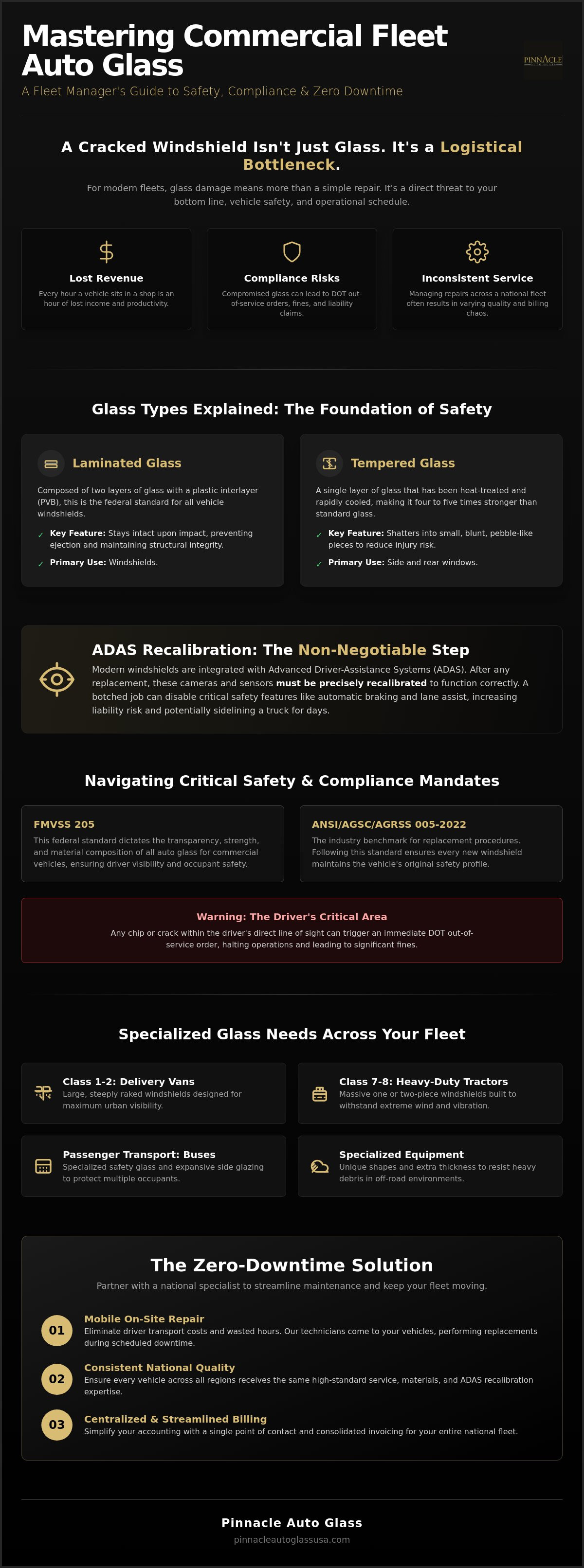
In large-scale vehicles, the sheer surface area of the glass creates unique challenges. Modern one-piece curves must manage extreme wind resistance at highway speeds without compromising clarity. We distinguish between tempered and laminated glass based on specific safety needs. Laminated glass is the standard for windshields because the plastic interlayer keeps the pane intact upon impact. Tempered glass is typically reserved for side and rear windows, where it's designed to shatter into small, blunt pieces to prevent injury during a collision.
DOT and ANSI Standards for Commercial Glazing
Commercial glazing must comply with FMVSS 205. This federal standard dictates the transparency and strength of materials used in all auto glass for commercial vehicles. Regulations also define the "critical area" of a windshield, which is the space directly in the driver's line of sight. Any chip or crack in this zone can trigger immediate DOT out-of-service orders. Beyond federal rules, the industry follows the ANSI/AGSC/AGRSS 005-2022 standard. This ensures that every replacement maintains the vehicle's original safety profile. Driving with compromised glass creates significant legal risks, leading to heavy fines or liability claims after an accident.
Class 1 through Class 8: Glass Needs by Vehicle Type
Glass requirements vary significantly across vehicle categories. Every class presents different installation and maintenance hurdles:
- Class 1-2 (Delivery Vans): These often use large, steeply raked windshields for maximum urban visibility.
- Class 7-8 (Heavy-Duty Tractors): These rely on massive one-piece or traditional two-piece windshields. Two-piece designs are common in older fleet models, allowing for cheaper, partial replacements when only one side is damaged.
- Passenger Transport (Buses and Shuttles): These require specialized safety glass to protect multiple occupants and often feature expansive side glazing.
- Specialized Equipment: Construction and agricultural vehicles need unique shapes and extra thicknesses to resist impact from heavy debris in off-road environments.
Specialized Solutions for Heavy-Duty Trucks and Logistics Fleets
A semi-truck isn't a passenger car. It operates at highway speeds with a massive front profile, turning the windshield into a primary target for wind resistance and debris. This constant physical pressure tests the adhesive bond every mile. Road vibrations from high-torque diesel engines and uneven interstates cause minor chips to spread into dangerous cracks faster than in light-duty vehicles. High-quality auto glass for commercial vehicles must be paired with industrial-strength seals to prevent cab leaks. Water intrusion is a serious threat. It can fry expensive dashboard electronics and lead to mold issues in the sleeper berth. Maintaining the health of weather-stripping and gaskets is just as vital as the glass itself for long-haul applications.
Semi-Truck Windshield Replacement: Beyond the Glass
Replacing a large-scale windshield is a team effort. These installs often require multi-technician teams to ensure the glass is set accurately without compromising the seal. The glass is heavy, awkward, and expensive. Using OEM-quality glass ensures that the curvature matches the frame perfectly. This precise alignment is critical for maintaining the safety levels required by Federal Motor Vehicle Safety Standard No. 205. While older fleets still utilize traditional two-piece windshields for their cost-effective partial replacement options, modern one-piece designs are the new standard. These curves offer better visibility and slightly improved fuel efficiency through superior aerodynamics. Our technicians use specialized suction tools and heavy-duty primers to ensure every installation meets these rigorous demands.
Last-Mile Delivery: Van and Box Truck Considerations
Urban delivery fleets face a different set of hazards. Vehicles like the Mercedes Sprinter, Ford Transit, and RAM Promaster are the workhorses of the last-mile economy. They deal with low-hanging branches, gravel from city construction sites, and frequent temperature shifts from constant cabin door cycles. These factors lead to high-frequency damage that can pull a van off its route. Rapid delivery van windshield replacement is essential for keeping your logistics chain moving. Stocking glass for such a diverse range of makes and models is a logistical challenge. We maintain a deep inventory of these specific SKUs to ensure your vans don't sit idle waiting for parts. If your fleet includes a mix of heavy tractors and urban delivery vans, you need a partner that understands the unique glass needs of both. Reliable fleet glass services help you avoid the frustration of backordered parts and extended downtime.
ADAS Recalibration: The Hidden Complexity of Commercial Glass
Modern auto glass for commercial vehicles serves as the mounting platform for a fleet's most critical safety technology. Advanced Driver Assistance Systems (ADAS) rely on cameras and sensors bonded directly to the windshield. When you replace a windshield on a heavy-duty tractor, you're moving these sensors. Even a shift of one millimeter at the mounting point can cause the system to miscalculate distances by several feet on the road ahead. This makes recalibration a mandatory safety step, not an optional add-on. It's the only way to ensure the vehicle's "brain" sees the road accurately.
Technicians must precisely align the camera's pitch, yaw, and roll. Pitch refers to the up-and-down tilt. Yaw is the side-to-side angle. Roll is the rotation around the center axis. If any of these are off, features like automatic emergency braking may engage at the wrong time or fail to engage at all. For fleet managers, the stakes are high. Skipping this process creates massive liability. New York state enacted a law on December 19, 2025, that requires glass shops to notify customers if their vehicle needs ADAS recalibration. Failing to follow these manufacturer specifications can lead to catastrophic safety failures and costly legal exposure.
Recalibration comes in two forms: static and dynamic. Static recalibration happens in a controlled shop environment using specialized targets and laser levels. Dynamic recalibration requires driving the vehicle at specific speeds on well-marked roads to allow the system to "learn" its surroundings. Many 2026 commercial platforms require a combination of both to meet the ANSI/AGSC/AGRSS 005-2022 standard.
Critical Safety Systems in Modern Commercial Fleets
Your fleet's Forward Collision Warning (FCW) and Lane Departure Warning (LDW) systems depend entirely on the clarity and positioning of the glass. These sensors monitor the gap between the bumper and the vehicle ahead. They also track lane markings to prevent drift-related accidents. Proper recalibration ensures these systems function exactly as intended by the OEM. For a deeper look at the technical requirements, consult our ADAS calibration auto glass pillar. Accurate sensor data is the foundation of a safe 2026 logistics operation.
The Recalibration Process for Commercial Vehicles
Heavy-duty ADAS work requires specialized software and hardware that differ from passenger car tools. Technicians must be certified to handle these safety-critical tasks. They use high-precision targets designed for the specific ride height and width of commercial tractors. A glass replacement is never finished until a successful recalibration report is generated. This document provides a digital audit trail, proving the vehicle is safe to return to service and fully compliant with current safety regulations.
Minimizing Fleet Downtime: Mobile Repair and Strategic Maintenance
The price of a windshield is only a fraction of the total cost when a truck sits idle. For fleet managers, the real expense of damaged auto glass for commercial vehicles includes lost driver hours, missed delivery windows, and potential contract penalties. Every hour a Class 8 tractor spends in a repair bay is an hour it isn't generating revenue. Strategic maintenance isn't just about fixing glass. It's about protecting your operational rhythm. By shifting from reactive repairs to a proactive maintenance model, you can eliminate the hidden costs that drain your annual budget.
Mobile service changes the math of fleet logistics. Instead of paying for expensive towing or losing a driver to transport duty, technicians come directly to your depot or job site. This allows repairs to happen during scheduled downtime, such as overnight or between shifts. This approach ensures your drivers stay on their routes and your cargo stays in motion. Centralized scheduling for national accounts further simplifies this process. It provides a single point of contact for multiple regions, ensuring consistent service quality and streamlined billing regardless of where your vehicles are located.
The Benefits of Professional Mobile Glass Service
On-site repairs at depots or job sites keep your logistics chain intact. High-quality mobile installations require more than just a technician and a tool kit. They demand strict environment controls to ensure adhesives cure correctly. Our teams use specialized mobile shelters and climate-control equipment to maintain these standards in various weather conditions. To maximize your efficiency, follow a proven framework for reducing fleet downtime with mobile glass repair. This ensures every mobile intervention meets the same safety benchmarks as an in-shop replacement.
Preventive Glass Maintenance for Fleet Managers
Strategic maintenance starts with the driver. We recommend a weekly glass inspection checklist to catch small chips before they spiderweb into full-scale replacements. We advocate for a "Repair First" philosophy. It's faster, cheaper, and keeps the original factory seal intact. Use the "quarter-sized" rule: if a chip is smaller than a quarter and located outside the driver's critical viewing area, a professional windshield repair is usually the best option. Professional glass specialists can also perform fleet-wide audits to identify vulnerabilities before they cause an out-of-service order. You can protect your bottom line and improve safety by prioritizing these early interventions. Contact us today to discuss our comprehensive fleet glass services and build a custom maintenance plan for your fleet.
Partnering with Pinnacle Auto Glass for National Fleet Success
Managing auto glass for commercial vehicles requires a partner who understands the high stakes of the logistics industry. Pinnacle Auto Glass serves as that dependable guide. We combine the expansive reach of a national entity with the focused, technical precision of a localized specialist. Your fleet isn't just a collection of vehicles; it's a massive capital investment. We treat it as such by prioritizing safety, speed, and long-term durability. Every installation we perform is designed to keep your drivers safe and your trucks compliant with the latest DOT regulations.
Expertise matters when handling complex safety systems. We utilize certified auto glass technicians for every service call. These professionals are trained to handle the specific requirements of 2026 model vehicles, from heavy-duty tractor windshields to intricate sensor arrays. By choosing a certified partner, you ensure that every repair meets the rigorous ANSI/AGSC/AGRSS 005-2022 standards. We take full responsibility for ADAS accuracy, providing the digital audit trails you need for liability protection and fleet compliance.
Quality Standards and Professionalism
We don't compromise on materials. Our technicians use high-grade industrial adhesives and OEM-spec glass to ensure your replacements last through hundreds of thousands of miles. This focus on quality reduces the frequency of secondary repairs and prevents the cab leaks that can sideline a vehicle. We also simplify the administrative side of fleet management. Our team handles the insurance claim process directly with your providers, reducing the paperwork burden on your dispatchers. Every job is backed by comprehensive service warranties, giving you peace of mind that the work is done right the first time.
Getting Started with Your Commercial Account
Setting up a recurring fleet maintenance partnership is a simple, three-step process. First, we conduct a needs assessment to understand your fleet size and vehicle types. Next, we establish a centralized scheduling and billing protocol tailored to your internal workflows. Finally, we deploy our mobile teams to begin proactive inspections and repairs. Our solution-oriented approach always prioritizes your bottom line. We focus on results, not just parts. Contact Pinnacle Auto Glass today for a consultation. Let us build a customized glass management strategy that keeps your fleet moving safely and efficiently.
Secure Your Fleet's Future with Professional Glass Management
Effective fleet management in 2026 requires more than just reacting to cracks as they appear. It demands a proactive strategy that integrates technical precision with logistical efficiency. You now understand how ADAS recalibration has become a critical safety component and why maintaining DOT-compliant heavy-duty glass solutions is essential for your bottom line. Catching chips early through a "Repair First" approach and utilizing mobile services are the most effective ways to keep your vehicles on the road. These steps protect your revenue and your drivers simultaneously.
Managing auto glass for commercial vehicles shouldn't be a source of stress or unexpected downtime. By partnering with experts who prioritize safety and efficiency, you ensure your fleet remains compliant and your drivers stay protected. We provide the certified ADAS recalibration experts and nationwide mobile service you need to streamline your maintenance operations across every region. It's time to eliminate the uncertainty of inconsistent service quality and liability concerns.
Schedule Your Commercial Glass Service with Pinnacle Auto Glass to experience the difference that professional, high-stakes service makes. We are ready to help you optimize your fleet's performance and safety today.
Frequently Asked Questions
How much does windshield replacement cost for a semi-truck?
Replacement costs vary based on the vehicle make, model, and the complexity of integrated ADAS features. Factors like one-piece vs. two-piece designs and the specific glass thickness required for heavy-duty applications also influence the final price. We provide custom quotes to ensure accurate pricing for your specific fleet needs. Contact us directly to receive a detailed estimate for your vehicle class.
Do commercial vehicles require special glass compared to passenger cars?
Yes, commercial glass is specifically engineered to handle higher stress levels from wind resistance and road vibration. These windshields are often thicker and must meet strict Federal Motor Vehicle Safety Standard No. 205 requirements for durability and clarity. High-mileage logistics vehicles require this specialized glazing to maintain structural integrity over hundreds of thousands of miles of highway travel.
How long does a commercial windshield replacement take to complete?
A standard replacement typically takes between two to four hours. This timeframe depends on the vehicle size and the specific curing time required for the industrial-strength adhesive. If the vehicle requires ADAS recalibration, you should factor in additional time for the technical setup and testing. Our teams prioritize efficiency to get your drivers back on their routes as quickly as possible.
Can ADAS recalibration be done on-site for commercial fleets?
On-site recalibration is possible for many vehicles, but it depends on the specific system requirements and the environment. Dynamic recalibration can often be completed on the road by a technician. Static recalibration requires a level surface and a controlled setting for precise target placement. We assess your fleet's technology to determine if on-site service or a shop visit is necessary.
Is it legal to drive a commercial vehicle with a cracked windshield?
Driving with a cracked windshield is a violation of DOT regulations if the damage is in the driver's critical area or impairs visibility. Compromised auto glass for commercial vehicles can lead to immediate out-of-service orders during roadside inspections. It's essential to address even minor chips before they spread to avoid heavy fines and significant safety risks for your drivers.
What is the difference between static and dynamic recalibration for trucks?
Static recalibration is performed in a stationary setting using specialized physical targets and laser alignment tools to reset sensor parameters. Dynamic recalibration involves driving the vehicle at a set speed on marked roads so the system can calibrate through real-world visual data. Many 2026 commercial models require a combination of both methods to ensure the full functionality of safety features.
Does insurance typically cover commercial glass repair and replacement?
Most commercial and fleet insurance policies cover glass repair and replacement, though coverage details depend on your specific provider and deductible. We work directly with major insurance carriers to streamline the claims process for our clients. This coordination helps reduce the administrative burden on your fleet management team and ensures that repairs are processed without unnecessary delays.
How can I set up a national account for my commercial fleet?
Setting up a national account starts with a consultation to evaluate your fleet size, vehicle locations, and specific service needs. We then establish a centralized scheduling and billing protocol to ensure consistent auto glass for commercial vehicles service across your entire operation. This partnership provides a single point of contact for all your logistics glass requirements and simplifies fleet maintenance.


