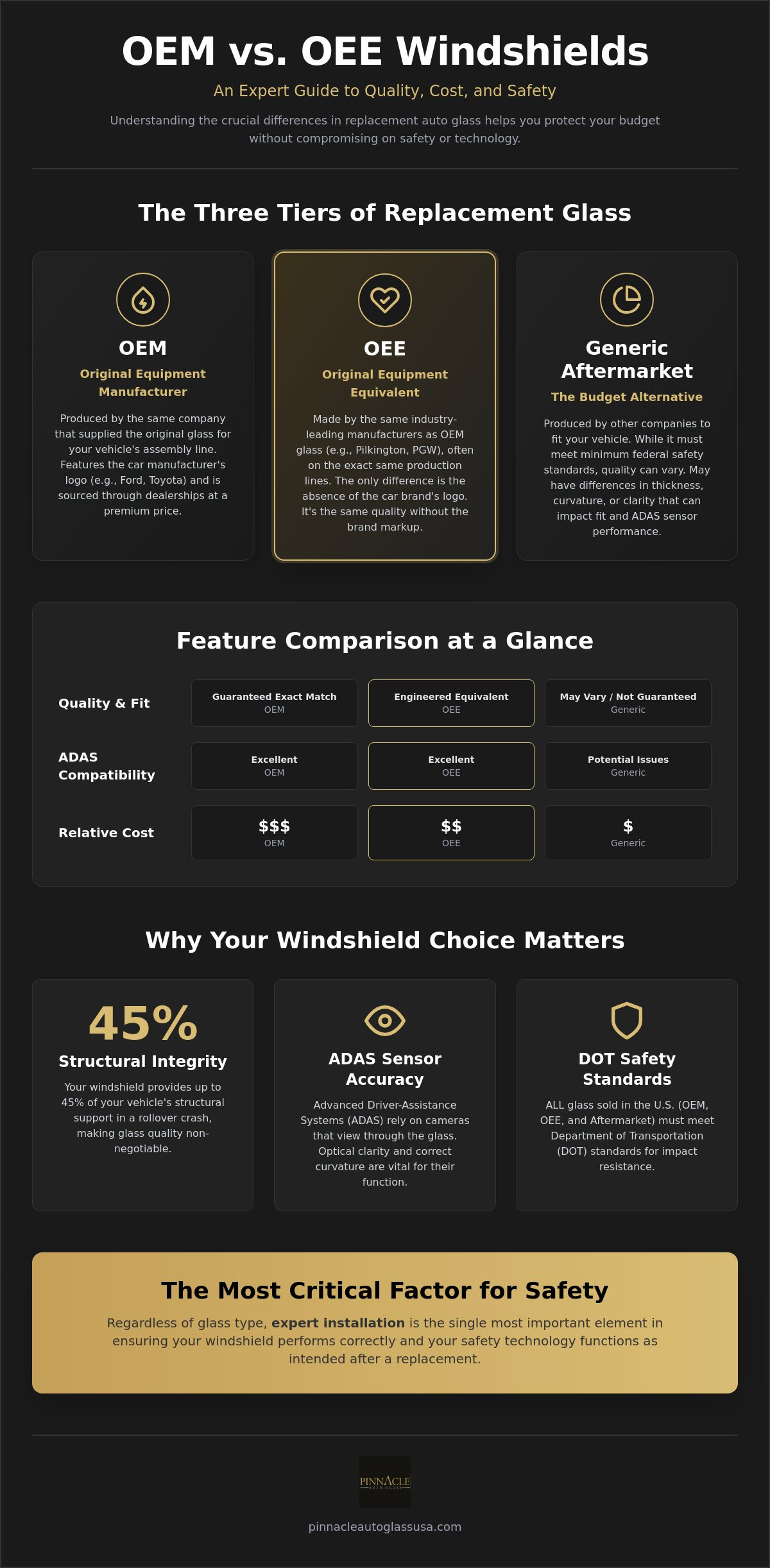
The most expensive windshield option might not actually be the best choice for your vehicle. It's common to feel overwhelmed by industry jargon when you're just trying to fix a crack. You likely want to save money, but you might fear that choosing an OEE vs OEM windshield could cause your safety sensors to malfunction. This is a valid concern. Your windshield provides up to 45% of your vehicle's structural integrity in a rollover crash, so the quality of your glass is non-negotiable.
We'll help you understand the critical differences in quality, cost, and safety to make an informed decision for your next replacement. You'll learn the truth about manufacturing standards and how different glass types interact with your Advanced Driver-Assistance Systems (ADAS). This guide provides a clear path to choosing a solution that protects your budget without risking your safety. We'll explain why OEE glass is often the exact same product as OEM, minus the brand logo and the price markup.
Key Takeaways
- Identify the manufacturing differences between OEM glass and equivalent OEE options to avoid overpaying for a brand logo.
- Confirm that both glass types meet federal safety standards to preserve your vehicle's structural integrity during a collision.
- Evaluate the performance of an OEE vs OEM windshield regarding the sensitive cameras and sensors in your ADAS.
- Determine if your insurance policy covers specific glass types and how vehicle age should influence your replacement choice.
- Learn why expert installation is the most critical factor in ensuring your safety tech works as intended after a replacement.
What Is the Difference Between OEE and OEM Windshields?
Understanding the technical labels on your auto glass is the first step toward a safe replacement. Deciding between an OEE vs OEM windshield often comes down to understanding branding versus performance. The primary difference isn't the raw material or the manufacturing process. Instead, the distinction lies in the branding and the specific distribution channel used to get the glass to your vehicle. Both types of glass must meet the same federal safety standards to be legally sold in the United States. This ensures that regardless of the logo, the glass provides the structural integrity required to protect you in an accident.
OEM Glass: The Dealership Standard
An Original Equipment Manufacturer (OEM) windshield is produced by the same company that supplied the glass for your vehicle when it was on the assembly line. These parts are sourced directly through vehicle dealerships. They feature the manufacturer's logo, such as Ford, Toyota, or BMW, etched into the corner. Because these parts are guaranteed to match the exact specifications of the original glass, they carry a premium price. This cost covers the brand licensing fees and the higher overhead costs associated with dealership parts departments.
OEE Glass: The Equivalent Alternative
Original Equipment Equivalent (OEE) glass offers a high-quality alternative without the brand markup. These windshields are manufactured by industry leaders like Pilkington, PGW, or Saint-Gobain. These companies often produce OEE glass on the same assembly lines as OEM glass using the identical molds. The main difference is the absence of the vehicle manufacturer's logo. It's that simple. Opting for an OEE vs OEM windshield allows you to access the same structural performance and optical clarity while bypassing the expensive branding fees.
The Critical Distinction: OEE vs. Generic Aftermarket
Many people confuse OEE glass with generic aftermarket glass. There is a significant difference in quality between the two. While all glass must meet minimum safety standards, generic aftermarket parts might not use the same thickness or precise curvature as the original design. OEE glass is specifically designed to be an equivalent to the original equipment. It maintains the exact specifications required for your vehicle's safety systems. This distinction is vital because lower-quality glass can lead to optical distortions. These distortions often interfere with the cameras used in modern safety technology. By choosing OEE, you ensure that you aren't compromising on the technical precision your vehicle requires.
Performance and Safety: Is OEE Glass Truly Equivalent?
Safety is the primary concern for any driver. Your windshield isn't just a piece of glass. It's a critical safety component that supports the roof during a rollover and ensures airbags deploy correctly. Many drivers worry that saving money on an OEE vs OEM windshield means sacrificing these protections. This isn't the case. OEE glass must meet identical performance criteria to ensure your vehicle remains structurally sound. The manufacturing process focuses on maintaining the same strength and impact resistance as the original part.
Manufacturing Standards and DOT Certification
Every windshield sold in the United States must pass rigorous impact and penetration tests. These are mandated by the Department of Transportation (DOT). You can check the DOT number etched into the corner of your glass to identify the actual manufacturer. Often, the same global companies that produce factory glass also manufacture the OEE versions. These industry leaders frequently supply the glass used in professional windshield replacement services. This certification guarantees that the glass will perform as expected during an emergency.
Optical clarity is another vital factor for driver safety. Both OEM and OEE options undergo testing to ensure zero distortion. This is essential for maintaining clear visibility and fast reaction times. An OEM and aftermarket glass comparison shows that reputable OEE brands match the acoustic and UV-protective layers found in modern vehicles. If your car features sound-dampening technology, your OEE replacement will include those same layers to keep the cabin quiet.
Addressing Common Myths About OEE Quality
Misinformation often leads to unnecessary spending at the dealership. Here are the facts regarding OEE performance:
- Myth: OEE glass is thinner than OEM. Fact: Glass thickness is strictly regulated for safety. Any variation is minimal and does not impact the structural integrity of your vehicle.
- Myth: OEE glass causes more wind noise. Fact: Wind noise is typically a result of poor installation or a failure to use acoustic-grade glass. High-quality OEE glass is available in acoustic variants.
- Myth: OEE glass pits or chips more easily. Fact: Surface hardness is consistent across reputable manufacturers like Pilkington and PGW. Environmental factors, not the glass brand, usually cause pitting.
Choosing the right glass ensures your vehicle remains as safe as the day it was built. If you have questions about which option fits your specific model, consult with our experts to find the best balance of cost and performance. We prioritize your safety by using only certified materials that meet or exceed federal requirements.
The Impact of Glass Choice on ADAS Recalibration
Your windshield serves as the primary lens for your vehicle's safety technology. Modern cars use Advanced Driver Assistance Systems (ADAS) to power features like lane-keep assist, adaptive cruise control, and emergency braking. These systems rely on cameras and sensors mounted directly behind the glass. When deciding between an OEE vs OEM windshield, you must consider how the glass affects these eyes on the road. High-quality glass ensures that your safety tech functions exactly as the manufacturer intended. As of early 2026, over 65% of all collision repairs require ADAS calibration, making the relationship between glass and tech more critical than ever.
Optical Clarity and Camera Performance
ADAS cameras are incredibly sensitive to optical distortions. Even a minor variation in glass thickness or a slight wave in the material can skew the camera's view. This is where the choice between an OEE vs OEM windshield becomes a safety priority. While both are designed for clarity, low-quality aftermarket glass often lacks the precision of OEE or OEM options. If the glass has incorrect tinting or microscopic imperfections, the system may throw error codes or suffer from "blindness." Top-tier OEE manufacturers use the same quality control standards as factory suppliers to prevent these issues. This ensures the camera "sees" the lane markings and obstacles with absolute accuracy.
Why Calibration Is Non-Negotiable
Replacing your windshield isn't a simple physical swap. Every time the glass is removed, the camera's mounting point shifts. Even a one-millimeter deviation can cause the sensors to miscalculate distances at highway speeds. This makes recalibration mandatory for every replacement, regardless of whether you choose OEM or OEE glass. If you skip this step, your forward collision warning might not trigger in time to prevent an accident. The National Highway Traffic Safety Administration (NHTSA) is incorporating ADAS performance into safety ratings starting with model year 2027, highlighting the growing importance of these systems.
Following a strict protocol is essential for a successful installation. Technicians refer to the Auto Glass Safety Council recalibration checklist to verify that every sensor is aligned. This process ensures that features like pedestrian detection and lane departure warnings work reliably. You can find more details in our guide on ADAS calibration auto glass requirements. Choosing a provider that handles both the glass installation and the tech recalibration ensures your vehicle's safety systems are fully restored. Don't risk your safety by ignoring the technical requirements of your modern windshield.
Choosing the Right Glass for Your Vehicle and Budget
Selecting the right glass requires a balance between your vehicle's technical requirements and your financial goals. Your decision between an OEE vs OEM windshield should start with a look at your car's age and your current insurance policy. For the majority of daily drivers on the road today, OEE glass is the most practical choice. It offers the same safety performance and optical clarity as factory glass but at a more accessible price. However, specific scenarios make the dealership option a better long-term investment for certain owners.
Review your insurance paperwork for an "OEM endorsement" rider before you schedule a replacement. This specific clause guarantees that your provider will pay for factory-branded glass regardless of your vehicle's age. Without this rider, most insurance companies will only cover the cost of OEE glass for vehicles older than two or three years. Knowing these terms in advance prevents unexpected out-of-pocket expenses and helps you plan your budget effectively. If you're paying for the replacement yourself, OEE provides the best value without compromising the safety features we discussed in previous sections.
When to Insist on OEM Glass
Leased vehicles are the most common reason to choose OEM glass. Most leasing companies require original parts for all major repairs. If you return a leased car with OEE glass, you may face significant penalties at the end of your term. Additionally, for brand-new luxury models or rare imports, OEE equivalents might not be in production yet. If you drive a high-end vehicle and plan to sell it within the next year, the manufacturer logo on the windshield can help maintain its resale value and appeal to buyers who want a completely original car.
The Advantages of OEE for Fleet Management
Fleet managers face the constant challenge of maintaining safety while controlling operational expenses. OEE glass is the primary tool for achieving this balance across a large number of vehicles. Choosing OEE significantly reduces how much does windshield replacement cost for a commercial fleet. This allows you to allocate your maintenance budget to other critical areas like engine health and tire safety without compromising on driver protection or visibility.
Availability is another major benefit for commercial operations. OEE glass is stocked through a wide network of independent suppliers. This bypasses the often slow dealership supply chains that can leave a vehicle grounded for days. Your trucks and vans get back into service faster, which reduces downtime and protects your daily revenue. Whether you need a single repair or a partner for long-term maintenance, you can get a windshield replacement quote from our team to see how we help you optimize your fleet's safety and budget.
Expert Windshield Solutions with Pinnacle Auto Glass
Choosing between an OEE vs OEM windshield is easier when you have a reliable partner to guide you. Pinnacle Auto Glass offers both options to suit your specific vehicle requirements and budget. We understand that every driver has different priorities. Our team provides the technical expertise to help you make a confident decision. You receive the same professional attention whether you're replacing a single windshield or managing an entire fleet of commercial vehicles. We prioritize your safety by using only certified materials and proven installation methods.
Certified Technicians and Quality Assurance
Our team stays current with the latest industry standards and installation techniques. We use premium adhesives to ensure a safe, leak-free bond that restores your vehicle's structural integrity. This bond is critical for proper airbag deployment and roof strength. Whether you need a simple windshield repair or a complete replacement, our precision remains the same. We don't cut corners on materials or curing times. Every job undergoes a thorough quality check before we return the keys to you.
We simplify the technical side of modern glass. Our technicians handle ADAS recalibration in-shop or through our convenient mobile service. You don't have to visit multiple locations to get your safety tech working correctly. We provide a comprehensive solution that covers both the glass and the sensitive electronics behind it. This direct approach saves you time. It ensures your lane-keep assist and emergency braking systems are ready for the road immediately after installation.
Seamless Service for Personal and Fleet Vehicles
We make the process stress-free for individual drivers and commercial businesses alike. Our team assists with insurance claims to handle the paperwork on your behalf. We work directly with your provider to verify coverage for your OEE vs OEM windshield choice. This transparency prevents hidden costs and simplifies your experience. We believe that professional glass service should be straightforward and efficient.
For commercial clients, our fleet glass services prioritize speed and reliability. We understand that a vehicle off the road is a vehicle losing money. We offer rapid response times to minimize downtime for your commercial trucks and vans. Our technicians are equipped to handle large-scale needs without sacrificing the quality that individual owners expect. Ready to secure your vehicle? Contact Pinnacle Auto Glass today for a professional quote. Trust our expertise to keep you safe and your vehicle in peak condition.
Secure Your Vehicle with Professional Glass Solutions
Choosing between an OEE vs OEM windshield involves balancing your budget with your vehicle's technical requirements. Both options meet strict federal safety standards and provide the structural support your car needs. Whether you prefer the factory brand or the value of an equivalent part, the quality of the installation is what truly matters for your safety. Modern safety systems rely on this precision to protect you on every trip.
Our team provides the expert guidance you need to make the right choice for your car or fleet. We are Certified ADAS Recalibration Specialists who ensure your safety tech works perfectly after every install. We offer National Fleet and Commercial Support and Expert Mobile and In-Shop Service for your convenience. We handle the complex technical tasks so you can drive with absolute confidence.
Get a Professional Windshield Replacement Quote from Pinnacle Auto Glass today. We are ready to restore your visibility and safety with precision and care.
Frequently Asked Questions
Is OEE glass the same as aftermarket glass?
No, OEE glass is a specific high-quality tier that is distinct from generic aftermarket options. OEE glass is produced by the same global manufacturers that supply vehicle brands, often using the same factory lines and molds. Generic aftermarket glass is made by companies with no connection to the original equipment. This can result in variations in fit and optical clarity that OEE glass avoids.
Will using OEE glass void my vehicle warranty?
No, installing OEE glass will not void your vehicle's manufacturer warranty. The Magnuson-Moss Warranty Act protects your right to use equivalent parts for repairs. As long as the glass meets federal safety standards and is installed by professional technicians, your warranty remains intact. This allows you to choose high-quality alternatives without risking your vehicle's long-term coverage or protection.
Does insurance cover the cost of an OEM windshield?
Insurance coverage for an OEE vs OEM windshield depends on your specific policy terms and your vehicle's age. Most standard policies cover the cost of OEE glass for vehicles older than two years. If you want guaranteed factory-branded glass, you usually need an OEM endorsement rider. Check your policy or speak with your agent to understand your specific out-of-pocket costs before scheduling service.
Why is OEM glass so much more expensive than OEE?
The higher cost of OEM glass is primarily due to brand licensing fees and dealership distribution overhead. You are paying a premium for the vehicle manufacturer's logo etched into the glass. Since OEE glass is sold directly through the glass manufacturer's distribution network, it bypasses these branding markups. This makes it a more cost-effective choice while still providing the same structural and safety performance.
Can OEE glass handle ADAS camera recalibration?
Yes, certified OEE glass is designed to work seamlessly with ADAS cameras and sensors. High-quality manufacturers ensure that the glass has the precise curvature and optical clarity required for safety systems like lane-keep assist. Regardless of whether you choose an OEE vs OEM windshield, professional recalibration is mandatory. This ensures your vehicle's safety technology is aligned correctly and functions as the manufacturer intended.
How do I know if my replacement glass is OEM or OEE?
You can identify the glass type by looking at the "bug" or watermark etched into the corner of the windshield. OEM glass features the vehicle manufacturer's logo, such as Ford, Toyota, or BMW. OEE glass will display the name of a reputable manufacturer like Pilkington, PGW, or Vitro. It will lack the vehicle brand logo but will include a DOT code that confirms its manufacturing origin.
Does OEE glass have the same UV protection as the original?
Yes, reputable OEE glass provides the same UV protection and acoustic properties as the glass installed at the factory. These manufacturers use the same interlayer materials and specialized coatings to block solar heat and reduce cabin noise. This ensures that your interior remains protected from sun damage. It also maintains the quiet, comfortable driving experience you expect from your specific vehicle model.
Is OEE glass thinner than the glass that came with my car?
No, OEE glass is manufactured to the same thickness specifications as the original factory equipment. Federal safety regulations mandate strict thickness levels to ensure the windshield can support the vehicle's roof during a rollover crash. While lower-quality generic glass might have slight variations, OEE glass maintains the exact dimensions required for structural integrity. This ensures your vehicle remains as safe as it was on the day of production.


