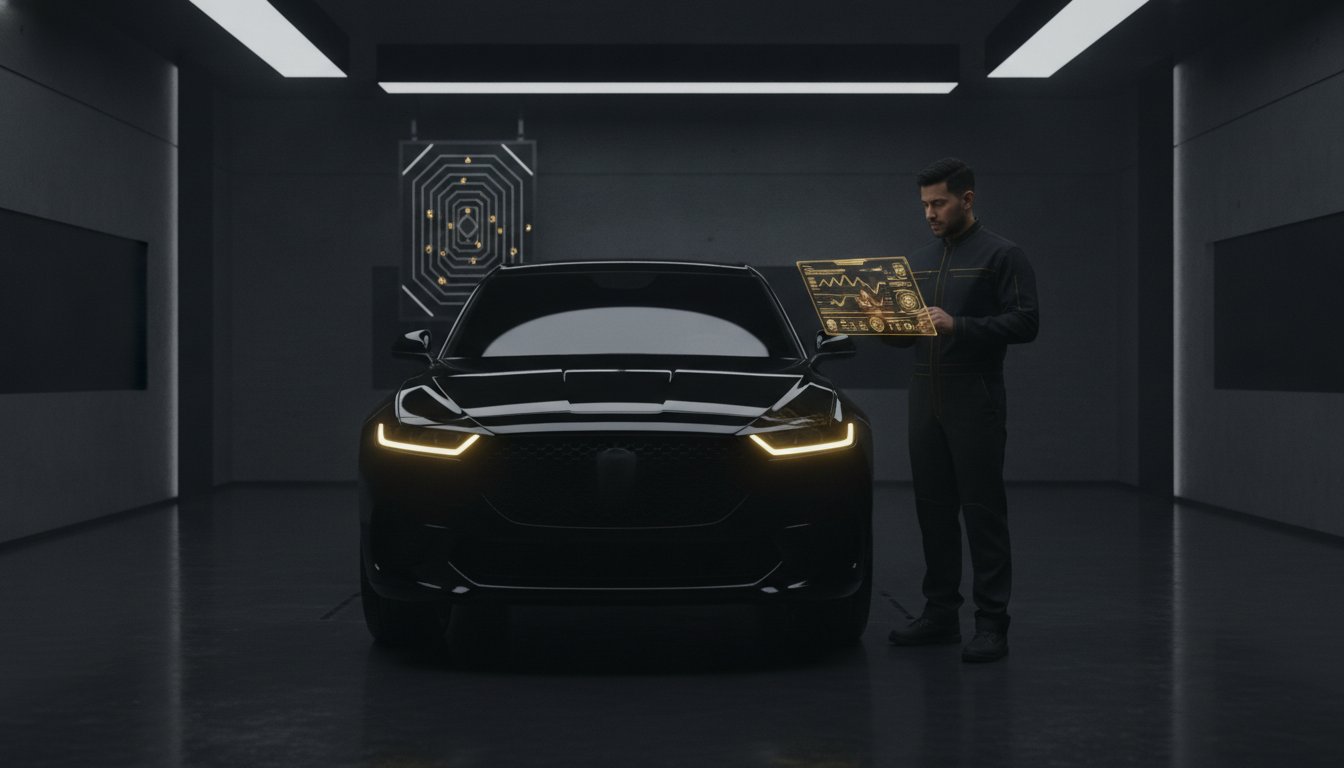
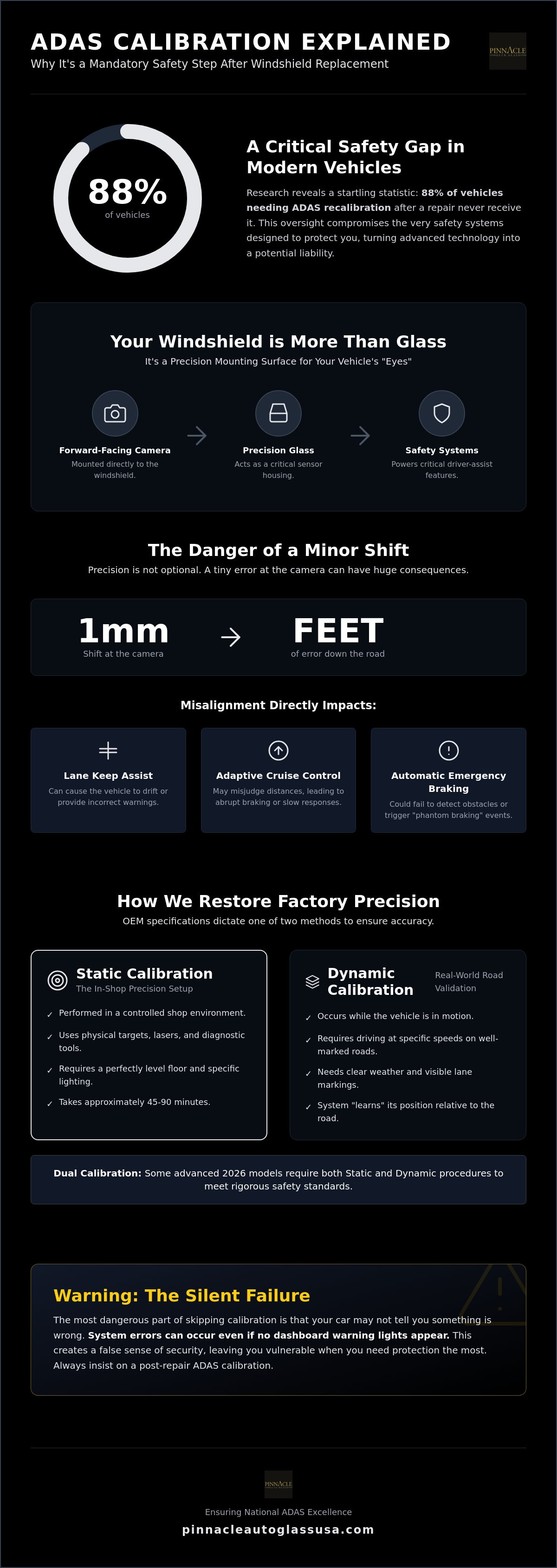
Research shows that 88% of vehicles requiring recalibration after a repair never actually receive it. This represents a critical safety gap for modern drivers. When you replace a windshield, you aren't just installing glass; you are reinstalling the "eyes" of your vehicle. If your cameras or sensors are misaligned by even a fraction of an inch, your safety systems can fail when you need them most.
It's natural to feel frustrated by unexpected technical steps or confusing jargon. You want to know your car is safe without being overwhelmed by the process. This guide explains why auto glass ADAS calibration is a mandatory safety requirement rather than an optional service. We'll break down how these systems protect you, what the service entails, and how insurance claims work to keep your vehicle road-ready.
Key Takeaways
- Learn why your windshield is a precision component that acts as the primary mounting surface for your vehicle's safety sensors.
- Understand the differences between static and dynamic methods and how manufacturer specifications dictate the required service.
- Discover why skipping auto glass ADAS calibration can lead to dangerous system errors even if no dashboard warning lights appear.
- Explore the multi-step 2026 calibration protocol, including essential pre-scans and physical alignments to ensure maximum accuracy.
- Identify why specialized calibration is vital for maintaining safety standards in commercial truck glass and fleet operations.
What is ADAS Calibration and Why Does Your Windshield Need It?
Modern vehicles rely on Advanced Driver-Assistance Systems (ADAS) to manage complex safety tasks. Think of ADAS as your car's electronic brain. It processes real-time data to prevent accidents and assist with daily driving. Most of these systems rely on a forward-facing camera mounted directly to the interior of your windshield. This setup allows the vehicle to "see" the road ahead, identifying lane markings, traffic signs, and other vehicles.
Your windshield is no longer just a piece of glass; it's a precision mounting surface. When you undergo a windshield replacement, the technician must remove the camera from its bracket and reattach it to the new glass. Even a standard replacement disturbs the factory-set viewing angle. A shift of just one millimeter at the camera level can result in several feet of error at 100 yards down the road. This physical displacement makes auto glass ADAS calibration a mandatory requirement to restore your car's safety protocols.
Misalignment directly impacts the vehicle's most critical assistance systems, including:
- Lane Keep Assist: Helps keep your car centered and warns you if you drift.
- Adaptive Cruise Control: Adjusts your speed to maintain a safe following distance.
- Automatic Emergency Braking: Initiates a stop if a collision is imminent.
The Windshield as a Safety Component
In current automotive design, the glass is a sophisticated sensor housing. 2026 models require extreme glass clarity for sensor "vision." While OEM glass meets strict manufacturer specifications, some aftermarket options may have slight distortions that confuse the camera. The "frit," or the black dotted pattern on the glass, also plays a functional role. It provides a secure bonding surface for the camera bracket and protects sensitive hardware from heat and UV degradation. Choosing the right glass ensures these sensors function as intended.
Common ADAS Features in 2026 Models
Today's vehicles use high-tech sensors to protect everyone on the road. Forward Collision Warning (FCW) relies on precise depth perception to calculate closing speeds. Pedestrian Detection needs millisecond-perfect data to identify moving objects and react. Many 2026 vehicles now integrate LiDAR alongside high-definition CMOS cameras to create a 3D map of the surroundings. This increased complexity makes professional auto glass ADAS calibration essential. If these sensors aren't perfectly aligned, the vehicle might fail to detect a hazard or trigger a phantom braking event.
Static vs. Dynamic Calibration: Understanding the Methods
Restoring sensor accuracy isn't a one-size-fits-all process. Technicians follow two distinct paths to ensure your safety systems function correctly: static or dynamic calibration. The Original Equipment Manufacturer (OEM) specifies exactly which method your car requires based on its year, make, and model. While many vehicles only need one type, some high-end 2026 luxury models now demand "Dual Calibration." This means the car must undergo both procedures to satisfy rigorous safety protocols. This is common in vehicles featuring advanced LiDAR and high-definition CMOS cameras.
Precision is the primary goal. According to research from the Insurance Institute for Highway Safety, even one degree of miscalibration can significantly impact how these systems react in real-world scenarios. This makes professional auto glass ADAS calibration a non-negotiable step after any windshield replacement. If you aren't sure which method your vehicle needs, you can consult with a specialist to determine the correct OEM requirements for your specific make and model.
Static Calibration: The In-Shop Precision Setup
Static calibration occurs in a highly controlled shop environment. Technicians use physical targets, laser levels, and specialized diagnostic software to reset the sensors. The shop floor must be perfectly level. Even minor unevenness can tilt the vehicle, causing the camera to aim too high or low. Proper lighting is also essential so the sensors can clearly "read" the calibration targets without interference from shadows or glare. A typical static session takes about 45 to 90 minutes, depending on the complexity of the sensor array.
Dynamic Calibration: Real-World Road Validation
Dynamic calibration happens while the vehicle is in motion. The car's computer "learns" its environment while the technician drives at specific speeds on well-marked roads. This process requires clear weather and visible lane markings. A handheld diagnostic tool stays connected to the vehicle's OBD-II port throughout the drive. This allows the technician to monitor the sensor's progress in real-time. If the road markings are faded or the weather turns poor, the system may fail to complete the auto glass ADAS calibration, requiring a second attempt under better conditions.
Each method requires specialized equipment and training. Static setups rely on precision-engineered targets that vary by manufacturer, while dynamic sessions require a technician who understands the specific driving parameters needed to trigger the system's learning mode. Regardless of the method, the goal remains the same: ensuring your vehicle's safety systems are perfectly aligned with the road ahead.
The Risks of Skipping Recalibration After Glass Replacement
Many drivers assume that if the dashboard is clear of warning lights, their vehicle is safe to drive. This is a dangerous myth. Sensors can be significantly misaligned without triggering a single alert on your console. The system might think it's working perfectly while its "vision" is actually skewed. This leads to a false sense of security that puts everyone on the road at risk. Professional auto glass ADAS calibration is the only way to verify that your safety systems are actually seeing the world as it exists.
Physics doesn't lie. A tiny 1mm shift in camera placement on your new windshield can translate into several feet of error at 100 yards. This is known as the "Angle of Error." If your Automatic Emergency Braking system thinks a car is 50 feet away when it's actually 40 feet away, those 10 feet make the difference between a safe stop and a high-speed collision. Precision is not optional when millisecond reactions are required for safety.
Misaligned sensors also cause erratic vehicle behavior. You might experience "phantom braking," where the car slams on the brakes for no apparent reason because it misidentifies a shadow or a road sign as an obstacle. Alternatively, Lane Keep Assist might provide erratic steering inputs, tugging the wheel toward oncoming traffic because it can't find the true center of the lane. These malfunctions turn helpful safety features into unpredictable hazards.
The Physics of Misalignment
The geometric centerline is the invisible line that runs perfectly through the middle of your vehicle from front to back, serving as the primary reference point for all sensor alignments.
When a camera is off-center, it miscalculates the distance to the car ahead by misinterpreting the perspective of the road. This isn't just a minor glitch; it's a fundamental failure of the safety system's depth perception. Lane Departure systems are particularly sensitive to this. If the camera's field of view is tilted, the car may "correct" your steering into another lane, thinking you've drifted when you haven't.
Legal and Insurance Implications
Skipping this service carries heavy financial and legal weight. Many insurance carriers now mandate auto glass ADAS calibration to maintain the validity of your policy. If you are involved in an accident and it's discovered that the safety systems were not properly reset after a glass replacement, you could face denied claims or personal liability. This is especially critical for fleet owners who must document safety compliance for every vehicle in their care.
Technicians use a "Post-Repair Scan" to create a digital record proving the systems were functional when the car left the shop. Beyond immediate safety, failing to calibrate can hurt your vehicle's long-term value. Dealerships and lease return inspectors often check for these records. Without them, you may face penalties or a lower resale price. Stay informed on emerging Federal ADAS Calibration Guidelines to ensure your vehicle meets the latest industry standards for safety and compliance.
The 2026 ADAS Calibration Process: What to Expect
The calibration process is highly technical and follows a strict sequence to ensure your vehicle meets factory safety standards. It begins with a pre-scan. Technicians use advanced diagnostic tools to identify any existing fault codes before the glass work starts. This step ensures that the vehicle's computer systems are healthy and ready for the new hardware. It also prevents pre-existing issues from complicating the new sensor alignment.
Physical alignment is the next critical phase. Your vehicle must be in a neutral state for accurate results. Technicians verify that tire pressure is consistent and the ride height matches manufacturer specifications. If the car is leaning or the tires are low, the sensors will aim incorrectly. This rigorous preparation distinguishes a professional auto glass ADAS calibration from a simple glass swap. Skipping these checks can result in a failed calibration or a system that performs poorly in real-world conditions.
Once the physical setup is complete, the technician executes the calibration run. They use OEM-specific software to guide the sensors through a series of tests. This might involve static targets or a dynamic road test, depending on your vehicle's requirements. Finally, a post-scan is performed. This generates a certificate of completion. This document serves as proof for your insurance records that the safety systems are fully functional and calibrated to original specifications.
Preparing Your Vehicle for Service
You can help ensure a smooth service by preparing your vehicle beforehand. Arrive with a full tank of gas and an empty trunk. These factors affect the vehicle's weight distribution and ride height. Remove all obstructions from the dashboard and the area around the rearview mirror. Technicians also need to know your exact trim level. This information determines which specific sensor suite is installed in your car, ensuring the auto glass ADAS calibration uses the correct software protocols.
Insurance and Cost Transparency
Most comprehensive insurance policies cover the cost of calibration as part of a glass claim. Insurance companies recognize that this is a mandatory safety requirement rather than an optional add-on. It's vital to work with certified auto glass technicians who have the training and equipment to handle these complex tasks. While the technology is advanced, the service is an investment in your safety. It prevents much more expensive accidents caused by system failure. If you need to schedule a service, you can book your windshield replacement and calibration with a team that prioritizes technical excellence.
Trusting Pinnacle Auto Glass for National ADAS Excellence
Pinnacle Auto Glass operates at the intersection of traditional craftsmanship and modern technology. We recognize that a windshield is no longer a passive component. It's a foundational part of your vehicle's safety architecture. Our technicians strictly adhere to the latest ADAS calibration auto glass standards to ensure every sensor performs exactly as intended. We treat auto glass ADAS calibration as a mandatory phase of every professional repair, never an optional upgrade.
Our nationwide presence allows us to maintain a consistent standard of excellence across the United States. Whether you are a solo driver or a national logistics coordinator, you receive the same level of technical rigor. We invest in the latest diagnostic software and hardware to keep pace with 2026 vehicle developments. This commitment ensures your car is returned to its precise factory safety specifications every time.
Advanced Solutions for Commercial Fleets
Fleet managers face unique challenges with vehicle uptime and safety compliance. We specialize in commercial truck glass services that prioritize both speed and accuracy. Our experience covers everything from light delivery vans to heavy-duty semi-trucks equipped with complex ADAS arrays.
We help minimize downtime through tech-integrated scheduling and streamlined billing. Multi-state logistics companies benefit from having a single national partner that understands their operational needs. We provide the documentation necessary to prove safety compliance for your entire fleet. This centralized approach simplifies maintenance and reduces the risk of liability issues across your organization.
The Pinnacle Promise of Safety
We never cut corners on windshield replacement safety protocols. Every installation is a precision event. Our team uses industry-leading diagnostic hardware and OEM-compliant targets to verify the accuracy of your sensors. This ensures that features like Forward Collision Warning and Lane Departure Warning are ready to protect you immediately.
Accuracy is our primary metric for success. We follow a methodical flow that transitions from the initial glass install to the final post-scan documentation. This professional auto glass ADAS calibration process guarantees that your vehicle's electronic "eyes" are correctly aligned. You can book your combined glass replacement and calibration service today by contacting our team. Let us help you maintain the integrity of your vehicle's most critical safety systems.
Secure Your Vehicle's Future with Precise Calibration
Modern vehicle safety depends on the seamless integration of glass and technology. You've learned how even a minor windshield replacement can disrupt the complex sensor arrays that power your driver assistance systems. Professional auto glass ADAS calibration isn't an optional upgrade; it's the final step in ensuring your car reacts correctly to the road ahead. Whether you need a static shop reset or a dynamic road validation, the goal is to return your vehicle to its original factory standards.
Pinnacle Auto Glass provides the expertise needed to handle these high-tech requirements across the country. Our certified ADAS technicians offer nationwide fleet support and comprehensive insurance claim assistance to simplify the process for both individual drivers and commercial operators. We prioritize technical accuracy so you can drive with total confidence, knowing your safety systems are fully functional and ready to protect you. Don't leave your safety to chance when expert solutions are readily available.
Schedule Your Professional Windshield Replacement and ADAS Calibration with Pinnacle Auto Glass today and keep your vehicle's safety systems operating at peak performance.
Frequently Asked Questions
Is ADAS calibration really necessary after a windshield replacement?
Yes, recalibration is mandatory because the windshield acts as the primary mounting surface for your vehicle's safety sensors. Even a standard replacement changes the camera's precise viewing angle. Without a reset, your car's electronic brain won't see the road accurately. This can lead to system failures when you need them most.
How much does ADAS recalibration typically cost in 2026?
Industry data from July 2026 shows that typical costs range between $150 and $600. Static procedures generally fall between $150 and $400, while dynamic road tests cost between $100 and $200. Some high-end vehicles requiring both types or multiple sensor resets can exceed $1,000 depending on the complexity of the sensor array.
Will my car insurance pay for the ADAS calibration service?
Most comprehensive insurance policies cover the cost of auto glass ADAS calibration as part of the glass claim. Laws in states like Arizona, New York, and Maryland now require repair facilities to inform you about these requirements before work begins. You should verify coverage with your insurer to ensure all manufacturer specifications are met during the repair.
Can I drive my car if I haven't had the camera recalibrated yet?
You should avoid driving until the calibration is complete. Misaligned sensors can trigger phantom braking or erratic steering inputs that compromise your control of the vehicle. It's safer to have the service performed immediately following the glass installation to maintain your vehicle's safety integrity and protect other drivers.
How long does the ADAS calibration process take to complete?
The entire process usually takes between 45 and 90 minutes to complete. Static setups often require more time for physical target alignment and shop floor leveling. Dynamic sessions depend on current road conditions and how quickly the vehicle's computer learns the environment during the required test drive.
What happens if my ADAS camera is not calibrated correctly?
Incorrect calibration leads to dangerous system failures such as failing to detect pedestrians or initiating late emergency braking. A tiny misalignment results in significant feet of error at highway speeds. This can turn your safety features into unpredictable hazards that actually increase your risk of a collision.
Do all windshields have cameras that need calibration?
Not every vehicle has these systems, but over 90% of new cars in 2026 are equipped with ADAS. You can identify these systems by looking for a camera bracket mounted near your rearview mirror. If your car features Lane Departure Warning or Forward Collision Warning, it requires auto glass ADAS calibration after glass work.
Can ADAS calibration be done via mobile service, or do I need to go to a shop?
There is a significant shift toward in-shop service for modern recalibration. Static procedures require a perfectly level surface and controlled lighting that mobile environments cannot provide. Dedicated calibration bays ensure the most accurate results for your safety sensors by removing environmental variables that cause errors.


