
Did you know that in many states, laws essentially mandate that your insurance provider covers the full cost of glass restoration without a single penny out of your pocket? Depending on your state's regulations, drivers with comprehensive coverage can often access professional cracked windshield repair services with a zero deductible. This unique legal protection means you don't have to watch a small chip spread across your glass while worrying about the bill. However, in 2026, a simple repair involves much more than just glass and resin.
It's stressful to see a tiny crack suddenly spiderweb across your line of sight during a volatile weather shift. You know your vehicle's safety is at stake, yet modern features like ADAS sensors often make the repair process feel confusing and technical. This guide will show you how to utilize your state insurance benefits correctly to restore your car's structural integrity. You'll learn how to avoid the hidden costs of DIY mistakes and ensure your safety technology is perfectly aligned. We'll cover the latest 2024 regulations, the necessity of ADAS recalibration, and the steps to take for a seamless, professional recovery.
Key Takeaways
- Leverage Kentucky’s zero-deductible insurance laws to cover 100% of your professional glass restoration costs.
- Apply the "dollar bill" test to identify when a cracked windshield repair Kentucky is safe versus when a full replacement is mandatory.
- Ensure your vehicle’s ADAS sensors remain functional through precise recalibration and zero-point alignment procedures.
- Identify the critical differences between high-index professional resins and retail DIY kits that impact your car's structural safety.
- Streamline operations for commercial fleets with mobile glass services tailored for heavy-duty trucks and semi-trailers.
The Science of Windshield Repair and Kentucky Insurance Law
Professional glass restoration is a precision engineering task. It involves injecting a specialized, high-index liquid resin into the damaged area to restore the structural bonds of the safety glass. This process, deeply rooted in The Science of Windshield Repair, uses vacuum pressure to remove air and replace it with a bonding agent that matches the glass's refractive index. In Kentucky, this vital maintenance is supported by unique legislation that prioritizes driver safety over insurance costs. Maintaining the factory seal through a repair is always the preferred first step for vehicle longevity.
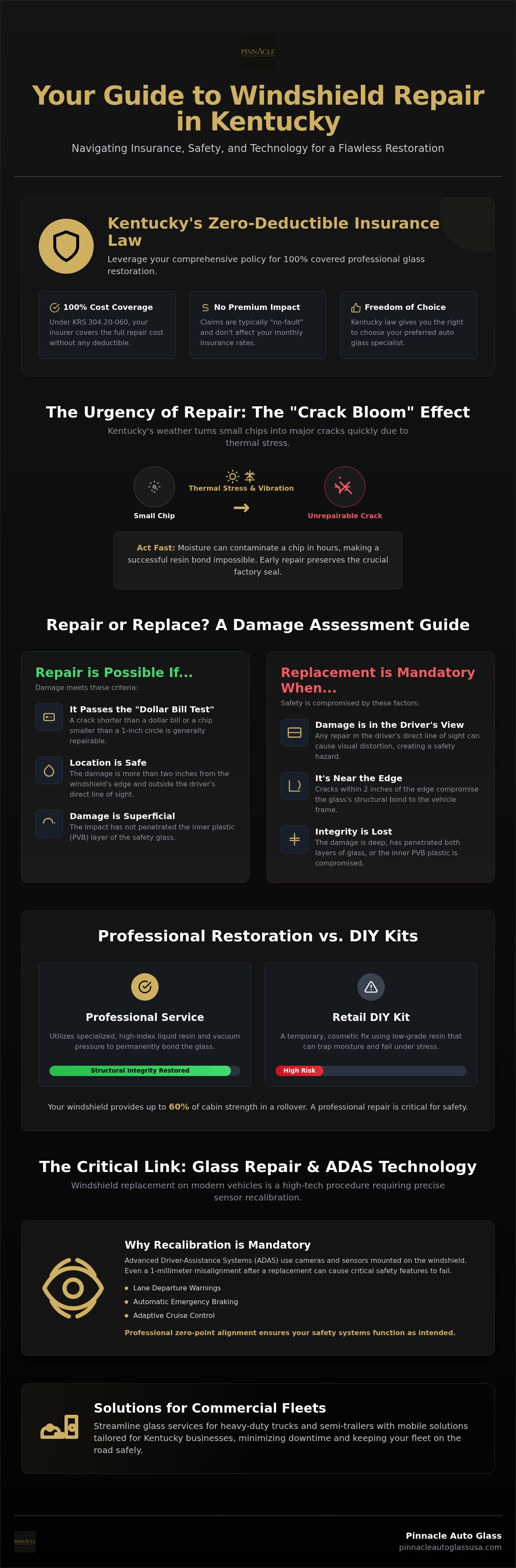
Kentucky Revised Statute 304.20-060 is the cornerstone of local glass safety. It mandates that insurance providers cover the full cost of cracked windshield repair Kentucky without applying a deductible, provided the owner has a comprehensive policy. These claims are generally treated as "no-fault" events. They don't typically impact your monthly premiums because repairing a chip is a proactive safety measure. The windshield provides up to 60% of a vehicle's cabin strength during a rollover accident. Maintaining its integrity is a legal and physical necessity for every driver on the road.
How Kentucky State Law Benefits Vehicle Owners
The "Zero Deductible" rule ensures that cost is never a barrier to road safety. You shouldn't pay out-of-pocket for a repair that the law has deemed essential. Under the 2024 updates to Kentucky Senate Bill 29, you have the absolute right to choose your service provider. Insurers cannot force you to use a specific "preferred" shop. It's often best to contact an auto glass specialist before your insurance carrier. A professional shop understands the specific documentation required by Kentucky law to ensure your claim is processed smoothly. This helps you avoid administrative delays and ensures the work meets national safety standards.
Thermal Stress and the 'Crack Bloom' Effect
Kentucky’s climate is particularly harsh on compromised glass. Rapid temperature swings and high humidity levels cause the glass to expand and contract. This thermal stress forces microscopic cracks to spread in a process known as "blooming." When you combine this with the vibrations caused by Kentucky’s seasonal potholes, a repairable chip can become a non-repairable crack in hours. Moisture contamination prevents successful resin bonding by creating a physical film that blocks the adhesive from reaching the glass's inner laminate. Acting quickly preserves the factory seal and prevents the need for a full replacement.
Repair vs. Replacement: Evaluating Your Glass Damage
Determining whether you need a full replacement or a simple cracked windshield repair Kentucky starts with a basic assessment. The "Dollar Bill" test is the industry standard for size. If a chip is smaller than a one-inch diameter or a crack is shorter than a standard dollar bill, the glass can usually be saved. However, size isn't the only factor. Technicians also look at the depth of the impact. If the damage has penetrated the inner Polyvinyl Butyral (PVB) layer, the structural integrity is lost. This inner plastic layer holds the glass together during an impact; once it's compromised, a repair won't suffice. Location also dictates the outcome. Any damage within two inches of the windshield edge usually requires a replacement because this area is under the most significant structural stress.
Safety regulations also restrict repairs in the driver's direct line of sight. Even a high-quality resin injection can leave a slight visual distortion. If this distortion sits directly in your field of vision, it becomes a legal and safety hazard. While Kentucky Insurance Law ensures these services are accessible, the final decision between repair and replacement must prioritize your safety on the road. If you aren't sure where your damage stands, you can request a professional assessment to get a clear, expert opinion.
Common Types of Repairable Fractures
Bullseye and Half-Moon fractures are the most straightforward to fix. These circular breaks have a clear impact point and are highly stable for resin injection. Star Breaks are more aggressive. They feature small "legs" radiating from the center that can spread instantly under pressure. These require immediate, pressure-controlled repair to stop the spread. Combination breaks involve both a crushed center and radiating cracks. These complex impact points require multi-stage vacuuming to ensure every air pocket is replaced with resin.
When Replacement is the Only Safe Choice
Replacement is mandatory when cracks exceed the length of a dollar bill or if the damage is located directly over Advanced Driver-Assistance Systems (ADAS) cameras. Sensors for lane departure and emergency braking rely on a perfectly clear view through the glass. Any obstruction here can cause system errors. You should also watch for delamination. This appears as milky, cloudy patches around the edges of the glass. It indicates the laminate layers are separating, usually due to neglected chips that allowed moisture to seep inside.
Professional Restoration vs. DIY Repair Kits
DIY windshield repair kits are widely available at local auto parts stores. They often promise a fast, inexpensive fix for minor chips. However, these retail products lack the precision required to restore a vehicle’s structural safety. A professional cracked windshield repair Kentucky service uses specialized equipment that store-bought kits simply cannot replicate. The primary difference lies in the vacuum-sealing process. While a DIY kit attempts to push resin into a crack, a professional bridge tool first extracts air and moisture from the fracture. Removing these contaminants is more critical than adding the resin itself. Trapped air bubbles in a cured DIY repair create permanent weak points and visual distortions that cannot be corrected later.
Optical clarity depends on matching the glass's refractive index. Professional technicians use high-index resins that mirror the light-bending properties of your specific windshield. When combined with industrial UV curing technology, this process restores up to 95% of the original optical clarity. Because Kentucky Revised Statute 304.20-060 ensures that professional glass services are available without a deductible for comprehensive policyholders, the risk of a botched home repair is unnecessary. Once a DIY resin hardens, any mistakes are permanent. Botched attempts often lead to irreversible clouding, which necessitates a full windshield replacement instead of a simple repair.
The Professional Multi-Step Process
Professional restoration follows a methodical sequence to ensure longevity. Technicians begin with precision cleaning and moisture extraction using professional-grade bridge tools. This ensures the fracture is completely dry and free of debris. Controlled pressure injection follows, forcing the resin to the microscopic tip of every crack. Finally, a diamond-grade polishing compound is applied. This creates a flush finish that protects your wiper blades from premature wear and ensures a smooth surface for the glass.
Why Structural Integrity Matters
Your windshield is a vital safety component. It provides the necessary support for proper passenger-side airbag deployment and maintains roof rigidity during a rollover. Professional-grade resins are engineered to mimic the strength of the original laminated glass. Choosing professional windshield repair preserves the factory seal of your vehicle. This prevents future leaks and protects your car's resale value. It also ensures your vehicle remains compliant with national safety standards, providing peace of mind for you and your passengers.
The Critical Link Between Glass Repair and ADAS Technology
Modern vehicles are mobile computers. Your windshield serves as the primary mounting point for Advanced Driver-Assistance Systems (ADAS). When you seek cracked windshield repair Kentucky, you aren't just fixing a cosmetic flaw. You're maintaining the housing for Forward Collision Warning (FCW) and Lane Departure systems. Even a small chip can disrupt the camera's line of sight. A professional cracked windshield repair Kentucky ensures that your safety tech is not compromised by poor resin application or trapped air bubbles.
A "Zero-Point" alignment is often necessary after glass work. This ensures the sensors are oriented exactly as the manufacturer intended. Depending on your vehicle, you may require static recalibration, which happens in a controlled shop environment using specialized targets, or dynamic recalibration, which involves driving the car at specific speeds. It's vital to choose ADAS calibration auto glass experts who understand these distinctions. Approximately 85% of vehicles manufactured after 2017 are equipped with these systems, making recalibration a standard part of the repair process.
Sensors and Cameras: The Windshield's New Components
Windshields are now "smart" components. They feature specialized brackets and heating elements designed specifically for sensors. If a repair uses resin with an incorrect refractive index, it can distort the camera's view. This distortion makes it difficult for the vehicle to recognize road lines or preceding vehicles. Most forward-facing cameras require a millimeter-level alignment tolerance of 0.5mm to 1.0mm to accurately process road data and prevent system errors.
Risks of Skipping Recalibration
Ignoring recalibration creates significant safety hazards. Misaligned sensors can trigger "ghost" braking events where the car stops abruptly for no reason. You might also notice Lane Keep Assist drifting or failing to engage. Beyond physical danger, skipping this step can lead to insurance compliance issues. Under Kentucky Senate Bill 29, repair shops must provide written disclosure if your vehicle requires recalibration after glass work. Failing to follow these safety protocols could leave you liable in the event of an accident. Ensure your safety systems are perfectly aligned by scheduling your ADAS recalibration today.
Fleet and Commercial Solutions for Kentucky Businesses
Commercial vehicle operations require specialized glass maintenance strategies. Unlike passenger cars, semi-trucks and box trucks carry large-format windshields that endure significant air pressure and vibration. A small chip can quickly become a structural failure, leading to costly Department of Transportation (DOT) violations or vehicle grounding. Professional cracked windshield repair Kentucky for fleets focuses on maintaining 100% uptime through proactive glass management. By utilizing pinnacle auto glass expertise, businesses can access national-standard quality with localized service speed.
Standardized safety reporting is essential for modern fleet management. Every repair or replacement must be documented to prove compliance with federal safety standards. This is especially true for vehicles equipped with ADAS, as misaligned sensors on a commercial truck can lead to catastrophic system errors. Our technicians provide detailed documentation for every service, ensuring your fleet remains compliant and your drivers stay safe. Mobile on-site repair is the most effective way to address these needs without pulling a vehicle out of its revenue-generating route. This approach reduces the logistical headache of moving heavy-duty vehicles to a central shop.
Commercial Truck Windshield Management
Managing glass for heavy-duty vehicles requires more than just resin injection. Large delivery van fleets benefit from bulk scheduling, allowing multiple vehicles to be serviced during scheduled downtime. Mobile technicians arrive equipped with specialized tools for heavy-duty gasket and seal restoration, which is critical for preventing cabin leaks in older commercial models. We prioritize the structural integrity of the glass to handle the unique stress loads found in long-haul trucking and urban delivery routes. This specialized focus prevents the "crack bloom" effect mentioned earlier, which is often accelerated by the high-mileage vibrations typical of commercial use.
Scheduling and Insurance Logistics
The Kentucky insurance claim process can be complex for business owners managing multiple policies. We streamline this by handling the paperwork directly with your provider, leveraging our deep knowledge of the Kentucky zero-deductible law. To receive an accurate mobile service quote, have your vehicle-specific details ready, including the VIN and any integrated camera features. Taking these steps is the most effective way of reducing fleet downtime with mobile glass repair. Our goal is to move your vehicles from the shop back to the road as efficiently as possible. We work closely with fleet managers to ensure that every repair meets both safety standards and operational budgets.
Securing Your Safety on Kentucky Roads
Navigating a damaged windshield involves more than just filling a crack. It requires an understanding of state insurance laws and the complex technology embedded in modern glass. By leveraging the Kentucky zero-deductible law, you can ensure your vehicle receives high-index resin restoration without the financial burden of a deductible. This professional approach preserves the factory seal and maintains the precise alignment of your ADAS sensors. Choosing a specialist for your cracked windshield repair Kentucky ensures that your vehicle remains a safe, structurally sound environment for every journey. Skipping these steps or opting for a DIY kit can lead to permanent visual distortions and safety system errors.
Pinnacle Auto Glass acts as your dependable guide through this technical process. We are certified ADAS recalibration specialists and experts in Kentucky zero-deductible insurance claims. Our team also provides specialized mobile fleet and commercial truck support to keep local businesses operational. Get a Professional Glass Repair Quote from Pinnacle Auto Glass today to restore your vehicle's integrity. Drive with confidence knowing your safety is managed by seasoned professionals who prioritize your security and time.
Frequently Asked Questions
How long does a professional cracked windshield repair take in Kentucky?
A professional cracked windshield repair Kentucky service typically takes between 30 and 60 minutes to complete. This includes the time needed for precision cleaning, vacuuming air from the fracture, and curing the high-index resin with UV lights. The exact duration depends on the complexity of the break and the number of chips being addressed. You can wait with your vehicle and drive away as soon as the technician finishes.
Does Kentucky law really allow for free windshield replacement and repair?
Kentucky law mandates that insurance companies cover the full cost of glass services for drivers with comprehensive coverage. Under Kentucky Revised Statute 304.20-060, there is no deductible for windshield repair or replacement. This "zero-deductible" rule has been in effect since 1979. It ensures that safety remains a priority by removing financial barriers to essential glass maintenance, including ADAS recalibration and professional resin injection.
Will a repaired windshield pass a Kentucky vehicle safety inspection?
A professionally repaired windshield will pass a Kentucky vehicle safety inspection as long as the structural integrity is restored. These inspections prioritize driver visibility and the strength of the glass. Because professional resin restores up to 95% of optical clarity, the repair is often nearly invisible. Technicians ensure the finish is flush with the glass surface, preventing any interference with wiper blades or safety sensors.
Can a crack be repaired if it is in the driver’s direct line of sight?
Repairs are generally prohibited if the damage sits directly in the driver's primary line of sight. Even the highest quality resin can leave a slight visual distortion that may distract the driver or obscure road hazards. If the chip or crack is located within the "acute area," which is the space directly in front of the steering wheel, a full replacement is required to maintain legal safety standards.
What happens if a chip spreads while the technician is repairing it?
Technicians will stop the process and recommend a full replacement if a chip spreads beyond repairable limits during service. Modern tools use controlled pressure to minimize this risk. If the damage expands beyond the size of a dollar bill, the structural bond cannot be guaranteed. In these cases, the Kentucky zero-deductible law still applies to the resulting replacement, ensuring you don't face unexpected out-of-pocket costs.
How soon can I drive my vehicle after the resin has been cured?
You can drive your vehicle immediately after a professional resin repair is cured. Technicians use industrial UV lamps to harden the bonding agent in minutes. This is a significant advantage over a full replacement, which often requires a "drive-away time" of one hour or more to allow the structural adhesive to set. The cured resin is stable and resistant to Kentucky's variable weather conditions right away.
Do I need ADAS recalibration if I only had a small rock chip repaired?
You typically don't need ADAS recalibration for a small rock chip repair unless the damage is located directly over a sensor or camera. Recalibration is a non-negotiable step for full replacements because removing the glass shifts the sensor's "zero-point" alignment. However, if a repair is performed near the camera housing, a technician will perform a diagnostic check to ensure the safety systems remain within their millimeter-level tolerances.
Does filing a glass repair claim in Kentucky raise my insurance rates?
Filing a claim for a cracked windshield repair Kentucky generally won't raise your insurance rates. Most insurance providers view glass repairs as proactive safety measures that prevent more expensive claims later. Because these are categorized as "no-fault" comprehensive claims, they aren't weighted the same as a collision. It's almost always more cost-effective for the insurer to pay for a simple resin injection than a full windshield replacement.


