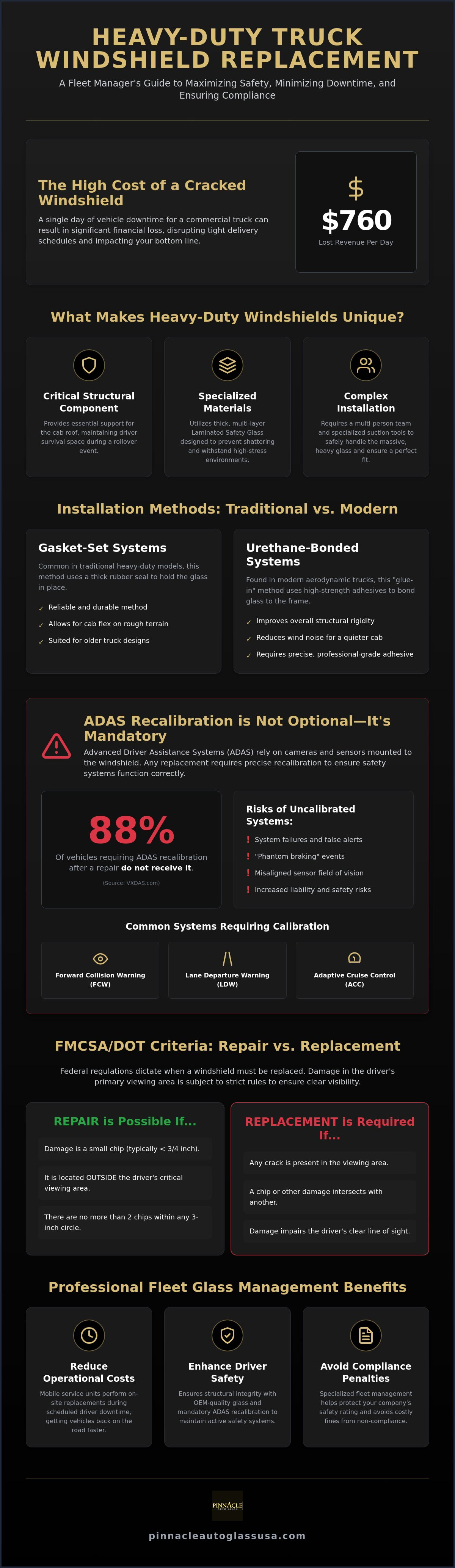
Did you know that a single day of vehicle downtime for a commercial truck can cost your fleet up to $760 in lost revenue? When a crack appears in the viewing area, you need a professional heavy duty truck windshield replacement that gets the vehicle back on the road without compromising safety. We know that managing a fleet means balancing tight delivery schedules with strict FMCSA regulations and complex insurance paperwork. It's a high-stakes environment where even a small delay impacts your bottom line.
This guide will teach you how to manage heavy-duty glass replacement efficiently to ensure driver safety and minimize costly vehicle downtime. You'll learn about the latest 2026 safety standards, the critical necessity of ADAS recalibration, and how to maintain structural integrity across your entire fleet. We'll also break down how upcoming regulations like the ADAS Functionality and Integrity Act affect your maintenance protocols. By the end, you'll have a clear path to fast, professional glass solutions that keep your drivers protected and your schedules on track.
Key Takeaways
- Understand why heavy-duty windshields act as critical structural components for rollover protection and cab integrity.
- Discover why precise ADAS recalibration is mandatory after a heavy duty truck windshield replacement to maintain active safety systems.
- Learn the specific FMCSA and DOT criteria for identifying when a chip requires repair versus a full replacement.
- Explore how mobile service units reduce operational costs by performing on-site replacements during scheduled driver downtime.
- Identify how specialized fleet glass management helps avoid compliance penalties and protects your company's safety rating.
What Makes Heavy Duty Truck Windshield Replacement Unique?
A heavy duty truck windshield replacement is a complex technical operation. It isn't a simple swap like you might see with a passenger sedan. The windshield in a Class 8 truck serves as a vital structural component. It provides essential support for the cab roof. In the event of a rollover, the glass helps maintain the survival space for the driver. This structural role means that any compromise in the installation process directly impacts the safety of the vehicle and the person behind the wheel.
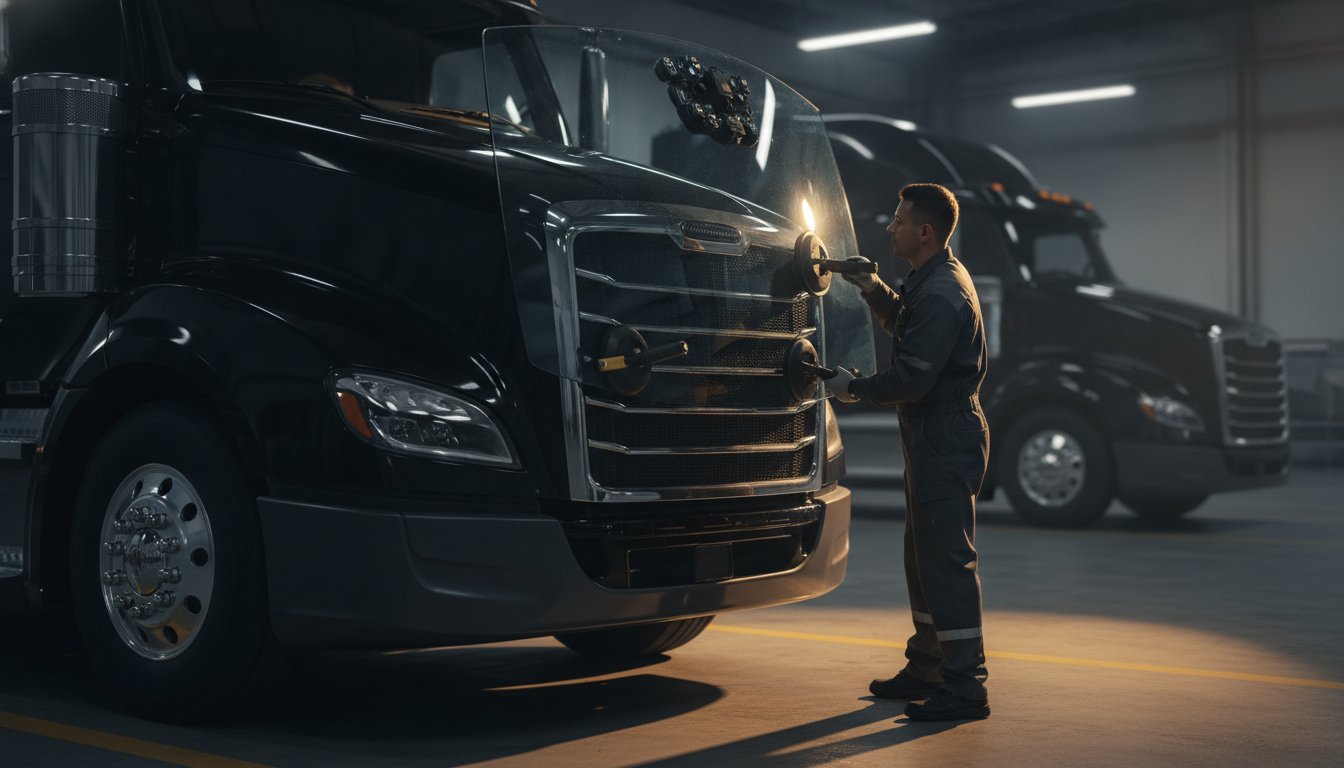
The materials used in commercial vehicles are specifically engineered for high-stress environments. Commercial glass is significantly thicker than standard automotive glass. It utilizes Laminated safety glass technology. This involves multiple layers of glass bonded with a specialized interlayer. This construction prevents the glass from shattering into dangerous shards during an impact. Because of the massive surface area, semi-truck windshields are heavy and unwieldy. Safe installation requires a multi-person team and specialized suction tools to ensure the glass is seated perfectly without any stress fractures.
Gasket-Set vs. Urethane Installations
Installation methods vary based on the truck's age and design. Traditional heavy-duty models often use gasket-set systems. These rely on a thick rubber seal to hold the glass in place. It's a reliable method that allows for some cab flex on rough terrain. However, modern aerodynamic trucks have shifted toward high-modulus urethane systems. These are bonded directly to the frame with high-strength adhesives. This "glue-in" method improves the truck's overall rigidity and reduces wind noise. Choosing the correct adhesive is critical. Technicians must use professional-grade urethane that meets the manufacturer's specific cure-time and strength requirements to maintain structural integrity.
Commercial Glass Standards and Quality
Every piece of glass used in a heavy duty truck windshield replacement must comply with Federal Motor Vehicle Safety Standards (FMVSS). These standards dictate the strength, transparency, and shatter resistance of the glass. For fleet managers, choosing OEM-quality glass is a strategic decision. While aftermarket options exist, they often lack the precise curvature required for a perfect seal. Minor imperfections in the glass can distort the view of advanced safety sensors. If the glass isn't optically clear, cameras for lane departure warnings or collision avoidance may malfunction. High-quality glass ensures that these safety systems receive accurate visual data, protecting your drivers and your equipment.
The Critical Role of ADAS Recalibration in Heavy Duty Trucks
Advanced Driver Assistance Systems (ADAS) are now standard in the heavy-duty sector. These systems use cameras and sensors mounted directly behind the glass to monitor the road. During a heavy duty truck windshield replacement, these sensors are removed and reinstalled. Even a microscopic shift in the mounting angle can throw off the system's field of vision by several feet at highway speeds. This misalignment creates a significant safety risk for the driver and other motorists. Operating a truck with uncalibrated sensors is a liability that fleet managers cannot afford to ignore.
Data from VXDAS.com published in June 2026 suggests that an estimated 88% of vehicles requiring ADAS recalibration after a repair do not receive it. This oversight leads to system failures or "phantom braking" events where the truck stops abruptly for no reason. Professional recalibration is not optional. It is a necessary technical step to restore the vehicle's safety envelope and ensure the sensors work as the manufacturer intended. If your fleet includes modern rigs with these safety features, choosing a partner with specialized ADAS recalibration expertise is the best way to manage liability.
Common Truck Safety Systems Requiring Calibration
Modern commercial trucks use a suite of sensors to protect the driver. Forward Collision Warning (FCW) relies heavily on windshield-mounted cameras to detect stopped or slowing traffic. Lane Departure Warning (LDW) systems monitor road markings to provide visual and audible alerts if the truck drifts. Additionally, Adaptive Cruise Control (ACC) integrates with these cameras to maintain safe following distances. Systems from major brands like Bendix and WABCO require specific technical protocols to ensure these features remain active and accurate after a glass change.
Static vs. Dynamic Recalibration for Commercial Fleets
Recalibration isn't a one-size-fits-all process. Static calibration happens in a specialized service bay using physical targets and laser levels. The truck must be on a level surface with specific lighting to ensure the camera aligns with the manufacturer's targets. Dynamic recalibration involves a controlled test drive. Technicians use OEM-specific software to teach the camera how to recognize road features in real-time.
The industry is moving toward stricter oversight to prevent safety lapses. The House Committee on Energy and Commerce passed the "ADAS Functionality and Integrity Act" (H.R. 7389) on May 21, 2026. This legislation aims to establish national guidelines for ADAS recalibration to ensure consistent safety across all repair providers. Following these established procedures keeps your fleet compliant with federal safety expectations and protects your drivers on the road.
Repair vs. Replacement: Evaluating Heavy Duty Glass Damage
Deciding between a minor fix and a full heavy duty truck windshield replacement requires a clear understanding of federal safety standards. Fleet managers must evaluate damage based on its size, location, and type. Heavy-duty vehicles face extreme road vibrations and temperature fluctuations. These factors cause small chips to develop into large stress cracks much faster than they would on a passenger car. If the structural laminate is compromised, the glass can no longer provide the necessary rollover protection for the driver. Safety is the priority, but unnecessary replacements drain your maintenance budget.
DOT Regulations for Windshield Damage
The Federal Motor Carrier Safety Administration (FMCSA) enforces strict rules under regulation 49 CFR § 393.60. Inspectors focus on the "critical viewing area," which is the space swept by the windshield wipers. No cracks are allowed to intersect in this zone. Any damage that obscures the driver's view can result in a costly "out-of-service" order. According to FMCSA standards, a single stone chip is generally acceptable only if it is smaller than a 3/4-inch diameter disc. Additionally, these chips must not be within 3 inches of any other damaged area. Ignoring these specifics leads to compliance violations that negatively impact your company's safety rating.
When Rock Chip Repair is a Viable Option
Repairing a chip is often the most efficient way to manage fleet costs while maintaining safety. The process involves injecting a specialized clear resin into the damaged area. This resin bonds the glass and prevents the chip from spreading into a full-blown crack. Industry standards suggest that chips smaller than a quarter are the best candidates for this service. This approach is highly effective for damage located outside the driver's direct line of sight. It keeps the original factory seal intact, which is often preferred for maintaining the cab's structural integrity.
Choosing repair over a complete heavy duty truck windshield replacement saves significant time. A repair can often be completed in under 30 minutes. In contrast, a full replacement requires several hours for the adhesive to cure properly. For a deeper look at these techniques, read our guide on professional windshield repair. This proactive maintenance keeps your trucks on the road and avoids the daily revenue loss associated with vehicle downtime. If the damage exceeds these limits or shows signs of spider-webbing, a full replacement is the only safe path forward.
Minimizing Fleet Downtime with Professional Mobile Services
For fleet managers, time is the most valuable asset. Every hour a truck sits in a repair bay is an hour it isn't generating revenue. Professional mobile services eliminate this conflict by bringing the heavy duty truck windshield replacement directly to your yard or terminal. This approach removes the logistical burden of transporting large vehicles to a central shop. It also cuts down on fuel costs and prevents the accumulation of "deadhead" miles that offer zero return on investment. Mobile glass units are fully equipped to handle the specialized requirements of commercial rigs on-site.
On-site service provides a unique advantage for driver management. Federal Hours of Service (HOS) regulations require drivers to take mandatory rest periods. By scheduling a heavy duty truck windshield replacement during these downtime windows, you maximize vehicle utility. The driver completes their required break while the technician performs the installation. This coordination ensures the truck is ready for the next haul as soon as the driver's clock resets. It's a pragmatic solution that keeps your logistics chain moving without forcing drivers to deviate from their routes.
Logistics of On-Site Heavy Duty Replacement
Successful mobile service requires specific site conditions. Technicians need a flat, stable surface to ensure the glass is seated correctly. Large cabs require significant overhead and side clearance for the installation team to maneuver safely. Weather also plays a major role in the process. High-strength urethane adhesives have specific temperature and humidity requirements for proper curing. If conditions aren't met, the structural integrity of the seal could be compromised. Mobile teams often use portable shelters to maintain a controlled environment for both the installation and the subsequent sensor calibration. This level of planning is essential for reducing fleet downtime while maintaining high safety standards.
Managing Insurance Claims for Commercial Glass
Commercial insurance claims involve complex paperwork that can delay repairs. Professional glass providers streamline this process by working directly with third-party fleet administrators. Direct billing for high-volume commercial accounts reduces the administrative burden on your office staff. It also ensures that all technical documentation is filed correctly from the start. Documentation is particularly vital for ADAS recalibration. You must have a verifiable record that all safety systems were tested and restored to OEM specifications after the glass change. This record-keeping is a critical component of your liability protection. If you need to simplify your maintenance workflow, our team provides comprehensive fleet glass services that handle the technical and administrative details for you.
Efficiency doesn't mean cutting corners. A coordinated mobile deployment can service multiple vehicles in a single visit. This batching strategy allows you to address minor chips and full replacements across your entire fleet in one afternoon. It is the most effective way to prevent small issues from becoming major compliance violations during a roadside inspection.
Why Pinnacle Auto Glass is the Leading Fleet Solution
Pinnacle Auto Glass combines a national footprint with the specialized technical precision required for heavy duty truck windshield replacement. We don't treat a Class 8 truck like a standard passenger vehicle. Our team understands that commercial glass is a structural safety component that requires specific materials and handling. We prioritize your fleet's uptime by providing a no-nonsense, results-oriented service that gets your drivers back on the schedule. By using only high-quality materials that meet or exceed all Federal Motor Vehicle Safety Standards (FMVSS), we ensure your vehicles remain compliant and your drivers stay protected.
Managing a large fleet requires a partner that can handle both the physical replacement and the complex electronics integrated into modern cabs. We provide a comprehensive solution that includes glass installation and precise ADAS recalibration. This dual-service approach eliminates the need for multiple appointments at different facilities. It simplifies your maintenance workflow and reduces the risk of liability associated with uncalibrated safety sensors. We operate as an extension of your maintenance department, focusing on reliability and long-term vehicle health.
Expert Technicians for Specialized Vehicles
Commercial trucks have unique cab geometries and sensor configurations that vary by manufacturer. Our technicians undergo rigorous training to handle the specific requirements of leading brands like Freightliner, Volvo, Kenworth, and Peterbilt. We understand the nuances between a gasket-set installation on an older rig and the high-modulus urethane bonding required for a modern aerodynamic model. Hiring certified auto glass technicians is the only way to ensure every installation meets the highest industry safety standards. This expertise allows us to anticipate potential issues before they cause delays, ensuring a smooth service experience for your logistics team.
Setting a New Standard for Fleet Glass Safety
Safety is the core of our business model. We integrate the latest research and technical data from our ADAS calibration and auto glass reference guide into every service call. This commitment to technical accuracy protects your company's safety rating and minimizes the risk of roadside inspection violations. Centralizing your glass management with a single professional partner provides consistent quality across your entire operation. You receive standardized documentation, predictable scheduling, and a team that understands the urgency of your delivery deadlines.
A proactive approach to glass maintenance is the best way to control operational costs and ensure driver safety. Don't wait for a small chip to become an "out-of-service" violation during a DOT inspection. Contact Pinnacle Auto Glass today for a professional fleet assessment and discover how our specialized commercial services can keep your trucks moving safely.
Secure Your Fleet’s Future on the Road
Efficient fleet management requires a balance between safety and productivity. This guide has demonstrated that modern glass maintenance is a sophisticated technical task. It involves cab structural integrity and the precise alignment of safety sensors. By utilizing mobile repair and replacement, you eliminate the logistical burden of transporting large vehicles to a shop. Staying compliant with DOT standards isn't just about avoiding fines; it's about protecting your drivers and your cargo.
Pinnacle Auto Glass acts as a specialized partner for every heavy duty truck windshield replacement. We provide nationwide commercial fleet support and include expert ADAS recalibration to restore your truck's safety systems. Our mobile service units are equipped to handle large-scale fleet needs at your location. Schedule your professional heavy-duty truck windshield replacement with Pinnacle Auto Glass today. We're ready to help you keep your fleet moving safely and reliably.
Frequently Asked Questions
How long does it take to replace a semi-truck windshield?
A professional heavy duty truck windshield replacement typically takes between two and three hours to complete. This timeframe includes the removal of the old glass, surface preparation, and the installation of the new unit. If your vehicle requires ADAS recalibration, you should plan for an additional hour of technical work. Total downtime depends on the specific adhesive used and the complexity of the sensor array.
Can a heavy-duty truck be driven immediately after a windshield replacement?
No, you cannot drive the truck immediately after the installation is finished. The urethane adhesive requires a specific curing period, known as the Safe Drive Away Time, to ensure the glass is structurally bonded to the cab. This period usually lasts between 60 minutes and two hours depending on environmental conditions. Driving too early can cause the seal to fail or compromise the vehicle's safety in a collision.
Is ADAS recalibration mandatory for commercial trucks after glass replacement?
Recalibration is mandatory for any commercial vehicle equipped with Advanced Driver Assistance Systems. When performing a heavy duty truck windshield replacement, the cameras and sensors are disturbed. Even a tiny misalignment can cause safety features like collision avoidance or lane departure warnings to provide inaccurate data. Restoring these systems to factory specifications is a critical step for maintaining fleet safety and managing company liability.
What are the DOT regulations regarding cracks in a semi-truck windshield?
Federal regulations prohibit any cracks that intersect or any damage that obscures the driver's view within the area swept by the windshield wipers. According to FMCSA standards, chips must be smaller than 3/4 of an inch and located at least three inches away from other damage. Violating these rules can lead to out-of-service orders during roadside inspections. It's best to address small chips before they develop into non-compliant cracks.
Do you offer mobile services for heavy-duty truck fleets?
Yes, we provide specialized mobile services designed specifically for heavy-duty truck fleets. Our technicians bring all necessary tools and glass to your yard or terminal to perform on-site installations. This service allows your drivers to complete their mandatory rest periods while we work. Mobile deployments are the most efficient way to manage multiple vehicles without the cost of transporting them to a service center.
Can you replace the side and back glass on commercial vehicles as well?
We provide comprehensive commercial glass services, including the replacement of side door glass and back windows. Heavy-duty vehicles often require specialized tempered or laminated glass for these areas to ensure durability and safety. Whether you have a sleeper cab with side windows or a standard day cab, our technicians can source and install the correct glass for your specific truck model.
How do I know if my truck's safety camera needs recalibration?
You should assume recalibration is necessary immediately following any heavy duty truck windshield replacement. While some systems may trigger a dashboard warning light or error code, others may simply provide inaccurate alerts without warning. If you notice lane departure warnings engaging late or collision sensors acting inconsistently, the system is likely misaligned. Professional testing is the only way to confirm the camera's field of vision is accurate.
Does insurance typically cover heavy-duty truck glass replacement?
Most comprehensive commercial insurance policies cover glass replacement and ADAS recalibration. We work directly with major fleet insurance providers and third-party administrators to streamline the claims process. Our team handles the documentation and billing to ensure the repair meets all policy requirements. It's important to verify your specific deductible and coverage limits with your insurance agent before scheduling service.


