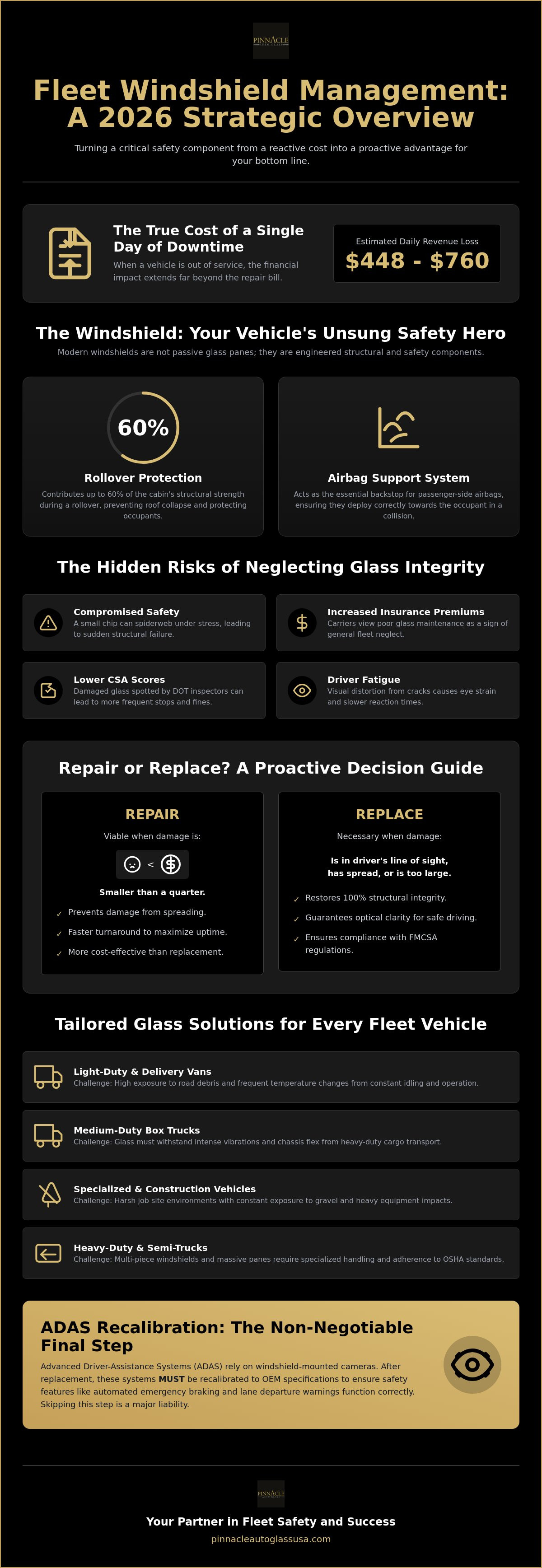
Did you know that a single day of a vehicle being out of service in 2026 can cost your company between $448 and $760? When a cracked windshield sidelines a driver, that revenue loss compounds quickly. Professional fleet windshield replacement is no longer just a simple maintenance task; it's a critical component of your logistics and safety strategy. You already understand that keeping your drivers on the road is the top priority, but the technical complexity of modern vehicle glass makes that goal harder to achieve every year.
This guide provides the roadmap you need to optimize commercial glass management and protect your bottom line. We'll show you how to streamline your repair workflows, ensure safety compliance through precise ADAS recalibration, and reduce the total cost of ownership for your entire fleet. We will cover everything from how glass contributes up to 60% of cabin strength during a rollover to navigating the latest FMCSA regulations. By the end, you'll have a clear plan to turn glass maintenance from a reactive headache into a proactive advantage for your business.
Key Takeaways
- Understand how maintaining glass integrity protects your drivers and reduces corporate liability in the event of an accident.
- Identify the specific glass requirements for different vehicle classes, from high-volume delivery vans to medium-duty box trucks.
- Master the decision-making criteria for fleet windshield replacement versus simple repairs to maximize vehicle uptime and safety.
- Streamline your administrative workload through centralized billing and efficient insurance claim management for multi-vehicle operations.
- Discover why certified ADAS recalibration is a non-negotiable step in modern commercial glass maintenance to ensure safety systems function correctly.
The Strategic Role of Fleet Windshield Replacement in 2026
Modern windshields are functional safety components, not simple accessories. In 2026, fleet managers must view glass as a primary structural asset. During a rollover accident, the windshield contributes up to 60% of the cabin's structural strength. It also acts as the essential backstop for passenger-side airbags. If the glass fails, the entire safety cage of the vehicle is compromised. Professional fleet windshield replacement ensures these systems function exactly as the manufacturer intended.
Using high-quality laminated safety glass is the industry standard for maintaining this integrity. Neglecting a small crack can lead to sudden structural failure under stress. This neglect also impacts your bottom line through insurance premiums. Insurance carriers view poor glass maintenance as a sign of general fleet neglect. Also, Compliance, Safety, Accountability (CSA) scores suffer when DOT inspectors spot damaged glass, leading to more frequent roadside stops and potential fines.
Driver fatigue is a less obvious but equally dangerous cost of delayed maintenance. Visual distortion from a poorly repaired or cracked windshield forces the driver's eyes to work harder to focus. Over an eight-hour shift, this leads to headaches, eye strain, and slower reaction times. A timely fleet windshield replacement removes these hazards and keeps your workforce sharp and safe on the road.
Reducing Fleet Downtime Through Proactive Maintenance
Reactive maintenance is a recipe for revenue loss. Transitioning to a scheduled glass management program allows you to catch "threshold damage" before it escalates. Generally, any chip smaller than a quarter is a candidate for repair. If you wait until the damage spreads, you're forced into a full replacement that takes longer and costs more. You can learn more about reducing fleet downtime with mobile glass repair to see how on-site service keeps your vehicles moving without the need for a shop visit.
Safety Compliance and Regulatory Standards
Federal standards are clear and unforgiving. FMCSA regulation 49 CFR § 393.60 outlines specific requirements for windshield clarity and integrity. Cracks cannot be in the driver's direct line of sight or exceed specific size limits near the center of the glass. Professional installation is the only way to guarantee your fleet meets these federal safety regulations. High-durability glass ensures your vehicles stay compliant for longer, even in harsh commercial driving conditions.
Comprehensive Glass Solutions for Every Fleet Vehicle Type
Fleet managers deal with everything from compact sedans to Class 8 semis. Each vehicle class presents unique challenges for fleet windshield replacement. Light-duty vehicles like delivery vans are the workhorses of urban logistics. They face constant exposure to road debris and frequent temperature changes from constant idling. Medium-duty box trucks require glass that can withstand the intense vibrations of heavy-duty cargo transport. You don't want a simple repair failing because the glass couldn't handle the torque of a fully loaded vehicle.
Specialized fleets like utility and construction vehicles face even harsher environments. They often require more frequent glass maintenance due to gravel and heavy equipment on job sites. Choosing a partner with experience in commercial truck glass services ensures your specialized equipment stays operational and safe. We understand that a cracked windshield on a bucket truck isn't just a visibility issue; it's a safety violation that can halt a job site.
Semi-Truck and Heavy-Duty Glass Requirements
Heavy-duty glass management is a different beast entirely. Class 7 and Class 8 vehicles often utilize multi-piece windshields. These designs allow for partial replacement, which can save money if only one side is damaged. However, the sheer size and weight of these panes require specialized handling. Technicians must adhere to OSHA Vehicle Maintenance Standards to ensure safety during the installation process. Specialized equipment is often needed to seat these massive windshields correctly without compromising the seal. If the seal isn't perfect, wind noise and water leaks will quickly frustrate your long-haul drivers.
ADAS Integration in Modern Commercial Fleets
Technology has changed the nature of glass service. Most commercial vehicles manufactured after 2020 include Advanced Driver Assistance Systems (ADAS). These systems rely on cameras and sensors mounted directly behind the windshield. When you perform a fleet windshield replacement, these sensors are often disturbed. It's a critical safety step that must be performed by certified technicians to maintain the vehicle's safety rating.
Precise ADAS calibration auto glass protocols are non-negotiable. If a camera is off by even a fraction of a degree, features like lane departure warnings or forward collision alerts will malfunction. This creates a massive liability risk for your company. We specialize in recalibrating common fleet sensors, including adaptive cruise control and automatic emergency braking. Ensuring these systems are functional protects your drivers and reduces the likelihood of expensive collisions.
Evaluating Replacement vs. Repair for Fleet Efficiency
Deciding between a quick fix and a full overhaul is a daily challenge for fleet operators. Efficiency depends on making the right call the first time. If a chip is smaller than a quarter and away from the edges, a repair is often the first choice. However, depth and impact type matter. A deep bullseye that penetrates multiple layers of the glass structure might hold for a while, but it often fails under the thermal stress of commercial use. You need a clear framework to avoid the hidden costs of repeat service calls.
High-quality resins are the backbone of a successful windshield repair. Cheap materials often yellow or shrink over time, which compromises the visual clarity and structural bond. For high-mileage vehicles, a failed repair is a significant liability. It leads to secondary downtime that could've been avoided with an initial fleet windshield replacement. Always consider the vehicle's remaining service life and typical route conditions before opting for a patch.
When to Opt for Full Windshield Replacement
Safety standards dictate that any damage in the driver's critical line of sight, known as the acute area, requires a full replacement. Repairs in this zone can cause visual distortion that leads to driver fatigue or missed hazards. Cracks longer than a credit card or any damage that reaches the edge of the glass also trigger a replacement. Edge cracks compromise the structural integrity of the entire pane. Additionally, highway fleets often suffer from sandblasting or pitting. This microscopic damage doesn't always crack the glass, but it creates a glare that makes night driving dangerous. A strategic fleet windshield replacement restores total clarity for the driver.
Material Standards: OEM vs. Aftermarket Glass
Choosing between Original Equipment Manufacturer (OEM) and Original Equipment Equivalent (OEE) glass is a balance of budget and precision. OEM glass is produced by the same manufacturer that supplied the factory glass. It guarantees the exact thickness, curvature, and acoustic properties required for the vehicle. This precision is vital for vehicles equipped with complex ADAS cameras. OEE glass is a high-quality aftermarket alternative that meets federal safety standards but may have slight variations. In high-turnover fleet environments, OEE glass can be a practical choice for older models without advanced sensor suites. For newer trucks, sticking with OEM ensures that your ADAS recalibration remains accurate and reliable.
The Logistics of Professional Fleet Glass Management
Managing glass across a large operation requires more than just technical skill. It demands a logistical system that prioritizes vehicle uptime and administrative simplicity. Professional glass management moves beyond reactive repairs to offer centralized billing and dedicated account oversight. You shouldn't have to manage dozens of individual invoices for your vehicles. A single-source provider streamlines this by consolidating your records, making it easier to track your total cost of ownership. This organization is vital for fleet compliance audits and safety documentation.
Priority scheduling is another core benefit of a commercial partnership. When a vehicle is sidelined, every hour counts. Dedicated account managers ensure your fleet windshield replacement moves to the front of the line. They understand your specific equipment and keep the necessary glass in stock. This proactive approach prevents small chips from becoming major logistical delays. If you are ready to simplify your operations, you can schedule your fleet assessment today to build a custom service plan.
Mobile Fleet Services: Bringing the Shop to the Yard
Efficiency in 2026 is defined by how well you manage "dwell time." This is the period when your drivers are off-duty or vehicles are being loaded at the warehouse. Mobile service allows us to perform a fleet windshield replacement during these natural breaks in your schedule. This eliminates the need to pay a driver to transport a vehicle to a shop and wait for the work to finish. It saves on fuel, labor, and wear and tear on your equipment.
Successful mobile installation requires the right environment. Our technicians need a flat surface and, ideally, protection from extreme weather or heavy rain to ensure the adhesive cures correctly. We also bring the technology required for on-site ADAS recalibration. This means your vehicle isn't just fitted with new glass; it's fully safety-compliant and ready for the road the moment we leave your yard.
Streamlining Insurance and Claims for Fleets
Commercial insurance claims are notoriously complex. Managing claims for multiple vehicles can overwhelm an internal maintenance department. Professional glass providers act as an extension of your team by handling the insurance paperwork directly. We coordinate with your carrier to ensure every claim is filed accurately and processed quickly. This reduces your administrative burden and helps minimize out-of-pocket costs through fleet-specific insurance programs. Using one provider across your entire service area ensures consistent pricing and service standards for every vehicle in your care.
Pinnacle Auto Glass: Your Partner in Fleet Safety and Success
Reliability is the foundation of a successful partnership. At Pinnacle Auto Glass, we prioritize your operations by delivering windshield replacement excellence across our service areas. Our approach combines technical precision with a deep understanding of commercial logistics. We don't just fix glass; we help you maintain a safe and compliant fleet. Whether you manage a local service business or a large national logistics network, our solutions scale to meet your specific volume and vehicle types.
Our technicians are the heart of our service. They undergo rigorous training in the latest commercial ADAS recalibration protocols to ensure every vehicle returns to service in factory condition. We utilize advanced diagnostic tools to handle the complex sensors found in modern trucks and vans. Choosing the right partner for your fleet windshield replacement means choosing a team that values your time and your safety equally. We provide the specialized commercial expertise required to keep your drivers protected and your vehicles profitable.
Why Fleet Managers Trust Pinnacle Auto Glass
We understand that every minute a vehicle sits idle is a minute it isn't generating revenue. Our workflow is designed to minimize downtime without cutting corners on federal safety standards. We employ both static and dynamic ADAS recalibration methods to accommodate various manufacturer requirements. Our proven track record includes extensive work with semi-trucks, box trucks, and high-volume delivery fleets. We have the equipment and the experience to handle Class 8 commercial glass with the same efficiency as a standard service van.
Get Started with a Custom Fleet Glass Program
Taking control of your glass management starts with a comprehensive audit. We can help you assess the current state of your fleet's glass integrity and identify potential risks before they lead to downtime. Setting up a priority service agreement ensures your business receives the fastest response times and consistent administrative handling. This proactive structure simplifies your maintenance schedule and stabilizes your glass-related expenses. Contact our commercial specialists today to request a customized quote and see how we can streamline your fleet operations.
Take Command of Your Fleet Glass Strategy
Effective glass management is a competitive advantage for your logistics operation. By transitioning from reactive repairs to a proactive strategy, you protect your structural integrity and avoid the high costs of vehicle downtime. Remember that modern safety systems require absolute precision. Ensuring every vehicle receives certified ADAS recalibration after a fleet windshield replacement is the only way to maintain compliance and driver safety on the road.
Pinnacle Auto Glass provides the specialized support your business needs to stay profitable. We offer nationwide commercial fleet support and dedicated mobile service to minimize disruptions to your delivery schedule. Our certified ADAS recalibration specialists ensure your vehicle technology works perfectly every time. We are ready to handle your light-duty vans and heavy-duty trucks with equal expertise and speed. Schedule your fleet glass service with Pinnacle Auto Glass today to secure your fleet's future. We look forward to helping your business reach its goals safely and efficiently.
Frequently Asked Questions
How long does a fleet windshield replacement typically take?
A standard replacement usually takes between 60 and 90 minutes to complete. However, the vehicle must remain stationary for at least one additional hour to allow the high-performance adhesive to cure properly. You should plan for approximately three hours of total downtime before the vehicle is safe to return to the road.
Do you provide mobile windshield replacement for semi-trucks?
Yes, we offer specialized mobile services for semi-trucks and other heavy-duty commercial vehicles. Our technicians arrive at your yard or warehouse with the specialized tools required for Class 7 and Class 8 glass. This on-site service eliminates the logistical headache and fuel costs associated with moving large equipment to a service center.
Is ADAS recalibration required for all commercial fleet vehicles?
Recalibration is mandatory for any vehicle equipped with Advanced Driver Assistance Systems after a new windshield is installed. These systems rely on cameras and sensors mounted directly to the glass. If your vans or trucks feature lane departure warnings or automatic emergency braking, recalibration ensures these life-saving technologies function with 100% accuracy.
Can you handle insurance claims for my entire fleet?
We manage the complete insurance claim process for all your commercial accounts. Our team works directly with your insurance provider to streamline paperwork and coordinate centralized billing. This professional management of your fleet windshield replacement claims reduces administrative stress and ensures your coverage benefits are fully utilized without constant back-and-forth communication.
What is the difference between OEM and aftermarket glass for commercial trucks?
Original Equipment Manufacturer (OEM) glass is produced to the exact specifications of the vehicle’s factory glass. Aftermarket glass meets federal safety standards but is manufactured by third-party companies. We typically recommend OEM glass for newer fleet vehicles because it provides the most reliable surface for ADAS camera mounting and sensor performance.
Do you offer priority scheduling for commercial fleet partners?
Commercial partners always receive priority scheduling to ensure minimal disruption to their operations. We recognize that vehicle downtime directly impacts your revenue. When you partner with us, your fleet windshield replacement requests move to the front of our queue, and we often keep specific glass for your vehicle models in stock for immediate dispatch.
What happens if a fleet vehicle is driven with a cracked windshield?
Operating a commercial vehicle with a cracked windshield is a violation of FMCSA regulation 49 CFR § 393.60. This can result in significant fines and negatively impact your CSA scores during roadside inspections. Beyond legal issues, a crack compromises the structural integrity of the cabin and can interfere with the driver's ability to spot road hazards.
How do I know if my fleet vehicle needs a repair or a full replacement?
Repairs are generally suitable for chips smaller than a quarter that are not in the driver's direct line of sight. If the damage is larger, reaches the edge of the glass, or consists of multiple cracks, a full replacement is the only safe option. We perform a professional assessment of every vehicle to determine the most cost-effective and safety-compliant solution.


