

How many glass claims can you file per year before your insurer says no? There’s no single annual limit for every driver. Your policy and insurer determine whether a claim is covered, while your claim history may factor into how the insurer assesses risk.
It’s reasonable to wonder whether a second claim will be approved, whether repeated claims could affect your premium or renewal, and how your deductible changes the decision. This guide explains what affects the answer, what to review before filing again, and how to weigh a claim against paying for the damage yourself.
You’ll learn how comprehensive coverage, glass-specific terms, deductibles, and claim frequency can affect the decision. Before filing, check your policy’s glass coverage and deductible, review your recent claim history, and compare the likely out-of-pocket expense with the potential insurance payment. If the glass needs attention, windshield repair or replacement may be the next practical step. Some windshield replacements also require ADAS recalibration. Understanding your options can help you decide without assuming every policy works the same way.
Key Takeaways
- There’s no universal answer to how many glass claims can you file per year. Your policy, insurer’s rules, and applicable state requirements shape coverage.
- A glass damage incident, a claim filed, and a claim paid aren’t necessarily the same thing. Check how your insurer records claims and which dates define your policy year.
- Repeated claims don’t guarantee a premium increase or no change. Your insurer may consider your policy terms and claim history.
- Before filing again, photograph the damage, note when and how it happened, review your coverage, and ask your insurer how the policy applies.
- After a claim decision, Pinnacle Auto Glass provides windshield repair and replacement for personal and commercial vehicles, plus ADAS recalibration when applicable.
How Many Glass Claims Can You File Per Year? The Direct Answer
There is no single annual glass-claim limit that applies to every driver. The answer to how many glass claims can you file per year depends on your policy, your insurer’s claim-handling rules, and any state requirements that apply to your coverage. You may be able to report more than one glass loss, but that doesn’t mean every claim will be covered or paid.
A universal annual cap is different from a policy-specific decision about whether each glass loss qualifies for coverage. An insurer may assess each reported incident under the policy terms, including the cause of the damage, applicable exclusions, and deductible. Filing a claim is a request for coverage, not a guarantee of payment. Even when a loss is covered, a deductible may leave some or all of the repair cost for you to pay.
Glass damage is often considered under comprehensive coverage, which generally applies to certain losses other than collisions. Coverage details vary, however. For a general overview of how policy types differ, see Understanding Auto Insurance Coverage, then refer to your own policy for the terms that apply to your claim.
Why there is no one-size-fits-all yearly limit
Policies and insurer procedures can treat glass damage differently. One policy may include separate glass terms, while another may apply its comprehensive deductible. An insurer’s review of a reported loss is also different from a fixed annual claim cap. If your contract states a limit, distinguish it from the conditions that determine whether a particular incident is covered. Don’t assume repeated claims will all be accepted or paid.
What drivers should check first
Start with your policy documents, not a general rule you’ve heard from another driver. Review the comprehensive coverage section and any glass-specific wording. Then look for the deductible, exclusions, reporting requirements, and any separate glass coverage conditions. Check whether a stated limit applies by calendar year or policy term, since those dates may not match. If the wording is unclear, ask your insurer how it applies to the damage you’re considering reporting.
Use this quick review before deciding:
- Coverage: Check whether your comprehensive coverage applies to the type of glass damage involved.
- Deductible: Find out what amount may apply and whether glass has different terms.
- Time period: Look for references to a calendar year, policy period, or another defined window.
- Claim handling: Ask how the insurer records a reported incident and evaluates coverage.
For example, two separate incidents in one policy term are not automatically treated as one event or automatically covered as two. The policy language and the insurer’s assessment matter. Keep the claim decision separate from the glass-service decision: whether insurance pays or you choose to pay yourself, windshield repair or replacement can address the damage. Reviewing your terms first can help you plan the next step with fewer surprises.
What Counts as a Glass Claim, and When Does the Policy Year Matter?
To understand how an insurer counts glass activity, separate three terms: the damage incident, the insurance claim, and the paid claim. They describe different stages, and an insurer’s records may not treat them as interchangeable. Understanding the distinction can clarify how many glass claims you can file per year without assuming that every repair, report, or payment is counted in the same way.
- Damage incident: A specific event that damages vehicle glass, such as a rock striking the windshield.
- Insurance claim: A request for the insurer to assess that loss under the policy. Reporting damage does not establish coverage or payment.
- Paid claim: A claim for which the insurer pays an amount under the policy, subject to its terms and any applicable deductible.
Claim count and coverage eligibility are separate questions. Your insurer may record a reported loss even if it doesn’t result in a payment, while coverage depends on the policy and the facts of that loss. Ask how each event appears in your claim history. For a general example of how an insurer describes the process, see Filing Auto Glass Claims with Nationwide. Its guidance doesn’t replace the terms of your own policy.
One damage event versus multiple glass incidents
Separate impacts or damage dates may be treated as separate losses, even if they affect the same windshield. For example, a chip from one event and a new crack after a later impact may need to be reported as distinct incidents. Don’t assume multiple repairs automatically count as one claim, or that one repair necessarily means there was only one incident. Describe what happened accurately and keep the dates as clear as possible.
If you’re unsure whether damage appeared all at once or worsened over time, explain what you know rather than guessing. Note when you first noticed it, where the vehicle was, and whether another impact occurred. Accurate details help the insurer assess the loss and record the relevant dates.
Calendar year, policy term, and claim history
A calendar year runs from January through December. Your policy term follows the dates in your insurance contract and may start or renew at a different point in the year. Damage reported in two calendar years could fall within one policy term, while two incidents in the same calendar year might occur across separate terms. When reviewing your history, the insurer’s recorded incident and claim dates are more useful than the calendar alone.
Keep claim confirmations and correspondence, then compare their dates with your policy’s start and renewal dates. For context on why glass work can involve more than the pane itself, review this windshield replacement safety and technology guide. Once you understand the incident and claim record, Pinnacle Auto Glass can help with windshield repair or replacement after a claim decision, whether the work is covered or self-paid.
Can Multiple Glass Claims Affect Your Premium or Coverage?
Repeated glass claims don’t guarantee that your premium will rise, and they don’t guarantee that it will stay the same. An insurer may review claim frequency when assessing renewal or pricing, but the outcome depends on the policy, the insurer’s procedures, and the details of your claim history. A review may affect future coverage or premiums without changing whether a particular glass loss qualifies under your policy.
Keep two questions separate. First, does the policy cover this specific damage, and what deductible or limits apply? Second, how might the insurer consider this claim alongside your history at renewal? A covered claim isn’t automatically free of future consequences, but filing doesn’t by itself prove that a premium increase or non-renewal will follow. The answer to how many glass claims can you file per year doesn’t predict an individual insurer’s decision.
What may influence an insurer’s decision
Ask your insurer how it evaluates claim frequency and what appears in your claim history. Relevant details may include how recent claims are recorded, the circumstances of each loss, and the policy language that applies. Insurers use their own policies and procedures, so another driver’s experience isn’t a reliable guide to your situation. Request clear information about both the current claim and any possible renewal implications.
An insurer can assess a claim for coverage and separately review your overall history. Those are related but different decisions. A glass loss might meet the policy’s coverage conditions, while claim frequency is considered in a later review. Conversely, a history review doesn’t establish that a new loss is covered. Get the insurer’s explanation for the specific policy and keep written claim records for reference.
Weighing the deductible against an out-of-pocket repair
Before deciding whether to file, compare the estimate for the needed work with the deductible that applies to glass. If the deductible is close to or greater than the estimate, a claim may not reduce your immediate expense. If the estimate is higher, coverage limits, separate glass terms, and the insurer’s decision still affect the potential payment. Compare the actual figures for your vehicle and policy rather than relying on a general cost assumption.
Windshield repair and replacement costs can vary with the damage and vehicle details. The windshield replacement cost guide explains factors that may affect an estimate. Use a specific estimate alongside your policy deductible, then weigh the potential claim payment against the possibility of a future review. If paying out of pocket makes more sense, Pinnacle Auto Glass provides windshield repair and replacement for personal and commercial vehicles. Learn about windshield repair and replacement as you consider your options.
What to Do Before Filing Another Auto Glass Claim
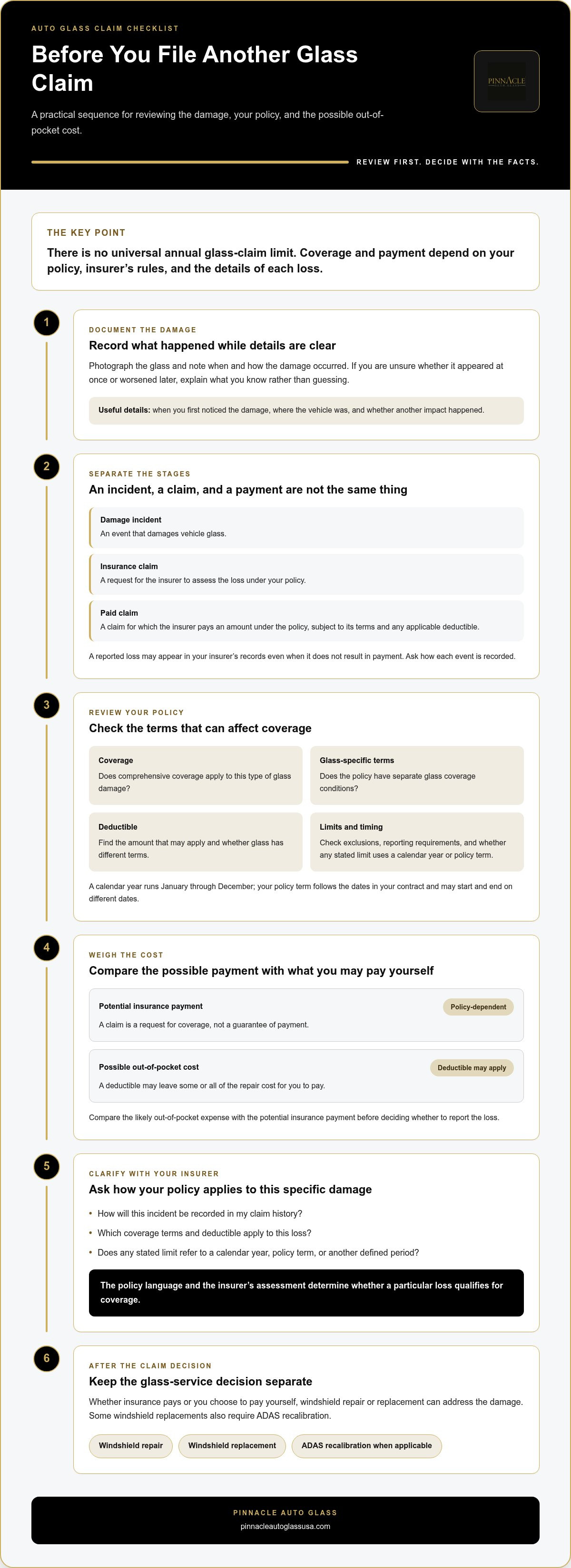
Before filing another claim, follow a clear sequence: document the damage, review your policy, ask your insurer how its terms apply, then choose the glass service. This helps you understand the potential out-of-pocket cost and claim steps before work begins. The answer to how many glass claims you can file per year won’t tell you how to handle this specific incident. Your records and policy details will.
A practical checklist for a new glass incident
Start by photographing the damage from a few angles. Record when you noticed it, where it is on the glass, and what you know about how it happened. If the damage changes, take another photo and note when you observed the change. Clear records can help you describe the incident accurately when you review it with your insurer.
- Document the damage. Save photos and note the date, location on the glass, and known circumstances. Keep the information factual if you’re uncertain about the cause.
- Review your policy. Check the comprehensive and glass-specific terms, deductible, and any applicable limits or exclusions.
- Follow the insurer’s current instructions. Ask how to report this incident, how the deductible applies, and whether authorization or inspection is needed before repairs or replacement begin. Processes can vary by insurer and policy.
- Choose the next step. Once you understand the claim process, arrange a professional assessment and decide whether to proceed through coverage or pay out of pocket.
Don’t assume every insurer uses the same reporting process or requires the same steps. Confirm the instructions for your policy before authorizing work. Keep claim reference details and any written guidance with your photos so you can refer to them later.
Repair or replacement: match the service to the damage
A chip or crack doesn’t automatically determine whether repair is suitable. The damage’s location and condition, along with other vehicle-specific factors, can affect the recommendation. A professional assessment helps establish whether windshield repair is appropriate or whether replacement is the better option. Don’t rely on a single size or crack-length rule as a guarantee of repair eligibility.
Use the professional windshield repair guide to learn more about repair considerations. If replacement is needed, ask your insurer about the applicable claim terms before work starts. Pinnacle Auto Glass provides windshield repair and replacement for personal and commercial vehicles, with ADAS recalibration when applicable after windshield replacement.
For details about available glass services, explore windshield repair and replacement with Pinnacle Auto Glass.
Get Professional Glass Repair or Replacement After a Claim Decision
Once you understand your coverage and claim requirements, the next step is addressing the damaged glass. Pinnacle Auto Glass provides windshield repair and replacement for personal and commercial vehicles. The right service depends on the damage and the vehicle, not simply on whether an insurer has approved a claim. Pinnacle handles the glass work, while your insurer determines coverage and payment under your policy.
This distinction matters if you decide to pay out of pocket or are waiting for a coverage decision. You can plan for the needed glass service while keeping insurance questions directed to your insurer. Understanding how many glass claims you can file per year is one part of the decision. The condition of the glass and your vehicle’s equipment also help determine what service to arrange.
What professional glass service can address
Repair and replacement are different service paths. An assessment can help determine whether the damage is suitable for windshield repair or whether replacement is more appropriate. A chip or crack alone doesn’t establish which option is right. The location and condition of the damage, along with vehicle-specific considerations, can affect the recommendation.
Some vehicles have Advanced Driver-Assistance Systems (ADAS) connected to cameras or sensors near the windshield. After windshield replacement, those systems may require recalibration when applicable. Pinnacle Auto Glass provides ADAS recalibration services for relevant glass work. Learn more about the connection between windshield service and these systems in this ADAS calibration and auto glass reference guide.
Plan your next step with Pinnacle Auto Glass
Before arranging service, follow any claim instructions your insurer has given you, including any required authorization or inspection. Keep a record of the claim decision and applicable terms, then share relevant details when organizing glass service. This helps keep the insurance decision and repair plan clear. A glass service provider handles the glass, while your insurer determines whether the policy covers the loss or approves payment.
With those details in hand, choose a service path that fits the damage and your vehicle. Pinnacle Auto Glass provides windshield repair and replacement for personal and commercial vehicles, with ADAS recalibration when applicable after glass work. Contact Pinnacle Auto Glass to discuss your glass repair or replacement needs.
Make Your Next Glass Decision With Confidence
Don’t let uncertainty about how many glass claims can you file per year delay a sensible plan for damaged glass. Treat the insurance decision and the vehicle’s glass needs as two connected but separate steps. Keep your claim details handy, understand what your insurer has decided, and choose a service plan that fits the damage.
Pinnacle Auto Glass provides windshield repair and replacement for personal and commercial vehicles, along with ADAS recalibration when applicable. Whether you’re proceeding through an approved claim or paying out of pocket, professional service can address the glass and help you plan for related recalibration needs. Your insurer determines coverage; Pinnacle handles the glass service.
When you’re ready to arrange service, contact Pinnacle Auto Glass for professional windshield repair or replacement.
Frequently Asked Questions
Is there a limit to how many glass claims you can file in a year?
There’s no single annual limit across all auto policies, so how many glass claims can you file per year depends on your insurer and policy. Glass-specific terms, deductibles, and limits may affect how each incident is handled. For example, a submitted claim may be reviewed but not paid if the damage doesn’t meet the policy’s coverage conditions. Check your policy and ask your insurer how it would treat a new incident.
Can filing multiple glass claims raise your insurance premium?
It may, but there’s no universal outcome. An insurer may consider your claim history when reviewing premiums or renewal, and its rules depend on your policy. A glass claim doesn’t automatically mean your premium will increase, but it also doesn’t guarantee there’ll be no effect. Before filing, ask whether your insurer considers reported claims, paid claims, or both when reviewing your account.
Does a windshield claim count as a comprehensive claim?
Windshield damage is often handled under comprehensive coverage if that coverage applies, but your policy terms and applicable state requirements matter. Check your declarations page to confirm comprehensive coverage, then review any glass-specific terms or deductible. Your policy may describe a separate glass provision. Ask your insurer how it classifies the incident rather than assuming a chip repair and a full replacement follow identical rules.
Should I file an insurance claim for a small windshield chip?
Compare the repair estimate with your applicable deductible and check whether your insurer requires notice or approval before work begins. If the estimate is below the deductible, filing may not reduce what you pay, though policy requirements can still matter. A chip’s size alone doesn’t establish whether repair is suitable. A professional assessment can help identify the appropriate service, while your insurer determines whether the loss is covered.
Do I need to file a glass claim before getting the windshield repaired?
Not always, because claim procedures differ by insurer and policy. Some insurers may ask you to report damage or obtain authorization first; others may use a different process. Check the current instructions before scheduling work, and keep photos and the incident date available. If you’re concerned the glass may be unsafe, prioritize vehicle safety and promptly contact your insurer for direction about the claim process.
Will insurance cover more than one windshield replacement in a year?
It may, depending on the policy, the circumstances and dates of each loss, and any applicable glass terms or deductibles. For example, a new impact after a prior replacement may be assessed as a separate incident, but the insurer determines how it’s recorded and whether coverage applies. A previous replacement alone doesn’t settle a later claim. Report the new damage accurately and ask how it will be reviewed.
Can I choose my own auto glass repair company for an insurance claim?
Your options depend on the insurer’s process, policy terms, and applicable requirements. Before authorizing work, ask whether approval or specific documentation is needed and how the deductible applies. Pinnacle Auto Glass provides windshield repair, replacement, and ADAS recalibration services. The insurer decides coverage and claim payment; the glass provider performs the service. Keep the claim instructions handy so the repair plan aligns with your policy’s process.


