
Did you know that your windshield provides up to 60% of your vehicle's structural strength during a rollover accident? It's a sobering statistic that changes how most drivers view a simple glass crack. Understanding the risks of cheap windshield replacement is no longer just about avoiding a messy leak. It's about ensuring your car remains a protective safety cell during a collision. In 2026, a windshield is a complex structural component, not just a piece of glass.
It's natural to look for the lowest price when hit with unexpected repair costs. You want a quick fix that doesn't break the bank. However, this guide will show you why discount services often compromise your safety and how to identify the professional standards that protect your investment. We'll explore the necessity of ADAS recalibration, the differences between OEM and aftermarket materials, and the technical requirements for a long-term, durable installation. You'll learn exactly what to look for to ensure your vehicle's safety systems and structural integrity remain fully intact.
Key Takeaways
- Understand how your windshield provides up to 60% of your vehicle's structural strength and serves as a vital backstop for airbag deployment.
- Identify the hidden risks of cheap windshield replacement, such as structural compromises and expensive long-term damage like rust or leaks.
- Learn why professional ADAS recalibration is mandatory for 2026 safety systems to prevent dangerous errors in emergency braking and lane-keep assist.
- Distinguish between OEM glass and low-tier aftermarket alternatives that can cause optical distortion and driver fatigue.
- Follow our expert "Red Flag" checklist to vet service providers and ensure your installation meets strict factory safety standards.
The Anatomy of the "Discount" Windshield Trap
Identifying the risks of cheap windshield replacement starts with understanding what a "discount" service actually entails. Most budget-driven shops prioritize high volume over Federal Motor Vehicle Safety Standards (FMVSS). While a low quote is tempting, it often masks a "hidden cost" model. You might save money on Monday, but by Friday, you're dealing with wind whistles, water leaks, or even cabin rust. A professional installation relies on three non-negotiable pillars: high-quality laminated safety glass, industrial-grade adhesive strength, and certified technician expertise.
In 2026, a $99 quote is mathematically impossible for a safe, modern installation. Between the cost of specialized resins, high-performance urethane, and the precision labor required for modern vehicle frames, that price point doesn't even cover the raw materials. If a shop offers a price that sounds too good to be true, they're likely sacrificing one of those three safety pillars to maintain their margins. Choosing these services creates a "passive failure" risk that only becomes apparent when the glass fails to perform during an accident.
The Difference Between Cost and Value in Auto Glass
Choosing the lowest bid often leads to a second replacement within 12 months. Low-quality glass is prone to stress cracks and pitting from minor road debris. Many discount installers frequently offer "tailgate warranties," meaning your protection ends the moment their truck leaves your driveway. Beyond the immediate repair, poor-quality glass can negatively impact your vehicle's resale value. Savvy buyers and dealerships look for factory-spec components, and a wavy or poorly fitted windshield is a major red flag during an inspection.
How Discount Shops Cut Corners
Unsafe shops frequently skip the use of specialized primers. This creates a weak bond between the glass and the metal frame. Without proper priming, the adhesive can fail, causing the windshield to pop out during a collision or airbag deployment. These shops also use "one-size-fits-all" moldings instead of vehicle-specific seals. This shortcut leads to weather-tightness issues and excessive cabin noise. Finally, they rush the installation to increase daily volume. Proper curing time is essential for structural integrity, but discount shops often push vehicles out the door before the bond is secure.
Structural Integrity: Why Your Windshield is a Safety Shield
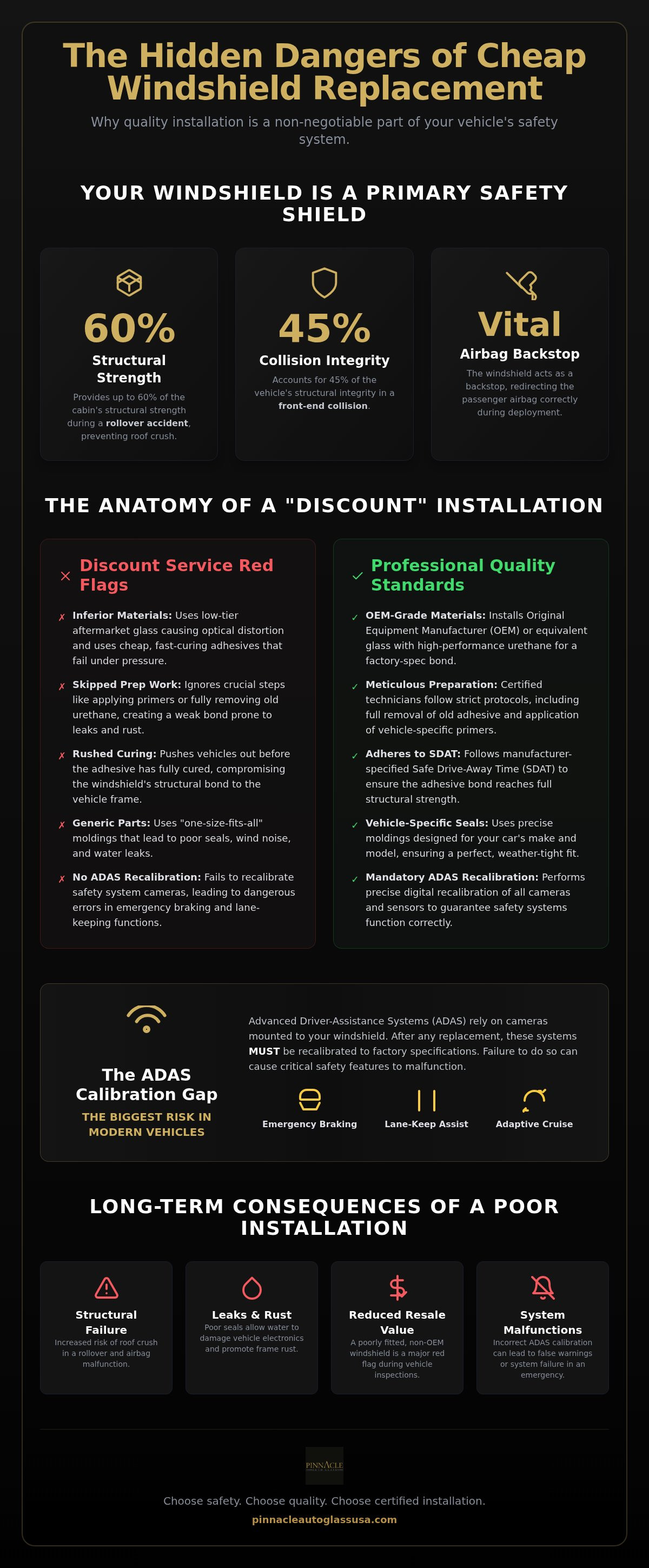
Your windshield serves as a critical structural component rather than a simple piece of glass. In a rollover accident, the windshield provides up to 60% of the cabin's structural strength. During a front-end collision, it accounts for approximately 45% of the vehicle's structural integrity. The Federal Motor Vehicle Safety Standard No. 205 establishes the specific performance requirements for glazing materials to ensure they resist impact and maintain cabin safety. One of the primary risks of cheap windshield replacement is the use of low-grade adhesives that cannot withstand these extreme forces.
When a windshield isn't bonded correctly, the "ejection risk" increases significantly. In a high-impact collision, a poorly secured windshield can detach completely from the frame. This allows the vehicle's roof to collapse more easily and increases the likelihood of passengers being thrown from the car. Maintaining a factory-grade bond is the only way to ensure these safety systems function as intended.
The Mechanics of Airbag Support
A deploying passenger-side airbag exerts thousands of pounds of pressure in a fraction of a second. It's designed to use the interior surface of the windshield as a backstop to redirect the bag toward the passenger. If a shop uses cheap, fast-curing adhesives that lack industrial strength, the glass will likely pop out upon deployment. This failure leaves the passenger without a functioning airbag and can lead to catastrophic head and neck injuries. A professional windshield replacement ensures the adhesive bond can handle this massive pressure without failing.
Rollover Protection and Roof Crush Resistance
Modern vehicle A-pillars rely on the windshield's glass-to-metal bond to prevent the roof from caving in during a rollover. "Quick-fix" installers often ignore the necessary preparation steps, such as removing old urethane or applying proper primers. This oversight weakens the entire upper structure of your vehicle. To ensure your car remains structurally sound, look for these indicators of a quality installation:
- Technicians who are certified in adhesive application.
- Use of high-performance, OEM-grade urethane.
- Adherence to strict Safe Drive-Away Time protocols.
- Complete removal of old adhesive down to the metal frame.
Restoring these factory standards is non-negotiable for driver safety. Cutting corners on the installation process effectively disables a major portion of your vehicle's safety cage. It's better to invest in a correct installation now than to face the consequences of a structural failure later.
Inferior Materials: The Chemistry of a Failed Bond
The risks of cheap windshield replacement often hide in the molecular structure of the materials used. Low-tier aftermarket glass frequently suffers from optical distortion. This isn't just a minor annoyance; it causes significant eye strain and can impair your depth perception during night driving. Professional installers prioritize materials that meet the Auto Glass Replacement Safety Standard (AGRSS) to ensure every component meets rigorous safety benchmarks. In 2026, the chemistry of the installation is just as important as the glass itself.
OEM vs. Aftermarket: More Than Just a Logo
OEM glass is manufactured to the exact specifications of your vehicle's frame. This precision is vital for the proper function of rain sensors and acoustic dampening layers that keep your cabin quiet. "Economy" glass often lacks these precise tolerances. It may not fit the frame perfectly, which creates localized stress points. These points lead to premature cracks from simple temperature changes. For a deeper look at these differences, see our guide on OEM vs Aftermarket Windshields: Which One Is Best?
The Science of Professional Adhesives
The adhesive is the most common point of failure in budget installations. High-modulus, non-conductive polyurethane is the industry standard for 2026. This material maintains the vehicle's structural stiffness and prevents interference with sensitive electronics. Discount shops often substitute these expensive urethanes for "quick-cure" industrial glues. These glues lack the necessary structural properties to support the roof or the airbag during an impact. They also fail to provide the necessary electrical insulation for modern vehicle sensors.
Safe Drive Away Time (SDAT) is a non-negotiable safety metric. It defines how long the adhesive must cure before the vehicle can be safely operated. In 2026, tech-heavy vehicles require specific curing environments to ensure the glass doesn't shift. If a shop ignores SDAT, the bond may fail during a minor collision. Additionally, skipping the priming step leads to frame corrosion. This rust eats away at the metal, making future replacements impossible and compromising the vehicle's long-term durability. Quality shops use specialized equipment to monitor temperature and humidity, ensuring the chemical bond is permanent and safe.
The ADAS Calibration Gap: The Biggest Risk in 2026
Advanced Driver Assistance Systems (ADAS) represent the most significant technological shift in modern automotive safety. These systems rely on cameras and sensors mounted directly to your glass to monitor the road. One of the primary risks of cheap windshield replacement is the failure to properly reset these sensitive components. A tiny 1-millimeter misalignment at the camera base can result in a 50-foot error for emergency braking at highway speeds. This discrepancy creates a massive safety hazard that most drivers don't realize exists. Driving with uncalibrated cameras also introduces significant liability risks for the vehicle owner. Professional windshield replacement must always include a full system recalibration to restore factory safety standards.
Passive Failure: When Your Safety Tech Lies to You
Passive failure is dangerous because it doesn't always trigger a dashboard warning light. Your Lane Departure Warning and Forward Collision Warning systems might appear active while they are actually "seeing" the road incorrectly. This creates a false sense of security. You might rely on an emergency braking system that miscalculates the distance to the vehicle ahead because the camera angle is off by a fraction of a degree. For a technical breakdown of how these sensors interact with your glass, consult the ADAS Calibration and Auto Glass: The Complete 2026 Reference Guide. Relying on misaligned tech is often more dangerous than having no tech at all.
Why Discount Shops Skip Recalibration
Most discount shops avoid recalibration because of the high barrier to entry. Professional calibration equipment requires a significant financial investment that budget-driven businesses refuse to make. They also lack the specialized training required to perform both static and dynamic calibrations correctly. A static calibration requires a controlled shop environment with specific floor leveling and target stands. Dynamic calibration involves a precise driving procedure using diagnostic software. If a shop can't provide a digital "proof of calibration" report after the install, they haven't finished the job. You should always verify that a provider has the in-house capability to perform a full system restoration before handing over your keys.
Don't leave your safety to chance with unverified sensors. Schedule your professional ADAS recalibration with our certified experts to ensure every safety feature on your vehicle works exactly as the manufacturer intended.
Choosing Quality: Long-Term Savings and Peace of Mind
The true risks of cheap windshield replacement extend far beyond the initial quote. While a discount service might save you money upfront, the total cost of ownership often skyrockets due to secondary repairs. Budget installations frequently lead to water damage in the cabin, electrical shorts from leaks, and the eventual need for a second, professional replacement. In contrast, a high-quality installation preserves your vehicle's value and ensures your safety systems remain functional for the life of the glass. At Pinnacle Auto Glass, we maintain strict national safety standards to prevent these costly "passive failures" and protect your investment.
Identifying an unsafe shop is easier when you know what to look for. Be wary of any provider that doesn't mention ADAS recalibration or suggests it's optional. Rushed labor is another major red flag. If a technician claims the job will take less than an hour, they're likely skipping essential priming and curing steps. Quality work requires precision, the right chemical environment, and a commitment to factory-spec materials. Choosing a reputable partner ensures you won't have to pay twice for the same repair.
The Professional Installation Checklist
Before you hand over your keys, verify that the service provider meets professional benchmarks. A reputable shop will be transparent about their process and the materials they use. Use this checklist to vet any auto glass business:
- Technician Certification: Confirm that the installers hold certifications from the Auto Glass Safety Council (AGSC) or an equivalent professional body.
- Adhesive Specifications: Ask about the specific brand of urethane used and its required Safe Drive Away Time (SDAT). Professional shops won't let you drive off until the bond is secure.
- Diagnostic Proof: Ensure you'll receive a detailed ADAS diagnostic report after the installation. This confirms that your cameras and sensors are functioning within manufacturer tolerances.
How to Navigate Insurance for Quality Service
Many drivers choose discount shops because they worry about high out-of-pocket costs. However, most comprehensive insurance policies in 2026 cover professional-grade glass and necessary recalibration services. You often have the legal "Right to Choose" your service provider. This means you aren't forced to use a "preferred" discount shop that might cut corners. Insurance companies generally prefer quality installations because they reduce the likelihood of future liability claims. For more details on budgeting and coverage, see our How Much Does Windshield Replacement Cost? 2026 Price & Buying Guide. Prioritizing quality through your insurance claim ensures your vehicle returns to the road in factory-safe condition.
Prioritize Your Safety with Professional Standards
Your windshield is a critical structural component, not a cosmetic accessory. We have discussed how choosing inferior materials can lead to catastrophic failures during a rollover or airbag deployment. Understanding the risks of cheap windshield replacement is the first step toward protecting your vehicle's occupants and your long-term investment. In 2026, the integration of advanced safety sensors makes professional installation and precise recalibration more important than ever before. Choosing quality today prevents expensive, dangerous failures tomorrow.
Pinnacle Auto Glass is ready to restore your vehicle to factory standards. We are certified ADAS recalibration specialists providing national fleet and commercial support. Our team maintains strict adherence to all FMVSS safety standards to ensure every installation is secure and durable. We focus on results that keep you safe on the road. Get a Professional Windshield Replacement Quote from Pinnacle Auto Glass and drive with confidence knowing your vehicle is in expert hands. We look forward to assisting you with reliable, high-quality service.
Frequently Asked Questions
Is a $99 windshield replacement safe for modern cars?
A $99 windshield replacement is not safe for modern vehicles in 2026. The cost of industrial-grade urethane and specialized labor for modern frames exceeds this price. One of the primary risks of cheap windshield replacement is the use of low-tier adhesives that fail to bond correctly. These budget services also skip the mandatory ADAS recalibration required for safety cameras. You're trading long-term safety for a very small upfront saving.
How can I tell if my new windshield was installed poorly?
You can identify poor installation by checking for wind noise, water leaks, or visible gaps in the molding. Blurry spots or waves in the glass also indicate low-quality materials. If your lane-departure warnings or emergency braking systems behave erratically, the glass is likely misaligned. A professional installation should leave no visible mess. The glass must sit perfectly flush with the vehicle frame without any uneven pressure points.
What happens if I skip ADAS recalibration after a windshield replacement?
Skipping ADAS recalibration results in the failure of your vehicle's critical safety systems. Cameras and sensors mounted on the windshield must be aligned to the millimeter to function correctly. Without professional calibration, features like automatic emergency braking and lane-keep assist will misinterpret the road. This creates a "passive failure" where the systems appear active but provide incorrect data. This increases your risk of a collision during a critical moment.
Does a cheap windshield affect my car’s structural integrity?
A cheap windshield significantly compromises your car's structural integrity. The glass provides up to 60% of the cabin's strength during a rollover and acts as a backstop for the passenger-side airbag. Low-quality glass or weak adhesives can cause the windshield to pop out during an impact. This failure removes a vital structural support, making the vehicle much more dangerous in a crash. Professional materials are required to maintain factory safety levels.
Why does my new windshield have blurry spots or distortion?
Blurry spots or distortion occur when "economy" glass is manufactured without strict quality controls. This optical distortion is a hallmark of low-tier aftermarket glass. It causes eye strain and reduces your depth perception, which is dangerous during night driving. Professional-grade glass meets higher manufacturing tolerances to ensure clear visibility. If you see waves or blurriness in your new windshield, it didn't meet the necessary safety and performance standards for modern driving.
Can a poorly installed windshield cause the roof to collapse in an accident?
Yes, a poorly installed windshield can cause the roof to collapse more easily during a rollover accident. The glass-to-metal bond provides essential support to the A-pillars and the upper frame. If a shop uses cheap adhesives or skips the priming process, that bond will fail under pressure. This allows the roof to cave into the passenger compartment. Restoring this structural strength requires high-performance urethane and a certified, meticulous installation process.
Will my insurance pay for a professional-grade windshield instead of a cheap one?
Most insurance policies in 2026 cover the cost of professional-grade glass and the necessary ADAS recalibration. You usually have the legal "Right to Choose" your service provider, allowing you to bypass "preferred" discount shops. Insurance companies often prefer professional installations because they adhere to FMVSS standards and minimize safety risks. Using your coverage for a quality repair ensures your vehicle remains structurally sound without causing high out-of-pocket expenses for the owner.


