
Did you know that nearly 88% of vehicles requiring safety system updates after a repair never actually receive them? It's a startling figure. Your windshield is no longer just a piece of glass; it's a critical housing for your car's sensors and cameras. If you've recently scheduled a repair, you might wonder if ADAS recalibration after windshield replacement is truly necessary or just an unnecessary expense.
We understand the uncertainty that comes with modern vehicle technology and the fear of hidden costs or unreliable safety systems. You rely on your car to keep you safe, and you shouldn't have to guess if your emergency braking will work when it matters most. This guide explains why recalibration is a non-negotiable safety requirement and how to ensure your system is accurately restored. We'll walk through the latest 2026 industry standards, insurance coverage details, and the specific steps needed to keep your personal or fleet vehicles performing at their best. You will gain a clear understanding of the calibration process and how to manage the technical requirements of your modern vehicle with ease.
Key Takeaways
- Understand why the forward-facing camera depends on precise windshield alignment to function as your vehicle's "eyes."
- Learn the technical differences between static and dynamic processes and why your manufacturer determines the specific method used.
- Discover why ADAS recalibration after windshield replacement is essential to prevent "ghost braking" and other dangerous system failures.
- Find out how most comprehensive insurance policies cover the cost of recalibration to ensure your safety systems are fully restored.
- Identify the critical diagnostic software and technician standards required to accurately service 2026 vehicle models.
What is ADAS Recalibration After Windshield Replacement?
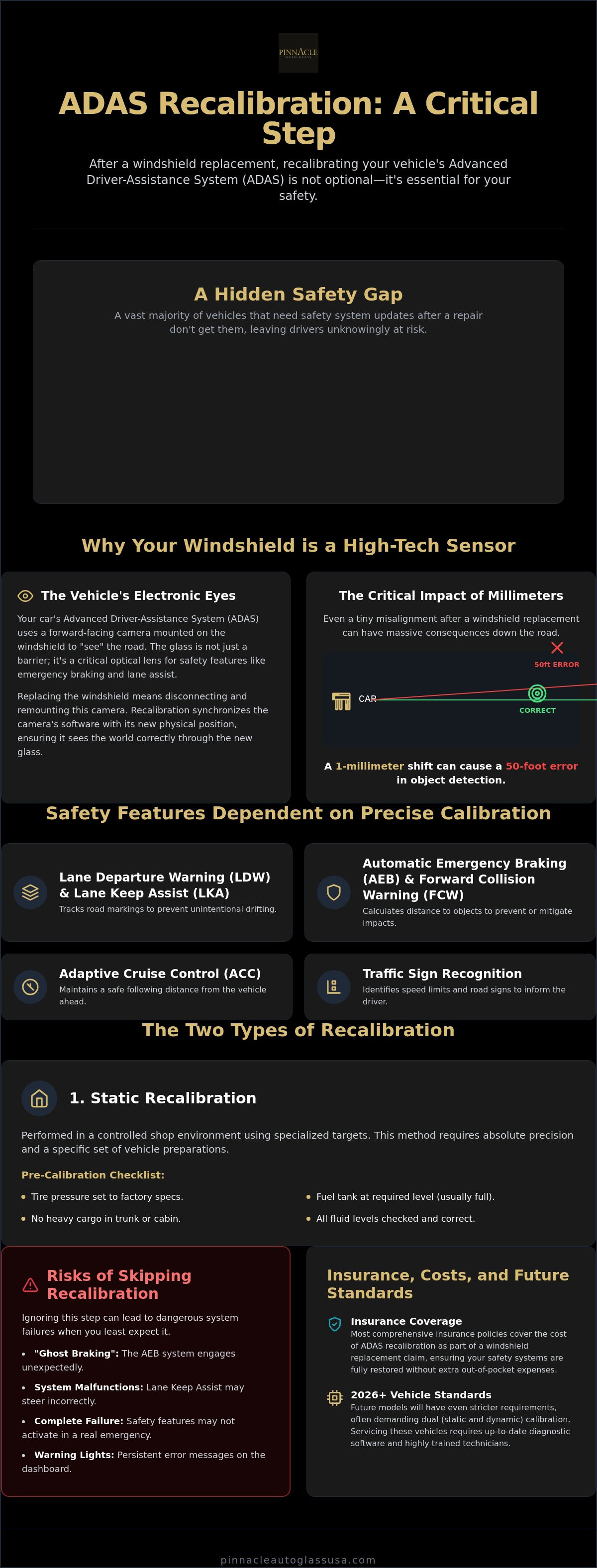
An Advanced Driver-Assistance System (ADAS) acts as the electronic eyes of your car. These systems use a network of sophisticated sensors to monitor the road and react to hazards faster than a human driver. Most modern vehicles rely on a forward-facing camera to power these features. This camera is not just near the glass; it's physically attached to a bracket on the interior of the windshield. Because the camera looks directly through the glass, the windshield becomes a functional part of the sensor's vision.
When a technician performs a windshield replacement, the camera is disconnected and removed from its mount. Even if it's reattached to the exact same spot, the new glass may have a slightly different pitch, curvature, or thickness. This is why ADAS recalibration after windshield replacement is so vital. It synchronizes the camera's software with its new physical perspective. Precision is the only acceptable standard here. A 1-millimeter shift in glass position can lead to a 50-foot error in where the vehicle perceives an object on the road ahead.
Recalibration is a mandatory safety requirement, not an optional convenience. Every vehicle manufacturer dictates that these systems must be reset after a glass change to ensure they function as intended. Skipping this step doesn't just result in an annoying dashboard light; it can cause your safety features to fail during a critical moment. You should treat recalibration as an inseparable part of the glass replacement process.
The Critical Link Between Auto Glass and Safety Sensors
The windshield serves as a high-tech optical lens for your vehicle's computer. The thickness and clarity of the glass directly impact how the camera processes visual data. If the glass has slight imperfections or is positioned incorrectly, the sensor receives distorted information that can lead to delayed reactions. The optical centerline is the precise path that light travels through the glass to the camera lens, ensuring the system calculates distances with absolute accuracy.
Common ADAS Features That Require Precise Alignment
Many standard safety tools depend on this perfect alignment to keep you safe on the road. These include:
- Lane Departure Warning (LDW) and Lane Keep Assist (LKA): These tools use the camera to track road markings and provide steering input if you drift.
- Automatic Emergency Braking (AEB) and Forward Collision Warning (FCW): These systems calculate the distance to objects ahead to prevent or mitigate impacts.
- Adaptive Cruise Control (ACC): This maintains a safe following distance by constantly monitoring the speed of the vehicle in front of you.
- Traffic Sign Recognition: This identifies speed limits and road signs in real-time to keep the driver informed.
Static vs. Dynamic Recalibration: How the Process Works
Every car manufacturer establishes a specific protocol for safety system resets. You don't get to choose the method; the vehicle's make, model, and year dictate it. Technicians use high-precision diagnostic tablets and computerized targets to communicate with the car's computer. Performing a professional ADAS recalibration after windshield replacement ensures that your vehicle's safety features respond correctly to real-world hazards. While these safety features improve protection, they also complicate repairs significantly. Many 2026 models now require a dual calibration, combining both static and dynamic steps to meet strict sensor tolerances for autonomous features.
Static Calibration: The Controlled Environment Method
Static calibration happens inside a controlled environment. The shop must have perfectly level flooring and specialized lighting to prevent glares that might confuse the sensors. Technicians set up physical targets at precise distances and heights based on the vehicle's centerline. Technicians perform this type of ADAS recalibration after windshield replacement when a vehicle requires a stationary environment to align its sensors with absolute precision. Before starting, we perform several critical vehicle preparations:
- Setting tire pressure to factory specifications to ensure the car sits level.
- Ensuring the fuel tank is at the required level, typically full, to maintain weight balance.
- Confirming the trunk and cabin are empty of heavy cargo.
- Checking all fluid levels to ensure the suspension is at its standard operating height.
Dynamic Calibration: Real-World Road Testing
Dynamic calibration takes the process to the pavement. A technician drives the vehicle on well-marked roads at a steady, manufacturer-specified speed. During this drive, the system identifies lane lines, signs, and landmarks to learn its position relative to the horizon. This isn't a casual drive; it requires specific conditions to succeed. Heavy rain, snow, or faded road markings can prevent the sensors from locking in. High traffic volume can also interfere with the camera's ability to focus on stationary markers. If the environment isn't ideal, the process must be restarted until the system confirms a successful sync.
Getting this right is about more than just clearing a code. It's about restoring the digital safety net you rely on every day. If you need expert assistance, you can trust a professional to handle your professional ADAS recalibration alongside your glass replacement for a seamless, safe result.
The Risks of Skipping ADAS Recalibration After Glass Service
Many vehicle owners assume that if no warning lights appear on the dashboard, their safety systems are functioning correctly. This is a dangerous misconception. Modern safety computers don't always detect a physical misalignment of the camera lens. The system may believe it's looking straight ahead when it's actually angled slightly toward the pavement or an adjacent lane. Skipping ADAS recalibration after windshield replacement creates a "silent failure" state where the car provides a false sense of security while its safety net is compromised.
One of the most unsettling results of this misalignment is "ghost braking." This occurs when the forward-facing camera misidentifies a shadow, a bridge underpass, or a manhole cover as a solid obstacle. Because the camera's perspective is skewed, it triggers the Automatic Emergency Braking (AEB) system without warning. Sudden, unexpected braking on a highway can lead to rear-end collisions and severe injuries. Conversely, a misaligned system might fail to recognize a pedestrian or a stopped vehicle entirely. For more technical details on how these malfunctions occur, you can review the official documentation on Troubleshooting Advanced Driver Assistance Systems.
Why a 'Minor' Misalignment Leads to Major Safety Failures
The technical reason behind these errors is the Angle of Incidence. Think of it like a laser pointer. If you move your hand a fraction of a degree, the red dot moves only slightly on a nearby wall but shifts several feet on a building across the street. At highway speeds, your car tracks objects hundreds of feet away. A tiny deviation at the windshield causes the computer to calculate distances incorrectly. This faulty data leads to aggressive steering corrections from Lane Keep Assist or improper braking interventions. Your ADAS is designed for worst-case scenarios where milliseconds and millimeters determine the outcome of a crash.
Liability and Insurance Implications for Vehicle Owners
Choosing to bypass safety protocols carries significant financial and legal weight. If you're involved in an accident and it's discovered that you skipped a mandatory ADAS recalibration after windshield replacement, your insurance provider may deny the claim. They often consider uncalibrated sensors as a failure to maintain the vehicle in a roadworthy condition. Most professional shops now use a Post-Repair Scan to document that all systems are restored to factory standards. You should always maintain a detailed service record from a certified auto glass technician to prove compliance. This documentation protects you from personal liability and ensures your safety features work exactly as the manufacturer intended.
Navigating the Recalibration Process: Costs, Time, and Insurance
Managing the logistics of a modern vehicle repair shouldn't be a burden for the owner. A standard service session for your vehicle typically lasts between 1 and 3 hours. This timeframe includes the physical glass installation and the subsequent technical sensor synchronization. You don't have to coordinate between a glass shop and a dealership when you choose an end-to-end provider. When you are reviewing quotes, remember that the total windshield replacement cost should always include a specific line item for the calibration. This ensures transparency and guarantees that ADAS recalibration after windshield replacement is handled correctly before you get back on the road.
OEM vs. Aftermarket Glass: Impact on Sensor Accuracy
The quality of the glass is just as important as the skill of the technician performing the work. Original Equipment Manufacturer (OEM) glass is produced using the exact same molds and specifications as your factory windshield. This is often the preferred choice for vehicles with high-complexity safety systems found in 2026 models. High-complexity sensors require a specific "clarity zone." This is a designated area of the glass that must be free of even the smallest optical distortions or waves. If the glass thickness varies or the mounting bracket is slightly off-center, the camera cannot "see" the road correctly. OEM glass ensures the mounting bracket is bonded with factory-level precision. Precision is key. This accuracy is vital for a successful sensor sync, as even a minor deviation can cause the software to reject the calibration attempt.
Working with Insurance Providers for Calibration Coverage
Most comprehensive insurance policies treat ADAS recalibration after windshield replacement as a necessary part of a safe and complete glass repair. You should verify your coverage before the technician arrives to avoid any unexpected out-of-pocket expenses. Follow these steps to ensure a smooth claim:
- Contact your insurance agent or use their mobile app to confirm your specific glass deductible.
- Ask specifically if ADAS services are covered as part of a standard glass claim under your policy.
- Request a copy of the itemized work order to provide to your adjuster for verification.
- Keep all digital records of the post-repair scan for your vehicle's permanent service history.
If an insurer refuses to pay for these critical safety steps, you have the "Right to Appraisal." This legal protection allows an independent third party to determine the fair and necessary cost of the repair. Pinnacle Auto Glass assists with all necessary documentation and direct insurance billing support to simplify your claim process.
Ensure your safety systems are accurately restored by scheduling your professional ADAS recalibration with our expert team today.
Choosing the Right Professional for Your Recalibration Needs
Selecting a service provider is the final step in ensuring your vehicle's safety network is fully operational. You need a team that understands the intersection of structural glass and computer science. A proper ADAS recalibration after windshield replacement requires more than just basic mechanical skills. It demands a significant investment in both technician training and the latest diagnostic software. Choosing a single provider for both the glass installation and the sensor sync streamlines the process. This approach eliminates the need to coordinate between multiple shops and ensures that one team is accountable for the final result.
Always ask for a final calibration report once the service is complete. This document serves as a digital certificate of health for your vehicle's safety systems. It provides a record for your insurance company and helps maintain the resale value of your car. If you ever sell your vehicle, having proof of professional safety maintenance is a major advantage. It shows that you prioritized the integrity of the car's advanced features.
Why Certified Technicians Are Essential for Modern Safety Systems
Certification is the clearest indicator of quality in the auto glass industry. Technicians must undergo rigorous training to operate complex ADAS diagnostic tools correctly. These tools communicate directly with your car's computer to verify sensor alignment. Many unqualified shops attempt to save costs by using outdated or generic software. This is a significant risk for 2026 models, which often feature specialized sensor tolerances for newer EV and autonomous platforms. Adhering to professional windshield replacement standards ensures that the glass is prepared correctly before the software sync even begins.
The Pinnacle Auto Glass Approach to Precision Safety
Commercial fleet operators and individual drivers alike require a partner that offers nationwide service standards. Managing a large number of vehicles requires consistent results across every repair. A failed safety system in a fleet vehicle isn't just a safety risk; it's a massive liability for the business. We provide comprehensive support designed to minimize downtime and maximize protection. Our goal is simple: we restore every vehicle to its original factory safety state through rigorous testing protocols. Our technicians handle the ADAS recalibration after windshield replacement with the same precision used by the manufacturer. We simplify the technical complexities of modern safety tech so you can focus on the road ahead.
Secure Your Vehicle's Safety Future
Modern driving depends on the invisible digital safety net built into your windshield. As vehicle technology evolves in 2026, the need for precision only grows. You now understand that even a minor glass shift can disrupt critical systems like emergency braking and lane keep assist. Proper ADAS recalibration after windshield replacement ensures these features function exactly as the manufacturer intended. It protects your liability, your insurance coverage, and most importantly, your passengers.
Don't leave your safety to chance or unqualified providers. You deserve a seamless repair process that prioritizes your time and security. Our team provides the specialized tools and expertise needed to restore your vehicle to its factory safety state. Benefit from our expert ADAS technicians, national service standards, and direct insurance billing support. Schedule your professional windshield replacement and ADAS recalibration with Pinnacle Auto Glass today. We are ready to help you get back on the road with total confidence in your vehicle's performance.
Frequently Asked Questions
Is ADAS recalibration really necessary after a windshield replacement?
Yes, recalibration is a non-negotiable requirement for any vehicle equipped with safety sensors. The forward-facing camera is mounted directly to the glass; even a microscopic shift in the new windshield's position changes the camera's field of vision. Without this service, your car's computer won't accurately "see" the road, leading to dangerous errors in distance and alignment calculations.
How much does ADAS recalibration cost in 2026?
The cost of ADAS recalibration after windshield replacement depends on your vehicle's specific technology and whether it requires a static or dynamic process. High-end luxury models or newer EVs often have more sensors that require additional time and specialized diagnostic tools. Most professional shops provide an itemized quote that includes these technical steps alongside the glass replacement.
Can I drive my car before the ADAS is recalibrated?
You should avoid driving your vehicle until the safety systems are fully restored. An uncalibrated camera can trigger unexpected steering corrections or emergency braking at the wrong time. If you must drive, you should manually disable your driver-assist features, though some systems remain active in the background. It's safer to have the work completed before leaving the shop.
Does insurance cover the cost of windshield camera recalibration?
Most comprehensive insurance policies cover the full cost of recalibration as part of a legitimate glass claim. Insurers recognize that these systems are essential safety components, not optional upgrades. We recommend verifying your specific deductible with your provider before the service begins. Many professional glass companies handle the direct billing and documentation for you.
How long does the recalibration process typically take?
A professional recalibration session typically takes between 1 and 3 hours to complete. This window allows the technician to perform a pre-scan, set up the specialized targets for a static process, or conduct the necessary road testing for a dynamic calibration. Complex 2026 models requiring a dual calibration process may sit at the longer end of that timeframe.
What happens if I choose not to recalibrate my safety sensors?
Choosing to skip this service puts you at significant physical and financial risk. Your vehicle may experience "ghost braking" or fail to stop during a genuine emergency. Additionally, you face personal liability if an accident occurs and it's proven that you knowingly operated a vehicle with compromised safety systems. Insurance companies often deny claims for unmaintained safety equipment.
Will I get a warning light if my windshield camera is misaligned?
You won't always see a warning light or an error code on your dashboard. Many systems continue to operate with a "silent failure" where they process distorted data without realizing the camera is misaligned. This is why professional testing is the only way to confirm your sensors are accurate. Don't rely on your dashboard lights to determine if your car is safe.
Do all new cars require recalibration after glass work?
Nearly every new vehicle produced today requires a reset after glass work if it features lane-keep assist or emergency braking. As of 2026, these systems are standard across most manufacturers, not just luxury brands. If your windshield has a camera mounted behind the rearview mirror, you must perform an ADAS recalibration after windshield replacement to maintain factory safety standards.


