
Did you know that 85% of new vehicles sold in 2026 are equipped with at least one ADAS feature that relies on windshield-mounted cameras? For most drivers, a small rock chip feels like a minor inconvenience that can wait. However, neglecting a simple autoglass repair can quickly lead to expensive cracks and compromised safety systems. You want a vehicle that protects you, but you also need to avoid the downtime that stalls your business or personal life.
It's frustrating when a small crack threatens your vehicle's structural integrity and your peace of mind. We understand that you need a solution that is both technically precise and minimally disruptive. This guide provides a comprehensive look at modern glass service, from structural standards like FMVSS 212 to the critical nuances of ADAS recalibration. You'll learn how to identify when a repair is possible, understand the 2026 legal requirements for sensor safety, and discover the most efficient ways to handle insurance claims for personal or fleet vehicles.
Key Takeaways
- Understand why your windshield provides up to 45% of your vehicle's structural integrity and how it facilitates proper airbag deployment during a collision.
- Learn to evaluate glass damage using the "Driver’s Primary View" rule to determine if a simple fix or a full replacement is necessary.
- Discover why precise ADAS recalibration is a non-negotiable step in modern autoglass repair to ensure your safety sensors remain accurate.
- Identify specialized glass standards for fleet and commercial vehicles to minimize business downtime and maintain heavy-duty safety requirements.
- Learn how to select a professional service provider that utilizes OEM-equivalent glass and high-grade urethanes for every installation.
The Evolution of Autoglass Repair: Why Prompt Action is Critical in 2026
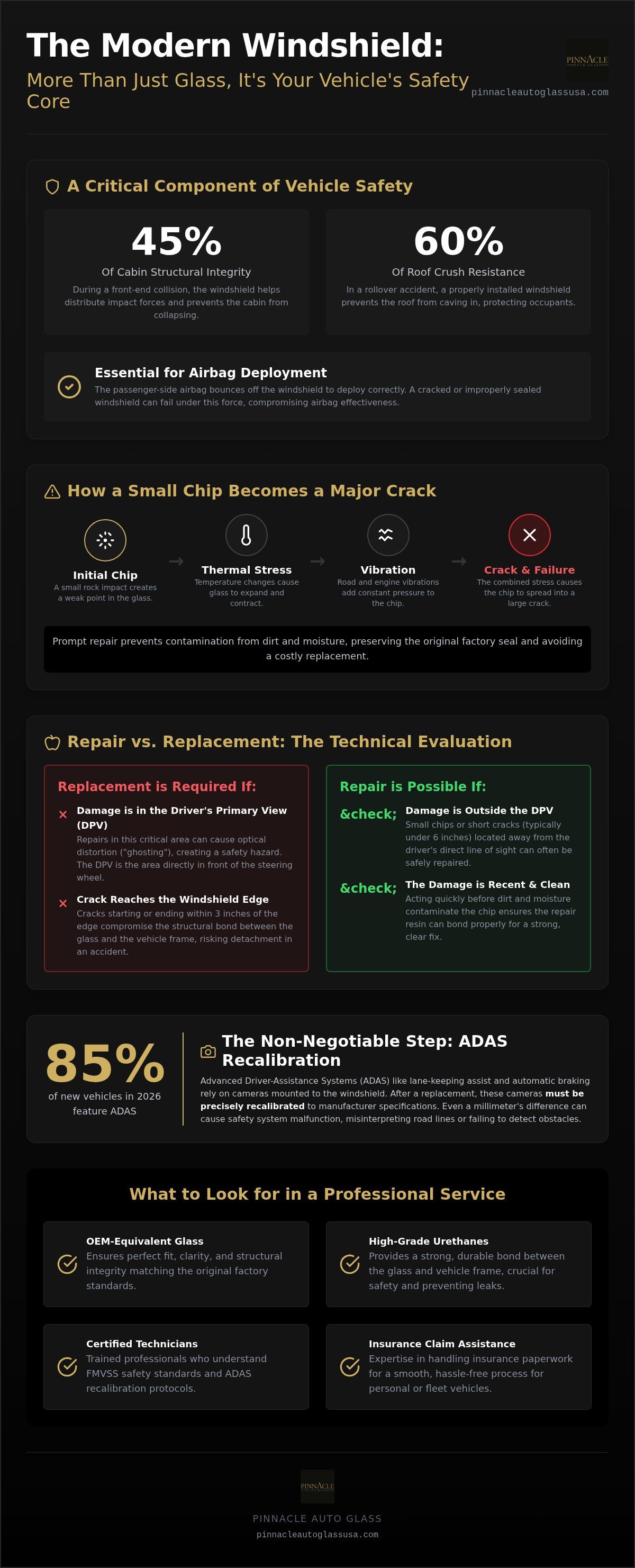
Modern vehicle engineering has transformed the windshield from a simple transparent barrier into a sophisticated safety component. In 2026, your windshield provides up to 45% of the cabin's structural integrity during a front-end collision and up to 60% in a rollover accident. Modern windshields are generally made of laminated safety glass, which consists of two layers of glass with a polyvinyl butyral (PVB) interlayer. This specific construction ensures the glass stays intact even when shattered, preventing passengers from being ejected and maintaining the vehicle's rigid frame.
Professional autoglass repair is no longer just about aesthetics or visibility. It's about maintaining the manufacturer's original safety specifications. When a windshield is compromised, the entire safety cage of the vehicle is weakened. This evolution in automotive design means that even a minor chip can have cascading effects on the vehicle's performance and occupant protection. Small chips can compromise the seal and thermal properties of the glass, leading to a total failure of these safety functions if left unaddressed.
The Structural Role of Automotive Glass
The windshield acts as a critical support beam for the vehicle's roof. In the event of a rollover, the glass prevents the roof from caving in on passengers. Additionally, the passenger-side airbag relies on the windshield for support during deployment. When the airbag inflates, it bounces off the interior surface of the glass at high speeds. If the glass is cracked or the seal is weak, the force of the airbag can displace the windshield, causing the safety system to fail. In modern unibody vehicles, the glass is a mandatory structural member that distributes energy throughout the frame during an impact.
The Escalation of Glass Damage
Small chips don't stay small for long. Environmental factors in 2026, including extreme temperature fluctuations, accelerate the spread of stress cracks. When a chip occurs, dirt and moisture immediately begin to penetrate the impact site. This contamination prevents the resin used in windshield repair from bonding correctly with the glass. Constant road stress and vehicle vibrations further weaken the compromised area, often leading to a sudden, spider-webbing crack while the vehicle is in motion.
- Thermal Stress: Rapid changes from interior air conditioning to intense outside heat cause the glass to expand and contract, turning chips into cracks.
- Vibration: Standard road stress and engine vibrations put constant pressure on compromised glass.
- Contamination: Road oils, moisture, and debris seep into the interlayer, making a successful, clear repair impossible over time.
Prompt autoglass repair preserves the factory seal and prevents the need for a full replacement. Acting quickly ensures that the multi-layered safety component remains capable of protecting you and your passengers as originally intended.
Windshield Repair vs. Replacement: A Technical Evaluation Framework
Determining the appropriate course for autoglass repair involves more than a cursory glance at a chip. Technicians use a specific framework to evaluate whether the glass can be safely restored or if the structural bond is too far gone. This assessment aligns with Federal motor vehicle safety standards, ensuring that every decision prioritizes occupant protection over convenience. If the damage is ignored, what started as a simple fix can quickly escalate into a safety failure.
One of the most important factors is the Driver's Primary View (DPV). This area is roughly the size of a standard piece of paper located directly in front of the steering wheel. Even a microscopic repair in this zone can cause light refraction or "ghosting" at night. This optical distortion is a significant safety hazard. Because of this, industry standards dictate that any damage within the DPV usually warrants a full replacement to ensure a clear, unobstructed line of sight.
Edge cracks present another critical technical challenge. These cracks start or end within three inches of the windshield's perimeter. Because the windshield is bonded to the vehicle frame using high-strength urethane, damage near the edge significantly weakens this structural seal. A compromised edge can lead to the windshield detaching during an accident; it's a risk that professional technicians won't take. If you're unsure about the severity of your damage, you can consult with our certified technicians for a definitive safety assessment.
Criteria for Professional Glass Repair
Repair is a viable option when the damage is superficial and localized. For a successful outcome, the damage must meet these technical requirements:
- The impact must be limited to the outer layer of the laminated glass only.
- The chip or crack must be smaller than one inch in diameter, which is roughly the size of a quarter.
- The damage must be located at least three inches away from the glass edge to preserve the urethane bond.
- The impact site must be free of heavy contamination from dirt or road oils.
When Full Replacement is Non-Negotiable
Replacement is required if a crack penetrates both layers of the laminated glass. If you can feel the damage on both the inside and outside of the windshield, the resin cannot restore the necessary structural tension. Modern vehicles with Advanced Driver Assistance Systems (ADAS) have even stricter requirements. Damage located directly over internal cameras, LIDAR, or rain sensors will always require a professional windshield replacement. This ensures that the safety sensors can "see" clearly through the glass without any interference from repair resins or glass imperfections.
Beyond the Glass: The Essential Role of ADAS Recalibration
In 2026, a windshield is no longer just a structural component. It serves as the primary housing for Advanced Driver Assistance Systems (ADAS). These systems use high-definition cameras and sensors to monitor the road and protect passengers. When you undergo an autoglass repair that involves a full replacement, the camera's mounting point is physically disturbed. Even if the technician reattaches the camera to the same bracket, its alignment relative to the road has changed. According to the Auto Glass Safety Council (AGSC), failing to recalibrate these sensors violates essential safety protocols and can leave your vehicle’s safety suite non-functional.
Precision is the most critical factor in modern glass service. A one-millimeter deviation at the camera lens translates to a significant error margin at highway speeds. If the camera is tilted slightly down, the Forward Collision Warning may trigger too late. If it's tilted up, the system might miss an obstacle entirely. This level of accuracy is why professional autoglass repair has transitioned from a mechanical trade into a high-tech calibration service. You can't rely on the glass alone to keep you safe; the software must be perfectly aligned with the hardware.
Static vs. Dynamic Recalibration Processes
Static recalibration takes place in a highly controlled shop environment. Technicians use specialized laser levels and physical targets to reset the camera's field of vision. This process requires a perfectly level floor and specific lighting conditions to succeed. Dynamic recalibration involves a prescribed test drive. The vehicle must be driven at specific speeds on roads with clear lane markings so the onboard computer can "learn" its surroundings. Some manufacturers require a dual process. This combination of static and dynamic steps ensures the highest level of safety validation for the vehicle’s specific safety suite.
The Consequences of Misalignment
Misalignment leads to dangerous and unpredictable system behavior. If the camera is off by a fraction of an inch, it may misinterpret road data, causing "phantom braking" where the car stops abruptly without cause. This creates a massive liability for vehicle owners and fleet managers alike. The correlation between camera angle and emergency braking distance is absolute; even a slight tilt can delay the system's reaction time by several critical seconds. For a deeper dive into these technical requirements, see our guide on ADAS calibration auto glass. Ensuring these systems function correctly is the only way to guarantee the safety outcomes promised by modern vehicle technology.
Specialized Solutions for Fleet and Commercial Vehicle Glass
Fleet operations require a specialized approach to autoglass repair. Commercial assets like delivery vans, box trucks, and semi-trucks face constant exposure to highway debris and extreme weather. High-mileage routes significantly increase the statistical likelihood of glass damage. For a logistics company, a cracked windshield isn't just an eyesore; it's a liability that can halt operations and trigger costly DOT violations. We understand that vehicle downtime directly impacts your bottom line.
The economic impact of a grounded vehicle is substantial. Every hour a delivery van sits idle is an hour of lost revenue and potential service delays. Strategic scheduling is the solution. Professional glass providers coordinate with fleet managers to perform repairs during off-peak hours or while vehicles are stationed at the depot. This proactive coordination ensures that your drivers stay on the road without compromising safety or structural integrity.
Heavy-Duty Glass for Commercial Trucks
Commercial truck glass is engineered for maximum durability. Semi-truck windshields are significantly thicker than those found in passenger vehicles to withstand higher wind loads and debris impact. Maintaining perfect visibility is a legal requirement under Department of Transportation (DOT) safety regulations. A single large crack can lead to an immediate "out-of-service" order during a roadside inspection. By reducing fleet downtime with mobile glass repair, operators can resolve these issues at their own facility. This eliminates the need for expensive towing or logistical rerouting.
Managing Multi-Vehicle Fleet Maintenance
Efficiency in fleet management requires centralized systems and consistent safety standards. For operators managing a regional or national fleet, a professional glass partner provides streamlined insurance handling and centralized billing. This reduces the administrative burden on your dispatch and accounting teams. A proactive chip repair program is the most cost-effective way to manage your assets. Fixing small chips immediately prevents them from spreading into large cracks that require a full replacement. If you need to secure your commercial assets, you can schedule a fleet service assessment to establish a maintenance protocol that fits your operational needs.
Maintaining a fleet involves balancing speed with precision. Our technicians are trained to handle the specific glass requirements of heavy-duty vehicles, ensuring that every autoglass repair meets rigorous commercial safety standards. This commitment to quality helps you maintain your safety ratings and protects your most valuable assets: your drivers and your vehicles.
Selecting a Professional Auto Glass Specialist for Your Vehicle
Choosing the right partner for autoglass repair is a decision that directly affects your vehicle's long-term safety. It's essential to select a provider that utilizes Original Equipment Manufacturer (OEM) equivalent glass. This ensures the replacement matches the exact dimensions, tint, and clarity of your factory windshield. High-grade urethanes are equally critical; these adhesives provide the structural bond necessary for proper airbag deployment and roof strength. Using sub-standard materials can compromise the safety cage of your vehicle during an accident.
Technician expertise remains the foundation of quality service. You should evaluate a provider based on their adherence to industry safety standards and their investment in specialized training. Modern glass work requires a blend of mechanical skill and technical knowledge, particularly when handling sensitive safety sensors. While mobile service offers unmatched convenience for most repairs, certain complex recalibrations may require the controlled environment of a professional shop. A dependable specialist will guide you to the most effective service model for your specific vehicle requirements.
Navigating the Insurance Claims Process
Professional glass services integrate directly with major auto insurance providers to simplify your experience. Many drivers are eligible for "no-fault" glass claims, which often allow for repairs without impacting your monthly premiums. In specific states, insurance laws mandate deductible waivers for windshield services, potentially eliminating your out-of-pocket costs. Specialists handle the complex paperwork and digital filings directly with your carrier to ensure a seamless process. If you're paying for the service yourself, reviewing the how much does windshield replacement cost framework can help you understand the current market pricing for 2026.
The Pinnacle Standards for Quality and Safety
At Pinnacle Auto Glass, we maintain a strict commitment to ADAS precision and structural integrity. We recognize that your safety depends on the perfect alignment of every sensor and the strength of every bond. Our mobile service model is designed to provide this high-level technical care without disrupting your daily schedule. We act as your authoritative guide, ensuring that your personal or commercial vehicles meet every manufacturer safety specification. Don't leave your vehicle's safety to chance. Schedule your professional auto glass service with Pinnacle Auto Glass today to ensure your vehicle is handled with the expertise it deserves.
Secure Your Vehicle’s Future and Safety
Modern driving in 2026 demands more than just a clear view through your windshield. You've seen how automotive glass provides nearly half of your car's structural strength and houses the sensors that power your safety systems. Choosing the right partner for autoglass repair ensures that every camera is perfectly aligned and every bond meets factory standards. Whether you manage a large logistics fleet or drive a personal vehicle, maintaining these components is a non-negotiable safety priority.
To ensure your entire vehicle remains in peak condition beyond just the glass, check out Auto Beauty Center for comprehensive maintenance and repair services.
Pinnacle Auto Glass offers the technical precision you need to stay safe on the road. We provide expert ADAS recalibration with every replacement and specialized services for commercial fleets to minimize your downtime. Our professional mobile service brings this expertise directly to your location for maximum convenience. Get a Professional Quote for Your Autoglass Repair today to restore your vehicle's integrity. We are ready to help you get back on the road with total confidence.
Frequently Asked Questions
Is it safe to drive with a cracked windshield?
It is not safe to drive with a cracked windshield because the glass provides up to 45% of the cabin's structural integrity. A crack can expand suddenly due to temperature changes or road vibration. This leads to a full failure of the safety component. Additionally, a compromised windshield may fail to support the passenger-side airbag during deployment. This leaves you and your passengers at significant risk during a collision.
How long does a typical autoglass repair take?
A standard autoglass repair for a small chip typically takes about 30 minutes to complete. If you require a full windshield replacement, the process usually takes between 60 and 90 minutes. You must also account for the safe drive-away time. This is the period required for the adhesive to cure properly before the vehicle is safe to operate. Most drivers are back on the road in under two hours.
Will my insurance cover the cost of ADAS recalibration?
Most insurance policies cover ADAS recalibration when it is part of a necessary windshield replacement. If you have comprehensive coverage, insurers generally treat recalibration as a mandatory safety requirement rather than an optional add-on. We handle the paperwork directly with your insurance carrier to ensure the process is seamless. This ensures that your safety systems are fully restored to manufacturer specifications without unnecessary administrative stress for you.
What is the difference between a chip and a crack?
A chip is a small, localized impact point where a rock or debris hit the glass, often appearing as a bullseye or star shape. A crack is a distinct line where the glass has actually separated. While many chips are eligible for a quick autoglass repair, cracks are more likely to require a full replacement. This is especially true if they are longer than a few inches or reach the edge of the glass.
Can a windshield be repaired if the damage is in the driver’s line of sight?
Industry safety standards generally prohibit repairs in the driver's line of sight, also known as the Driver's Primary View (DPV). Even a high-quality resin repair can cause slight optical distortions or light refraction. These visual imperfections can be distracting or dangerous during night driving. A full replacement is the professional recommendation for damage in this critical area to ensure your vision remains completely unobstructed while on the road.
How long should I wait to drive my car after a windshield replacement?
You should wait at least one hour after the installation is finished before driving your vehicle. This is known as the Safe Drive-Away Time (SDAT). This hour allows the high-strength urethane adhesive to bond sufficiently to the frame. Driving too soon can cause the windshield to shift. This compromises the seal and your safety in the event of an accident. Always follow the technician's specific timing instructions for your vehicle.
What happens if I don’t recalibrate my cameras after a glass replacement?
Skipping recalibration can cause your Advanced Driver Assistance Systems to malfunction or fail entirely. Cameras that are off by even a millimeter can trigger "phantom braking" or fail to detect lane departures correctly. This creates a significant safety risk and potential liability for the owner. Proper recalibration ensures that your vehicle’s safety software accurately interprets the physical environment around you. It is a critical step for modern vehicle maintenance.
Do you provide mobile services for semi-trucks and commercial fleets?
Yes, we provide professional mobile services specifically designed for semi-trucks, box trucks, and delivery vans. We understand that fleet downtime is a major expense for logistics businesses. Our technicians travel to your depot or job site to perform repairs and replacements. This allows your drivers to get back on the road without the need for a shop visit. We focus on efficiency to keep your commercial operations moving without delay.


