
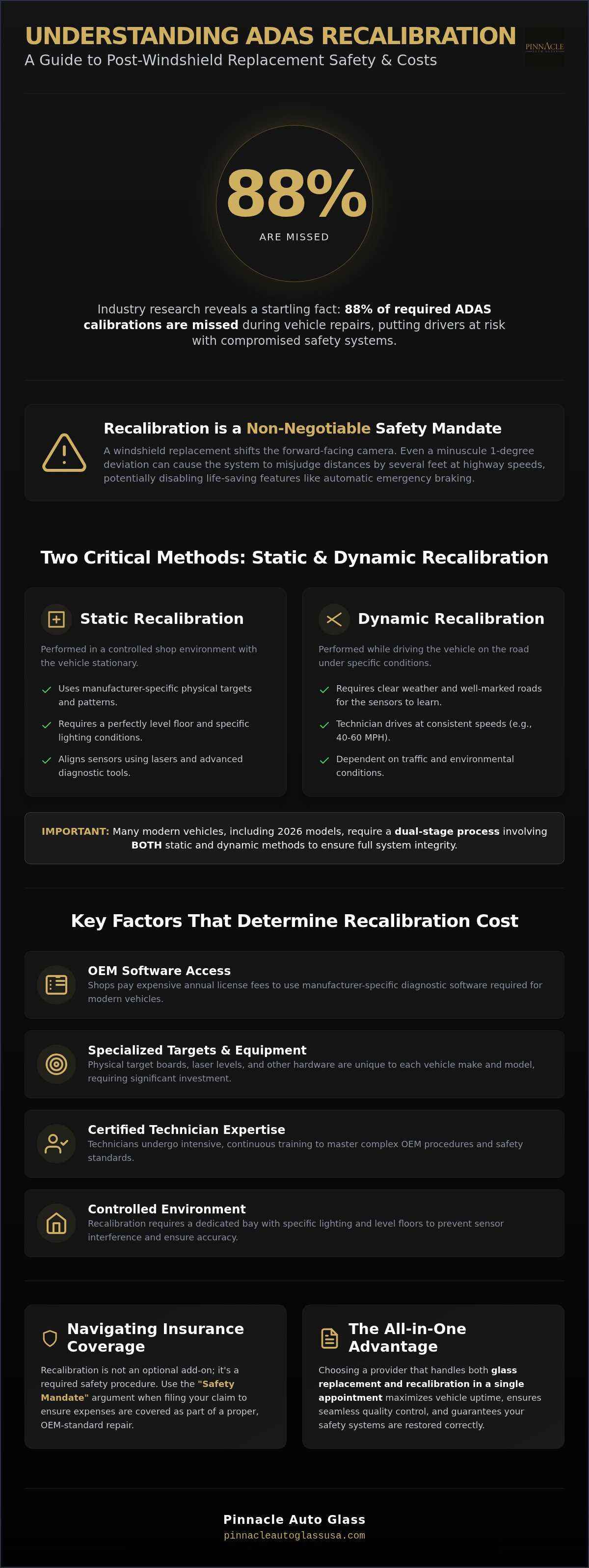
Industry research shows that 88% of required ADAS calibrations are missed during vehicle repairs. This startling figure means many drivers are operating vehicles with compromised safety sensors without even knowing it. When you receive a quote for a windshield replacement, the additional cost to recalibrate ADAS systems often feels like an unexpected tech fee. It's natural to feel sticker shock or confusion regarding whether your insurance policy will cover these specialized services.
We understand that you prioritize both your budget and your family's safety. This 2026 guide provides the transparency you need to make informed decisions. You will discover the specific technical factors that drive recalibration pricing and learn how to navigate the insurance claim process effectively. We also explain why restoring your vehicle to exact OEM standards is the only way to ensure your automatic braking and lane-departure warnings function as intended. This overview moves from identifying your technical needs to confirming your coverage, ensuring you leave with total confidence in your vehicle's performance.
Key Takeaways
- Understand why ADAS recalibration is a mandatory technical alignment required after windshield replacements to ensure sensor accuracy.
- Learn the differences between static and dynamic procedures and how each method impacts the total cost to recalibrate ADAS systems.
- Identify how your vehicle's specific make and model, including modern 2026 dual-camera systems, influence the complexity of the service.
- Discover how to navigate insurance claims to cover recalibration expenses under the "Safety Mandate" argument for guaranteed system integrity.
- Find out why choosing a provider that handles both glass replacement and recalibration in one appointment maximizes vehicle uptime and safety.
Understanding the Cost to Recalibrate ADAS Systems
ADAS recalibration is a precision process that aligns the physical sensors and digital software of your vehicle. These Advanced Driver-Assistance Systems (ADAS) rely on cameras, radar, and lidar to "see" the road. When you replace a windshield, you are moving the bracket that holds the forward-facing camera. Even a movement of a few millimeters changes the camera's field of view. This necessitates a professional recalibration to ensure the computer interprets visual data correctly.
Many drivers assume that if no warning lights appear on the dashboard, the system functions perfectly. This is a dangerous misconception. Sensors can be misaligned enough to provide inaccurate data without triggering a system fault light. The cost to recalibrate ADAS systems reflects the specialized labor and technology required to verify these tolerances. It's a necessary step to ensure your safety features aren't just present, but active and accurate.
Why Recalibration is a Safety Mandate
Precision is the difference between a safe stop and a collision. A deviation of just one degree in a camera's mounting can cause the system to miscalculate the distance to an obstacle by several feet at highway speeds. This error could prevent your automatic emergency braking from engaging in time. If the camera thinks an object is further away than it actually is, the reaction time of the vehicle slows down.
Failing to restore these systems to OEM specifications creates significant liability for both vehicle owners and service shops. If a safety system fails to deploy during an accident because it wasn't calibrated after a repair, the legal and financial consequences are severe. You can learn more about the integration of glass and safety tech in our Professional Windshield Replacement: The Complete Safety and Technology Guide.
The Components Involved in the Price
Several backend factors influence the cost to recalibrate ADAS systems. It isn't a simple "plug-and-play" task. Shops must invest in a specific infrastructure to perform this work correctly. The price you pay covers these essential resources:
- OEM Software Access: Shops pay for expensive annual licenses to access manufacturer-specific diagnostic software for 2026 models.
- Specialized Targets: Static recalibration requires physical target boards that are unique to each vehicle make and sensor type.
- Technician Expertise: Certified technicians undergo intensive training to master complex safety standards and diagnostic tools.
- Facility Overhead: Recalibration requires a controlled environment with perfectly level floors and specific lighting to prevent sensor interference.
These investments ensure your vehicle leaves the shop in a condition that meets original factory safety standards. It's about restoring the digital safety net your vehicle provides.
Static vs. Dynamic Recalibration: Cost and Complexity
The specific method used to align your vehicle's sensors significantly influences the cost to recalibrate ADAS systems. Manufacturers define these procedures based on the sensor technology installed in your car. There are two primary categories: static and dynamic. While some vehicles only require one, a growing number of 2026 models from brands like Honda, Toyota, and Mercedes require a dual-stage process involving both methods. This complexity directly impacts the labor hours and specialized tools required for the job.
Dynamic recalibration occurs while the vehicle is in motion. A technician connects a handheld diagnostic device to the car's computer and drives it under specific conditions. Static recalibration, by contrast, happens inside a specialized facility using high-tech target boards and laser levels. The choice isn't up to the shop; it's a requirement set by the vehicle's original manufacturer to ensure safety systems operate within factory tolerances.
Dynamic Recalibration Requirements
Dynamic recalibration requires a technician to take the vehicle on the road to "teach" the sensors how to recognize real-world surroundings. This process is highly dependent on external factors. The technician needs:
- Clear weather with no heavy rain, fog, or snow.
- Well-maintained roads with clearly visible lane markings.
- Consistent speeds, typically between 40 and 60 MPH, for a set duration.
Static Recalibration and Shop Infrastructure
Static recalibration is a highly controlled procedure performed inside a specialized service bay. Technicians use physical target boards, laser levels, and radar reflectors to simulate road conditions while the car is stationary. This method is common for luxury brands and vehicles with complex 360-degree camera systems. The facility must meet strict requirements, such as perfectly level flooring and neutral lighting to prevent camera glare. Unobstructed space around the vehicle is also vital, often requiring a bay 30 feet or longer.
Because of the high overhead and expensive equipment, static procedures often result in a higher total cost to recalibrate ADAS systems. For a deeper look into these technical requirements, see our ADAS Calibration and Auto Glass: The Complete 2026 Reference Guide. Choosing a shop with the right infrastructure ensures your safety systems are restored to factory standards without guesswork.
Factors That Influence Your Recalibration Estimate
Every vehicle has a unique digital footprint that dictates the cost to recalibrate ADAS systems. A basic sedan with a single forward-facing camera requires less time and equipment than a luxury SUV equipped with a suite of surround-view sensors. As we move through 2026, the complexity of these systems continues to rise. Modern safety suites often integrate multiple technologies, meaning a single calibration event may actually involve several distinct software procedures to ensure the vehicle's computer "handshakes" correctly with every piece of hardware.
Pricing also varies between dealerships and independent specialists. Dealerships often charge a premium due to high brand overhead and proprietary software fees. Independent specialists provide the same level of OEM-standard precision but typically offer more streamlined scheduling. For fleet owners, these factors are even more critical. Minimizing the time a vehicle spends in the shop directly impacts your bottom line. Choosing a provider that manages both the windshield replacement and the recalibration in a single appointment reduces logistical hurdles and total service time.
Vehicle Technology and Sensor Count
The number of sensors requiring alignment is a primary driver of your estimate. While systems like Lane Keep Assist and Adaptive Cruise Control often share a central camera, they may require separate digital aiming sequences. Many 2026 models now feature "Dual Camera" systems. These setups provide better depth perception for pedestrian detection but double the alignment work for the technician. Luxury brands like BMW, Mercedes, and Tesla often utilize proprietary software gates. Accessing these secure data ports requires specialized licensing, which influences the final service fee. Economy vehicles generally have fewer sensors, leading to a more straightforward calibration process compared to high-end sensor arrays.
The Role of Aftermarket Parts
Physical modifications to your vehicle can complicate or even prevent a successful recalibration. If you have installed a lift kit or changed your tire size, you have altered the vehicle's ride height. This change shifts the "pitch" of the camera. A camera aimed just a fraction of a degree too low will focus on the asphalt rather than the car ahead. Technicians must manually input these new offsets into the diagnostic tools to compensate for the modification.
The quality of the glass itself matters. Using non-OEM glass can sometimes lead to failures. Minor distortions in the glass, invisible to the human eye, can confuse a high-definition camera. Always disclose any aftermarket modifications to your technician before service begins. This transparency ensures the team uses the correct targets and software parameters to restore your safety systems to factory standards.
Navigating Insurance and Out-of-Pocket Expenses
ADAS recalibration is almost always covered under the same comprehensive insurance claim as your windshield replacement. Since safety sensors are factory-installed equipment, insurers recognize that restoring them is a mandatory part of the repair process. When you file your claim, the cost to recalibrate ADAS systems should be listed as a line item alongside the glass and labor. This ensures that your safety systems are not just physically installed, but digitally verified and active.
If an insurance adjuster questions the necessity of the service, you should rely on the "Safety Mandate" argument. Every major vehicle manufacturer (OEM) provides specific documentation stating that recalibration is required after any glass disturbance. Remind your adjuster that skipping this step creates a liability risk for both the insurance company and the vehicle owner. Most insurers will approve the expense once they confirm the technician is using OEM-compliant software and providing a pass/fail report.
For those paying out-of-pocket, transparency is your best defense against overcharging. Request an itemized quote before work begins. This quote should clearly distinguish between the glass itself and the technical calibration fee. You can manage your insurance claim directly with our team to ensure all technical documentation is submitted correctly for approval.
How to File an ADAS Insurance Claim
Filing an ADAS-related claim is a straightforward process when you have the right documentation. Follow these steps to ensure your coverage is confirmed:
- Contact your insurance carrier and provide your VIN to confirm that ADAS recalibration is a covered expense under your policy.
- Inform the adjuster that your vehicle requires a specific calibration method (static, dynamic, or dual) as mandated by the manufacturer.
- Consult our How Much Does Windshield Replacement Cost? 2026 Price & Buying Guide to understand how calibration fits into your total repair budget.
- Request that the shop sends the pre-scan and post-scan reports directly to your claims portal as digital evidence of the work performed.
Verifying the Quality of the Service
Not all calibration services provide the same level of precision. To protect your vehicle's integrity, ask these three questions before scheduling your appointment:
- "Do you provide a comprehensive post-calibration report for my records?"
- "Are your technicians certified to work on 2026 ADAS sensor arrays?"
- "Do you use OEM-compliant software that provides a direct digital handshake with my vehicle's computer?"
Professional ADAS Solutions with Pinnacle Auto Glass
Pinnacle Auto Glass simplifies the repair process by providing a comprehensive, one-stop solution. We handle both the windshield replacement and the technical recalibration in a single appointment. This approach eliminates the need for multiple service visits; it ensures your vehicle's structural and digital components are perfectly synchronized. By utilizing state-of-the-art diagnostic tools that meet 2026 OEM standards, we provide a level of precision that smaller shops can't match. Our nationwide reach allows us to serve individual owners and large commercial fleets with the same high level of reliability. We maintain a strict commitment to safety. No vehicle leaves our care without a successful system test and a verified post-scan report.
We don't outsource the technical portion of the job. Many providers do, which can lead to miscommunication and delayed results. At Pinnacle, we maintain full control over the service quality. Our technicians use the same software interfaces found at high-end dealerships. This allows us to perform the digital handshake required for modern 2026 safety suites. This integrated service model helps manage the total cost to recalibrate ADAS systems by reducing logistical overhead and ensuring the job is done right the first time. We focus on efficiency without ever compromising the integrity of your safety systems.
Expertise for Personal and Commercial Vehicles
We provide specialized services tailored to both personal cars and heavy-duty commercial vehicles. For business owners, we understand that every hour a truck is off the road translates to lost revenue. Our mobile recalibration units bring expert service directly to your location, maximizing uptime. Our team is trained to handle the complex sensor arrays found in late-model fleet vehicles, including those with advanced collision avoidance and driver monitoring. If you manage a large number of vehicles, see our guide on Reducing Fleet Downtime with Mobile Glass Repair: A Strategic Guide for 2026. This strategic approach helps fleet managers control the cost to recalibrate ADAS systems while keeping operations moving.
The Pinnacle Difference in Safety
Our technicians undergo a rigorous certification process to stay current with evolving automotive technology. This expertise is vital. Modern safety systems are incredibly sensitive to minor installation errors. A single loose bracket or a slight software mismatch can disable your lane-keep assist or emergency braking. Understanding why hiring a certified auto glass technician is critical for vehicle safety is the first step in protecting your investment. We prioritize accuracy, ensuring that every camera and radar sensor is restored to its factory-intended state. Schedule your professional glass and ADAS service with Pinnacle today.
Restoring Your Vehicle's Safety and Performance
As automotive technology advances through 2026, the cost to recalibrate ADAS systems represents a critical investment in your safety and liability protection. You now understand that your vehicle's make, model, and even aftermarket modifications dictate the technical requirements of the job. Whether the procedure involves a static shop environment or a dynamic road test, precision is the only way to ensure your emergency braking and lane-keep assist function correctly. It's also clear that insurance usually covers these expenses as part of a comprehensive windshield replacement claim.
At Pinnacle Auto Glass, we eliminate the complexity of these high-tech repairs. Our Certified ADAS Calibration Specialists provide a seamless experience by managing both the glass and the software in one visit. We offer Nationwide Commercial Fleet Support and provide Direct Billing to All Major Insurance Carriers to simplify your recovery. Don't leave your safety to chance or skip essential technical steps. Get a Professional Quote for Glass and ADAS Recalibration today. We are ready to help you get back on the road with total confidence in your vehicle's safety systems.
Frequently Asked Questions
Is ADAS recalibration actually necessary after a windshield replacement?
Yes. Most modern vehicles house the forward-facing camera in a bracket attached directly to the windshield. When the glass is replaced, the camera's alignment shifts. Even a tiny deviation can cause safety features like lane-keep assist to fail or provide inaccurate data. Manufacturers mandate recalibration to ensure the sensors accurately perceive road markings and obstacles. Skipping this step compromises the integrity of your collision-avoidance systems and your overall safety.
Will my insurance company pay for the cost of ADAS recalibration?
Most insurance companies cover the cost to recalibrate ADAS systems as part of a comprehensive glass claim. Since the calibration is a mandatory safety step required by the manufacturer, it is typically treated as a necessary component of the windshield replacement. We provide direct billing to all major insurance carriers to streamline this process for you. Always verify your specific policy details with your adjuster before scheduling the service.
How much does ADAS recalibration typically cost in 2026?
Pricing depends on the complexity of your vehicle's sensor array and the required calibration method. A car requiring only a dynamic recalibration generally involves less labor than one requiring a static, shop-based alignment with physical targets. Modern 2026 models with dual-camera systems or 360-degree views often require both methods, which increases the total technician time. Your specific vehicle make and model year are the primary factors that determine the final service fee.
Can I drive my car if the ADAS system has not been recalibrated yet?
Driving without recalibration is not recommended because your safety features may not function correctly. Systems like automatic emergency braking or lane-departure warnings rely on precise sensor data to protect you. If the camera is misaligned, the vehicle might react to non-existent obstacles or fail to see a real hazard. It is best to have the calibration completed during the same appointment as your windshield replacement for immediate peace of mind and safety.
How long does the recalibration process usually take?
The duration varies between 30 minutes and two hours depending on the calibration type. Dynamic recalibrations require a technician to drive the vehicle for a set time under specific road conditions. Static calibrations involve setting up physical targets in a controlled environment, which requires more setup time. If your vehicle requires a dual calibration, the process will take longer. We prioritize efficiency to ensure your vehicle is returned to you as quickly as possible.
What happens if I skip the recalibration after getting a new windshield?
Skipping recalibration can lead to system failures, inaccurate warnings, or a complete shutdown of safety features. Your car's computer may not trigger a dashboard warning light, leaving you unaware that the sensors are blind. This creates a significant safety risk during highway driving or parking maneuvers. You may also face liability issues if an accident occurs and it is discovered that the safety systems were not restored to factory standards after a repair.
Do I have to go to a dealership for ADAS recalibration?
No. You can choose a certified independent specialist like Pinnacle Auto Glass. We use OEM-compliant diagnostic tools and software that match dealership capabilities. Many owners prefer independent specialists because we often provide faster scheduling and more personalized service. We handle both the glass and the technical alignment in one seamless appointment. This saves you from the logistical headache of visiting multiple facilities to complete a single repair and restoration.
How do I know if my car even has ADAS features that need service?
You can check for a camera mounted behind the rearview mirror or sensors embedded in the front bumper. If your vehicle has features like adaptive cruise control, lane-keep assist, or pedestrian detection, it utilizes ADAS technology. Your owner's manual will also list these safety systems. When you provide your VIN during the quote process, our team can verify the exact sensor array and the necessary cost to recalibrate ADAS systems for your specific model.


