
Did you know that your windshield provides up to 60% of your vehicle's structural strength during a rollover accident? It is no longer just a piece of glass. In 2026, it is a sophisticated safety component housing critical sensors and cameras. When you face a crack or chip, a professional car windshield replacement is essential to keep your vehicle's safety systems and structural integrity intact.
We know that modern auto glass technology can feel overwhelming. You might feel confused about whether your ADAS cameras need recalibration or worry that a low-quality replacement will hurt your car's resale value. It is also common to feel anxious about navigating complex insurance claims. This guide settles those concerns by providing a clear, technical roadmap for the entire process. We promise to help you master the safety essentials so your vehicle remains both structurally sound and technologically accurate.
We will explain how to verify a quality installation and understand the vital role of ADAS recalibration. We also outline how to achieve seamless insurance integration without the typical stress. This overview ensures you have the facts to act quickly and confidently when your glass is compromised.
Key Takeaways
- Recognize the windshield's role in providing up to 60% of cabin structural integrity and facilitating correct airbag deployment.
- Follow the professional car windshield replacement process to ensure precision installation and prevent frame damage or leaks.
- Differentiate between static and dynamic ADAS recalibration to maintain the accuracy of your vehicle's safety cameras and sensors.
- Navigate the complexities of insurance claims and understand how features like Head-Up Displays (HUD) affect total service requirements.
- Select an expert provider that offers seamless, one-stop solutions for both glass installation and technical safety system resets.
Beyond the View: The Structural Role of Your Car Windshield
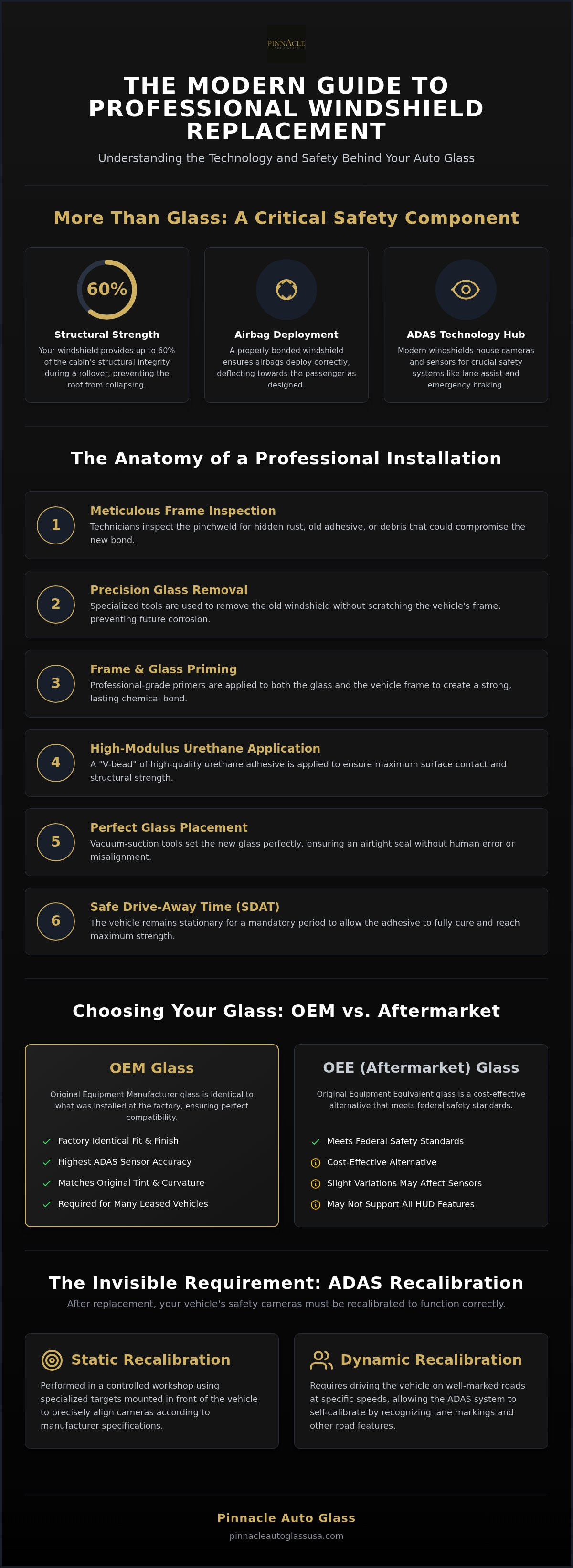
Your windshield is far more than a transparent barrier against wind and debris. It is a vital safety component that supports the entire roof structure of your car. In the event of a rollover accident, the windshield can contribute up to 60% of the structural strength of the cabin. This prevents the roof from crushing inward and protects passengers from severe injury. If the glass is cracked or improperly bonded, this protection vanishes. A professional car windshield replacement ensures that your vehicle's safety cage remains intact.
Properly installed glass is also essential for correct passenger airbag deployment. When an airbag triggers, it bounces off the interior surface of the windshield to position itself correctly for the passenger. If the adhesive bond is weak or the glass is damaged, the force of the airbag can actually push the windshield out of the frame. This causes the airbag to deploy into the wrong space, rendering it useless during a crash. A "simple" crack is never just an aesthetic issue; it is a compromise of the vehicle's structural integrity.
How Windshields Support Vehicle Integrity
Modern windshields are generally made of laminated safety glass, which consists of two layers of glass with a vinyl interlayer. This construction ensures the glass stays in one piece even when shattered. The bond between the glass and the vehicle frame provides critical roof crush protection. The windshield is a primary structural safety component that reinforces the vehicle's roof and maintains cabin volume during a collision.
The Evolution of Glass Technology in 2026
Glass technology has advanced significantly by 2026. Modern windshields now serve as the primary housing for Advanced Driver Assistance Systems (ADAS). These systems rely on cameras and sensors mounted directly behind the glass. Additionally, newer glass incorporates specialized features:
- Integrated Head-Up Displays (HUD) that project data onto the glass surface.
- Acoustic dampening laminates that reduce exterior road noise.
- Solar reflective coatings that block infrared heat to maintain cabin temperature.
These features make a car windshield replacement more complex than it was a decade ago. Specialized handling is required to ensure that coatings remain undamaged and that sensors stay perfectly aligned. The precision required for these high-tech components is why professional installation is non-negotiable for modern vehicles.
The Anatomy of Professional Windshield Replacement
A professional car windshield replacement is a rigorous technical process. It requires more than just swapping glass; it demands precision engineering at every stage. The process begins with a meticulous inspection of the pinchweld and the surrounding frame. Technicians must identify any hidden rust, old adhesive residue, or debris. If the frame isn't perfectly clean, the new bond will fail. Following this, the team uses specialized fiber lines or power tools for precision removal. This method prevents paint scratches that often lead to invisible frame corrosion over time.
Once the frame is prepared, technicians apply professional-grade primers to both the glass and the vehicle metal. This chemical bond is the foundation of your car's structural safety. High-quality urethane adhesive is then applied in a specific "V-bead" shape to ensure maximum contact and strength. The new glass is set using vacuum-suction tools. This ensures a perfect seal without the risk of human error or misalignment. Finally, every installation must respect the Safe Drive-Away Time (SDAT). This is the mandatory period for the adhesive to cure before the vehicle can be safely operated. Skipping this step can lead to glass displacement during an emergency stop.
OEM vs. Aftermarket (OEE) Glass: Making the Right Choice
Original Equipment Manufacturer (OEM) glass is identical to the part installed at the factory. It matches the exact thickness, tint, and curvature specified by the automaker. Original Equipment Equivalent (OEE), or aftermarket glass, is a cost-effective alternative made by different manufacturers. While OEE glass meets federal safety standards, subtle differences in curvature can affect the performance of rain sensors and cameras. For vehicles with complex tech, OEM glass provides the highest level of sensor accuracy. You can explore the details in our OEM vs Aftermarket Windshields comparison to see which option fits your needs.
The Importance of High-Modulus Urethane Adhesives
Modern vehicles are designed with high-modulus urethane adhesives to improve overall body stiffness. This adhesive isn't just glue; it is a structural element. In 2026, many vehicles require these specific adhesives to support advanced frame designs and airbag deployment. Using generic or "quick-cure" products in extreme weather can lead to brittle bonds that fail under pressure. Professional technicians never skip the priming stage because it creates the necessary chemical link between the metal and the urethane. Choosing a windshield replacement specialist who uses premium materials ensures your car remains as rigid and safe as the day it was built.
The Invisible Requirement: ADAS Recalibration After Installation
Modern windshields are sophisticated technology hubs. The camera mounted behind your rearview mirror acts as the primary "eye" for your vehicle's safety features. During a car windshield replacement, this camera is physically removed and reattached to the new glass. Even a microscopic shift in the camera's position changes its field of vision. A 1-degree misalignment might seem insignificant, but at highway speeds, it can cause a 50-foot error in where the vehicle "thinks" an object is located. This discrepancy can lead to the Automatic Emergency Braking (AEB) system triggering too late or failing to engage entirely.
Recalibration is not an optional upgrade; it is a safety mandate. By early 2026, over 65% of all collision and glass repairs require ADAS recalibration to function correctly. State laws in places like Arizona and New York now strictly require auto glass facilities to inform customers about these needs and follow manufacturer specifications. Ignoring this step creates significant legal liability and puts lives at risk. Technicians use two primary methods to reset these systems. Static recalibration occurs in a controlled shop environment using specialized targets and lasers. Dynamic recalibration requires a technician to drive the vehicle at specific speeds on well-marked roads to allow the system to "learn" its new orientation.
Critical Systems Affected by Glass Replacement
Many drivers don't realize how many features rely on the windshield's clarity and camera alignment. Systems like Lane Departure Warning (LDW) and Lane Keep Assist (LKA) depend on the camera to identify road markings. Adaptive Cruise Control (ACC) and Forward Collision Warning (FCW) use these sensors to maintain safe distances from other vehicles. If your car windshield replacement isn't followed by a precise reset, these features may provide false warnings or fail to intervene during a crisis. You can find a full list of these technologies in our ADAS Calibration 2026 Reference Guide.
The Pinnacle Approach to Recalibration
We treat recalibration as a core safety protocol rather than a secondary service. Our technicians use dealership-level diagnostic tools to interface directly with your vehicle's computer. We don't return your keys until every safety system is verified as active and accurate. To ensure your peace of mind and protect your vehicle's resale value, we provide a formal certificate of calibration for your safety records. This document proves that your car meets all manufacturer safety standards after the glass service is complete. Our process ensures that your advanced safety systems are ready to protect you the moment you leave our facility.
Navigating Replacement Costs and Insurance Claims
The total price for a car windshield replacement varies significantly based on your vehicle's specific technology. While a standard sedan might be straightforward, luxury vehicles equipped with Head-Up Displays (HUD) and rain sensors require specialized glass. These components must meet exact optical standards to ensure the projected data remains clear and the sensors function without interference. Glass type, sensor complexity, and vehicle make are the primary drivers of cost in 2026.
Most comprehensive insurance policies cover glass damage, but your out-of-pocket expense depends on your specific deductible. Professional shops manage the claim process directly with your carrier to minimize your administrative burden. They handle the paperwork and ensure the insurer understands the technical necessity of using high-quality materials and performing mandatory safety resets. This seamless integration allows you to focus on getting back on the road safely.
Total Cost of Ownership vs. Initial Price
Choosing the lowest bid for glass service often leads to higher long-term expenses. Cheap glass can result in persistent leaks, excessive wind noise, and frequent sensor failures that require costly diagnostic visits later. You can find a detailed breakdown of these variables in our Windshield Replacement Cost Buying Guide. It's vital to remember that ADAS recalibration is a mandatory safety requirement and a standard part of the total service cost for modern vehicles.
Filing a Claim Without the Stress
A successful glass claim requires specific documentation to ensure your carrier approves the work. You should have your insurance policy number, vehicle identification number (VIN), and the date the damage occurred ready for the technician. Insurance companies generally prefer certified technicians because they prioritize safety-critical standards, reducing the likelihood of secondary claims due to poor installation. Professional providers often offer mobile service that integrates directly into your coverage, allowing for a convenient repair at your home or office.
We simplify the entire process by acting as your partner with the insurance company. If you need assistance with your coverage or want to schedule a service, contact Pinnacle Auto Glass for a professional consultation today.
Choosing the Expert: Why Pinnacle Auto Glass Leads the Industry
Selecting a provider for a car windshield replacement requires more than just finding the nearest shop. It involves choosing a partner that understands the intersection of structural safety and advanced electronics. Pinnacle Auto Glass leads the industry by combining national-scale resources with the meticulous attention of a specialized service provider. Our technicians don't just swap glass; they restore your vehicle's safety cage and recalibrate its digital eyes. We prioritize ADAS safety over speed to ensure every camera and sensor functions exactly as the manufacturer intended.
Our solution-oriented approach simplifies complex technical tasks for vehicle owners. Whether you drive a single passenger car or manage a massive logistics network, our team coordinates every detail from insurance integration to final safety certification. We maintain nationwide service standards that guarantee consistent quality, regardless of your vehicle type or location. This commitment to reliability has established us as a dependable guide for drivers navigating the complexities of 2026 automotive technology.
Specialized Solutions for Commercial and Fleet Vehicles
Logistics and heavy-duty operations face unique challenges when glass is damaged. We provide specialized solutions for commercial and fleet vehicles, including semi-trucks and heavy-duty transport. A single day of downtime for a commercial truck can disrupt entire supply chains. To combat this, we offer efficient mobile scheduling that brings our expertise directly to your yard or job site. Our technicians are trained to handle the larger, more complex glass requirements of commercial rigs while ensuring all integrated safety systems remain operational. You can learn more about optimizing your operations in our Fleet Downtime Strategic Guide.
The Pinnacle Quality Guarantee
Quality is the cornerstone of our service model. Every car windshield replacement we perform is backed by a lifetime warranty on workmanship and leaks. This guarantee reflects our confidence in the premium materials we use, all of which meet or exceed Department of Transportation (DOT) standards. We don't settle for "good enough" when it's your safety on the line. Our team is ready to assist you with professional mobile or in-shop options tailored to your schedule. Get your professional windshield replacement quote today and experience the industry standard in safety and service.
Driving Toward a Safer Technical Future
Modern vehicles require more than a basic glass swap. You now understand that a professional car windshield replacement is a technical necessity that preserves your car's structural integrity and ensures your safety systems respond accurately in a crisis. From maintaining roof strength to the precision required for ADAS recalibration, every step in the process protects your passengers and your vehicle's value.
Pinnacle Auto Glass acts as your dependable guide through these complex technical requirements. We utilize safety-first installation standards and provide nationwide fleet and commercial support for vehicles of all sizes. Our certified ADAS recalibration specialists ensure your technology remains a reliable asset on every journey. We prioritize precision and quality to ensure your vehicle meets all manufacturer safety standards before it leaves our care.
Don't compromise on your vehicle's safety cage. Schedule Your Professional Windshield Replacement Now and drive with the confidence that your car is fully restored to its factory safety specifications. We are ready to assist you today.
Frequently Asked Questions
How long does it take to replace a windshield professionally?
Professional windshield installation typically takes between 60 and 90 minutes. You must also account for the Safe Drive-Away Time, which allows the adhesive to cure properly before the car is moved. If your vehicle is equipped with modern safety sensors, ADAS recalibration will add another hour or two to the process. Most technicians can complete the entire car windshield replacement and safety system reset within a single morning or afternoon appointment.
Can I drive my car immediately after the windshield is replaced?
You shouldn't drive the vehicle immediately after the glass is installed. The urethane adhesive requires a specific curing period, known as the Safe Drive-Away Time, to reach its full structural strength. This period usually lasts between 30 and 60 minutes after the technician finishes the job. Operating the car too early can cause the glass to shift, which creates leaks and compromises the effectiveness of your passenger side airbag during a collision.
Does my car insurance premium go up if I replace my windshield?
In most cases, insurance premiums don't increase due to a comprehensive glass claim. Insurance providers generally categorize glass damage as a no-fault event caused by road debris or environmental factors. Many carriers encourage car windshield replacement because it maintains the vehicle's structural integrity and safety standards. It's always best to review your policy or consult your agent to understand how your specific insurance company handles glass repairs and potential deductible waivers.
What happens if I skip ADAS recalibration after glass replacement?
Ignoring recalibration can lead to catastrophic failures in your vehicle's Advanced Driver Assistance Systems. The camera mounted to your windshield provides the data for features like automatic emergency braking and lane-keeping assistance. If the camera isn't reset to manufacturer specifications, it may miscalculate distances or fail to detect obstacles entirely. This misalignment compromises your safety on the road and can lead to significant legal and financial liability if a system failure causes an accident.
Is mobile windshield replacement as safe as in-shop service?
Mobile service is entirely safe when performed by qualified professionals using the correct equipment. Our technicians follow the same rigorous safety protocols in the field as they do in our physical shops. The key to a successful mobile car windshield replacement is ensuring the work area is protected from extreme rain or debris during the curing process. We use the same high-quality primers and structural adhesives to ensure your mobile installation meets all federal safety requirements.
How do I know if I need a full replacement or just a repair?
Technicians can typically repair small chips or cracks that are less than six inches long. However, a full replacement is necessary if the damage is in the driver's line of vision or if it extends to the outer edge of the frame. Any crack that penetrates both layers of the laminated glass or interferes with ADAS sensors also requires new glass. We prioritize your safety by recommending a replacement whenever the structural bond is compromised.
What is the difference between OEM and aftermarket glass?
OEM glass is produced by the vehicle's original manufacturer and matches the factory specifications exactly. This includes the precise curvature, thickness, and acoustic dampening properties. Aftermarket glass is manufactured by third-party companies to meet basic safety standards but may have slight variations in fit or clarity. For vehicles with Head-Up Displays or complex safety cameras, we recommend OEM glass to ensure these high-tech systems continue to function with the highest level of accuracy.
Are there specific care instructions for a new windshield?
To protect your new seal, you should avoid high-pressure car washes for the first 48 hours. It's also helpful to leave a window cracked about an inch to prevent air pressure from pushing against the fresh adhesive when you close the doors. Don't remove the technician's retention tape until the recommended time has passed. Following these simple steps ensures the urethane cures correctly and prevents future leaks or wind noise from developing in the frame.


