
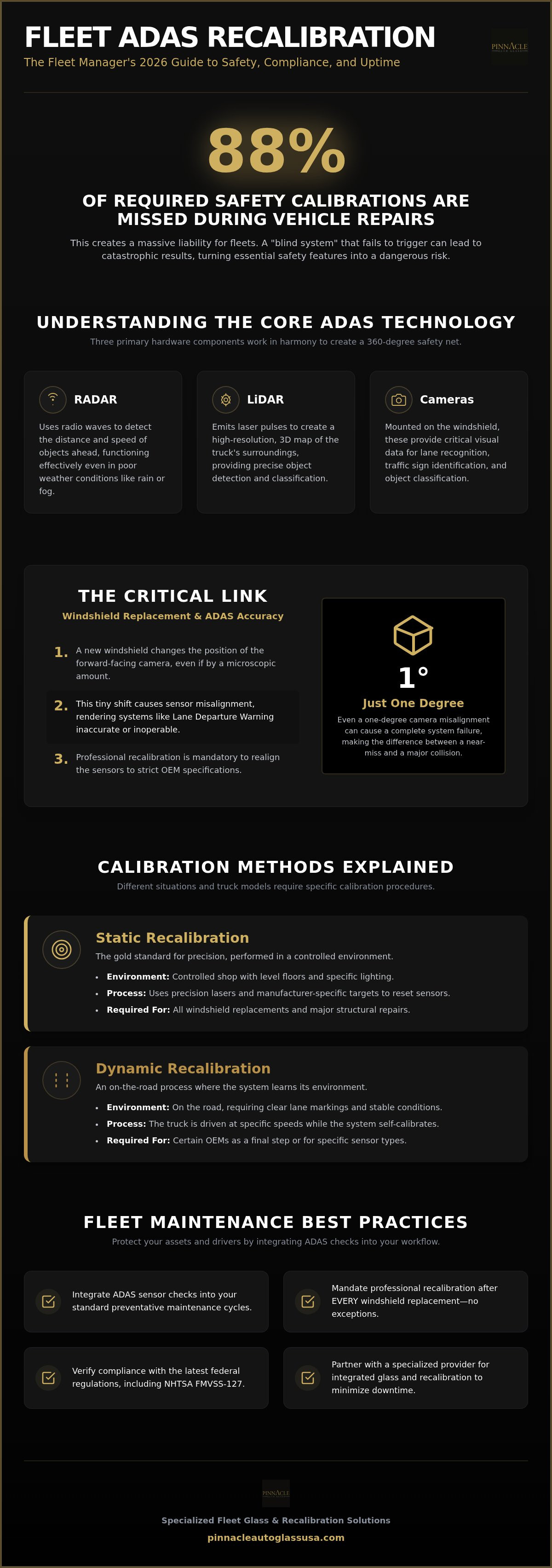
Did you know that 88% of required safety system calibrations are missed during vehicle repairs? For a fleet manager, that isn't just a statistic; it's a massive liability. When your drivers rely on Lane Departure Warning or Forward Collision Warning, a "blind system" that fails to trigger can lead to catastrophic results. Proper commercial truck ADAS recalibration is no longer optional; it's a critical safety protocol for every modern fleet.
We understand that vehicle downtime is your biggest enemy. You need your trucks moving, but you also need them to meet strict OEM safety standards. Balancing technical requirements across different truck classes can be frustrating, especially when liability concerns are at an all-time high. You want a solution that ensures compliance without keeping your assets in the shop for days.
This 2026 guide provides the clarity you need to manage your fleet's safety systems effectively. You'll learn why professional recalibration is essential for safety and how it actually reduces operational downtime. We'll preview the latest federal regulations and show you how to verify that every truck in your fleet is road-ready and fully compliant after a windshield replacement.
Key Takeaways
- Identify the core components of heavy-duty safety tech, including RADAR, LiDAR, and camera systems, to better manage your fleet's equipment.
- Distinguish between static and dynamic calibration methods to ensure your specific truck models meet all manufacturer requirements.
- Understand why even a one-degree camera misalignment makes professional commercial truck ADAS recalibration mandatory after every windshield replacement.
- Learn how to integrate ADAS sensor checks into your standard preventative maintenance cycles to maintain long-term system reliability.
- Discover the operational advantages of partnering with a specialized provider for integrated glass replacement and recalibration to minimize fleet downtime.
Understanding Commercial Truck ADAS: More Than Just Sensors
An Advanced Driver-Assistance System (ADAS) is a suite of electronic technologies designed to assist drivers with safe vehicle operation. In the heavy-duty trucking world, these systems act as a second set of eyes for the operator. They don't just provide warnings; they actively work to mitigate human error, which is the leading cause of highway accidents. For Class 6, 7, and 8 vehicles, these technologies are now essential components of the powertrain and safety architecture.
Modern commercial truck ADAS recalibration ensures three primary hardware components work in harmony:
- RADAR: Uses radio waves to detect the distance and speed of objects ahead, even in poor weather.
- LiDAR: Emits laser pulses to create a high-resolution 3D map of the truck's surroundings.
- Cameras: Mounted inside the windshield, these provide visual data for lane recognition and object identification.
As we move into 2026, the demand for precision has reached a peak. The NHTSA has finalized FMVSS-127, focusing heavily on ADAS performance. These new standards mean your safety systems must operate within tighter tolerances than ever before. A minor sensor misalignment that was acceptable five years ago can now cause a "blind system" failure today. Accuracy is no longer a luxury; it's a regulatory requirement.
Common ADAS Features in Modern Fleets
Lane Departure Warning (LDW) is the most visible feature. It relies entirely on camera alignment to "read" lane markers. If the camera is off by even a fraction of an inch, the system may fail to alert the driver during a drift. Forward Collision Warning (FCW) and Automatic Emergency Braking (AEB) are equally critical. These systems use RADAR and camera data to detect an impending crash and apply the brakes if the driver fails to act. Adaptive Cruise Control (ACC) and blind-spot monitoring round out the suite, providing a 360-degree safety net around the vehicle.
The Evolution of Truck Safety Technology
Safety technology has evolved from passive warnings to active interventions. Industry leaders like Bendix and Continental have set the standard with systems that can steer or brake the vehicle automatically. We've moved beyond simple buzzers to integrated computers that make split-second decisions. ADAS recalibration is the process of realigning vehicle sensors to OEM specifications. Maintaining this alignment is the only way to ensure these active systems perform as intended during an emergency. Proper commercial truck ADAS recalibration keeps these sophisticated tools from becoming a liability on the road.
Static vs. Dynamic Recalibration for Heavy-Duty Fleets
Choosing the right method for commercial truck ADAS recalibration depends on the vehicle's make and the specific sensors involved. There are two primary types: static and dynamic. While they both aim to restore safety system accuracy, the environments and tools required are completely different. Some heavy-duty trucks even require a dual-stage process that combines both methods to ensure full compliance with safety regulations.
Static calibration occurs in a controlled shop setting. It requires a level floor, specific lighting conditions, and a large amount of open space to accommodate Class 7 or 8 vehicles. Technicians use precision lasers and manufacturer-specific targets to reset the sensors. This method is highly accurate because it eliminates variables like traffic, weather, or poor road markings. For a heavy-duty fleet, this controlled environment is often the only way to guarantee that sensors are aligned to within a fraction of a millimeter.
Dynamic calibration happens on the road. The truck's computer is placed into a "learning mode," and a technician drives the vehicle at a specific speed for a set distance. The system "learns" its environment by identifying stationary objects like road signs and lane lines. If you're looking for a partner that understands these technical nuances, our team provides expert fleet glass services that include these essential safety checks.
When Static Calibration is Required
Static calibration is mandatory after a windshield replacement or any major structural repair. It's the only way to ensure the camera's pitch, yaw, and roll are perfect. For Lane Departure Warning (LDW) systems, target-based precision is the gold standard. It ensures the camera "sees" the road exactly as the OEM intended. Without this shop-based reset, the safety system may provide false alerts or fail to trigger entirely.
The Dynamic Recalibration Process
Dynamic resets involve real-world testing. The technician must maintain a consistent speed on well-marked roads to satisfy the system's software requirements. Environmental factors like heavy rain or faded lane lines can delay the process, as the sensors need clear visual data to calibrate. However, 2026 onboard diagnostics have made these resets faster by providing real-time feedback to the technician during the drive. This technology helps ensure the vehicle meets Automated Vehicle Safety standards before it returns to service. Proper commercial truck ADAS recalibration is the final step in ensuring your drivers are protected by fully functional technology.
The Critical Link Between Windshield Replacement and ADAS Accuracy
Most ADAS cameras are mounted directly to the interior of the windshield. When you replace the glass, you're effectively removing and reinstalling the "eyes" of your truck. This physical bond makes the glass a critical component of the safety system. Even a 1-degree shift in the camera's mounting angle leads to massive errors at a distance. At 600 feet, that single degree of deviation can cause the system to track the shoulder instead of the vehicle directly ahead. This misalignment creates a dangerous gap between what the driver expects and what the truck actually detects.
One of the most significant risks in fleet management is the "Ghost Error." This happens when a system is misaligned but doesn't trigger a fault light on the dashboard. The driver continues to operate the vehicle with full confidence in features like Forward Collision Warning, unaware that the sensors are looking at the wrong part of the road. Proper commercial truck ADAS recalibration is the only way to identify and fix these hidden issues before they lead to an accident. Without a professional reset, your safety tech is just expensive hardware that might fail when it's needed most.
Optical Clarity and Sensor Performance
The glass itself acts as a lens for the camera. OEM-quality glass is preferred for ADAS-equipped commercial vehicles because it meets strict thickness and curvature specifications. Aftermarket glass can sometimes have slight distortions that interfere with signal processing. These optical imperfections can cause the camera to "see" lane markers or obstacles incorrectly. It's also vital to monitor the glass for damage. Even a minor windshield chip in the camera's field of vision can trigger a system shutdown. Maintaining a clean, clear, and high-quality windshield is the foundation of sensor accuracy.
Liability and Insurance Implications
Documented recalibration protects your fleet in post-accident litigation. If a truck is involved in a collision, investigators will check if the safety systems were maintained according to automotive industry training standards. Failing to provide proof of commercial truck ADAS recalibration after a glass replacement can lead to massive liability and "nuclear verdicts" in court. There's also a clear relationship between ADAS maintenance and commercial insurance premiums. Many carriers now offer discounts for fleets that prove their safety systems are functional. Meeting DOT and FMCSA expectations through certified service ensures your fleet remains compliant and your insurance rates stay manageable.
Best Practices for Fleet ADAS Maintenance and Compliance
A structured maintenance plan is the only way to ensure your safety technology remains a reliable asset. Fleet managers should establish a routine inspection schedule that focuses specifically on sensor housing and windshield integrity. Integrating these checks into your standard preventative maintenance (PM) cycles prevents small issues from becoming major liabilities. Since 88% of required ADAS calibrations are missed during repairs, having a set protocol is essential for every logistics company.
Driver training is equally important. Your operators must understand that a dashboard alert isn't just a suggestion. Train your team to recognize and report ADAS warnings immediately. Once a report is filed, maintain a comprehensive digital record of the resulting service. These records are vital during DOT audits and can prove your commitment to safety in the event of an accident. Keeping your fleet glass services and recalibration logs organized simplifies compliance and protects your bottom line.
When to Schedule Immediate Recalibration
Certain events make commercial truck ADAS recalibration mandatory. Windshield replacement is the most common trigger, but it isn't the only one. You must also schedule a reset after:
- Suspension repairs that alter the vehicle's ride height or pitch.
- Wheel alignment changes that affect the steering angle.
- Minor front-end collisions that may have jarred sensor mounts.
Maximizing Uptime During Service
Downtime affects your profitability. To minimize the impact, coordinate your glass replacement and calibration into a single service window. Choosing a provider that handles both tasks at once eliminates the need for multiple appointments. Mobile service providers can often perform these tasks at your yard or logistics hub, saving you the time and expense of transporting vehicles. Always verify that your technician has specific experience with Class 7 and 8 trucks. Heavy-duty systems require specialized knowledge that general auto shops simply don't possess. Efficiency comes from working with experts who prioritize your fleet's readiness and understand the urgency of your schedule.
Professional Fleet Glass and Recalibration Solutions
Partnering with a specialized provider is a strategic move for any logistics fleet. Some equipment manufacturers suggest bringing these technical tasks in-house to meet emerging demand. However, the high cost of hardware and the continuous training burden often outweigh the benefits for most companies. Choosing a dedicated partner for commercial truck ADAS recalibration ensures your vehicles receive expert attention without the overhead of maintaining specialized tools. This approach covers everything from initial glass repair to final system verification in one seamless workflow.
Professional service eliminates the risk of technical failures and costly "comebacks." When a single provider manages both the glass installation and the sensor reset, there's no room for communication gaps. This integrated process ensures that your safety systems are fully functional before the truck returns to the road. Whether you manage a small local delivery fleet or a national logistics operation, scalable solutions allow you to maintain high safety standards across all your assets. We prioritize efficiency to keep your drivers safe and your trucks moving.
The Pinnacle Advantage for Commercial Clients
We specialize in heavy-duty windshields and the complex ADAS technology found in modern Class 8 trucks. Our commitment to OEM-spec recalibration means your fleet always meets the highest safety standards. We also understand the administrative needs of fleet managers. Our streamlined billing and insurance processing eliminate the paperwork headaches often associated with glass claims. We act as a dependable guide, simplifying technical tasks so you can focus on your core operations. Reliability is the foundation of our service model.
Getting Started with Fleet Services
Setting up a commercial account is the first step toward better fleet health. This allows for faster scheduling and consistent service quality across your entire operation. You can easily schedule your first semi truck windshield replacement through our streamlined service portal. Ensuring your vehicles are ready for the road starts with a certified auto glass technician who understands the nuances of commercial truck ADAS recalibration. Contact us today to establish a partnership that prioritizes your safety and maximizes your uptime.
Protecting Your Fleet and Your Bottom Line
Maintaining a safe and compliant fleet in 2026 requires more than just mechanical upkeep. You've seen how precise sensor alignment is the backbone of modern safety features like Automatic Emergency Braking and Lane Departure Warning. Failing to prioritize commercial truck ADAS recalibration after a windshield replacement isn't just a technical oversight; it's a significant risk to your drivers and your business. Proper documentation and expert service are your best defenses against liability and unexpected downtime.
Pinnacle Auto Glass acts as your dependable guide for all heavy-duty glass needs. We offer specialized expertise in Class 3-8 commercial vehicles and provide national fleet support for logistics operations of any size. Our integrated approach ensures that your glass and safety systems are handled in a single, efficient service window. Stop worrying about "blind systems" or technical failures and start focusing on your deliveries.
Schedule your commercial fleet ADAS recalibration with Pinnacle Auto Glass today. Let our team provide the comprehensive glass and ADAS solutions you need to keep your trucks moving safely and efficiently.
Frequently Asked Questions
Is recalibration required every time a commercial truck windshield is replaced?
Recalibration is mandatory after every windshield replacement. Because the ADAS camera is physically mounted to the interior of the glass, even a minor change in the mounting position alters its field of vision. A misalignment of just one degree can cause the system to miss obstacles hundreds of feet away. Following OEM requirements for every glass change is the only way to ensure your safety systems remain functional and compliant.
How long does a typical commercial ADAS recalibration take?
Recalibration times typically range from one to three hours depending on the required method. Static calibration involves setting up precision targets in a controlled shop environment; dynamic calibration requires a test drive on well-marked roads. Some heavy-duty models require both stages for full compliance. Choosing a one-stop-shop that handles both the glass and the tech can significantly reduce the time your truck spends out of service.
Can a standard auto shop handle heavy-duty truck ADAS recalibration?
Standard auto shops generally lack the space and specialized equipment needed for heavy-duty vehicles. Class 7 and 8 trucks utilize unique software and hardware from manufacturers like Bendix or Continental. These systems require specific targets and larger calibration bays that aren't found in passenger car facilities. You should always partner with a specialist who understands the technical requirements and safety standards specific to the commercial trucking industry.
What happens if I don't recalibrate the ADAS after a glass change?
Operating a vehicle without a reset creates a "blind system" where the dashboard shows no errors, but the sensors are misaligned. This can lead to phantom braking or a total failure of the Automatic Emergency Braking during a real crisis. Beyond the physical danger, it opens your fleet to massive legal liability and potential lawsuits. Proper commercial truck ADAS recalibration is the only way to verify that your safety systems are actually road-ready.
Does commercial insurance cover the cost of ADAS recalibration?
Most commercial insurance policies cover the full cost of recalibration when it's part of a glass replacement claim. Carriers recognize that these systems are essential for preventing accidents and reducing overall risk. In fact, many insurance providers now require proof of calibration to maintain coverage or offer premium discounts. Always check with your provider, but professional recalibration is generally viewed as a standard, covered part of the repair process.
What are the differences between Class 8 truck ADAS and passenger vehicle systems?
Class 8 systems are engineered for much longer detection ranges and more aggressive braking interventions compared to passenger vehicles. They must account for the massive weight and extended stopping distances of heavy-duty trailers. While a car might only need to see 200 feet ahead, a truck's RADAR and camera systems often track objects at double that distance. This complexity requires specialized tools and expertise that differ significantly from standard automotive repair.
Will my ADAS alert me if it needs to be recalibrated?
Your truck won't always alert you if the system is misaligned. While a disconnected sensor will trigger a fault light, a camera that is slightly off-angle often produces a "Ghost Error." The system continues to operate, but it tracks the wrong part of the road or fails to identify lane markings correctly. Drivers should never assume the technology is working perfectly just because there are no warning lights on the dashboard.
Can ADAS sensors be recalibrated if the truck has a lift kit or modified suspension?
Sensors can be recalibrated for modified vehicles, but the process requires extra precision. Any change in ride height or pitch shifts the camera's field of vision and the RADAR's detection path. Technicians must manually input the new measurements into the system to reset the reference points. Professional commercial truck ADAS recalibration is mandatory after any suspension modifications to ensure the safety tech still functions as the OEM intended.


