
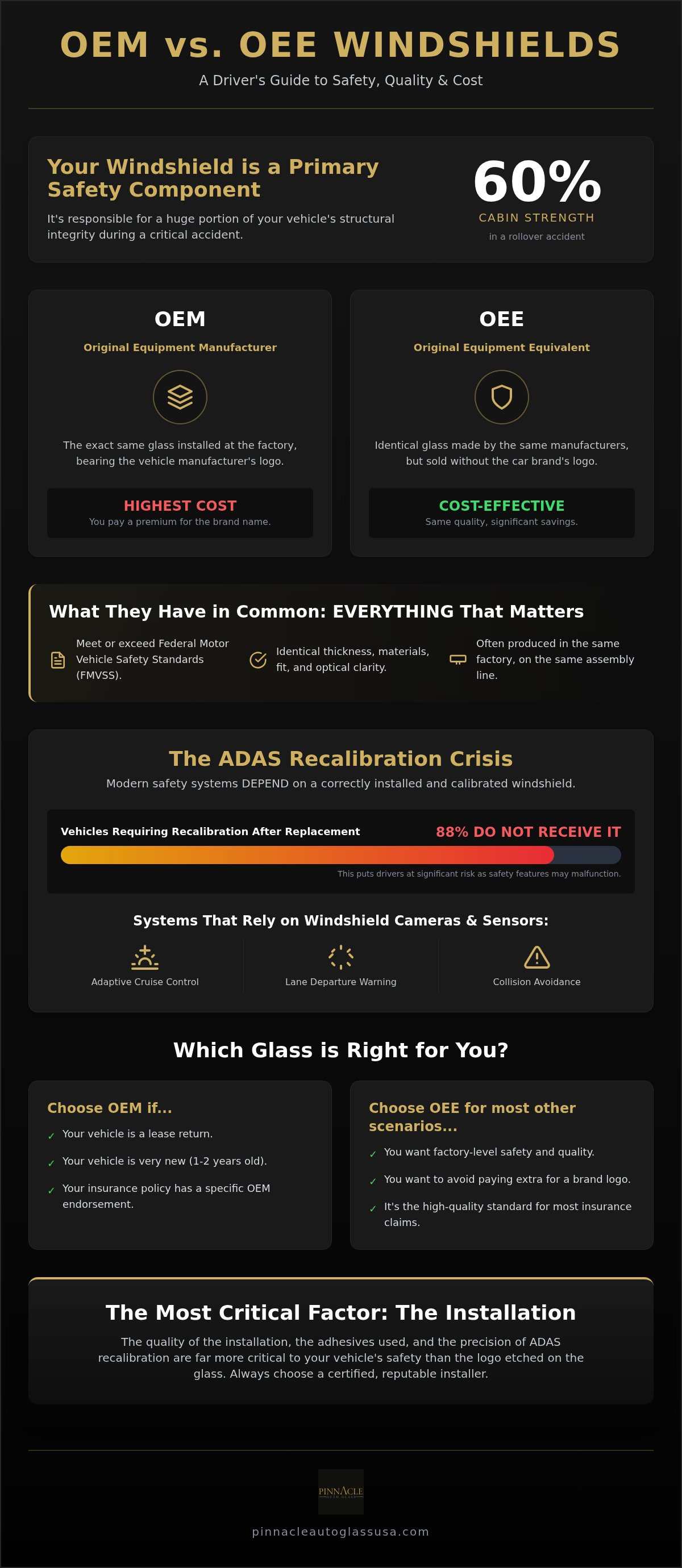
Did you know that your windshield provides up to 60% of your vehicle's cabin strength during a rollover accident? This single piece of glass is a primary safety component, yet most drivers feel overwhelmed when choosing a replacement. You might worry about whether a cheaper option will leak or if your advanced safety sensors will stop working. It's a common concern, especially when you're caught between the high cost of a dealership part and the uncertainty of aftermarket alternatives. Understanding the OEE vs OEM windshield debate is the first step toward a smart, safe investment.
We'll help you cut through the industry jargon to understand exactly what you're paying for. You'll learn the technical differences between factory-original glass and equivalent alternatives, ensuring you don't sacrifice safety for savings. This article explains how your choice affects ADAS recalibration and why professional installation is the most critical factor in any glass replacement. We also address why an estimated 88% of vehicles requiring recalibration don't receive it, putting drivers at risk. By the end, you'll have the confidence to select a windshield that protects both your passengers and your budget.
Key Takeaways
- Learn the fundamental differences between OEE vs OEM windshield options to determine if you are paying for quality or simply a brand logo.
- Discover how OEE glass maintains the same safety and manufacturing standards as factory parts while offering significant cost savings.
- Understand why ADAS recalibration is a non-negotiable step for modern vehicles to ensure safety sensors function accurately after installation.
- Identify specific scenarios, such as lease returns or newer vehicle ownership, where choosing OEM glass may be the preferred strategy.
- Learn why the quality of the installation and camera mounting brackets is more critical to vehicle safety than the logo on the glass.
Defining the Choice: Understanding OEM and OEE Windshield Glass
Deciding on a replacement starts with understanding the specific grades available. An Original Equipment Manufacturer (OEM) windshield is the exact part installed during the vehicle's assembly, bearing the automaker's trademark. Original Equipment Equivalent (OEE) glass is produced by the same manufacturers using the same technical blueprints but sold without the car brand's logo. Both options provide the structural support your vehicle needs to keep passengers safe.
It's vital to distinguish OEE from low-tier bargain aftermarket glass. While OEE glass meets the highest production standards, budget alternatives might use thinner materials or generic molds that lead to visual distortion. Regardless of the branding, all legal replacements must comply with Federal Motor Vehicle Safety Standards (FMVSS) 205 and 212. These regulations mandate that the glass resists impact and remains securely mounted during a collision. Choosing OEE ensures you meet these requirements while managing your repair costs effectively.
The Role of the Manufacturer Logo
The branding on a windshield accounts for a large portion of its price. Automakers don't usually make their own glass; they hire companies like Pilkington or Saint-Gobain to do it. These manufacturers are often restricted by licensing agreements that prevent them from selling glass with a car logo directly to independent repair shops. When comparing an OEE vs OEM windshield, you're often looking at the same glass from the same factory. You're simply paying for the trademark license when you choose the OEM version.
Why Terminology Matters for Insurance Claims
Insurance companies frequently prioritize OEE glass because it provides the same safety performance as the branded version at a lower cost. Many standard policies default to OEE unless your vehicle is very new. Some insurance regulations require providers to authorize OEM parts for vehicles within the first few years of ownership to maintain factory standards. You should check your specific policy language to see if you have an OEM endorsement. OEE serves as the high-quality alternative to dealer-branded glass, offering professional reliability for drivers who want factory-level safety without the unnecessary branding markup.
Technical Standards: How Replacement Glass is Manufactured
Many drivers assume their car manufacturer actually makes the glass. In reality, automakers contract specialized glass companies to build windshields to their design. These same factories then produce OEE glass using the same machinery and raw materials. When comparing an OEE vs OEM windshield, you're often looking at products that came off the same assembly line. The primary difference is the box it's packed in and the logo etched into the corner.
Optical clarity is a non-negotiable requirement for all glass tiers. Manufacturers use precision testing to check for distortion, ensuring the driver's view remains crisp across the entire surface. These tests measure luminous transmittance and abrasion resistance. High-tier OEE glass undergoes the same rigorous quality control checks as OEM parts, ensuring it meets the specific needs of modern safety systems.
Same Factories, Different Boxes
Production lines at major glass plants switch between OEM and OEE runs regularly. They use the same molds and glass compositions to maintain consistency. This ensures the structural integrity remains identical. Since a windshield provides up to 60% of a vehicle's cabin strength in a rollover, there's no room for compromise on material quality. The idea that OEE glass is thinner or more prone to pitting is a common myth; both must meet the same Federal Motor Vehicle Safety Standards for thickness and impact resistance.
Quality Control and Safety Certification
Every windshield features a "bug" or permanent stamp in the corner. This mark contains a Department of Transportation (DOT) number, which identifies the specific factory where the glass was made. Reading this bug allows you to verify if your OEE glass came from a top-tier manufacturer like Pilkington or Vitro. Rigorous quality control checks ensure the glass can withstand the pressure of an airbag deployment, which uses the windshield as a backstop.
A professional windshield replacement requires these certified materials to function as part of your vehicle's safety system. If the glass lacks proper certification, it may not support the weight of the roof during an accident or could fail to deploy airbags correctly. We prioritize these technical standards to ensure every installation meets factory-level safety. If you need assistance determining which glass grade is right for your car, you can contact our team for expert guidance.
The Comparison: Fit, Finish, and the Cost of the Logo
The financial gap in the OEE vs OEM windshield debate is often the most significant factor for vehicle owners. Choosing an OEM part can increase your total bill by 40% to 60% compared to an OEE alternative. This price hike rarely stems from superior glass quality. Instead, it covers the automaker's trademark licensing and dealership distribution networks. For most daily drivers, paying this premium provides a branded logo rather than a safer driving experience.
Fit and finish remain top priorities for any replacement. Some drivers worry that non-dealer glass won't sit flush or will cause leaks. While low-tier aftermarket glass might have slight molding inconsistencies, high-quality OEE parts are built to the same dimensions as the original. They use the same attachment points and accommodate the same weather stripping to ensure a watertight seal. Professional installers verify these tolerances before the urethane sets to prevent wind noise or moisture intrusion.
Acoustic and Thermal Performance
Many modern vehicles use acoustic glass to reduce engine and wind noise. This technology involves a specialized vinyl interlayer sandwiched between glass sheets. High-tier OEE manufacturers use the same acoustic interlayer technology to match the original cabin decibel levels. Similarly, thermal coatings are replicated to provide UV protection and heat rejection. If your original windshield had a "SoundScreen" or "Acoustic" label, an OEE replacement from a reputable manufacturer will offer identical performance.
Visual Comparison and Aesthetics
The "black frit" is the ceramic paint band around the glass edge. While OEM frit patterns are designed specifically for the car's aesthetic, OEE patterns might vary slightly in dot size or shading. These differences are purely cosmetic and don't affect visibility or structural safety. OEE glass is the logical choice for how much does windshield replacement cost considerations because it prioritizes function over form. When evaluating an OEE vs OEM windshield, you'll find that the visual differences are nearly imperceptible once the glass is installed.
Regarding resale value, most trade-in inspectors focus on the glass's condition rather than the manufacturer's stamp. A crack-free OEE windshield is worth more than a damaged OEM one. However, if you own a rare luxury model or a vintage collector car, the original logo might be necessary to maintain the vehicle's historical accuracy. For standard personal and fleet vehicles, the OEE option provides the best balance of performance and value.
Why ADAS Recalibration Dictates Your Glass Choice
Modern Advanced Driver Assistance Systems (ADAS) have transformed the windshield from a simple barrier into a sophisticated tech housing. Features like automatic emergency braking and lane-keep assist rely on forward-facing cameras mounted directly to the glass. In the OEE vs OEM windshield debate, some claim that only a dealer-branded part ensures these systems work. This is an outdated perspective. While glass clarity is essential, high-quality OEE glass provides the same optical precision required for sensor accuracy.
Recalibration failure is rarely caused by the glass grade itself. Instead, issues usually stem from poor bracket alignment or a technician's lack of specialized equipment. High-tier OEE manufacturers produce glass with the exact same camera apertures as OEM versions. This ensures that light reaches the sensors without distortion, allowing the vehicle's computer to process road data correctly. The glass provides the window, but the calibration provides the intelligence.
The Critical Nature of Camera Brackets
Precision alignment is the most vital factor for safety tech. Even a 1-degree tilt in a camera bracket can cause a lane departure warning to miscalculate the road by several feet at highway speeds. We prioritize high-spec OEE glass that features pre-bonded brackets. These factory-set mounts ensure the camera sits in the correct position from the moment of installation. For a deeper look at how these systems interact, see our ADAS calibration auto glass guide. Using pre-bonded brackets eliminates the human error often associated with manually attaching mounts to the glass.
Recalibration Success Rates
After the glass is set, your vehicle must undergo either static or dynamic recalibration. Static calibration uses fixed targets in a controlled shop environment; dynamic calibration involves driving the car at specific speeds to "teach" the cameras. Modern shops use advanced diagnostic tools to verify that sensors are performing within factory tolerances. Recalibration is the mandatory final step for all tech-heavy vehicles to ensure your safety features aren't just present, but functional. Successful sensor alignment is achievable with both glass types as long as the material meets professional standards.
The technician's skill in handling the recalibration process is just as vital as the glass itself. A perfectly installed OEM windshield is useless if the camera isn't calibrated correctly. We specialize in both professional glass installation and precise sensor alignment to keep your safety systems active. If your vehicle features advanced safety tech, you should schedule your ADAS recalibration and replacement with our expert team to ensure total system reliability.
Selecting the Right Glass for Your Personal or Fleet Vehicle
Choosing between an OEE vs OEM windshield often depends on your specific ownership situation. If your vehicle is currently under a lease, you must review the return terms carefully. Many lessors mandate OEM glass to avoid end-of-lease penalties. If you own your vehicle outright and it's over three years old, the cost-benefit analysis shifts toward OEE. Since this glass meets identical safety specs, the savings can be redirected into other maintenance needs. The decision should prioritize a shop that handles both the glass installation and the necessary sensor alignment.
For high-mileage drivers, the frequency of rock chips and cracks increases. Using OEE glass allows you to maintain factory-level safety without the premium price tag every time a replacement is required. Professional installers can help you navigate this choice by evaluating your vehicle age, insurance coverage, and budget. For most daily drivers, the functional equivalence of OEE glass makes it the most pragmatic option for long-term vehicle care.
Fleet and Commercial Considerations
Commercial operators view glass as a major line item in maintenance budgets. Standardizing on OEE across a diverse fleet reduces per-vehicle costs while ensuring all drivers are protected by FMVSS-certified materials. Logistics become simpler when you aren't waiting for dealer-only parts. High-quality OEE availability is generally better, meaning your heavy-duty trucks return to service faster. Maximizing uptime is essential for fleet profitability, and reliable glass sourcing is a key part of that strategy.
Professional glass solutions for commercial fleets also simplify the recalibration process. Standardizing your glass specs makes it easier to maintain a consistent calibration schedule for safety sensors. Whether you operate delivery vans or semi-trucks, choosing a specialist that offers both mobile and in-shop options is vital. Mobile service handles standard replacements on-site, while shop facilities provide the controlled environment needed for complex sensor alignment.
Next Steps: Booking Your Professional Replacement
When booking, verify the technician's experience with your specific vehicle's tech suite. Ask if they provide mobile recalibration or if an in-shop visit is required for your safety system. Requesting a quote that specifies the glass tier prevents surprises on your final invoice. You can rely on Pinnacle Auto Glass for expert installation that balances budget with safety. Contact a specialist today to receive a professional assessment of your personal or commercial glass needs.
Secure Your Safety with Professional Glass Installation
Choosing between an OEE vs OEM windshield doesn't have to be a trade-off between safety and savings. Both options provide the same structural integrity and meet rigorous federal safety standards. The most vital factors are the precision of the installation and the accuracy of the ADAS recalibration. Whether you manage a commercial fleet or need a replacement for your personal vehicle, focusing on technical quality ensures your safety systems perform exactly as intended.
We specialize in helping you find the most cost-effective solution without compromising on quality. Our team provides nationwide mobile and in-shop service tailored to your schedule. We are personal and commercial fleet specialists who prioritize your vehicle's uptime and safety. Every replacement we handle includes expert ADAS recalibration to keep your advanced driver assistance systems fully functional. Take the next step toward a clear and secure view of the road today.
Get a Professional Windshield Replacement Quote from Pinnacle Auto Glass
Frequently Asked Questions
Does OEE glass void my vehicle warranty?
No, using OEE glass does not void your vehicle warranty. Under the federal Magnuson-Moss Warranty Act, manufacturers cannot deny warranty coverage simply because an equivalent part was used instead of a branded one. The only exception is if the specific part directly caused a failure in another vehicle component. Since high-quality OEE glass meets all original factory specifications, it is a safe choice for maintaining your vehicle's protection and performance.
Is OEE glass as strong as OEM glass during an accident?
Yes, OEE glass is structurally identical to OEM glass and must meet the same Federal Motor Vehicle Safety Standards (FMVSS). These regulations require all automotive glass to withstand specific impact and pressure levels to protect passengers. Because a windshield provides significant cabin strength during a rollover, manufacturers use the same safety laminates for both tiers. The primary difference in the OEE vs OEM windshield comparison is the branding, not the structural integrity.
Why is OEM glass so much more expensive than OEE?
OEM glass is more expensive primarily due to trademark licensing fees and automaker branding. When a glass manufacturer produces a windshield with a car brand's logo, they pay a royalty to that automaker. Additionally, these parts are often distributed through dealership networks, which adds layers of logistics and markup. OEE glass avoids these specific costs while utilizing the same raw materials and manufacturing molds, providing a more cost-effective alternative for vehicle owners.
Will my insurance company pay for an OEM windshield?
Insurance coverage for an OEM windshield depends on your specific policy and the age of your vehicle. Many standard policies default to OEE glass to manage costs. However, certain 2026 regulations require providers to authorize OEM parts for vehicles that are 36 months old or newer. If you have an OEM endorsement on your policy, the insurer will cover the full cost; otherwise, you may pay the price difference out-of-pocket for the branded part.
Does OEE glass affect my rain sensors or heads-up display (HUD)?
High-quality OEE glass is designed to support all integrated technology, including rain sensors and heads-up displays (HUD). For HUD-equipped vehicles, the glass includes a specialized interlayer to prevent image ghosting or blurring. Rain sensor brackets are pre-bonded to the glass in the same position as the original part. As long as you select a professional grade of glass that matches your vehicle's specific tech requirements, these safety and convenience features will function without any degradation.
How can I tell if my replacement glass is OEM or OEE?
You can identify the glass type by examining the "bug," which is the permanent stamp in the corner of the windshield. OEM glass features the vehicle manufacturer's logo, such as Ford, Toyota, or BMW. OEE glass shows the name of a reputable glass manufacturer, like Vitro or Saint-Gobain, but lacks the automaker's trademark. Both types will include a Department of Transportation (DOT) number, which you can use to verify the specific factory where it was produced.
Can OEE glass be recalibrated for ADAS systems?
Yes, OEE glass can be successfully recalibrated for all Advanced Driver Assistance Systems (ADAS). The glass provides the necessary optical clarity for cameras to see the road clearly. Successful calibration depends more on the precision of the camera mounting brackets and the technician's skill than the logo on the glass. We include expert ADAS recalibration with our installations to ensure that lane-keep assist and emergency braking systems operate within factory tolerances after replacement.
Is OEE glass the same as aftermarket glass?
OEE glass is technically a premium category of aftermarket glass, but it is distinct from low-tier "bargain" options. While all non-OEM glass is aftermarket, OEE parts are made by the same companies that supply the automakers. They use identical molds and materials to ensure a perfect fit. Lower-tier aftermarket glass may use different manufacturing processes that can lead to wind noise or visual distortion. Choosing a high-spec OEE vs OEM windshield ensures you receive factory-level quality.


