
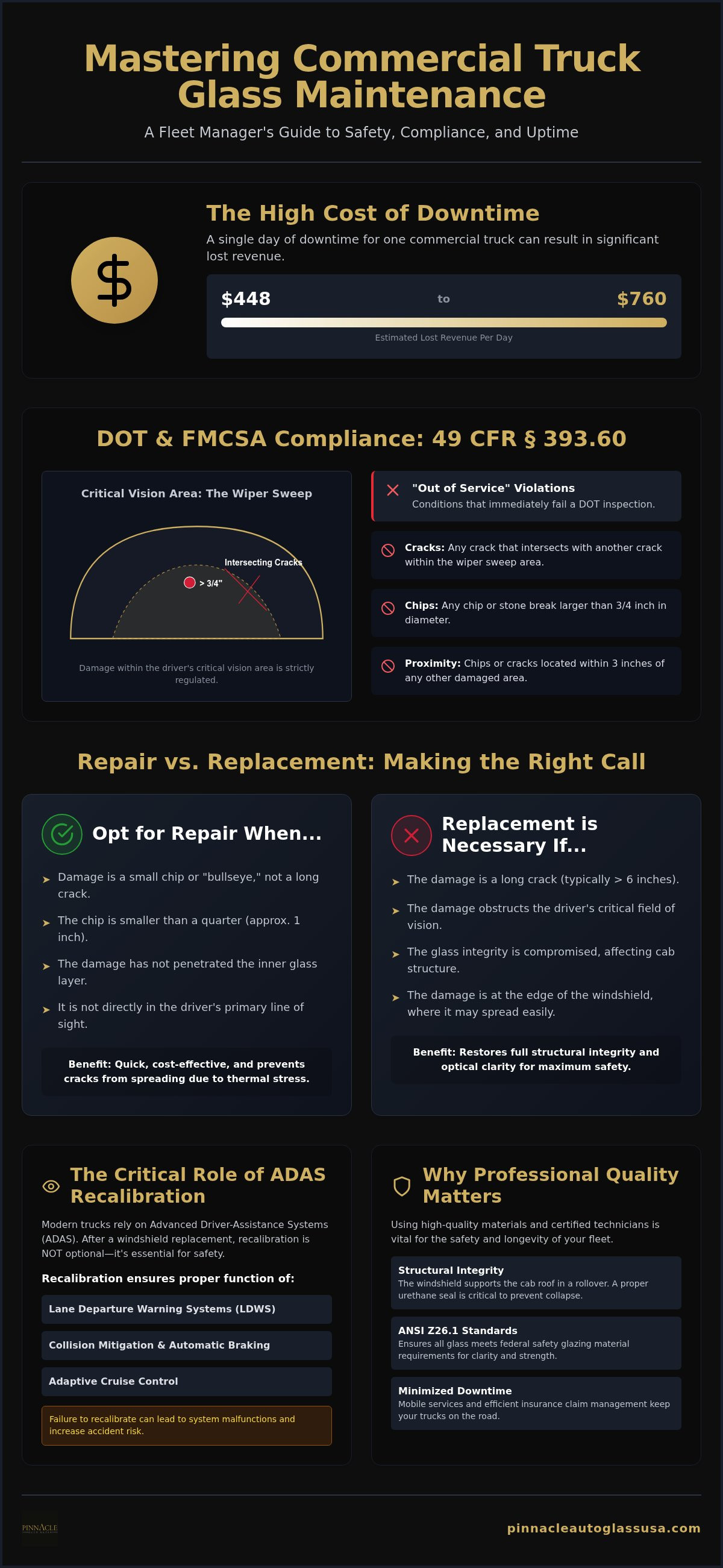
A single day of downtime for a commercial truck can cost your fleet between $448 and $760 in lost revenue. When a driver spots a crack in the line of sight, the pressure to find reliable semi truck windshield repair near me becomes an urgent logistics priority. You already know that a damaged windshield is more than a cosmetic issue. It is a safety risk and a primary cause for DOT inspection failures. Federal regulations under 49 CFR § 393.60 are strict. Even a small chip can lead to an "out of service" order if it exceeds 3/4 inch in diameter or sits within the wiper sweep area.
We understand that your primary goals are driver safety and keeping your fleet on the road. This 2026 guide provides the essential knowledge needed to master commercial glass maintenance. You will learn about the latest FMCSA visibility standards, the necessity of ADAS recalibration for newer models, and how on-site mobile services minimize operational delays. We cover the technical requirements for modern safety systems to ensure your trucks remain compliant and your drivers stay protected.
Key Takeaways
- Understand the specific FMCSA 393.60 standards to ensure every vehicle in your fleet remains compliant and avoids costly "out of service" orders.
- Learn to distinguish between repairable stone chips and structural cracks that require a full windshield replacement to maintain rig integrity.
- Discover how to source mobile semi truck windshield repair near me to minimize vehicle downtime and keep your logistics operations moving.
- Master the critical requirements for ADAS recalibration to ensure collision mitigation and lane departure systems function perfectly after glass installation.
- Evaluate the logistics of fleet glass services, including the benefits of professional insurance claim management and high-quality glass selection.
Understanding Semi-Truck Windshield Safety and DOT Standards
A semi-truck windshield is much more than a transparent barrier. It is a critical safety component that contributes to the overall structural integrity of the cab. Unlike passenger vehicles, commercial rigs face extreme wind resistance and constant vibration. These forces put immense pressure on the glass and its adhesive seal. Finding professional semi truck windshield repair near me is a logistics priority because even a minor chip can compromise the entire unit under heavy-duty operating conditions.
Most commercial windshields are made from laminated safety glass. This design uses two layers of glass bonded by a plastic interlayer. It's engineered to stay in one piece during an impact. In contrast, side windows often use tempered glass, which is designed to shatter into small, blunt pieces. For semi-trucks, the laminated front glass must withstand significant stress while maintaining perfect clarity for the driver.
FMCSA Compliance: What Drivers Need to Know
The Federal Motor Carrier Safety Administration (FMCSA) maintains strict rules under 49 CFR § 393.60. Safety inspectors don't take glass damage lightly. If a crack intersects another crack within the area swept by the wipers, the vehicle is non-compliant. For smaller chips or stone breaks, the damage must be no larger than 3/4 inch in diameter. Additionally, these chips cannot be located within 3 inches of any other damaged area.
Violating these standards often leads to immediate "Out of Service" (OOS) orders during roadside inspections. These delays hurt your delivery schedules and increase your carrier's CSA score. According to DOT standards, the critical area of a truck windshield is the portion of the glass directly in front of the driver that is cleared by the windshield wipers. Maintaining this field of vision is mandatory for legal operation.
Structural Integrity and Driver Protection
The windshield provides essential support for the cab roof. In the event of a rollover, the glass helps prevent the roof from crushing inward. This structural role is why proper adhesive bonding is vital. If the glass isn't installed correctly with high-quality urethane, it can pop out during a collision. This failure increases the risk of driver ejection, which is a leading cause of fatalities in heavy-truck accidents.
Quality matters when selecting replacement glass. All commercial glass should meet ANSI Z26.1 standards for safety glazing materials. Using inferior materials can lead to:
- Reduced visibility due to optical distortion
- Weakened roof support during accidents
- Premature seal failure from road vibrations
- Difficulty with semi truck windshield repair near me if the glass is prone to spreading cracks
Windshield Repair vs. Replacement for Commercial Rigs
Deciding whether to patch a chip or swap the entire glass is a critical choice for any fleet manager. The decision depends on the type of damage, its location, and the specific configuration of your truck. Most modern Class 8 trucks feature large, one-piece aerodynamic windshields. Older or specialty models might use a two-piece system divided by a center bar. If you are searching for semi truck windshield repair near me, understanding these differences helps you communicate effectively with a service technician.
Heavy-duty glass requires specialized extraction tools. Technicians often use wire-cutting systems or oscillating power tools to remove the old urethane seal without damaging the cab frame. For two-piece systems, the focus shifts to the rubber gaskets. These gaskets must be inspected for dry rot or compression set during every service. A faulty gasket leads to water leaks and wind noise, which can distract drivers during long hauls.
When to Opt for Professional Repair
Small stone chips are the most common candidates for professional windshield repair. A chip is generally repairable if it is smaller than a quarter and does not penetrate the inner layer of the laminated glass. Technicians use a resin injection process to fill the void. This resin is cured with ultraviolet light, restoring the structural bond and preventing the damage from spreading under thermal stress.
Thermal stress is a major factor for commercial rigs. Rapid temperature changes between a frozen exterior and a heated cab can cause a small chip to "spider" across the entire surface in minutes. Acting quickly saves the cost of a full replacement. If you notice a bullseye or star break, it's best to schedule a service immediately to maintain your uptime.
Signs a Full Replacement is Non-Negotiable
Some damage is too severe for resin to fix. Cracks that originate from the edge of the glass, known as edge cracks, almost always require a full replacement. These cracks compromise the structural bond between the glass and the cab. Additionally, any damage that sits directly in the driver's primary line of sight should be replaced rather than repaired. Repairs can leave slight optical distortions that interfere with visibility, especially during night driving or in heavy rain.
Adhering to FMCSA windshield safety standards is the only way to ensure your rig is legally roadworthy. If a crack has already branched out or if multiple repairs are clustered together, the integrity of the glass is gone. For fleets focused on long-term reliability, choosing professional fleet glass services ensures that every replacement meets OEM specifications. This proactive approach keeps your drivers safe and your trucks compliant during every inspection.
Mobile vs. In-Shop Glass Services: Managing Fleet Downtime
Fleet managers face a constant balancing act between vehicle safety and operational uptime. When a driver reports a cracked windshield, the immediate goal is to find semi truck windshield repair near me that doesn't derail the week's delivery schedule. Choosing between mobile and in-shop service is a strategic decision that impacts your bottom line. While mobile services offer unmatched convenience, certain technical requirements might make an in-shop visit the more reliable choice for complex rigs.
Coordinating glass service with scheduled vehicle maintenance is the most effective way to maximize efficiency. By aligning a windshield replacement with a routine oil change or brake inspection, you eliminate an extra day of standing still. This proactive approach ensures that your trucks stay on the road while maintaining the highest safety standards for your drivers.
Maximizing Uptime with Mobile Service
The primary advantage of reducing fleet downtime with mobile glass repair is that the rig never leaves the yard. Technicians arrive at your terminal or a designated truck stop, allowing the driver to complete their mandatory rest period while the work is performed. This eliminates the fuel costs and labor hours associated with shuttling vehicles to a repair facility.
Successful mobile installation requires specific environmental conditions. Technicians need at least 15 feet of clearance around the cab and a relatively level surface. Climate also plays a massive role in the Safe Drive-Away Time (SDAT). High-performance adhesives used for semi-trucks require specific temperature and humidity levels to cure correctly. In extreme cold or heavy rain, the SDAT can extend significantly, meaning the truck must remain stationary for several hours to ensure the bond is permanent and structural.
The Benefits of In-Shop Commercial Service
While mobile service is ideal for standard chips, in-shop service is often superior for full replacements on newer models. A controlled environment is essential for following industry best practices for ADAS recalibration. Parking lots rarely offer the perfectly level floors and consistent lighting required to align sensitive cameras and lane-departure sensors. A shop environment removes these variables, ensuring the safety systems are calibrated to OEM specifications.
In-shop service also provides better access to a comprehensive inventory. If your fleet uses specialized or rare commercial glass models, the shop likely has the necessary parts and specialized gaskets on hand. Working in a debris-free, indoor bay ensures a cleaner bond between the glass and the cab frame. This attention to detail prevents the small leaks or wind whistles that can become a major nuisance during long-haul routes. If you are looking for semi truck windshield repair near me for a truck equipped with advanced collision mitigation, the precision of an in-shop visit is often the safest path forward.
The Critical Role of ADAS Recalibration in Modern Semi-Trucks
Modern semi-trucks are no longer just mechanical machines. They are sophisticated computers on wheels. Advanced Driver Assistance Systems (ADAS), such as collision mitigation and lane departure warning, are now standard on most Class 8 vehicles. These systems rely on high-definition cameras and sensors mounted directly behind the windshield. When you search for semi truck windshield repair near me, you must ensure the provider can handle the digital side of the installation. A simple glass swap is no longer enough to get a rig back into service safely.
Replacing the glass physically disturbs these sensitive sensors. Even if the camera is reattached to the same bracket, its perspective has changed relative to the road. Recalibration is mandatory because the system must re-learn its position. Without this step, your safety features are effectively blind or, worse, prone to dangerous errors like false braking. Misaligned sensors can misinterpret a shadow or a bridge as an obstacle, leading to unexpected emergency stops that put your driver and cargo at risk.
Recalibration and Commercial Safety Systems
Effective ADAS calibration auto glass services ensure that your Lane Departure Warning (LDW) functions with pinpoint accuracy. The thickness and clarity of the replacement glass are vital. Minor variations in glass manufacturing can refract light differently, confusing the camera's processor. Professional installers use high-quality glass to maintain the exact optical path required for these sensors to "see" the road ahead.
A camera misalignment of just one degree can result in the vehicle's safety system failing to detect obstacles or lane markings by dozens of feet at highway speeds. This creates a significant safety gap during long-haul trips. Ensuring the glass is perfectly clear and the camera is precisely aimed is the only way to maintain the protective envelope around your vehicle.
Static vs. Dynamic Calibration for Trucks
Static recalibration takes place in a controlled shop environment. It requires specialized targets, precise floor leveling, and specific lighting conditions. Because semi-trucks are significantly larger than passenger cars, the floor space and target distance requirements are much greater. This process ensures the sensors are aligned while the vehicle is stationary, providing a baseline for the system's logic.
Dynamic calibration involves a road test. The technician drives the truck at a specific speed on clearly marked roads to allow the system to calibrate using real-world data. Many modern rigs require both static and dynamic procedures to be fully compliant. Only certified technicians should perform these tasks to ensure your fleet meets all safety standards. To keep your rigs safe and compliant, schedule professional ADAS recalibration with your next windshield installation.
Professional Fleet Solutions: Why Quality Glass Matters
Selecting a partner for semi truck windshield repair near me involves more than just finding the lowest quote. For large-scale logistics operations, the total cost of ownership (TCO) is the most important metric. Low-quality glass often leads to premature pitting, stress cracks, and poor sensor performance. Investing in high-quality materials ensures your rigs stay on the road longer without recurring maintenance issues.
A professional installation acts as the final line of defense for your drivers. Beyond the glass itself, the quality of the adhesive and the precision of the technician determine how well the windshield performs during a collision. By prioritizing quality, you reduce the long-term risks associated with structural failure and system errors. This proactive approach is the hallmark of a well-managed fleet.
OEM Standards and Long-Haul Durability
Original Equipment Manufacturer (OEM) glass is produced to the exact specifications of the truck's maker. This ensures perfect fitment and superior optical clarity. When evaluating how much does windshield replacement cost, fleet managers must look beyond the initial invoice. High-quality glass resists the constant sandblasting effect of highway debris better than budget alternatives. This durability extends the vehicle lifecycle and reduces the frequency of downtime.
Warranties are another critical factor in a commercial environment. Professional glass providers offer robust warranties against stress cracks and air leaks. These protections provide peace of mind for long-haul routes where a failure in a remote location could cause significant delays. Choosing glass that meets or exceeds OEM standards is the best way to protect your investment and ensure your ADAS remains accurate over thousands of miles.
Streamlining the Insurance Process
Administrative efficiency is vital for fleet coordinators managing dozens or hundreds of vehicles. Professional glass providers specialize in streamlining the insurance process. They offer direct billing for major commercial policies, which removes the need for your team to handle complex paperwork. This direct integration ensures that claims are processed quickly and accurately, minimizing the administrative burden on your back office.
Proper documentation is essential for fleet insurance claims. A reputable service provider will supply detailed records to support your logistics operations. These records often include:
- Pre-installation inspection reports
- Proof of ADAS recalibration completion
- Glass manufacturer specifications
- Clear photos of the damage and the completed work
Before releasing a rig back into service, use a final checklist to ensure the job was done correctly. First, verify that the glass is free of any optical distortions. Second, check the urethane seal for a smooth, consistent bead. Third, confirm that all ADAS features are active and error-free on the dashboard. Finally, ensure the driver's field of vision is perfectly clear and compliant with all DOT standards. Following these steps ensures your fleet remains a safe and efficient logistics operation.
Maintain Fleet Compliance and Safety
Managing a commercial fleet in 2026 requires a proactive approach to glass maintenance. You've learned that meeting FMCSA 393.60 standards is essential to avoid "out of service" orders and protect your CSA scores. Integrating ADAS recalibration with every windshield replacement is no longer optional; it's a fundamental safety requirement for modern collision mitigation systems. By choosing high-quality glass and professional installation, you minimize the long-term total cost of ownership for your rigs.
When you need reliable semi truck windshield repair near me, don't settle for providers who overlook the technical complexities of heavy-duty vehicles. Our certified technicians specialize in commercial glass and provide nationwide support designed for minimal downtime. We include expert ADAS recalibration on-site to keep your trucks safe and compliant. Get a professional quote for your fleet glass needs from Pinnacle Auto Glass today. Keep your drivers protected and your logistics operations moving forward with confidence.
Frequently Asked Questions
Is it legal to drive a semi-truck with a cracked windshield?
It is illegal to operate a commercial vehicle if the glass damage violates FMCSA 49 CFR § 393.60 standards. Any crack that intersects another crack within the area swept by the windshield wipers is a violation. Additionally, individual chips must be smaller than 3/4 inch in diameter. Driving with non-compliant glass puts your fleet at risk for fines and immediate safety violations during roadside inspections.
How long does a semi-truck windshield replacement take?
A standard semi-truck windshield replacement typically takes between one and two hours to complete. This timeframe includes removing the old glass, cleaning the cab frame, and applying professional-grade adhesive. You must also account for the safe drive-away time, which allows the urethane to cure. Most high-performance adhesives require at least one additional hour of stationary time before the truck can safely return to the road.
Do I really need ADAS recalibration for my commercial rig?
Yes, recalibration is mandatory for any commercial rig equipped with Advanced Driver Assistance Systems. When you search for semi truck windshield repair near me, ensure the provider includes this digital service. Replacing the glass changes the camera's alignment relative to the road. Without precise recalibration, features like collision mitigation and lane departure warnings may fail or trigger false braking, creating a significant safety hazard.
Can a mobile technician replace a two-piece semi-truck windshield?
Yes, a qualified mobile technician can replace a two-piece windshield system at your yard or terminal. These systems often use rubber gaskets rather than urethane adhesive. The technician will inspect the center bar and gaskets for wear or dry rot during the process. While mobile service is convenient, the work area must have enough clearance and be protected from extreme weather to ensure a proper, long-lasting seal.
What is the safe drive-away time for a heavy-duty truck?
The safe drive-away time for a heavy-duty truck generally ranges from one to three hours after the installation is finished. This duration depends on the specific type of high-viscosity urethane used and the local weather conditions. High humidity and warmer temperatures often help the adhesive cure faster. It's vital to follow the technician's instructions to ensure the windshield remains structurally bonded during a collision or rollover event.
Does insurance cover semi-truck glass replacement?
Most commercial insurance policies cover windshield replacement and repair under comprehensive coverage. Many professional glass providers offer direct billing to simplify the process for fleet managers. You will typically need to provide your policy information and documentation of the damage. Using a provider that understands the nuances of commercial claims can significantly reduce the administrative burden on your logistics team and speed up the entire repair process.
What happens if a truck fails a DOT inspection due to glass damage?
Failing a DOT inspection due to glass damage often results in an immediate "Out of Service" order. This means the truck cannot move until the windshield is repaired or replaced to meet federal standards. Beyond the logistical delay, your carrier will likely face fines and an increase in its CSA score. Finding semi truck windshield repair near me quickly is essential to resolve the violation and get the vehicle back into service.
What is the difference between static and dynamic recalibration for trucks?
Static recalibration occurs in a controlled shop environment using specialized targets and precise floor leveling to provide a fixed baseline for the sensors. Dynamic recalibration requires the technician to drive the truck on the road at specific speeds so the system can learn from real-world markers. Many modern Class 8 trucks require both types of calibration to ensure the safety systems are fully compliant and functioning according to OEM specifications.


