
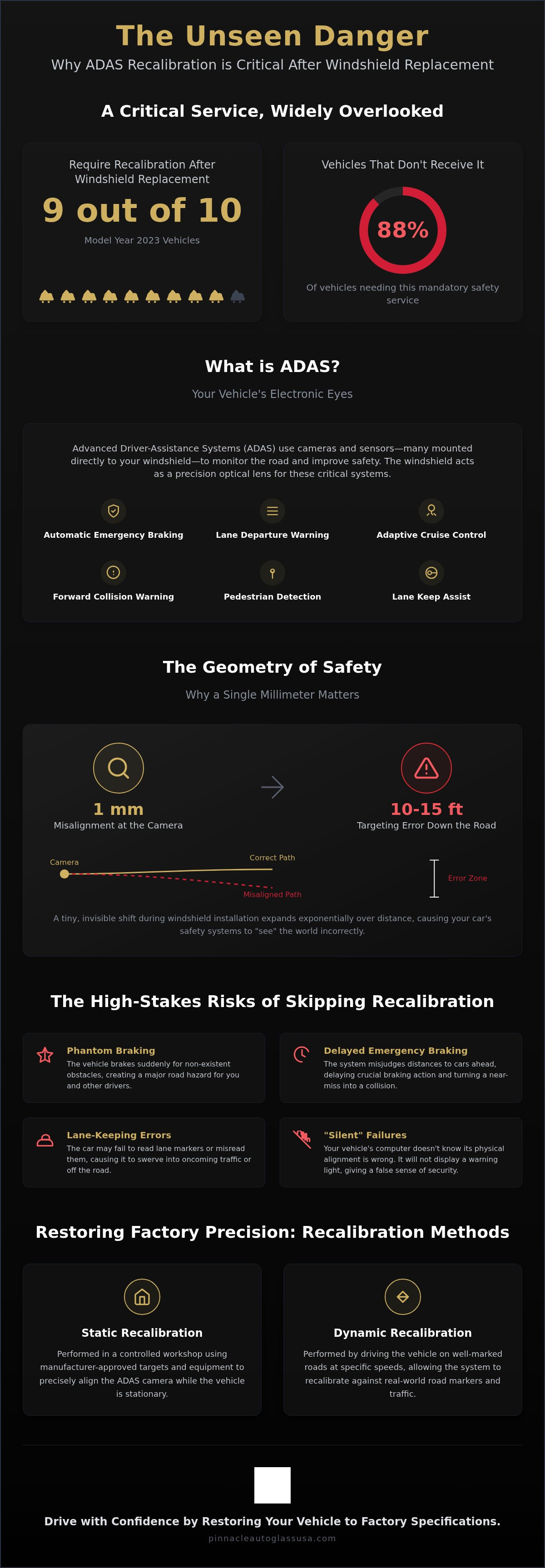
Nearly 9 out of 10 model year 2023 vehicles require ADAS recalibration after a windshield replacement, yet market data from 2026 suggests that 88% of vehicles needing this service don't actually receive it. You might feel like this requirement is just an extra line item on your bill or wonder why is ADAS recalibration necessary after windshield replacement. It’s natural to feel frustrated by technical jargon or unexpected costs when you simply want your vehicle fixed and back on the road.
The reality is that your vehicle's safety systems depend on precise alignment to function. Even a tiny shift during glass installation can cause your automatic emergency braking or lane-keep assist to fail at highway speeds. This article clarifies the technical reasons for this service and explains how 2026 federal and state regulations affect your repair. You’ll learn how professional recalibration restores your vehicle to factory specifications so you can drive with total confidence.
Key Takeaways
- Understand how ADAS functions as your vehicle's eyes and why sensors are mounted directly to the glass.
- Learn why is ADAS recalibration necessary after windshield replacement to correct tiny alignment shifts that cause major errors at highway speeds.
- Differentiate between static and dynamic recalibration methods to ensure your safety systems meet 2026 manufacturer standards.
- Recognize the dangers of "silent failures" and how skipping professional service can impact your insurance liability.
- Discover how integrated glass and technology solutions simplify the process of restoring your vehicle to factory specifications.
What is ADAS and Why is it Bonded to Your Windshield?
Modern vehicles are complex computers on wheels. Much of this intelligence lives in Advanced Driver-Assistance Systems (ADAS), which serve as the primary "eyes" of your car. These systems use a network of cameras and sensors to monitor the road, identify hazards, and intervene when you cannot react fast enough. Most of these critical sensors are mounted directly to your windshield, making the glass a vital piece of safety equipment rather than just a clear barrier. Understanding the physical bond between the camera and the glass helps clarify why is ADAS recalibration necessary after windshield replacement.
Common ADAS features that rely on these sensors include:
- Lane Departure Warning: Alerts you if the vehicle drifts out of its lane.
- Automatic Emergency Braking: Applies the brakes to prevent or mitigate a collision.
- Adaptive Cruise Control: Maintains a safe following distance from the car ahead.
The Windshield as a Critical Safety Component
Today's windshield is a precision optical lens. Cameras are bonded to the glass to ensure they have an unobstructed, high-definition view of the environment. These cameras must see through specific zones of the glass that are free from distortion or imperfections. Even when using high-quality glass, the physical act of removing and reinstalling the camera housing creates microscopic shifts in alignment. This is a primary reason why is ADAS recalibration necessary after windshield replacement to ensure the "eyes" are looking exactly where they should. By 2026 standards, even a tiny misalignment can cause the system to misinterpret the road ahead.
Common Systems Relying on Clear Vision
Forward Collision Warning (FCW) relies on depth perception to calculate the distance between you and the vehicle ahead. If the camera is off by even a fraction of a degree, it might misjudge that distance by several feet. Pedestrian Detection systems translate millions of pixels into life-saving braking actions in milliseconds. Similarly, Lane Keep Assist (LKA) tracks road markers through the glass to keep you centered. If the camera's perspective is skewed, these systems might fail to activate or, worse, activate at the wrong time. Professional recalibration ensures these pixels translate into accurate safety responses every time you drive.
The Geometry of Safety: Why a Millimeter Matters
Many drivers assume that if a camera is physically reattached to its bracket, the job is done. This logic ignores the mathematical reality of camera focal points. A shift of just 1 millimeter at the lens might seem insignificant to the human eye. However, as the camera projects its view hundreds of feet down the road, that tiny deviation expands exponentially. At highway speeds, a 1mm misalignment can result in an error of 10 to 15 feet in the system's perception of the road. This mathematical reality is why is ADAS recalibration necessary after windshield replacement.
Your car's computer often fails to recognize this physical misalignment. It lacks a manual "self-check" for physical positioning relative to the horizon. Instead, it continues to process data based on the original factory settings. This leads to "phantom braking," where the car detects a non-existent obstacle and slams on the brakes. The National Highway Traffic Safety Administration (NHTSA) emphasizes that these technologies must function exactly as intended to maintain road safety. Without professional verification, your safety systems are essentially guessing.
The Impact on Emergency Braking
A misaligned camera fundamentally miscalculates the distance between your vehicle and the one ahead. If the system thinks a car is 50 feet away when it is actually only 35 feet away, it will delay braking. This delay is often the difference between a safe stop and a severe rear-end collision. Optical deviation refers to the change in the path of light as it passes through the glass, which can distort the camera's view if not corrected. If you've recently had glass work, ensuring your windshield replacement included tech verification is essential for your safety.
Lane Departure and Steering Inaccuracies
Miscalibrated systems frequently "see" lane markers where none exist or miss them entirely. This creates a risk where the Lane Keep Assist might pull the steering wheel toward a ditch or into oncoming traffic. Some owners believe their vehicles have "self-healing" or "auto-learning" capabilities that will fix the alignment over time. While some systems do adapt, they still require a precise baseline calibration to operate within safe margins. Professional shops emphasize why is ADAS recalibration necessary after windshield replacement to avoid these steering risks. Without this foundation, the system's learning process starts from a flawed position, compromising every safety intervention.
Static vs. Dynamic Recalibration: What Happens During Service?
Recalibration is a specialized technical procedure that restores your vehicle's safety sensors to their factory settings. It's not a generic task. Each vehicle manufacturer establishes specific protocols for their safety systems. A trained technician uses sophisticated diagnostic software to perform a "handshake" with the vehicle’s Electronic Control Unit (ECU). This digital connection ensures the car recognizes the new windshield as a clear, properly aligned window for its sensors. The Insurance Institute for Highway Safety (IIHS) notes that while these features significantly improve safety, they make the repair process more technical and precise. Understanding these methods helps explain why is ADAS recalibration necessary after windshield replacement for different makes and models.
The Static Calibration Environment
Static recalibration takes place in a highly controlled shop environment. It requires a perfectly level floor and specific lighting conditions to prevent glare from interfering with the camera's vision. Technicians set up digital targets or physical boards at precise distances and heights from the vehicle. The camera then "reads" these targets to reset its "zero point" or baseline perspective. This level of precision is a major reason why is ADAS recalibration necessary after windshield replacement; a standard driveway or uneven parking lot cannot provide the stable environment needed for these measurements. For many 2026 models, this shop-based setup is the only way to meet OEM safety standards.
The Dynamic Road Test Process
Dynamic recalibration involves a specific road test. The technician connects a diagnostic tablet to the vehicle's OBD-II port and drives at a consistent speed on well-marked roads. During this drive, the system monitors road lines and traffic patterns to "learn" its new position relative to the road. This process requires clear weather and highly visible lane markings. If it rains or the road lines are faded, the system won't complete the calibration. The tablet provides real-time feedback on the system's learning progress. Some manufacturers require only one method, while others demand both static and dynamic procedures to ensure total system integrity. This hands-on verification ensures the software and hardware are perfectly synced before you get back behind the wheel.
The Risks of Skipping Recalibration: Safety and Liability
Skipping recalibration creates a "silent failure" risk. Unlike a flat tire or a cracked windshield, a misaligned camera rarely triggers a dashboard warning light. The system stays active but operates with flawed data. This is exactly why is ADAS recalibration necessary after windshield replacement; you won't know the system is broken until it fails to stop for a hazard. This creates a massive safety gap for you and your passengers. A system that "thinks" it's looking straight while it's actually angled toward the shoulder is more dangerous than no system at all.
Insurance implications are equally serious. If you're involved in a collision and the investigation shows you skipped a mandatory safety reset, your insurer could deny the claim. They may argue the vehicle was not maintained to manufacturer standards. This negligence can lead to thousands in out-of-pocket expenses. Additionally, uncalibrated systems negatively impact resale value. In 2026, safety reports and vehicle history checks often flag missing ADAS service records, making it harder to sell or trade in your vehicle.
Insurance Coverage and Your Deductible
Most comprehensive insurance policies cover recalibration as a standard part of a glass claim. You don't have to pay for this service separately. It's bundled into your existing coverage. You can find more details in our windshield replacement cost guide. Paying your deductible for a full safety reset is a far better investment than risking a total system failure on the highway. It ensures your safety tech is restored to factory specifications without a separate financial burden.
Legal and Fleet Considerations
For business owners, the stakes are higher. You have a legal duty of care to provide safe vehicles for your employees. An accident caused by a miscalibrated ADAS system in a commercial vehicle can lead to devastating negligence lawsuits. Proper documentation of every recalibration protects your business from these claims by proving you met all safety requirements. We focus on reducing fleet downtime with mobile glass repair and integrated tech services to keep your drivers safe without stalling your operations. Documentation is your best defense against liability.
Protect your safety and your liability by choosing a partner that handles both glass and tech. Schedule your professional ADAS recalibration today to ensure your vehicle is road-ready.
The Pinnacle Standard: Integrated Glass and Tech Solutions
Pinnacle Auto Glass simplifies the repair process by providing a seamless transition from glass installation to technical recalibration. We don't just replace the glass and leave the safety checks to someone else. Our certified technicians receive specialized training in the latest 2026 ADAS protocols to ensure your vehicle's cameras and sensors interact perfectly with the new windshield. Understanding why is ADAS recalibration necessary after windshield replacement is the first step toward a safe repair. Our team prioritizes OEM-quality glass because sensor transparency is non-negotiable. Even a slight tint or glass thickness variation can interfere with sensor accuracy. Whether you drive a personal sedan or manage a nationwide commercial fleet, our integrated approach removes the guesswork. We handle the entire safety chain in a single appointment to get you back on the road quickly.
Why Trust a Specialist?
Choosing a full-service safety specialist over a "glass-only" shop is a matter of liability and protection. A shop that lacks calibration equipment leaves your safety systems in a state of failure. You can learn more about why hiring a certified auto glass technician is critical for these advanced repairs. We ensure every job meets safe windshield replacement standards by verifying the camera's field of vision before you leave the shop.
Professional oversight is a core reason why is ADAS recalibration necessary after windshield replacement; it guarantees that the hardware and software are perfectly synced. We provide the digital documentation you need for insurance records and fleet compliance. This certification proves that your vehicle was restored to factory specifications using industry-leading tools. Our expertise covers both personal vehicles and commercial truck glass, ensuring every driver has the same level of protection.
Getting Started with Your Service
Identifying whether your vehicle needs this service is straightforward. Look at the top center of your windshield from the outside. If you see a triangular or rectangular plastic housing behind the glass, your car likely has a forward-facing camera. These housings often contain sensors for lane keep assist, pedestrian detection, or collision avoidance. If you see these features, you must schedule a calibration with your glass service.
To provide an accurate quote, we'll need your vehicle's Year, Make, Model, and Trim level. This information helps us determine which specific calibration targets and software protocols your car requires. Some trim levels include advanced sensor packages that require dual static and dynamic procedures. Don't leave your safety to chance. Reach out to our team to restore your vehicle's safety features to factory specifications today.
Secure Your Vehicle's Safety for the Road Ahead
Driving in 2026 requires more than just a clear view; it demands a perfectly aligned safety system. You now understand that a shift of just one millimeter at the camera lens can lead to significant errors in emergency braking and lane keep assist. This precision is the core reason why is ADAS recalibration necessary after windshield replacement. By choosing a service that integrates glass installation with technical verification, you avoid the dangers of "silent failures" and potential insurance liability. Don't leave your safety to chance after a glass repair.
Pinnacle Auto Glass provides a comprehensive solution with expert ADAS recalibration and nationwide service for personal and fleet vehicles. Our certified professional technicians ensure your cameras are restored to factory specifications before you ever pull out of the shop. It's the most efficient way to protect your investment and your passengers. Restore Your Vehicle's Safety—Schedule Your Windshield Replacement and Recalibration with Pinnacle Auto Glass. We're ready to help you get back on the road with total confidence.
Frequently Asked Questions
Can I drive my car if the ADAS is not recalibrated?
You can technically operate the vehicle, but it's not safe to do so. Your safety systems may behave unpredictably because they're working with unverified data. Features like automatic emergency braking could engage without reason or fail to activate during a real emergency. Driving without recalibration compromises your safety and increases the risk of a collision.
How long does the recalibration process take after the glass is installed?
The process typically takes between 45 minutes and two hours. This timeframe depends on whether your vehicle requires a static procedure, a dynamic road test, or both. We coordinate the calibration with your windshield installation to ensure you're back on the road as quickly as possible. Some complex systems may require additional time for precise sensor alignment.
Will my insurance cover the cost of ADAS recalibration?
Most comprehensive insurance policies cover the cost of recalibration as part of a glass replacement claim. Insurers recognize this as a mandatory safety requirement rather than an optional upgrade. We work directly with major providers to streamline the billing process. You should check your specific policy to confirm how your deductible applies to these integrated safety services.
Does every new windshield require recalibration?
Not every vehicle requires it, but almost all cars manufactured after 2020 with safety technology do. If your vehicle has a forward-facing camera mounted behind the rearview mirror, this service is mandatory. This is a primary reason why is ADAS recalibration necessary after windshield replacement for modern vehicles equipped with collision avoidance or lane-keeping features.
What happens if I choose to skip the recalibration service?
Skipping this service leaves your safety systems in a state of "silent failure." The car might not show an error light, but it will miscalculate distances and road positions. This leads to dangerous steering corrections or delayed braking. You also face significant legal liability and potential insurance claim denials if an uncalibrated system is linked to an accident.
Is there a difference between dealership recalibration and a glass specialist?
Glass specialists use the same OEM-standard software and diagnostic tools as dealerships. The primary difference is the efficiency of the service. We provide a one-stop solution that handles both the glass installation and the technical reset in a single visit. This saves you the time and hassle of scheduling a separate follow-up appointment at a dealership.
Will my dashboard show a light if calibration is needed?
Your dashboard won't always display a warning light if the camera is misaligned. Many systems continue to function with a slight "degree of error" without triggering a fault code. This lack of a visual warning is exactly why is ADAS recalibration necessary after windshield replacement. Professional verification is the only way to ensure the sensors are actually looking where they should.
Can ADAS recalibration be done through a mobile service?
Some vehicles allow for dynamic recalibration through a mobile service, but many require a controlled shop environment. Static calibration requires level flooring and specific lighting to ensure the camera reads digital targets accurately. We evaluate your vehicle's specific manufacturer requirements to determine if the service can be performed at your location or in one of our dedicated bays.


