
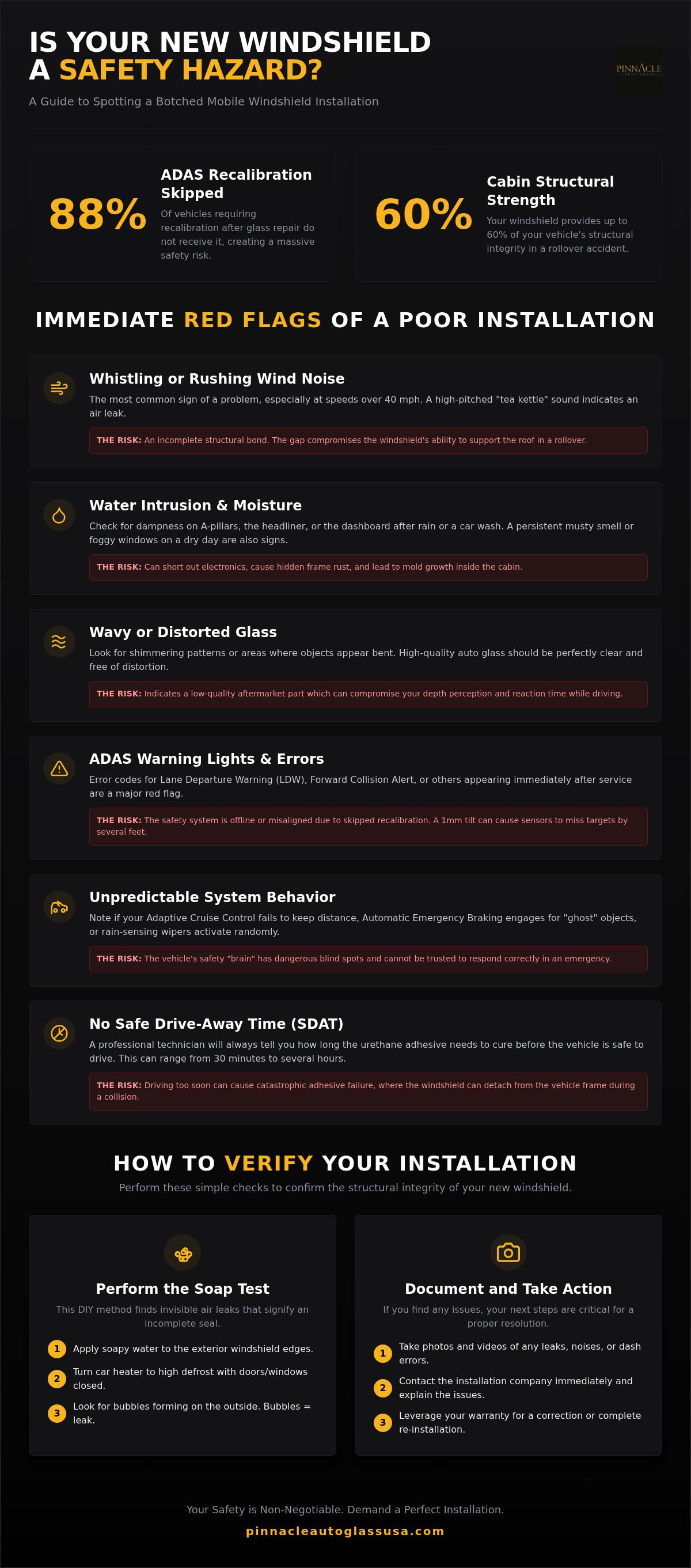
An estimated 88% of vehicles that require ADAS recalibration after a glass repair do not actually receive it, according to 2026 market data from Accio. This is a staggering risk considering your windshield provides up to 60% of your cabin’s structural strength in a rollover accident. When researching what to expect from mobile windshield replacement, most drivers prioritize convenience. However, a botched installation is a structural safety failure rather than a simple cosmetic nuisance.
It is frustrating to deal with whistling sounds at high speeds, water leaks, or safety sensors throwing error codes immediately after a service. You shouldn't have to guess if your car is safe to drive. We understand that you need your vehicle back on the road without compromising your family's safety. This article identifies dangerous installation errors and teaches you how to verify your vehicle’s structural integrity after a mobile service. We provide a clear roadmap for warranty claims and explain the critical risks of skipped ADAS recalibration to ensure your safety systems function exactly as intended.
Key Takeaways
- Identify immediate warning signs like whistling wind noise or water leaks that indicate a compromised seal and structural failure.
- Understand what to expect from mobile windshield replacement regarding ADAS recalibration to ensure your safety sensors function correctly.
- Perform simple DIY checks like the Soap Test or Flush Test to verify the structural integrity and alignment of your new glass.
- Recognize process shortcuts such as failing to provide a Safe Drive-Away Time (SDAT) which can lead to catastrophic adhesive failure.
- Learn the professional steps to document installation errors and leverage your warranty for necessary corrections or re-installation.
Audible and Visual Indicators of a Failed Windshield Seal
Identifying a failure starts the moment you drive. Whistling or rushing air sounds at speeds above 40 mph are the most common red flags. If you're wondering what to expect from mobile windshield replacement, you should anticipate a quiet cabin that matches the original factory seal. Visual issues also matter. Look for wavy patterns or distortions in the laminated safety glass. High-quality glass should be perfectly clear. If objects look bent or shimmery while you're moving, the glass is likely a low-quality aftermarket part that could compromise your depth perception and reaction time.
The Mechanics of Wind Noise
High-pitched whistling occurs when air forced against the vehicle finds a tiny gap in the urethane bead. This isn't just an annoying sound. It's a sign that the structural bond is incomplete. A properly installed windshield should be completely airtight. Sometimes, loose plastic trim or molding can rattle, but a true seal failure creates a distinct tea kettle sound. If the noise changes or disappears when you slightly adjust the cabin pressure by opening a window, you've confirmed a seal breach. This gap weakens the ability of the glass to support the roof during a rollover.
Detecting Water Leaks Early
Water intrusion is a slow-motion disaster for your vehicle's interior. Check your A-pillars and the edge of the headliner after the first heavy rain or car wash. Moisture on the dashboard or a persistent musty smell indicates a leak. These leaks don't just ruin upholstery. They can short out expensive electronics or cause hidden frame rust that weakens the vehicle's pillars over time. If your windows are foggy on a dry day, it's likely that water is trapped inside the cabin due to a failed installation. Dealing with these issues early prevents mold growth and electrical failures.
Conducting the Soap Test
You can locate invisible air leaks using a simple DIY method called the soap test. Apply a mixture of liquid dish soap and water to the outside edge of the windshield glass. Turn your car's heater to the highest defrost setting with all windows and doors tightly closed. This creates positive pressure inside the cabin. If you see bubbles forming in the soapy water on the outside, you've found an air leak. This confirms that the technician failed to apply a continuous bead of professional-grade urethane, which is a major safety violation that requires immediate correction.
Hidden Dangers: ADAS Malfunctions and Sensor Errors
Modern vehicles rely on Advanced Driver Assistance Systems (ADAS) to keep you safe. These systems use cameras and sensors mounted directly behind your windshield. When you're considering what to expect from mobile windshield replacement, you must account for the digital handshake between the new glass and your vehicle's computer. A technician who only focuses on the physical installation leaves the job half-finished. If you see warning lights for Lane Departure Warning (LDW) or Forward Collision Alert immediately after service, the system is likely offline or misaligned. You should also visually inspect the camera through the glass. If the lens isn't perfectly centered in its bracket, the system cannot function correctly.
The Critical Role of ADAS Recalibration
Precision is mandatory for safety. Even a tiny 1-millimeter tilt in the camera mounting bracket can cause the sensor to "look" several feet off-center when scanning 100 yards ahead. This misalignment creates dangerous blind spots for your vehicle's safety brain. The Auto Glass Safety Council (AGSC) sets strict standards for these installations to ensure your car responds correctly in emergencies. You can learn more about these technical requirements in our guide on ADAS calibration auto glass. If your technician didn't use a specialized scanning tool or calibration targets, they skipped a vital step that leaves your safety suite compromised.
Common System Failures Post-Replacement
Improper calibration leads to unpredictable and scary driving behaviors. Your Adaptive Cruise Control (ACC) might fail to maintain a safe following distance, or your Automatic Emergency Braking (AEB) could slam on the brakes for "ghost" obstacles that aren't there. Other signs of a failed digital installation include:
- The car pulling toward lane lines instead of staying centered.
- Rain-sensing wipers that activate on sunny days or fail during a downpour.
- High-beam assist failing to toggle when oncoming traffic appears.
- The vehicle failing to recognize speed limit signs or pedestrian crossings.
These errors aren't just minor glitches; they are fundamental safety failures. A professional service always includes a post-installation scan to verify that all systems are communicating. If your car feels different or displays "Service ADAS" messages, you need a certified technician to perform a proper recalibration immediately. Don't ignore these warnings, as a malfunctioning safety suite can be more dangerous than having no assistance at all.
Technical Red Flags: Improper Urethane Application and Alignment
A sloppy installation often leaves behind visible evidence. When learning what to expect from mobile windshield replacement, many drivers focus on the speed of the service. However, the physical placement of the glass is a complex technical task. Visible oozing of black urethane adhesive inside or outside the vehicle is a sign of poor technique. While some might see this as purely aesthetic, it often points to a lack of precision that affects the structural bond. You should also check for gaps between the glass edge and the vehicle molding or A-pillars. If the exterior trim and cowlings feel loose or look mismatched after service, the technician likely rushed the reassembly process. Understanding what to expect from mobile windshield replacement means looking past the clean glass to the quality of the fitment underneath.
The Science of Pinchweld Preparation
Proper bonding requires meticulous preparation of the vehicle's frame, known as the pinchweld. Technicians must trim the old urethane to a specific thickness of 1-2mm. This creates a fresh, level surface for the new adhesive to grip. If the old material is removed completely down to the bare metal, the technician must apply a specialized primer to prevent oxidation. Failure to prime leads to catastrophic bonding failure and frame rust over time. Metal-to-glass contact is another major risk. Without a consistent, professional-grade urethane bead, the glass can vibrate directly against the metal frame. This friction leads to immediate stress cracks that can shatter the glass without warning. These technical steps ensure the windshield supports the roof as intended during a collision.
Alignment and Fitment Standards
Correct alignment is verified through the Flush Test. Run your hand across the top of the windshield where it meets the roofline. The glass should sit level with the vehicle roof. If the glass is pushed too deep into the frame, a condition called over-decking, it can interfere with internal sensors. According to NHTSA on ADAS safety, structural integrity is foundational to how modern automated systems perform. Conversely, under-decking occurs when the glass sits too high. This creates excessive wind drag and increases the risk of the glass popping out during an airbag deployment. Finally, verify the VIN plate alignment in the bottom corner of the windshield. If the identification number is obscured or crooked, the glass isn't seated correctly.
Process Failures: Signs Your Technician Took Shortcuts
Efficiency is a hallmark of professional mobile service, but speed should never replace safety. Shortcuts are often invisible until a crisis occurs. A technician who ignores industry protocols puts your vehicle's structural integrity at risk. When considering what to expect from mobile windshield replacement, you should look for a professional who follows a certified auto glass technician protocol. This includes the use of high-quality primers and professional-grade adhesives. If a technician finishes the installation and leaves without discussing specific safety timelines, they have likely skipped critical quality control steps.
Understanding Safe Drive-Away Time (SDAT)
Safe Drive-Away Time (SDAT) is defined as the specific amount of time the urethane adhesive needs to cure before it can safely withstand the force of a crash or airbag deployment. This is a non-negotiable structural requirement. The chemical curing process is heavily influenced by environmental factors such as temperature and humidity. High humidity often accelerates the cure, while extreme cold can slow it down significantly. If you drive the vehicle before the urethane has bonded, the glass can shift in the frame. This creates air leaks or, in a worst-case scenario, causes the windshield to fly out during an accident. Professional mobile services provide a specific, documented time when it's safe to resume driving.
Professionalism and Cleanup
A technician's workspace reflects their attention to detail. Grease marks on the upholstery or a dirty headliner aren't just cosmetic annoyances. They indicate a lack of care that likely extends to the hidden glass bond. Protective covers on seats and steering wheels are standard for high-quality service providers. If you find glass shards in your vents or on the floor, the technician was rushed and careless during the removal process. Retention tape is another indicator of process quality. While often necessary to hold the glass in place during the initial cure, it shouldn't be left on for an inappropriate amount of time. Understanding what to expect from mobile windshield replacement involves more than just watching the glass go in; it requires monitoring the technician's professionalism from start to finish.
These process failures are red flags that your installation might be compromised. Don't settle for a rushed job that endangers your vehicle's structural integrity. If you suspect a shortcut was taken during your service, contact our team for a professional safety inspection to verify your installation and ensure your peace of mind.
How to Correct a Poor Windshield Installation
Discovering a defect after your service requires immediate action. Start by documenting every issue with clear evidence. Take high-resolution photos of oozing adhesive, misaligned trim pieces, or gaps in the molding. Record videos of whistling wind noises at highway speeds or water intrusion during a car wash. This documentation is essential for your warranty claim. When you know what to expect from mobile windshield replacement, you can identify exactly where the technician failed to meet industry standards. Contact the original service provider to request a formal re-inspection. If they are unresponsive or dismissive, seek a second opinion from a reputable specialist like Pinnacle Auto Glass to confirm your vehicle is safe to drive.
The Re-Installation Process
A patch job with extra silicone is never a valid fix for a leaking windshield. This method fails to address the underlying bonding issue and leaves the glass structurally compromised. A proper correction requires a full Remove and Reinstall (R&R) procedure. The technician must remove the glass entirely and clean the pinchweld to ensure a fresh bonding surface. Ensuring a full windshield replacement is performed correctly is the only way to restore the vehicle's structural integrity. This process follows the same rigorous safety standards as a factory installation, including meticulous priming and the application of a consistent urethane bead. Do not accept anything less than a full reinstall if the initial bond was compromised.
Dealing with Insurance and Warranties
Review your paperwork for Lifetime Leak guarantees. Most reputable providers offer these to protect against workmanship errors and seal failures. If a shop refuses to correct a documented defect, contact your insurance agent immediately. Insurance companies prioritize vehicle safety and can often facilitate a resolution with the service provider on your behalf. For commercial clients, maintaining detailed service records is vital for fleet vehicle glass maintenance and safety compliance. Always prioritize providers that offer a National Lifetime Warranty. This coverage ensures you can access corrections regardless of your location. Understanding what to expect from mobile windshield replacement means knowing your rights as a consumer. You have the right to a vehicle that meets all Federal Motor Vehicle Safety Standards. Never compromise on the structural safety of your car due to a technician's shortcut.
Securing Your Vehicle’s Structural Integrity
Your windshield is a critical safety component that supports your vehicle's roof and houses essential driver assistance sensors. Identifying installation errors early prevents long-term damage and ensures your safety systems respond correctly in an emergency. By understanding what to expect from mobile windshield replacement, you can confidently verify that your technician followed proper urethane bonding protocols and respected the required Safe Drive-Away Time. A quiet cabin and functioning ADAS are the results of a job done right.
You deserve a service provider that prioritizes reliability and technical precision. Pinnacle Auto Glass offers national coverage for both personal vehicles and commercial fleets. Our certified ADAS recalibration specialists ensure every job meets all Federal Motor Vehicle Safety Standards (FMVSS). We focus on high-quality materials and professional-grade installation protocols to protect your investment and your family. Don't compromise on your safety with a rushed or uncertified installation. Trust Pinnacle Auto Glass for a Safe, Professional Installation Today. We are here to help you get back on the road with total peace of mind.
Frequently Asked Questions
Is it normal to hear wind noise after a windshield replacement?
No, it isn't normal to hear whistling or rushing air after a new installation. These sounds indicate a gap in the urethane bead that prevents an airtight seal. Beyond the annoyance, this gap compromises the structural integrity of the cabin. When you're learning what to expect from mobile windshield replacement, you should anticipate a cabin that's as quiet as the factory original. If noise persists at speeds over 40 mph, the seal has failed and needs correction.
How long should I wait to wash my car after getting a new windshield?
You should wait at least 24 to 48 hours before taking your vehicle through a car wash. High-pressure water jets and heavy brushes can shift the glass before the adhesive has fully cured. While most urethane is rain-safe shortly after installation, the intense pressure of a commercial wash is different. Always follow the specific Safe Drive-Away Time provided by your technician to ensure the chemical bond remains intact and your vehicle stays leak-free.
Can a poorly installed windshield fall out while driving?
A windshield can absolutely detach during an accident or under extreme pressure if it wasn't installed correctly. The glass provides up to 60% of the cabin's strength during a rollover. If the technician skipped the priming step or used low-quality adhesive, the bond might fail entirely. This is why following FMVSS standards is non-negotiable. A windshield that pops out during airbag deployment can't protect the occupants as the vehicle manufacturer intended during a collision.
What happens if my ADAS camera isn’t recalibrated after a glass change?
Skipping recalibration causes your safety systems to provide inaccurate data or shut down completely. Your Lane Departure Warning might fail to trigger, or Automatic Emergency Braking could activate for no reason. In 2026, over 65% of collision repairs require these digital adjustments to function. Without proper calibration, your car's safety brain is essentially blind. This makes the vehicle more dangerous to drive than one without any assistance features at all; it's a major safety risk.
Why is there black goo leaking from my new windshield?
The black substance is urethane adhesive, and it shouldn't be oozing into your cabin or onto the exterior paint. Visible residue is a sign that the technician applied an excessive or uneven bead of adhesive during the process. This sloppy application often hides underlying gaps where the seal didn't bond correctly to the frame. When researching what to expect from mobile windshield replacement, professional results should always include a clean, flush finish without any visible chemical residue.
Is water leaking into my car a sign of a bad windshield job?
Yes, water entering the cabin is a definitive sign of a failed installation. You might notice dampness on the A-pillars, moisture on the dashboard, or foggy windows on dry days. This happens when the urethane bead is inconsistent or wasn't allowed to cure properly. Water leaks lead to mold growth and can short out the complex electronics housed near the dashboard. Any sign of moisture requires an immediate inspection and likely a full re-installation.
Can I fix a windshield leak myself with silicone sealant?
You shouldn't attempt to fix a windshield leak with consumer-grade silicone sealant. Silicone doesn't provide the structural strength required to hold the glass in place during a collision. Applying a patch only masks the symptom while leaving the structural failure unaddressed. The only safe solution for a leaking windshield is a full Remove and Reinstall (R&R) performed by a certified professional using industry-standard urethane and priming agents. Don't risk your safety with a temporary fix.
What should I do if the shop that replaced my glass won’t fix a leak?
If the original provider refuses to honor their warranty, you should immediately document the defects with photos and video. Contact your insurance agent to report the workmanship issue, as they often have leverage to resolve claims with their vendors. You should also seek a professional safety inspection from a reputable specialist. Don't continue driving a vehicle with a known structural defect, as it puts everyone in the car at significant risk until it's corrected.


