

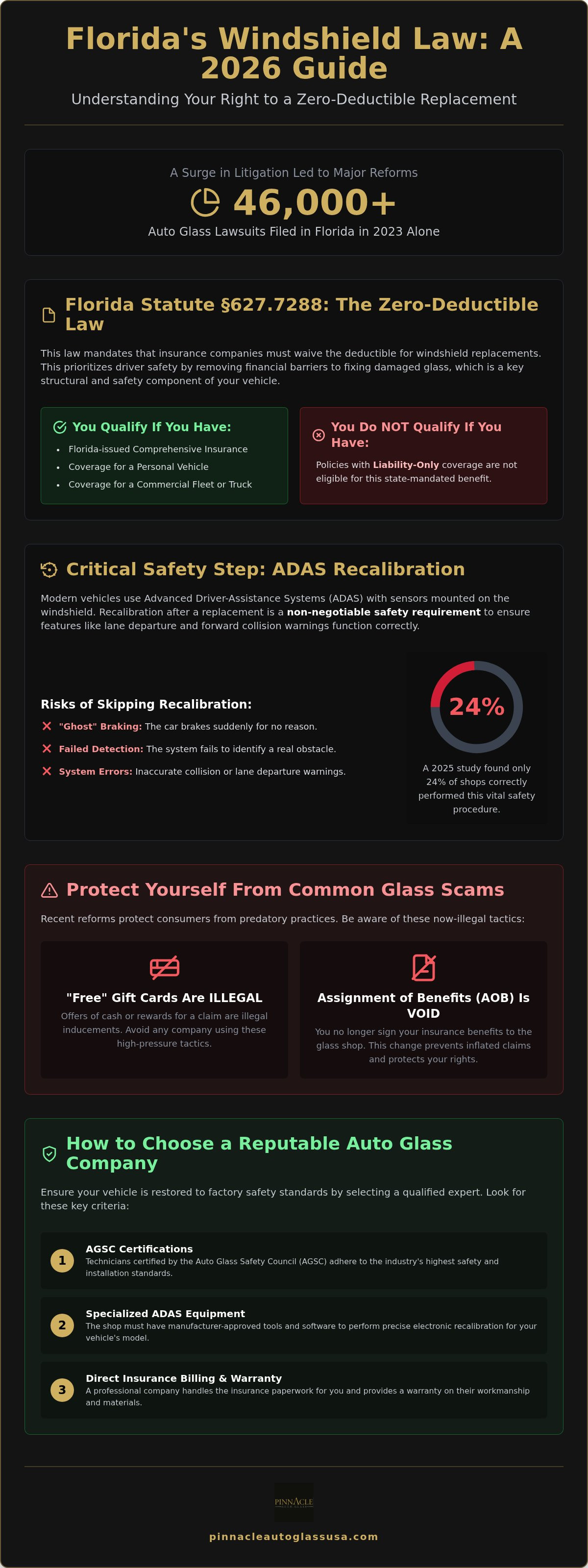
Did you know that over 46,000 auto glass lawsuits were filed in Florida in 2023 alone? This massive surge in litigation led to significant legislative reforms, yet the most important benefit for drivers remains intact. Under the Florida windshield replacement law, specifically Florida Statute §627.7288, you can still replace a damaged windshield with zero out-of-pocket costs if you have comprehensive insurance. It's a critical safety mandate designed to keep cracked glass off the road without financial strain on policyholders.
You likely want your vehicle restored to factory standards without the stress of insurance premium hikes or pressure from parking lot solicitors. We agree that safety shouldn't be a source of confusion or legal risk. This 2026 guide teaches you exactly how to claim your zero-deductible replacement while navigating the latest industry regulations. We'll explain why "free" gift card offers are now illegal and how to ensure your technician correctly performs mandatory ADAS recalibration. You'll gain a clear path to finding a trustworthy expert who handles the paperwork and protects your vehicle's advanced safety systems.
Key Takeaways
- Understand how the Florida windshield replacement law mandates zero-deductible repairs for drivers with comprehensive insurance coverage.
- Recognize why ADAS recalibration is a non-negotiable safety step required to restore your vehicle's cameras and sensors to factory standards.
- Protect yourself from common glass scams by identifying illegal inducements and understanding why Assignment of Benefits (AOB) agreements are now void.
- Identify the criteria for selecting a reputable technician, including AGSC certifications and specialized equipment for modern safety tech.
- Learn how to navigate the insurance claim process efficiently for both personal vehicles and commercial fleet operations.
Understanding Florida Statute §627.7288: The Zero-Deductible Law
The Florida windshield replacement law exists to prioritize driver safety above all else. Florida Statute §627.7288 mandates that insurance companies cannot apply a deductible to windshield claims. This specific carve-out applies because a damaged windshield is a primary safety hazard, not just a cosmetic flaw. It serves as a structural component of your vehicle and a mounting point for Advanced Driver-Assistance Systems (ADAS). By removing the financial barrier of a deductible, the state encourages drivers to fix glass issues immediately before they lead to accidents or structural failures during a collision.
Legally, the distinction between a "cracked" and "broken" windshield is less about the terminology and more about the impact on vehicle safety. If the integrity of the glass is compromised or the driver's vision is obscured, the law's protections trigger. It's a common misconception that the glass must be shattered to qualify. Even a small "bullseye" or a hairline crack that expands can justify a full replacement under the statute if a repair cannot restore the glass to its original safety specifications.
Who Qualifies for No-Cost Replacement?
To use this benefit, your vehicle must be insured in Florida with comprehensive or "combined additional" coverage. This is a standard requirement across the industry. If you carry liability-only insurance, the statute doesn't apply to you. This law extends beyond personal cars to include commercial vehicle fleets and heavy-duty trucks. For business owners, this means your fleet glass services can often be handled without impacting your immediate cash flow or requiring a per-vehicle deductible. It's an essential provision for keeping commercial operators safe on the road without the burden of unexpected out-of-pocket expenses for every stone chip encountered during a haul.
Repair vs. Replacement: What the Law Covers
The law covers both repair and replacement, but the decision depends on the damage severity and location. Technicians generally consider a windshield "non-repairable" if a crack is longer than six inches or if damage is directly in the driver's line of sight. Insurance carriers often prefer repairs for small chips because they're efficient and preserve the original factory seal. However, you aren't forced to accept a repair if it doesn't restore the vehicle to a safe operating condition. If the damage compromises the structural integrity of the glass, a full replacement is the only viable path. Modern standards require that any replacement also includes a full reset of safety sensors to ensure your vehicle remains compliant with factory safety specifications.
Beyond the Glass: ADAS Recalibration and Modern Safety Standards
By 2026, the average vehicle on Florida roads is equipped with sophisticated Advanced Driver Assistance Systems (ADAS). These systems use cameras, LIDAR, and radar sensors typically mounted to the interior of the windshield. When you replace your glass under the Florida Statute §627.7288, the job isn't finished until these sensors are reset. The Florida Motor Vehicle Repair Act now regulates this process. It requires facilities to inform you if recalibration is necessary and ensures the work meets manufacturer specifications. Restoring safety features to factory specifications isn't just a recommendation; it's a legal and technical necessity.
A new windshield introduces slight physical variances that the car's computer must learn. Without this step, your safety tech is essentially blind or misinformed. Modern standards require a specialized technician to handle both the glass and the high-tech sensors behind it.
The Role of Cameras and Sensors in Your Windshield
Modern vehicles rely on precise data for Lane Departure Warning and Forward Collision Warning systems. Sensors detect road markings and distance to other vehicles with extreme precision. Even a microscopic shift in glass thickness or angle can throw these measurements off by several feet. ADAS recalibration is the synchronization of vehicle software with new hardware. This step ensures that your car reacts exactly as the manufacturer intended during an emergency. It's a critical step for maintaining the safety net your vehicle provides.
The Risks of Skipping Recalibration
Neglecting this step creates severe safety risks. A misaligned camera might trigger "ghost" braking, where the car slams on the brakes for no reason. It could also fail to detect an actual obstacle. A 2025 study found that only 24% of body shops have technicians with specific ADAS training. This shortage means many shops skip the step or outsource it poorly. For vehicle owners and fleet managers, skipping this service introduces massive liability. If a safety system fails after a glass replacement, the responsibility falls on those who bypassed the mandatory reset. You can find more technical details in our ADAS Calibration and Auto Glass: The Complete 2026 Reference Guide.
Under the Florida windshield replacement law, recalibration is treated as a mandatory part of the repair process. It is billed directly to your insurance carrier as part of the comprehensive claim. You shouldn't pay any out-of-pocket expenses for this safety check. It's a non-negotiable requirement for modern vehicle maintenance. If you need assistance navigating this process, Pinnacle Auto Glass experts can guide you through the insurance requirements and perform the calibration in-house.
Navigating Insurance Claims and Avoiding Florida Glass Scams
Florida has historically struggled with predatory auto glass practices. In 2023 alone, more than 46,000 auto glass lawsuits were filed in the state. This litigation surge led to "glass harvesting," where solicitors approach drivers at gas stations or grocery stores to offer unsolicited inspections. These individuals often use high-pressure tactics to convince you that your glass is dangerously damaged. They may even offer illegal incentives, such as gift cards or cash, to entice you into filing a claim. Under the Florida windshield replacement law, these inducements are now strictly prohibited to protect consumers and stabilize insurance markets.
The most significant shift in protection came with the recent changes to the law effective July 1, 2023. This legislation officially banned the Assignment of Benefits (AOB) for auto glass claims. Previously, shops could force you to sign over your insurance rights, allowing them to sue your insurer directly. Today, any AOB agreement for windshield repair or replacement is considered void and unenforceable. You remain in control of your policy and your benefits throughout the entire process.
How to File a Claim Correctly
Filing a zero-deductible claim is a straightforward process when handled through legitimate channels. Follow these steps to ensure your claim is processed without complications:
- Contact your insurance provider or local agent to report the damage.
- Provide your policy number and the date the damage occurred.
- Exercise your right to choose your own repair facility.
- Verify that your chosen shop can handle mandatory ADAS recalibration in-house.
You aren't required to use the "insurance-preferred" aggregators often suggested by call centers. Selecting an independent, reputable expert ensures that your vehicle receives high-quality glass and precise sensor calibration rather than the cheapest available parts.
The Truth About Insurance Premiums
Many drivers hesitate to fix a cracked windshield because they fear their rates will go up. This is a common myth. Florida law protects policyholders from premium increases when filing a no-fault glass claim under comprehensive coverage. Because a damaged windshield is a safety hazard, the state encourages immediate resolution. Comparing the zero out-of-pocket cost of an insurance-backed replacement to the high price of a retail repair makes the choice clear. Using your benefits is the most cost-effective way to maintain your vehicle's safety standards and structural integrity. It's a proactive step that protects both your wallet and your passengers.
How to Choose a Reputable Auto Glass Company in Florida
The Florida windshield replacement law ensures you don't pay out-of-pocket, but it doesn't choose the technician for you. Selecting the right company is a primary safety decision. You must look beyond the convenience of a mobile van and evaluate technical proficiency. A reputable provider balances high-tech expertise with a deep understanding of Florida insurance statutes to streamline your experience. They should treat your vehicle as a complex safety system rather than just a piece of glass.
Start by evaluating the materials used for the installation. Original Equipment Manufacturer (OEM) glass is the preferred choice. It matches the exact dimensions, thickness, and clarity of the glass installed at the factory. Original Equipment Equivalent (OEE) glass is a common alternative, but it often has slight variances in curvature or light transmission. These deviations can distort the view of your vehicle's cameras and sensors. Ensure your provider prioritizes OEM glass for any vehicle equipped with advanced safety features to maintain system integrity.
Checking Certifications and Standards
The Auto Glass Safety Council (AGSC) certification is the industry's most rigorous standard. It ensures that a shop follows strict adhesive cure times and installation protocols. Why Hiring a Certified Auto Glass Technician is Critical for Vehicle Safety explains how these standards prevent windshield ejection during a collision. Before booking a service, ask these specific questions:
- Are your technicians currently AGSC certified?
- Do you perform both static and dynamic ADAS recalibration in-house?
- Do you handle the entire insurance claim process on behalf of the customer?
A shop that cannot answer "yes" to all three may not be equipped to handle modern vehicle requirements. Professionalism in documentation is also a key indicator of a trustworthy business.
Commercial and Fleet Considerations
Business owners face unique challenges with heavy-duty vehicles. Semi-trucks and delivery vans require specialized fleet glass services that account for the vehicle's size and safety tech. A cracked windshield on a commercial vehicle isn't just a safety risk; it's a liability that can ground your entire operation. Minimal downtime is essential for maintaining profitability. High-quality providers offer mobile services that bring the repair shop directly to your terminal. This approach keeps your drivers on the road and your cargo moving. You can learn more about Reducing Fleet Downtime with Mobile Glass Repair to optimize your maintenance schedule.
Reliable shops also offer in-shop options for complex recalibrations that require a controlled environment. This flexibility ensures your safety tech is restored correctly every time. If you need expert assistance that follows the latest safety protocols, contact Pinnacle Auto Glass today for professional service.
Pinnacle Auto Glass: Your Florida Windshield Experts
Pinnacle Auto Glass acts as your dependable guide through the complexities of vehicle safety and insurance claims. We understand that navigating the Florida windshield replacement law requires more than just technical skill; it requires a partner who understands the latest legal reforms. Our team specializes in processing claims under Florida Statute §627.7288, ensuring you receive the zero-deductible benefits you're entitled to. We prioritize efficiency and precision to get you back on the road safely.
Our expertise extends across a wide range of vehicle types and professional needs. We provide comprehensive solutions including:
- Expert Windshield Replacement for personal vehicles
- Precision ADAS Recalibration for modern safety systems
- Durable Windshield Repair for minor chips and cracks
- Specialized Fleet Glass Services for business operators
- Heavy-duty Commercial Truck Glass for long-haul transport
We use high-quality materials that meet or exceed factory standards. Every installation is performed by professionals who understand that a windshield is a structural safety component. We don't just swap glass; we restore the safety net your vehicle provides.
Professional Recalibration Included
We take a state-of-the-art approach to safety system restoration. Many shops treat recalibration as an afterthought, but we view it as a non-negotiable step in the repair process. Our technicians use specialized equipment to sync your vehicle's software with its new hardware. This ensures your emergency braking and lane-keeping systems remain reliable. We treat your windshield as a critical safety component because your life depends on its performance. This integrated approach provides peace of mind for every Florida driver, knowing their high-tech sensors are correctly calibrated to 2026 safety standards.
Get Started with Your Replacement
Scheduling your service is simple and direct. We offer flexible options to fit your busy schedule, whether you need mobile assistance at your location or a controlled environment in our shop. Our team handles the communication with your insurance carrier from start to finish. You can expect a transparent process where we explain every step, from the initial inspection to the final sensor reset. We focus on results and organization so you don't have to worry about the paperwork or technical hurdles. Schedule your professional windshield replacement with Pinnacle Auto Glass today.
Secure Your Vehicle with Expert Glass Care
Your windshield is more than just glass; it's a structural safety shield and a hub for advanced safety technology. Understanding the Florida windshield replacement law ensures you can access zero-deductible repairs without the fear of premium hikes or predatory scams. By choosing a provider that prioritizes mandatory ADAS recalibration, you protect your vehicle's integrity and your passengers' safety. It's about combining legal benefits with technical expertise to maintain factory standards for every mile ahead.
Pinnacle Auto Glass stands ready to guide you through this process with precision and reliability. We offer Certified ADAS Recalibration Specialists, Expert Insurance Claim Assistance, and Fleet & Commercial Grade Glass Solutions tailored to your specific needs. Don't let a small chip compromise your safety or lead to costly system failures. Take the next step toward a clear and calibrated view of the road.
Get Your Professional Florida Windshield Replacement today. We look forward to helping you restore your vehicle's safety systems with the professional attention you deserve.
Frequently Asked Questions
Is windshield replacement really free in Florida?
Yes, windshield replacement is available with no out-of-pocket costs for drivers who carry comprehensive insurance. Under the Florida windshield replacement law, specifically Statute § 627.7288, insurance companies must waive the deductible for windshield damage. This applies to both personal vehicles and commercial fleets. You won't pay anything for the glass or the labor as long as your policy includes the required coverage types.
Does a windshield claim count against my insurance in Florida?
A windshield claim typically does not count against your insurance in a way that raises your premiums. Florida law prohibits insurance companies from increasing rates solely for filing a no-fault glass claim under your comprehensive coverage. Since a cracked windshield is considered a safety hazard rather than an at-fault accident, the state encourages immediate repair to keep roads safe for everyone.
Can I choose any auto glass shop I want in Florida?
You have the legal right to choose any auto glass repair facility you prefer. Insurance companies cannot mandate that you use a specific "preferred" shop or aggregator. Selecting an independent expert allows you to ensure the use of high-quality materials and professional ADAS recalibration. Always verify that your chosen shop understands the latest 2026 safety standards and insurance processing requirements.
What if I don’t have comprehensive insurance coverage?
The zero-deductible benefit only applies to policies with comprehensive or combined additional coverage. If you only carry liability insurance, you're responsible for the full cost of the replacement. In these cases, it's still vital to choose a qualified technician. A professional can provide a competitive quote for the glass and necessary sensor calibration to ensure your vehicle remains safe to operate.
Will my safety cameras still work after the windshield is replaced?
Your safety cameras will function correctly only if they undergo professional ADAS recalibration after the glass is installed. Most modern vehicles house cameras and sensors directly on the windshield. Even a slight shift during installation can cause system errors. A certified technician must sync the vehicle software with the new hardware to restore features like lane-keeping assist and emergency braking to factory specifications.
How long does a windshield replacement and recalibration take?
A standard windshield replacement and recalibration usually takes between two and four hours to complete. The physical glass installation takes about one hour, followed by the mandatory recalibration of safety sensors. Some vehicles require a dynamic calibration, which involves driving the car at specific speeds. We recommend allowing a half-day window to ensure all adhesives cure properly and safety systems are fully tested.
Can I drive my car immediately after the glass is installed?
You should not drive your car immediately after the installation. Every adhesive has a specific Safe Drive Away Time (SDAT) that must be respected to ensure the glass remains bonded during a collision. This period usually lasts at least one hour after the installation is finished. Your technician will provide a specific timeframe based on the high-quality materials used and the current environmental conditions.
Does the Florida law cover side windows or rear glass too?
No, the zero-deductible provision in the Florida windshield replacement law applies specifically to the front windshield. Side windows, vent glass, and rear windows are not covered under this specific statute. If these other glass components are damaged, you'll likely need to pay your standard comprehensive deductible. Always check your specific insurance policy details to understand how your carrier handles non-windshield glass claims.


