
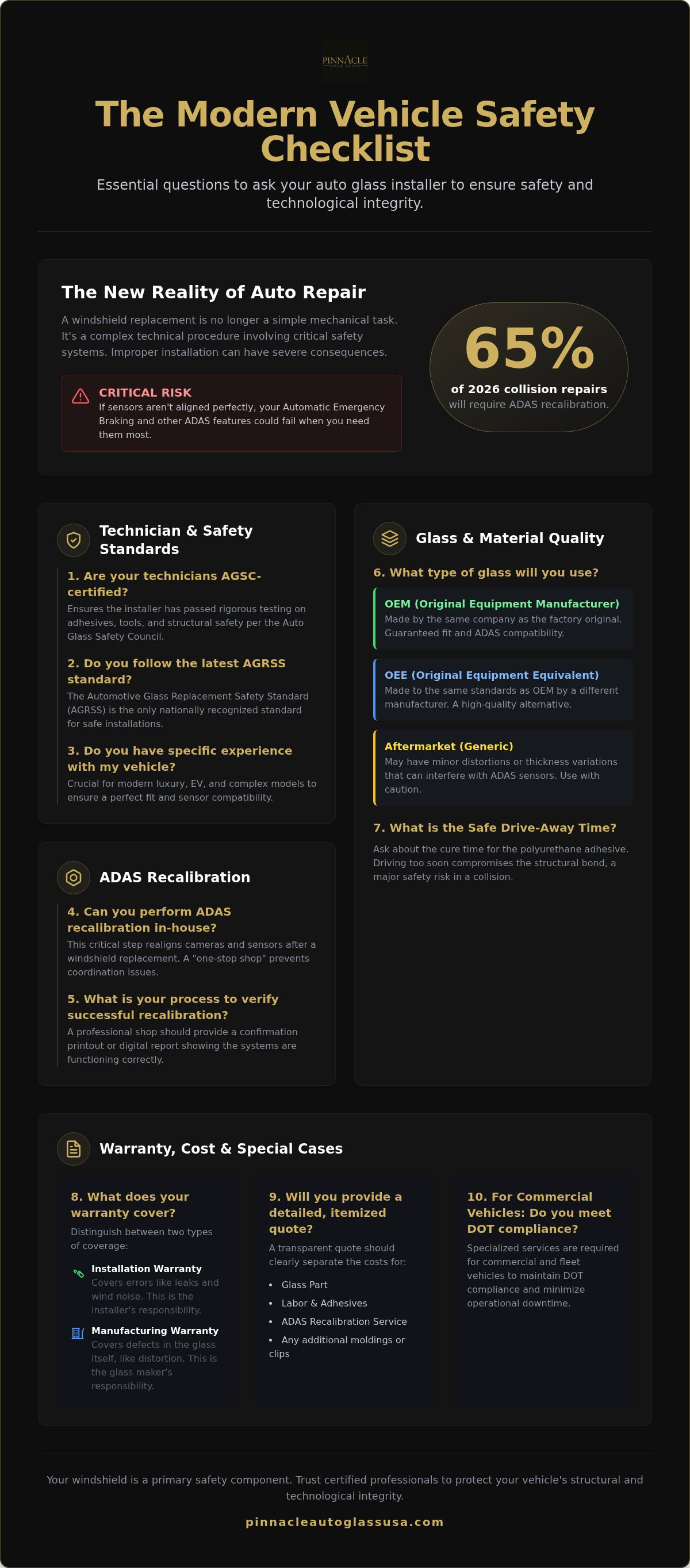
Did you know that in 2026, approximately 65% of all collision repairs require precise ADAS recalibration to keep safety systems functional? This shift means a windshield replacement is no longer a simple mechanical task. It's a complex technical calibration. If the sensors aren't aligned perfectly, your automatic emergency braking could fail when you need it most. You need a clear list of questions to ask your auto glass installer to verify they have the expertise to handle modern vehicle technology.
You deserve to know that your vehicle remains structurally sound and technologically accurate. We understand the anxiety that comes with choosing a shop, especially with new 2026 regulations like the Virginia Motor Vehicle Glass Act now in effect. This guide provides a professional checklist to validate technician certifications and warranty terms. You'll learn how to distinguish between OEM and aftermarket glass while ensuring your shop follows the latest AGSC safety standards and state notification requirements. We will walk through fifteen essential points that separate professional installations from budget alternatives.
Key Takeaways
- Verify that individual technicians are certified under current AGSC standards to ensure your installation meets national safety requirements.
- Identify the differences between OEM and generic aftermarket glass to protect your vehicle's structural integrity and sensor accuracy.
- Use our expert list of questions to ask your auto glass installer to confirm they can perform the mandatory ADAS recalibration required in 2026.
- Learn why commercial and fleet vehicles require specialized glass services to maintain DOT compliance and minimize operational downtime.
- Clarify warranty terms by learning how to distinguish between a simple manufacturing defect and a critical installation error.
Asking About Technician Certifications and Safety Standards
A shop's general business license is just a permit to operate. It doesn't prove that the person handling your vehicle has mastered modern installation techniques. When you start vetting shops, the primary questions to ask your auto glass installer should focus on individual certifications. You want an expert who understands the evolving landscape of 2026 automotive technology, especially with new laws like the Virginia Motor Vehicle Glass Act now setting higher bars for transparency and safety.
The Auto Glass Safety Council (AGSC) is the leading authority on these matters. They manage the Automotive Glass Replacement Safety Standard (AGRSS), which is the only nationally recognized standard for the industry. In many states, adherence to these standards is now a legal requirement for insurance reimbursement. A certified technician has passed rigorous testing on adhesive chemistry, tool usage, and structural safety. Without this validation, you're trusting your safety to guesswork.
Verifying Professional Credentials
Directly ask if the technicians are AGSC-certified. Don't settle for a vague "yes" from a manager; ask to see the credentials of the person assigned to your car. Professional installers undergo continuous training to keep up with new safety systems and materials. Because of this, hiring a certified auto glass technician is the single most effective way to ensure a safe installation. It guarantees the worker understands the specific requirements of the latest AGRSS 005-2022 standards.
Confirm that the technician has specific experience with your vehicle make. Modern luxury brands and electric vehicles often use specialized glass configurations. A technician trained only on older domestic models might struggle with the nuances of a 2026 panoramic roof or integrated sensor array. Expertise in your specific model is non-negotiable for a perfect fit.
Adherence to Industry Safety Standards
Your windshield is a critical safety component. It supports the roof during a rollover and ensures air bags deploy correctly. Most modern windshields consist of laminated safety glass designed to remain in one piece upon impact. To maintain this protection, the installer must follow Federal Motor Vehicle Safety Standards (FMVSS) regarding light transmittance and impact resistance.
Ask the shop about their internal quality control. A reputable provider will follow manufacturer-specific protocols for every step. This includes proper surface preparation and using the correct polyurethane adhesives. These steps ensure the glass stays bonded to the frame during a collision. If a shop can't explain their quality check process, they aren't prioritizing your safety or your vehicle's structural integrity.
Questions Regarding Glass Quality and Adhesive Safety
Choosing the right materials is just as critical as the skill of the technician. Your windshield is a structural element of the vehicle. It must meet specific Federal Motor Vehicle Safety Standards to protect occupants during a collision. One of the vital questions to ask your auto glass installer is whether they use glass that matches your vehicle's original specifications. High-quality materials ensure that safety systems and structural reinforcements function as intended.
OEM vs. Aftermarket Glass Selection
Not all glass is created equal. OEM (Original Equipment Manufacturer) glass is produced by the same company that provided the factory glass for your car. OEE (Original Equipment Equivalent) glass is made to the same standards but by a different manufacturer. Generic aftermarket glass is often the cheapest option. However, understanding the nuances of OEM vs aftermarket windshields is essential for modern drivers. Generic glass can have slight distortions or thickness variations. These imperfections interfere with the cameras and sensors mounted behind the glass. This can lead to safety system failures or recalibration errors. Always check for glass clarity and thickness standards before the technician begins the installation.
Adhesive Quality and Safe Drive-Away Time
The adhesive used to bond your windshield is a high-performance polyurethane. It's designed to keep the glass in place even if the roof is crushed or the airbags deploy. You must ask for the specific Safe Drive-Away Time (SDAT) for the product being used. This is a non-negotiable safety metric. SDAT is the time needed for the adhesive to cure sufficiently to meet crash-test standards. Cheaper adhesives may require several hours to set, while premium products cure much faster. If you want a service that uses premium materials and provides clear safety guidelines, you can book your windshield replacement with a trusted specialist.
Environmental factors like temperature and humidity also play a role in the bonding process. Cold or dry air can slow down the chemical reaction of the polyurethane. Professional installers monitor these conditions to provide an accurate SDAT based on the current weather. Never drive your vehicle until this time has passed. High-quality polyurethane maintains the structural integrity of your vehicle's cabin. In a rollover accident, the windshield provides up to 60% of the roof's strength. If the adhesive fails, the roof can collapse. Request the technical data sheet for the adhesive to verify its performance rating and ensure it meets your vehicle's requirements.
Confirming ADAS Recalibration and Safety System Integrity
Modern vehicles are no longer just mechanical machines; they are sophisticated computers on wheels. Your windshield serves as the primary mounting point for cameras and sensors that power your safety suite. When you replace the glass, you disturb these delicate instruments. One of the most critical questions to ask your auto glass installer is how they handle the recalibration of Advanced Driver Assistance Systems (ADAS). If a shop suggests this step is optional, they are compromising your safety. Even a tiny misalignment can "blind" your lane departure warnings or cause your collision avoidance system to engage at the wrong time.
Skipping this process is a major risk. A camera that is off by just one degree can result in a significant error margin 50 feet down the road. This can lead to delayed braking or unintended steering corrections. In 2026, with 65% of collision repairs requiring these technical adjustments, you cannot afford to overlook this step. Professional installers treat recalibration as a mandatory part of the installation process, not an upsell.
Recalibration Methods and Equipment
Ask the shop if they perform the work in-house or sublet it to a third party. In-house service is usually more efficient and ensures better quality control. You should also inquire about the specific diagnostic tools they use for your vehicle make. Because technology varies by manufacturer, ADAS calibration for auto glass requires specialized technician training and expensive hardware. There are two primary methods used today:
- Static Recalibration: This happens in a controlled shop environment using specific targets and laser levels.
- Dynamic Recalibration: This requires driving the vehicle at a steady speed on well-marked roads for a set distance.
Some vehicles require a combination of both. Your installer should know exactly which method your specific model needs based on the manufacturer's 2026 guidelines.
Verification and Reporting
Many shops claim to perform the work but offer no tangible proof. Ask: "Will I receive a digital validation report after the recalibration?" This report is your proof of safety. It confirms that the cameras and radar systems function within factory tolerances. If your dashboard safety lights remain on after the service, the calibration was likely unsuccessful. A professional shop won't return your vehicle until all safety systems are clear and fully operational. This documentation is also vital for insurance records and future vehicle resale value.
Specific Questions for Commercial and Fleet Vehicle Glass
Managing a fleet requires a different set of questions to ask your auto glass installer compared to personal vehicle maintenance. For commercial operators, glass damage isn't just a safety issue; it's a direct threat to your bottom line. A grounded truck or delivery van represents lost revenue and disrupted logistics. You need a service partner who understands the high stakes of heavy-duty transport and the specialized safety standards required by the Department of Transportation (DOT).
Commercial glass installation involves unique structural requirements. Semi-trucks, box trucks, and specialized transport vehicles often use different bonding agents and gasket systems than passenger cars. Verify that your chosen provider has specific experience with these heavy-duty configurations. Ensuring your fleet stays compliant with federal glazing standards is essential for passing inspections and maintaining operational safety on the road.
Minimizing Fleet Downtime
Ask: "Do you offer on-site mobile service for commercial yards?" Bringing the repair shop to your fleet is the most efficient way to manage repairs. It eliminates the need for your drivers to transport vehicles, saving you both time and labor costs. This is a core strategy for reducing fleet downtime with mobile glass repair. You should also inquire about bulk scheduling and priority service for commercial accounts. A provider that can handle multiple replacements during your fleet's off-peak hours provides a significant competitive advantage.
Inquire about their inventory for commercial makes. A shop that stocks glass for major brands like Freightliner, Kenworth, or Peterbilt can often complete repairs much faster than a generalist shop. If your business depends on a constant flow of goods, you can schedule professional fleet glass services to ensure your vehicles spend more time on the road and less time in the bay.
Commercial Vehicle Technical Requirements
Ask: "Are your technicians experienced with Class 8 truck windshields?" These large-scale installations require specialized tools and multiple technicians to ensure a proper seal. You must also verify compliance with DOT standards regarding light transmittance and optical clarity. These rules are particularly strict for the driver's primary line of sight, known as Zone A. Any replacement glass must meet ANSI/SAE standards to ensure it can withstand the rigors of long-haul driving.
Modern commercial vehicles also feature integrated ADAS for long-distance safety. This includes lane departure warnings and collision avoidance systems that rely on the windshield's integrity. Ensure the installer has the equipment to recalibrate these systems on heavy-duty chassis. A failure to recalibrate a commercial ADAS unit can lead to dangerous malfunctions during highway operation. Professional fleet service providers treat these technical steps as mandatory for every installation.
Finalizing the Deal: Warranty and Maintenance Questions
The final phase of a windshield replacement is often the most overlooked. You've verified the technician's skills and the glass quality. Now, you must secure your investment. The last set of questions to ask your auto glass installer should focus on long-term protection and immediate care. A professional provider won't just hand you the keys; they'll provide a clear path for resolving future issues and protecting the new bond.
Understanding the difference between a manufacturing defect and an installation error is vital. A manufacturing defect involves flaws like delamination or optical distortion within the glass itself. An installation error results in wind noise, water leaks, or stress cracks caused by improper mounting. Most reputable shops offer a lifetime warranty, but you need to know exactly what that covers before you leave the shop. This ensures you aren't left paying for a mistake made during the service.
Warranty Terms and Coverage
Ask: "Does your warranty cover wind noise, water leaks, and stress cracks?" A comprehensive warranty should protect you against any failure of the adhesive bond for as long as you own the vehicle. Since you may travel across state lines, ensure the warranty is valid nationwide. If you develop a leak while on a trip, a stable provider with a broad service network can resolve the issue without requiring you to return to the original location.
Documentation is your best defense. Keep a digital copy of your service receipt and the recalibration validation report. These documents prove the work was done to industry standards. If you need to file an insurance claim, ask if the installer handles the paperwork directly. Many professional shops coordinate with major insurers to simplify the billing process. This removes the administrative burden from the vehicle owner and ensures the claim is processed accurately.
Post-Service Maintenance Checklist
Ask: "What are the specific 'do not' rules for the next 24 to 48 hours?" Even if the Safe Drive-Away Time has passed, the polyurethane adhesive continues to cure for several days. Follow these guidelines to protect the seal:
- Avoid high-pressure car washes: The intense water jets can shift the glass or create gaps in the fresh adhesive.
- Leave a window cracked: This prevents air pressure buildup inside the cabin when you close the doors, which can push against the new seal.
- Retain the tape: Don't remove the retention tape for at least 24 hours. It holds the moldings in place while the bond stabilizes.
Following these simple steps ensures the structural integrity of your vehicle remains intact. A professional installer will provide these instructions in writing to prevent any confusion. Taking these precautions protects the bond and ensures your ADAS sensors remain in their calibrated positions.
Securing Your Vehicle's Future on the Road
Your windshield is a foundational safety component that requires expert handling. By using this list of questions to ask your auto glass installer, you can ensure your vehicle meets the strict 2026 safety and technical standards. Remember that AGSC certification and verifiable ADAS recalibration are mandatory for modern safety systems to function correctly. Whether you manage a massive commercial fleet or your personal car, prioritizing professional standards over budget alternatives protects your safety and your vehicle's structural value. You've now learned how to verify credentials, check glass quality, and protect your new seal during the curing process.
Ready for a high-quality installation? Schedule your professional windshield replacement with Pinnacle Auto Glass today. We provide nationwide mobile service and employ certified ADAS recalibration experts to ensure your safety suites are perfectly aligned. Our team also offers specialized commercial and fleet glass solutions designed to minimize downtime for heavy-duty vehicles. Don't settle for guesswork when it comes to your safety. Drive with total confidence knowing your vehicle is structurally sound and technologically accurate.
Frequently Asked Questions
Can I drive my car immediately after the windshield is replaced?
No, you cannot drive immediately. You must wait for the Safe Drive-Away Time (SDAT) specified by the adhesive manufacturer. Most premium polyurethane adhesives require at least 30 to 60 minutes before the car is safe to operate. Driving too early compromises the bond and your vehicle's structural integrity. Always ask your technician for the exact wait time before they leave. Following these instructions ensures the glass stays secure during a collision.
Is it necessary to recalibrate my camera if the windshield isn't broken?
Recalibration is necessary whenever the camera is moved or the windshield is replaced. Modern safety systems rely on precise camera angles to function. Even if the glass isn't broken, removing it for other repairs disturbs the factory settings. In 2026, manufacturers require recalibration to ensure lane departure and collision warnings remain accurate. Skipping this step can lead to system errors or total safety suite failure during an emergency.
What happens if my ADAS system isn't recalibrated correctly?
An incorrectly recalibrated ADAS system can lead to dangerous driving malfunctions. Cameras that are off by just a few millimeters will miscalculate distances and lane positions. This might cause your automatic emergency braking to engage without cause or fail to trigger when an obstacle is present. These errors put you and other drivers at risk. It's critical to verify that your installer provides a digital validation report confirming the system meets factory specs.
Will my insurance cover the cost of OEM glass?
Insurance coverage for OEM glass depends on your specific policy and state regulations. While many standard policies cover aftermarket glass, you may need an OEM endorsement for original factory parts. In 2026, new laws in states like New York prevent insurers from mandating glass that can't be properly recalibrated. Check your policy details and ask your provider if they cover the higher costs associated with original manufacturer components for safety reasons.
How can I tell if my auto glass installer is actually certified?
You can verify an installer's credentials by asking for their Auto Glass Safety Council (AGSC) certification. A professional shop will gladly show you the individual technician's certification card and their shop's accreditation status. This is one of the most important questions to ask your auto glass installer. Certified professionals have passed rigorous exams on adhesive chemistry and safety standards. You can also check the AGSC website to confirm their current standing.
What should I do if I notice a whistle or leak after the installation?
If you hear a whistle or see water leaking, contact your service provider immediately. These signs indicate a gap in the polyurethane seal or an improper fitment. Don't attempt to patch the leak yourself with household silicone or tape. A leak compromises the structural integrity of your vehicle and can damage sensitive interior electronics. A reputable shop will inspect the bond and perform a warranty repair to ensure the seal is airtight and secure.
Can a windshield be repaired instead of replaced to save time?
Windshield repair is an option for small chips and minor cracks, typically those smaller than a credit card. If the damage is in the driver's primary line of sight or directly over an ADAS camera, replacement is usually required. Repairs are faster and cost less, but they don't restore 100% of the glass's original strength. A certified technician will assess the damage to determine if a safe repair is possible or if replacement is necessary.
Do you offer mobile recalibration services for modern vehicles?
We offer mobile solutions for many modern vehicles, but the type of service depends on your safety system. Dynamic recalibration can often be performed by a mobile technician while driving the vehicle on the road. However, static recalibration requires a controlled shop environment with level floors and specialized targets. Our team evaluates your vehicle's specific requirements to determine if an in-shop visit is necessary for total safety system accuracy and DOT compliance.


